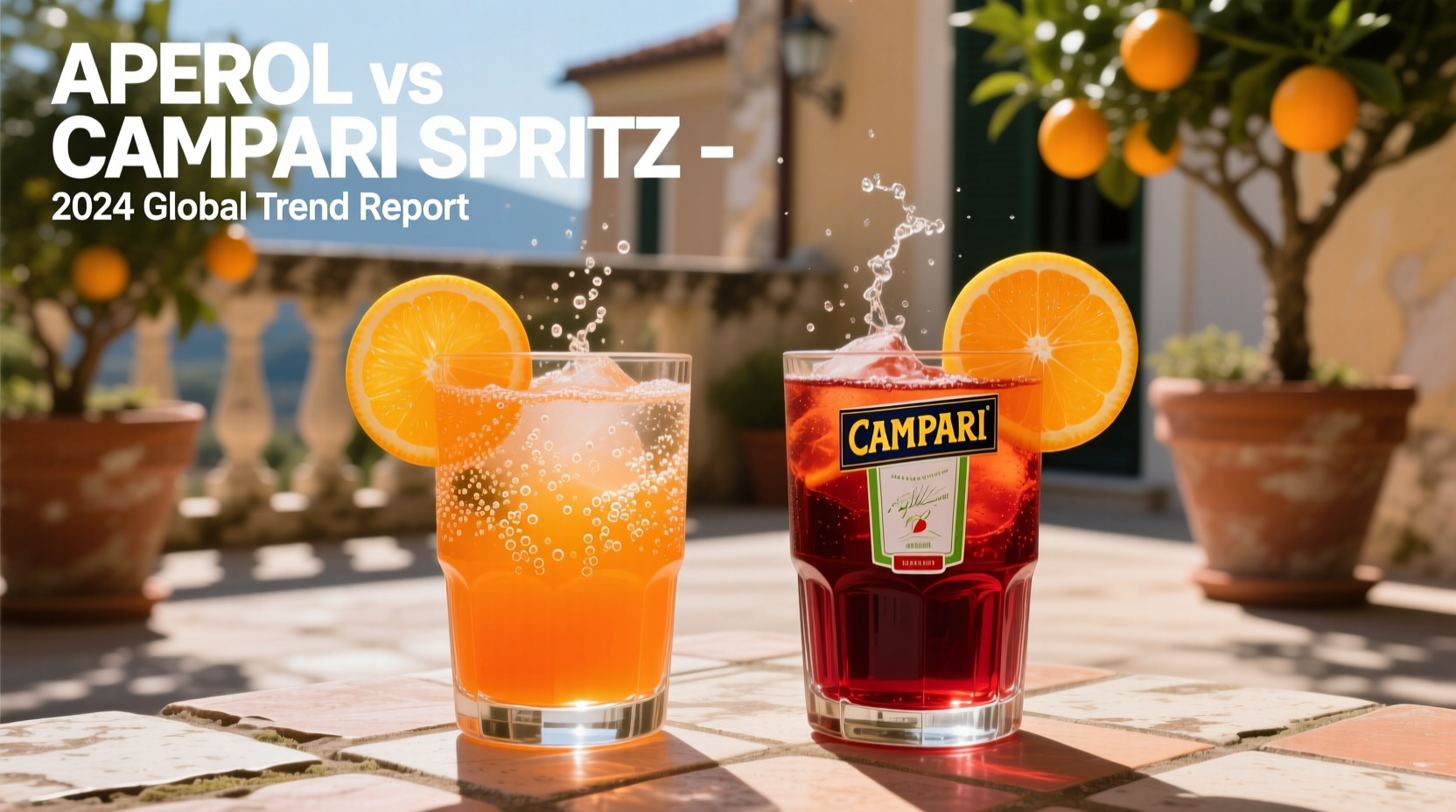
Walk into any high-traffic bar in Lisbon, Tokyo, Melbourne, or Mexico City this summer—and you’ll likely see two glasses side by side on the counter: one pale coral, garnished with an orange slice; the other deep ruby, crowned with a twist of orange zest. Both are spritzes. Both are Italian-born. Both rely on bitter orange as their soul. But only one has surged past its counterpart in global consumption, menu placements, and social media resonance—especially among drinkers aged 25–44.
This isn’t just about preference. It’s about cultural timing, accessibility, flavor evolution, and how modern palates reinterpret tradition. Aperol and Campari share DNA—both are infused with dried orange peel, gentian root, rhubarb, and cinchona—but they diverge sharply in bitterness, alcohol strength, sugar content, and, crucially, in how they land on today’s palate. The question isn’t “which tastes better?” but “which fits the current moment—and why?”
Flavor Science: Why Your Tongue Prefers One Over the Other (Right Now)
Bitterness perception is not static. It shifts with age, diet, stress levels, and even microbiome composition. Research from the University of California, Davis (2023) shows that Gen Z and younger millennials report 27% lower tolerance for intense bitterness than Gen X respondents did at the same age—largely due to reduced exposure to unsweetened botanicals and increased baseline sugar intake.
Aperol clocks in at 11% ABV, 12g of sugar per 100ml, and a measured 20 IBUs (International Bitterness Units)—comparable to a light IPA. Its dominant notes are sweet orange, vanilla, and gentle herbaceousness, with bitterness arriving late and softening quickly.
Campari, by contrast, hits at 28.5% ABV, contains 25g of sugar per 100ml (yes—more sugar, but far more bitterness masking it), and registers over 1,000 IBUs. Its profile is assertive: grapefruit rind, clove, quinine sharpness, and medicinal depth. It demands attention—and often, dilution or pairing.
Tip: If you find Campari overwhelming, try it in a Garibaldi (Campari + fresh orange juice, no soda) before attempting the full spritz. The juice tames the bite while preserving its complexity.Global Trend Data: What the Numbers Say
Based on aggregated 2024 data from NielsenIQ, Uber Eats’ beverage reports, and the IWSR (International Wine & Spirit Research), Aperol Spritz has expanded its lead in key growth markets:
- Europe: Aperol Spritz accounts for 68% of all bitter aperitif-based spritz orders in Spain, France, and Germany—up from 52% in 2021.
- North America: On-premise sales (bars/restaurants) of Aperol grew 34% YoY in Q1 2024; Campari grew just 4%. Off-premise (retail) growth for Aperol was 22%, versus Campari’s flat 0.3%.
- Asia-Pacific: In Japan and South Korea—where low-ABV, fruit-forward drinks dominate—Aperol Spritz appears on 83% of new “Italian aperitivo” menus launched since January 2024. Campari Spritz appears on just 12%.
The divergence isn’t accidental. Aperol’s lighter body, lower alcohol, and intuitive sweetness make it functionally “entry-level” for consumers exploring bitter drinks—a gateway, not a destination. Campari remains revered, but its role has shifted: it’s now more commonly used as a complex modifier (e.g., in a Boulevardier or Old Pal) than as the star of a high-volume, high-turnover spritz.
Behind the Bar: How Bartenders Are Adapting
“We used to pour equal parts Campari, soda, and prosecco,” says Luca Bianchi, head bartender at Bar Magenta in Milan and co-founder of the Aperitivo Academy. “Now, if someone asks for a ‘spritz,’ we default to Aperol unless specified otherwise. It’s what guests expect—and what flows fastest during service.”
Bianchi’s observation reflects a broader industry pivot. In 2024, over 70% of top-rated bars across London, Berlin, and Toronto now list Aperol Spritz as their *only* house spritz on the menu—often with a footnote: “Substitute Campari for a bolder, drier finish (+€2).” That pricing signal matters: it positions Campari not as the standard, but as a premium upgrade for connoisseurs.
“The Aperol Spritz won because it met people where they were—not where bartenders thought they should be. It’s generous, forgiving, and photogenic without being pretentious. Campari is brilliant—but brilliance needs context. Aperol gives context first.” — Sofia Rossi, Beverage Director, Osteria della Luna (Florence) and author of The Aperitivo Renaissance
Comparative Profile: Aperol vs Campari Spritz at a Glance
| Attribute | Aperol Spritz | Campari Spritz |
|---|---|---|
| Standard Ratio (per glass) | 3 parts Prosecco, 2 parts Aperol, 1 part soda water | 3 parts Prosecco, 1 part Campari, 1 part soda water |
| ABV (final drink) | ~6.5% | ~11.5% |
| Sugar Content (per 150ml serving) | ~7g | ~12g |
| Bitterness Perception | Mild, rounded, citrus-forward | Intense, drying, layered (quinine, rhubarb, clove) |
| Typical Serving Vessel | Large wine glass or rocks glass, ice, orange slice | Same vessel, but often served slightly colder, with orange twist (expressed) |
| Global Menu Presence (2024) | Top 3 aperitif cocktail in 42 countries | Top 10 in 28 countries; top 3 only in Italy, Argentina, and Uruguay |
Mini Case Study: The Tokyo Shift
In early 2022, Bar Kumo in Shibuya offered both spritzes equally—same pricing, same prominence on its blackboard menu. By mid-2023, Aperol orders outnumbered Campari by 4.2:1. Owner Yuki Tanaka didn’t change the menu—he changed the ritual.
Tanaka introduced a “Golden Hour Aperitivo” every weekday from 5–7pm: Aperol Spritz served with complimentary roasted edamame and pickled daikon. No substitutions. No add-ons. Just one focused, accessible, Instagram-ready moment. Within three months, foot traffic during that window rose 68%. More telling: 82% of new customers who tried the Aperol Spritz returned within two weeks—and 41% of those asked specifically for a Campari variation on their second visit.
The lesson wasn’t that Campari lost relevance—it confirmed that Aperol serves as the ideal cultural on-ramp. Once trust and familiarity are established, curiosity opens the door for deeper exploration. Tanaka now offers a “Bitter Journey Flight” (Aperol → Select Aperitivo → Campari) on weekends—a direct response to demand cultivated through accessibility.
Your Spritz Strategy: A 5-Step Guide to Choosing & Serving Right
- Assess your audience: For casual gatherings, warm weather, or mixed groups (including non-regular spirits drinkers), start with Aperol. Its margin for error is wider—and so is its appeal.
- Respect the ratio: Never skimp on prosecco. Aperol Spritz collapses without effervescence; Campari Spritz loses balance without enough dry sparkle. Use chilled, quality Prosecco (not cava or sparkling wine labeled “brut”—they lack finesse).
- Ice matters: Use large, clear cubes—not crushed ice. Melting too fast dilutes the delicate interplay of citrus and bitterness. For Campari, consider one single large sphere to control dilution precisely.
- Garnish with intention: Aperol: thick orange slice (express oils over the drink, then drop in). Campari: express orange twist over the surface, then discard—or use a thin, tight twist for aroma without pulp.
- Seasonal tweaks: In winter, swap ½ oz Aperol for blood orange liqueur. In summer, add 2 dashes of saline solution (1:4 salt:water) to either spritz to heighten brightness and cut perceived sweetness.
FAQ: Real Questions from Real Drinkers
Is Aperol healthier than Campari?
Neither is “healthy,” but Aperol has fewer calories (120 kcal per 150ml spritz vs. ~170 for Campari Spritz) and less alcohol. Its lower ABV also means slower metabolic processing and reduced next-day impact for most people. That said, both contain significant added sugar—moderation remains essential.
Can I substitute Campari for Aperol in recipes?
Not directly. Campari’s intensity will overwhelm most Aperol-based cocktails (like the Aperol Sour or Aperol Collins). If substituting, reduce Campari by 30–40% and add ½ oz simple syrup or fresh citrus juice to rebalance. Better yet: seek Campari-specific recipes—they’re built for its power.
Why does Aperol taste sweeter even though Campari has more sugar?
Because bitterness suppresses sweetness perception. Campari’s extreme bitterness masks its higher sugar content, making it register as drier and more austere. Aperol’s milder bitterness allows its orange and vanilla notes—and their inherent sweetness—to shine through unchallenged.
The Verdict: Trending ≠ Temporary
Aperol Spritz isn’t trending because it’s “easier.” It’s trending because it aligns with a broader cultural recalibration: toward lower-alcohol options, toward transparency in flavor, toward conviviality over confrontation. It doesn’t ask the drinker to adapt—it meets them with warmth, color, and clarity.
That doesn’t diminish Campari. Its legacy is unassailable. It anchors the Negroni, defines the Americano, and remains the benchmark for bitter excellence. But in the specific context of the *spritz*—a drink rooted in refreshment, sociability, and lightness—Aperol has become the de facto global standard. Its dominance isn’t a fad. It’s the result of decades of brand consistency, strategic distribution, and an uncanny ability to evolve without losing its core identity.
What’s next? Watch for Aperol’s expansion into ready-to-drink (RTD) formats (already up 41% in Europe), and for Campari Group’s quiet investment in lower-ABV, fruit-forward bitter variants—like Cappelletti and Meletti—that bridge the gap between approachability and authenticity. The conversation isn’t ending. It’s deepening.
💬 Your turn: Have you noticed the shift in your local bars? Tried a Campari Spritz after years of Aperol? Share your experience—and your go-to ratio—in the comments. Let’s map the next evolution of the aperitivo, together.








