The Aperol Spritz is a global phenomenon — sun-drenched, effervescent, and Instagram-famous. Campari Spritzes, by contrast, remain a niche choice, often met with raised eyebrows and cautious sips. Yet both are Italian aperitifs rooted in the same tradition: stimulating the appetite before a meal with a measured dose of botanical bitterness. For newcomers to the world of bitter aperitifs, the question isn’t just “which one should I try?” — it’s “which one won’t make me wince on the first sip?” The answer lies not in marketing slogans or color alone, but in chemistry, cultural context, and how each liquid behaves when diluted, chilled, and paired with prosecco and soda.
Understanding the Bitterness Spectrum: Not All Bitter Is Created Equal
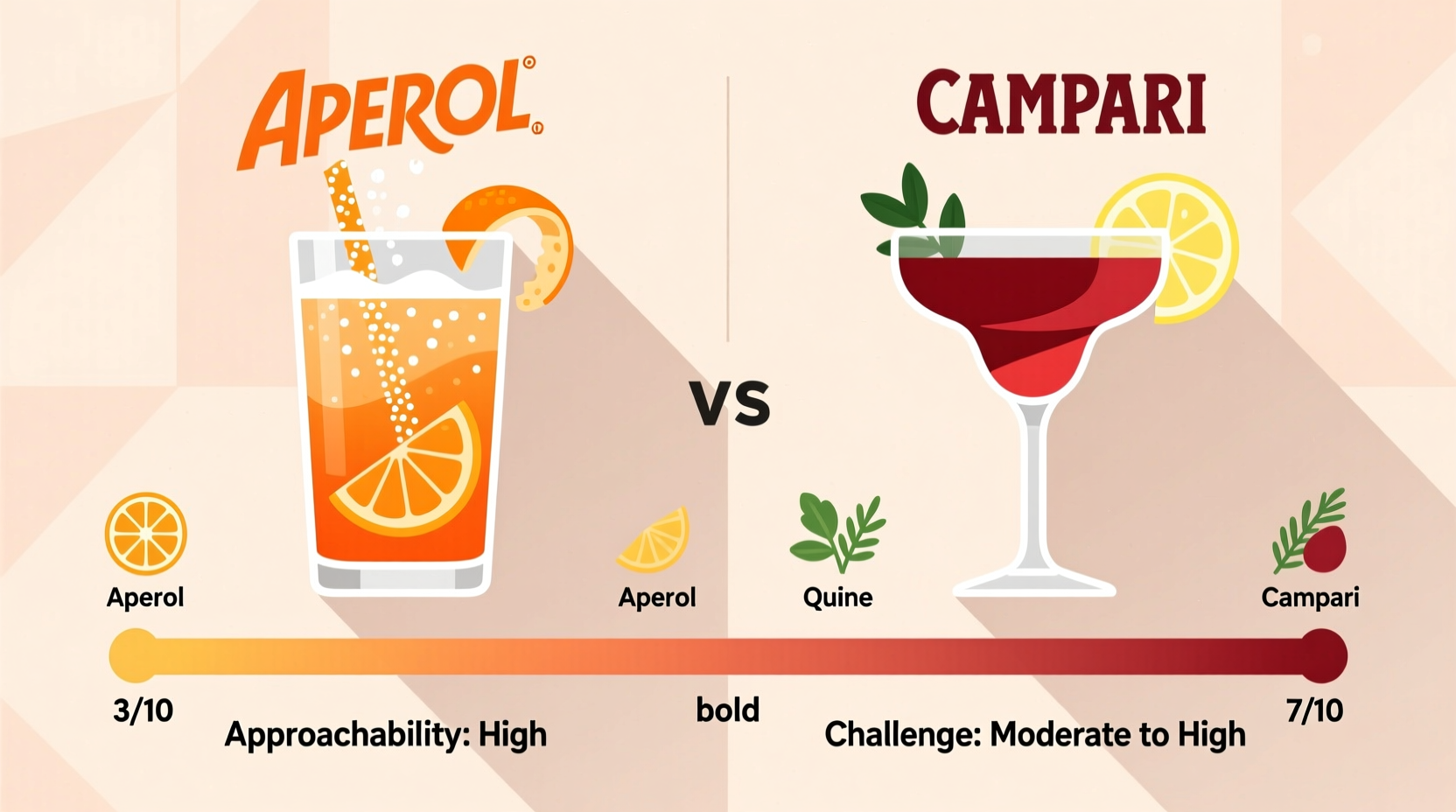
Bitterness in aperitifs is rarely monolithic. It’s a layered sensation shaped by dozens of botanicals — gentian root, quinine, rhubarb, orange peel, wormwood, cinchona bark — each contributing different qualities: sharp, drying, medicinal, citrusy, or earthy. Aperol and Campari share some ingredients (notably bitter orange peel and gentian), but their proportions, extraction methods, and supporting components create divergent sensory experiences.
Aperol, launched in 1919 in Padua, was formulated as a lighter, more accessible alternative to existing bitters. Its base includes gentian, rhubarb, and cinchona, but it’s rounded out with sweet orange, caramel, and a generous 11% ABV. Campari, created in Milan in 1860, is far more intense: its exact recipe remains a closely guarded secret, but it’s known to contain over 60 botanicals, including quassia, cascarilla, and potent doses of quinine and gentian. At 20.5–28.5% ABV (depending on market), it delivers bitterness with structural authority — assertive, persistent, and unapologetically dry.
This distinction matters profoundly in a spritz, where dilution and effervescence play key roles. In the classic 3-2-1 ratio (3 parts prosecco, 2 parts aperitif, 1 part soda water), Aperol’s lower alcohol and higher sugar content (11 g/100 ml) buffer its bitterness, allowing citrus and herb notes to shine through. Campari’s higher alcohol and lower sugar (10–11 g/100 ml, but perceptually drier due to intensity) mean its bitterness dominates the profile — even when cut with sparkling wine and bubbles.
Side-by-Side Comparison: Key Metrics That Shape Drinkability
| Attribute | Aperol | Campari |
|---|---|---|
| Alcohol by Volume (ABV) | 11% | 20.5–28.5% (varies by country) |
| Sugar Content | ~11 g per 100 ml | ~10–11 g per 100 ml (but tastes drier) |
| Primary Bittering Agents | Gentian root, rhubarb, cinchona bark | Quinine, gentian, cascarilla, quassia, bitter orange |
| Perceived Bitterness (1–10 scale) | 3–4 (mild, rounded) | 7–8 (intense, lingering) |
| Color & Clarity | Bright tangerine-orange, translucent | Deep ruby-red, opaque |
| Classic Spritz Ratio (Prosecco:Soda:Aperitif) | 3:1:2 (balanced, refreshing) | Often adjusted to 4:1:1 or 5:1:1 (to tame intensity) |
Crucially, sugar content alone doesn’t determine approachability. Campari’s bitterness is so structurally dominant that its sugar registers not as sweetness, but as a subtle counterpoint — like salt enhancing umami rather than tasting salty. Aperol’s sugar integrates seamlessly, lending body and softening the edge of its gentian note. This is why beginners consistently describe Aperol Spritz as “fruity,” “light,” or “easy-drinking,” while Campari Spritz is more often called “complex,” “bracing,” or “an acquired taste.”
Real-World Mixing: What Happens When You Build the Spritz?
Let’s walk through what occurs at the bar counter — not theoretically, but sensorially.
You pour 90 ml of chilled Prosecco into a large wine glass over ice. Then you add 60 ml of Aperol. Instantly, the liquid blooms into a luminous coral hue. The aroma lifts immediately: zesty orange oil, faint vanilla, a whisper of herbs — no medicinal sting. When you top with 30 ml of soda water and stir gently, the effervescence carries citrus forward; the bitterness appears only on the mid-palate, brief and clean, like the pith of a blood orange — present, but never harsh. The finish is short, slightly sweet, and refreshingly dry.
Now repeat the process with Campari. You add 60 ml to the same Prosecco base. The color darkens dramatically to a garnet red. The nose is more restrained — less fruit, more clove, dried orange rind, and a distinct medicinal tang. After adding soda, the first sip hits with pronounced bitterness: sharp, tannic, almost peppery. It lingers — 15 to 20 seconds — coating the tongue with a drying, quinine-driven finish. The Prosecco’s fruit recedes; the soda’s lift feels insufficient against Campari’s density. Without adjustment, the drink can feel confrontational rather than welcoming.
Tip: If trying Campari for the first time in a spritz, start with a 5:1:1 ratio (prosecco:soda:Campari) and serve it extra cold — temperature suppresses perceived bitterness and enhances effervescence.Beginner-Friendly Pathways: How to Navigate the Bitter Threshold
Approachability isn’t binary — it’s a spectrum, and progression matters. Many seasoned drinkers began with Aperol and later gravitated toward Campari as their palate adapted. This isn’t a sign of “leveling up”; it’s a natural evolution of sensory tolerance and appreciation.
Here’s a realistic, step-by-step pathway for developing comfort with bitterness — grounded in how taste receptors adapt over time:
- Start with Aperol Spritz (3:2:1) — Serve over abundant ice, use high-quality, dry Prosecco (not sweet spumante), and garnish with an orange slice. Drink slowly, paying attention to how the bitterness emerges *after* the initial citrus burst.
- Introduce a “bridge” drink after 3–4 sessions — Try Cynar (16.5% ABV, artichoke-based, milder than Campari but more complex than Aperol) in a 4:2:1 ratio. Its vegetal sweetness builds familiarity with layered bitterness.
- First Campari exposure: Campari & Soda (1:3) — Skip Prosecco entirely. Use chilled, high-effervescence soda water and a generous orange twist. The citrus oil cuts through bitterness; the dilution tempers intensity without masking character.
- Graduate to Campari Spritz — but adjust rigorously — Use 45 ml Campari, 120 ml Prosecco, 30 ml soda. Stir well and serve with two large ice cubes (not crushed) to avoid rapid dilution that blunts flavor development.
- Explore variations that soften Campari’s edge — Add 5 ml of simple syrup or a barspoon of grapefruit juice. Or substitute half the Campari with Aperol (“Bitter Blend Spritz”) to ease the transition.
This progression respects neurobiology: repeated, low-stakes exposure to mild bitterness gradually desensitizes TRPM5 receptors on the tongue while building associative positive experiences (social setting, pleasant aroma, refreshing temperature). Pushing too fast — say, jumping from zero to full-strength Campari Spritz — triggers aversion reflexes that can form lasting negative associations.
Mini Case Study: Marco’s Spritz Journey in Verona
Marco, 28, works in digital marketing in Verona. He’d never ordered a spritz before moving to Italy for a six-month assignment. His first attempt — at a bustling enoteca near Piazza delle Erbe — was a classic Aperol Spritz. “It tasted like summer,” he recalls. “I expected something medicinal, but it was bright and fizzy, like orange soda with class.”
By week three, he noticed friends ordering darker spritzes. Curious, he tried one — Campari, served in a smaller glass with less prosecco. “I took a sip and paused. My face must have shown it — my friend laughed and said, ‘Don’t worry, we all do that.’ She added extra soda and a second orange wedge. It was still intense, but the extra dilution made it manageable. I finished half.”
Over the next month, Marco experimented: sometimes Aperol, sometimes Campari with adjusted ratios, occasionally a mix. By week ten, he confidently ordered a Campari Spritz at a rooftop bar overlooking the Adige River — 4:1:1, extra-cold, with a grapefruit twist. “It wasn’t about ‘liking it more’ than Aperol,” he says. “It was about hearing the whole orchestra — not just the violins.” His takeaway? “Bitterness isn’t a wall. It’s a language. You learn the vocabulary by listening, not shouting.”
Expert Insight: The Palate Adaptation Principle
“Bitterness perception is highly modifiable. Studies show that regular, moderate exposure to bitter compounds — especially when paired with positive contextual cues like social enjoyment or food pairing — increases tolerance within 2–3 weeks. Aperol serves as an ideal ‘gateway’ because its bitterness is calibrated to be detectable but non-threatening. Campari, meanwhile, functions as a benchmark — revealing how much nuance the palate can resolve once foundational sensitivity is established.”
— Dr. Sofia Ricci, Sensory Scientist & Director of the Italian Institute of Taste Education
Dr. Ricci’s research confirms what bartenders observe daily: approachability is less about inherent “mildness” and more about balance, context, and intentionality in preparation. A poorly made Aperol Spritz — using warm Prosecco, stale soda, or low-quality orange garnish — can taste flat and cloying, undermining its natural advantages. Conversely, a thoughtfully constructed Campari Spritz, respecting its power, can deliver remarkable clarity and depth.
Frequently Asked Questions
Can I substitute Campari for Aperol in a classic spritz recipe without changing ratios?
No — doing so creates an unbalanced, aggressively bitter drink. The standard 3:2:1 ratio assumes Aperol’s lower ABV and integrated sweetness. Substituting Campari at the same volume results in excessive alcohol burn and overwhelming bitterness. Always reduce Campari to 30–45 ml and increase Prosecco to 120–150 ml for comparable drinkability.
Is Aperol “less authentic” than Campari for a traditional Italian spritz?
Authenticity depends on region and era. The modern Aperol Spritz rose to prominence in the Veneto region in the 1950s–70s and is now codified by the Italian Ministry of Agricultural, Food and Forestry Policies as a protected geographical indication. Campari Spritzes are more common in Lombardy and Piedmont, but historically, the original “spritz” referred to any wine “spritzed” with water or soda — a practice dating to Austrian Habsburg rule. Neither is inherently more authentic; they represent distinct regional evolutions.
Does chilling temperature really affect bitterness perception?
Yes — significantly. Cold temperatures suppress the activity of bitter taste receptors (TAS2Rs) and slow chemical reactions on the tongue. Serving both aperitifs well-chilled (6–8°C / 43–46°F) and using cold Prosecco and soda reduces perceived harshness by up to 30%, according to peer-reviewed gustatory studies. Warm spritzes amplify bitterness and alcohol heat, making either option less beginner-friendly.
Conclusion: Choosing Your Entry Point, Not Your Endpoint
There is no universal “best” aperitif — only the right entry point for where you are today. Aperol’s approachability isn’t a compromise; it’s thoughtful design. Its gentle bitterness invites curiosity without demanding surrender. Campari’s intensity isn’t elitism; it’s an invitation to deeper attention — to trace the echo of quinine, to notice how orange oil transforms bitterness into aroma, to appreciate structure over immediacy.
If you’re new to spritzes, begin with Aperol. Not as a placeholder, but as a masterclass in balance: how sweetness frames bitterness, how effervescence lifts weight, how temperature shapes perception. Sip mindfully. Notice the shift from citrus front-palate to herbal mid-palate to clean, dry finish. Then, when you feel ready — not pressured, but genuinely curious — reach for Campari. Adjust the ratio. Add the twist. Chill it thoroughly. Give it space.
Because the goal of the aperitif tradition has never been to endure bitterness — it’s to awaken the senses, spark conversation, and prepare the body and mind for what comes next. Whether that begins with tangerine light or ruby depth is yours to choose. What matters is that you begin.
💬 Have your own spritz story — the first sip, the “aha” moment, the ratio tweak that changed everything? Share it in the comments. Your experience might be the nudge someone else needs to take their first confident step into the world of Italian aperitivi.








