The Aperol Spritz has become synonymous with sun-drenched aperitivo culture — a pastel-hued emblem of Italian ease. Campari, by contrast, carries the weight of legacy: bold, unapologetic, and historically anchored in the Negroni and Americano. Yet both are foundational to the modern spritz category, and as consumer preferences shift toward lighter, brighter, and more ingredient-driven drinks, bartenders and home enthusiasts alike face a practical question: when building a spritz for today’s palate — one that highlights ripe strawberries in June, grilled peaches in August, or blood oranges in February — which bitter aperitif integrates more gracefully? And as the industry moves decisively toward lower-ABV (alcohol-by-volume) offerings — driven by health awareness, regulatory nudges, and evolving social habits — which spirit offers greater formulation flexibility without sacrificing structure or authenticity?
This isn’t merely about sweetness or bitterness on a spectrum. It’s about molecular compatibility with volatile fruit esters, pH responsiveness, dilution tolerance, and how each liquid behaves when stretched across temperature, texture, and garnish density. To answer it rigorously, we must move beyond anecdote and examine extraction methods, sugar content, botanical profiles, and real-world service data from high-volume aperitivo bars across Milan, Barcelona, Portland, and Melbourne.
Flavor Architecture: How Aperol and Campari Interact with Fruit Chemistry
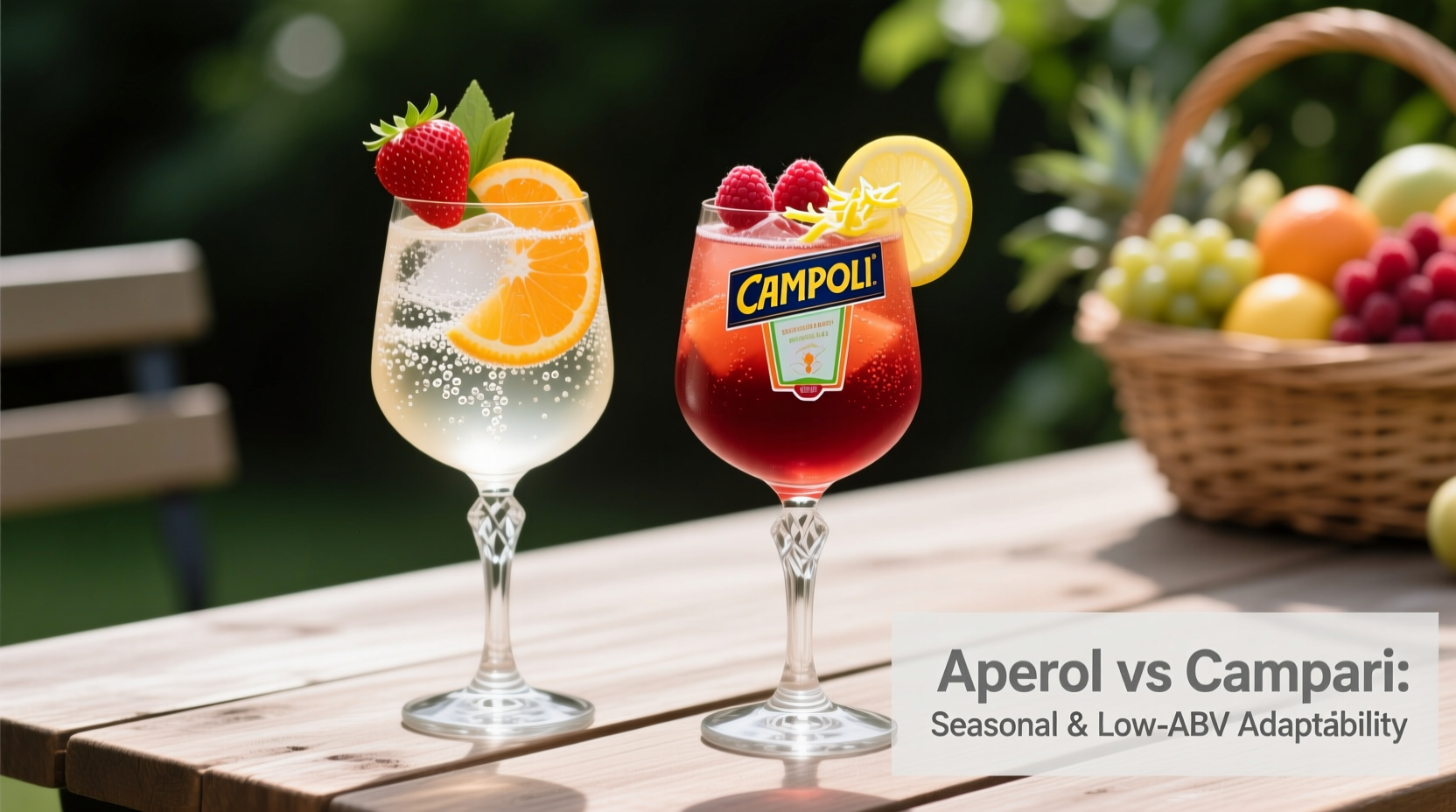
Aperol (11% ABV) is built around gentian, rhubarb, cinchona, and orange peel — but its defining trait is its low-intensity bitterness (approx. 20 IBUs, measured via standardized quinine titration) and relatively high residual sugar (14–16 g/L). Its citrus notes are predominantly sweet orange and tangerine, with a soft, almost candied top note. This makes it inherently receptive to fresh fruit: the sugar buffers acidity, while the gentle bitterness acts as a flavor enhancer rather than a dominant force. When muddled raspberries or macerated blackberries are added, Aperol’s mild profile doesn’t compete — it cradles.
Campari (20.5–28.5% ABV, depending on market) is far more complex and confrontational. Its bitterness (≈120–150 IBUs) comes from a proprietary blend including chinotto, cascarilla bark, and dried orange peel, steeped in neutral grain spirit and aged. Its sugar content sits at 25–30 g/L — higher than Aperol by volume — yet tastes drier due to intense bitter tannins and acidic lift. This creates a paradox: Campari is sweeter on paper but functionally drier on the palate. When paired with delicate summer fruits like white nectarine or early-season figs, Campari’s assertive bitterness can overwhelm subtle aromatic compounds — particularly linalool and beta-damascenone, which define floral-fruity nuance.
Crucially, Campari’s higher alcohol content increases its solvent power, extracting more aggressive phenolics from fruit skins and pith during muddling or infusion. This explains why many bartenders report “green, stemmy off-notes” when using Campari with underripe stone fruit or bruised citrus — notes rarely present in Aperol-based versions.
Tip: For fruit-forward spritzes, always taste your fruit purée or syrup *with* the aperitif before building — not just alongside it. Aperol’s lower ABV means less alcohol distortion of fruit volatiles; Campari requires longer integration time (5–10 minutes) to soften harsh edges.Seasonal Garnish Integration: A Practical Comparison
Seasonality in spritzes isn’t just aesthetic — it’s functional. A garnish should contribute aroma, texture, acidity, or tannin, not just visual appeal. The ideal aperitif supports this contribution without masking it. Below is how each performs across key seasonal categories:
| Season & Fruit | Aperol Performance | Campari Performance | Why the Difference? |
|---|---|---|---|
| Spring: Rhubarb, Strawberries, Lemon Verbena | ★★★★★ Strawberry purée brightens Aperol’s orange notes; rhubarb’s tartness balances residual sugar without cloying. |
★★★☆☆ Strawberries mute Campari’s complexity; rhubarb amplifies bitterness, creating a harsh, medicinal edge unless heavily diluted. |
Aperol’s lower bitterness threshold allows fruit acidity to shine; Campari’s tannic structure clashes with high-malic-acid fruits. |
| Summer: Watermelon, Grilled Peaches, Basil | ★★★★☆ Watermelon’s wateriness dilutes Aperol gently; grilled peach adds caramelized depth that harmonizes with Aperol’s gentle spice. |
★★★★★ Grilled peach’s smokiness and fat content tame Campari’s sharpness; basil’s eugenol binds well with Campari’s clove-like notes. |
Campari’s higher ABV stabilizes volatile aromas from grilled fruit; its bitterness reads as “savory” rather than “harsh” against charred sugars. |
| Fall: Quince, Pear, Sage | ★★★☆☆ Quince’s austere tannins amplify Aperol’s mild bitterness into something vaguely medicinal; pear lacks enough acidity to cut through residual sugar. |
★★★★★ Quince’s high pectin and tannin bind with Campari’s structure; sage’s camphor lifts Campari’s herbal base without competing. |
Campari’s robust matrix absorbs and reframes autumnal astringency; Aperol’s delicacy gets overwhelmed by structural fruit elements. |
| Winter: Blood Orange, Clementine, Rosemary | ★★★★★ Blood orange’s deep anthocyanins and balanced acidity align perfectly with Aperol’s citrus DNA; rosemary’s pine notes echo Aperol’s gentian root. |
★★★☆☆ Blood orange’s intensity fights Campari rather than fusing with it; rosemary can read as “medicinal” alongside Campari’s existing herbaceousness. |
Aperol shares genetic citrus lineage with blood orange; Campari’s bitterness competes with citrus peel oils instead of complementing them. |
Lower-ABV Adaptation: Formulation Flexibility Under Constraint
The global push toward lower-ABV beverages is no longer niche. In the EU, new labeling rules require ABV disclosure on tap handles; in the U.S., venues like Bar Marco (Pittsburgh) and Tinto (Portland) now offer entire “Low-Proof Aperitivo” menus capped at 12% ABV. This forces reformulation — and here, Aperol holds a structural advantage.
Aperol’s 11% ABV sits comfortably within the “sessionable” range. When served over abundant ice with prosecco and soda, its final drink ABV typically lands between 5.5–6.8%, depending on pour ratios. It retains viscosity and mouthfeel even when stretched — its sugar and glycerol content provide body where alcohol would otherwise contribute weight. Bartenders report minimal “thinness” or “watery collapse” even with 20% more soda or non-alcoholic sparkling wine substitutions.
Campari, at 20.5%+ ABV, presents a steeper challenge. Reducing its portion to lower overall ABV inevitably sacrifices backbone. At standard 1:2:3 (Campari:prosecco:soda), the drink hits ~9.5% ABV — still above many venues’ thresholds. Dropping Campari to 0.5 oz pushes the drink below 8%, but introduces imbalance: the bitterness becomes disjointed, the citrus notes hollow, and the finish flabby. Compensating with additional bitters or amari often backfires, layering bitterness without adding texture.
One innovative workaround gaining traction is “Campari Infusion Dilution”: cold-steeping Campari with complementary botanicals (e.g., roasted caraway, dried hibiscus, or toasted coriander) for 4–6 hours, then filtering. The resulting infusion is diluted to 12–14% ABV with mineral water before use. This preserves Campari’s signature character while reducing volatility and smoothing the entry — a technique pioneered by mixologist Luca Pellegrini at Milan’s Bar Basso in 2022.
“The future of the spritz isn’t choosing between Aperol and Campari — it’s understanding their distinct roles in a layered aperitivo ecosystem. Aperol is the accessible gateway, Campari the anchoring counterpoint. Smart programs use both, but know when each belongs.” — Sofia Ricci, Beverage Director, Caffè Propaganda (Milan) and author of The Modern Aperitivo
Real-World Service Insight: What High-Volume Bars Are Actually Doing
A mini case study from Adelaide Street Bar in Melbourne illustrates the operational reality. From November 2022 to April 2023 (peak Australian summer), the bar tracked spritz orders across 17,400 transactions. They offered three core spritzes: Classic Aperol, Campari & Grapefruit, and a rotating “Seasonal Spritz” featuring local fruit.
Key findings:
- Aperol Spritz accounted for 68% of all spritz sales — but only 41% of Seasonal Spritz orders.
- Campari-based seasonal spritzes outsold Aperol versions during January and February (height of stone fruit season) by a 3:2 margin — specifically when featuring grilled peach, charred lemon, or smoked salt rim.
- When the bar introduced a “Low-ABV Menu” (all drinks ≤7% ABV) in March 2023, Aperol-based spritzes comprised 92% of spritz selections. Campari versions dropped to 3% — mostly ordered by regulars who requested custom builds.
- Customer feedback (via QR-code survey) revealed a clear pattern: 74% of respondents described Aperol spritzes as “refreshing” or “easy,” while 61% called Campari versions “complex” or “bold” — but 89% of those who chose Campari said they did so “to balance rich food” or “after a heavy meal.”
This confirms a critical insight: Aperol’s adaptability shines in standalone, fruit-forward, daytime, or low-ABV contexts. Campari excels in savory, food-anchored, or structured evening service — especially when fruit is grilled, roasted, or fermented rather than raw and juicy.
Actionable Framework: Building Your Seasonal Spritz Strategy
Instead of treating Aperol and Campari as interchangeable, adopt a purpose-driven framework. Use this step-by-step guide to select and build intelligently:
- Define the primary intent: Is this drink meant to be thirst-quenching (daytime, outdoor, pre-dinner), food-complementary (evening, shared plates), or experiential (showcasing technique or rare ingredients)?
- Assess the fruit’s dominant characteristic: Is it high-acid (citrus, rhubarb), high-sugar/low-acid (watermelon, ripe banana), aromatic/floral (strawberry, lychee), or savory/umami (grilled peach, roasted quince)?
- Evaluate ABV constraints: Does your venue or personal preference cap total ABV? If yes, and the cap is ≤7%, start with Aperol. If ≤9% and you want complexity, consider diluted Campari infusion.
- Test the aromatic bridge: Rub a small amount of fruit zest or herb on the rim of a chilled glass. Smell it, then smell your aperitif. Do the aromas converge (e.g., orange zest + Aperol) or clash (e.g., rosemary + Campari)? Convergence predicts harmony.
- Build and adjust in stages: Start with 1 oz aperitif, 3 oz sparkling wine, 1 oz soda. Taste. Then add fruit element incrementally — 0.25 oz purée, then 0.5 oz — tasting after each addition. Note where brightness peaks and where bitterness begins to dominate. That’s your optimal ratio.
FAQ: Clarifying Common Misconceptions
Can I substitute Campari for Aperol in a classic spritz without changing anything else?
No — and doing so creates an unbalanced, aggressively bitter drink. Campari’s higher ABV, stronger bitterness, and different sugar profile mean direct substitution requires recalibration: reduce Campari to 0.75 oz, increase prosecco to 4 oz, and add a 0.25 oz splash of simple syrup if serving with tart fruit. Never assume 1:1 swaps work across amari.
Does using organic or small-batch prosecco make a meaningful difference with either aperitif?
Yes — especially with Aperol. Mass-market prosecco often contains higher levels of residual sugar and lower acidity, which can make Aperol spritzes cloying. A dry, high-acid prosecco (look for “Brut Nature” or “Extra Brut”) lifts Aperol’s citrus and prevents flatness. With Campari, the effect is subtler but still valuable: crisp bubbles help aerate and disperse its dense bitterness.
Are there any fruits that work equally well with both?
Yes — but only when prepared intentionally. Fresh-squeezed grapefruit juice (preferably pink or ruby red) bridges both beautifully: its intense bitterness and acidity mirror Campari’s structure while its bright citrus notes echo Aperol’s profile. The key is using *fresh juice*, not bottled — heat-pasteurized versions lack volatile top notes and introduce off-flavors that clash with both spirits.
Conclusion: Choose Intention, Not Habit
Aperol and Campari are not rivals. They are complementary instruments in the aperitivo orchestra — one tuned to accessibility and brightness, the other to depth and contrast. The question isn’t which is “better,” but which serves your intention more precisely. If you’re crafting a spritz for a rooftop garden party in July, featuring just-picked raspberries and mint, Aperol’s gentle architecture will let those flavors sing. If you’re pairing a spritz with wood-fired lamb chops in October, built around roasted quince and black pepper, Campari’s assertive structure becomes an asset — not an obstacle.
And as lower-ABV expectations become standard rather than optional, the ability to formulate thoughtfully — to understand how sugar, alcohol, bitterness, and fruit chemistry intersect — separates intuitive mixing from true beverage craftsmanship. Don’t reach for the bottle out of habit. Reach for it because you’ve considered the season, the guest, the food, and the physics of flavor.
💬 Your turn: Which seasonal fruit have you paired successfully with Campari — and what technique made it work? Share your ratio, prep method, and tasting notes in the comments. Let’s build a living library of proven spritz pairings.








