The Aperol Spritz and Campari Spritz are both icons of Italian aperitivo culture—but they respond very differently when paired with seasonal fruit. While Aperol’s gentle bitterness and bright orange notes make it the default choice for summer patios, Campari’s assertive, complex bitterness offers unexpected depth with cooler-weather produce. Understanding how each spirit interacts with fruit acidity, sugar content, tannin structure, and aromatic volatility is essential for crafting seasonally intelligent spritzes—not just decorative ones. This isn’t about preference alone; it’s about structural compatibility, pH synergy, and how volatile esters in ripe fruit express themselves alongside botanicals.
Flavor Architecture: Why Bitterness Isn’t One-Dimensional
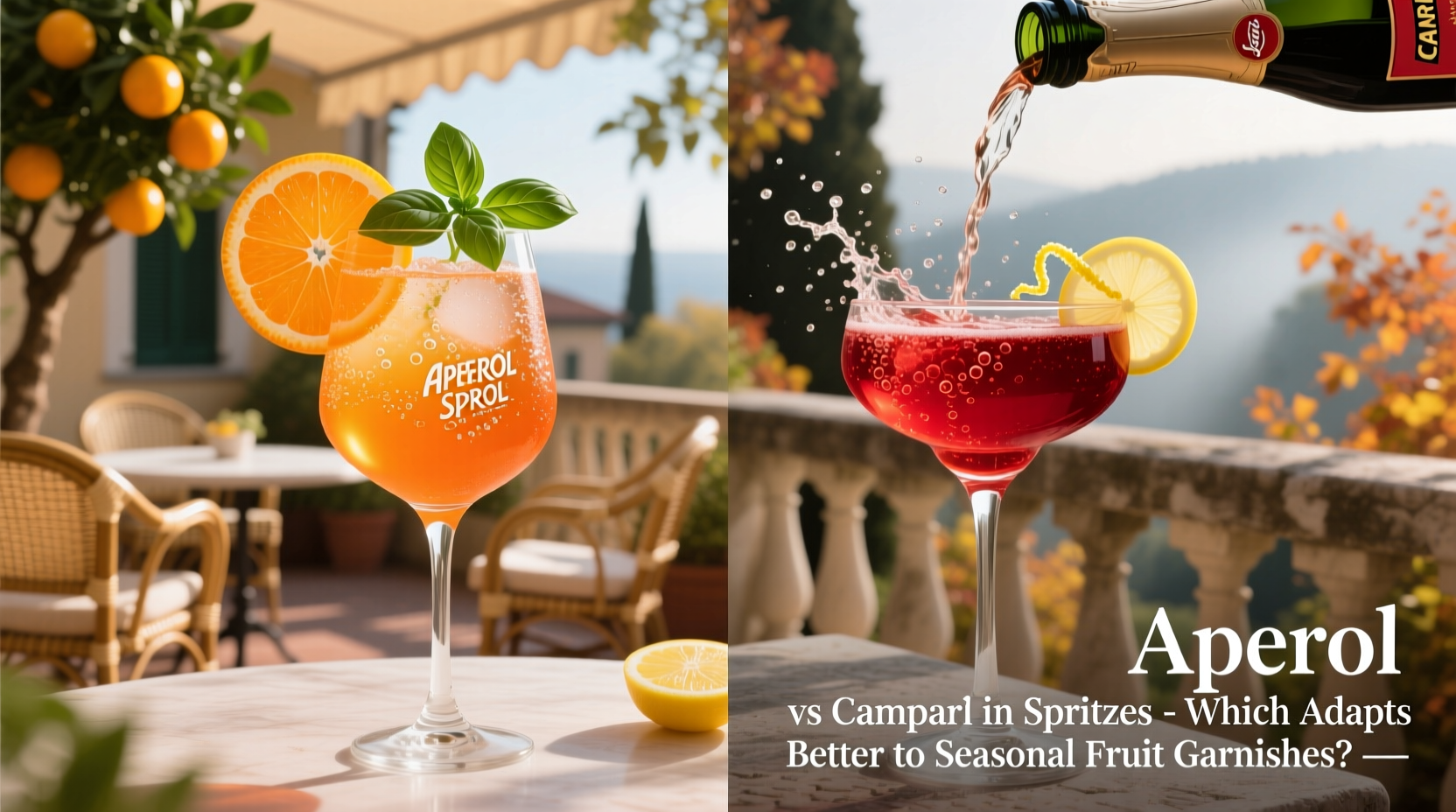
Bitterness in amari functions as a palate catalyst—not merely a taste sensation, but a neurological trigger that enhances salivation, amplifies fruit aroma perception, and balances sweetness. Yet Aperol and Campari occupy opposite ends of the bitter spectrum. Aperol (11% ABV, ~30 IBU equivalent) delivers a soft, rounded bitterness derived primarily from gentian root, rhubarb, and sweet orange peel. Its sugar content (12–14 g/L) provides immediate roundness, while its lower alcohol permits delicate fruit aromas to rise unimpeded.
Campari (20.5–28.5% ABV, ~55–65 IBU equivalent) is structurally denser: its bitterness comes from a proprietary blend including chinotto, cascarilla bark, and quinine, yielding sharp, medicinal, and grapefruit-pith notes. With only 2–4 g/L residual sugar, Campari demands contrast—either through dilution, effervescence, or complementary sweetness from garnish or mixer. Its higher alcohol also volatilizes certain fruit esters more aggressively, which can either lift or overwhelm depending on ripeness and variety.
“Campari doesn’t *mix* with fruit—it *converses* with it. You need to listen to what the fruit is saying: is it tart and green? Ripe and honeyed? Underripe fruit fights Campari; fully mature fruit invites it into dialogue.” — Luca Berti, Bar Director at Bar Magenta (Milan) and former Campari Global Ambassador
Seasonal Fruit Chemistry & Spritz Compatibility
Fruit isn’t static across seasons. Its sugar-to-acid ratio, pectin content, aromatic compound profile (e.g., linalool in peaches, limonene in citrus), and enzymatic activity all shift with temperature, sunlight exposure, and harvest timing. These variables determine whether a fruit will harmonize with Aperol’s approachability or require Campari’s corrective power.
Tip: Always macerate fruit garnishes in a small amount of Prosecco or dry vermouth for 2–3 minutes before adding to the spritz—this gently extracts volatile oils and pre-balances acidity without diluting the drink.Spring: Stone Fruits & Early Berries
In spring, apricots, early nectarines, and wild strawberries offer high acidity and low sugar. Their tartness pairs beautifully with Aperol’s inherent sweetness: a thin slice of underripe apricot adds floral top notes without clashing, while crushed wild strawberries contribute bright ethyl butyrate (a fruity ester) that Aperol’s orange oil complements directly. Campari, however, risks amplifying green-tannin notes in unripe stone fruit, resulting in an astringent, almost chalky finish.
Summer: Peak Berries & Citrus
Midsummer brings peak-sugar raspberries, blackberries, and blood oranges. Here, Aperol remains highly adaptable—its lower bitterness lets berry jamminess shine, and its orange character echoes blood orange’s myrcene and limonene. But Campari reveals nuance: a single segment of ruby red grapefruit, expressed over the drink before garnishing, unlocks Campari’s own grapefruit backbone, creating layered bitterness. The key is restraint—Campari needs *one* dominant fruit note, not a medley.
Autumn: Apples, Pears & Late Grapes
Fall fruit introduces tannin and earthiness. A crisp, tart Pink Lady apple expresses malic acid that cuts cleanly through Aperol’s syrupy texture, but the pairing lacks resonance. Campari, however, finds its match: a thin wedge of quince (poached in ginger syrup) or a sliver of Bartlett pear dusted with black pepper activates Campari’s clove and cinchona notes. The tannins in underripe pears bind subtly with Campari’s polyphenols, creating a savory, almost umami-like mouthfeel rare in spritzes.
Winter: Citrus Zest, Preserved Fruits & Dried Elements
Winter shifts toward preserved lemons, candied kumquats, and dried figs rehydrated in rosewater. Aperol’s sweetness can compete with preserves, making drinks cloying unless heavily diluted. Campari thrives here: its bitterness cuts through sugar density, while its alcohol extracts aromatic compounds from dried fruit more efficiently. A single twist of yuzu zest expressed over a Campari Spritz releases high-volatility citral and nerol—compounds that bind tightly with Campari’s quinine base, yielding a startlingly fresh, almost pine-forest aroma despite the cold season.
Structural Comparison: How Each Spirit Interacts with Fruit Components
| Fruit Property | Aperol Response | Campari Response |
|---|---|---|
| High Acidity (e.g., green apple, cranberry) | Softens perceived tartness; adds roundness via residual sugar. Risk: muddying bright top notes if over-diluted. | Amplifies acidity—can sharpen or overwhelm. Requires buffering (e.g., splash of simple syrup or ripe pear juice). |
| High Sugar (e.g., ripe mango, fig) | Risk of cloying richness; best with tart counterpoints (lime zest, shiso leaf). | Essential contrast—bitterness prevents flabbiness. Ideal partner for dense, caramelized fruit. |
| Low Volatile Aromatics (e.g., banana, plantain) | Lacks aromatic lift; fruit fades behind orange notes. | Alcohol extraction enhances subtle esters; works well with grilled or roasted fruit preparations. |
| Tannic Skin/Seeds (e.g., unpeeled pear, quince) | Tannins clash with Aperol’s gentian—creates drying, unbalanced astringency. | Synergistic binding; tannins and Campari’s polyphenols create structured, wine-like finish. |
| Delicate Floral Notes (e.g., elderflower, lychee) | Complementary—Aperol’s orange blossom and rhubarb notes harmonize seamlessly. | Overpowers; floral notes vanish beneath medicinal intensity unless used in minute quantities (e.g., 1 drop elderflower cordial). |
Real-World Application: A Milanese Bar’s Seasonal Menu Shift
At Bar Magenta in Milan, head bartender Sofia Rossi redesigned their spritz program in 2023 around fruit-driven seasonality—not just garnish swaps, but foundational spirit selection. In June, their “Lugano Rosso” featured Aperol, Prosecco, and crushed Alpine strawberries with a basil leaf—a drink built for immediacy and refreshment. By October, the same bar launched the “Bergamo Nero”: Campari, dry Lambrusco (for natural tannin), and a slow-macerated mix of quince, black currant, and toasted fennel seed. The shift wasn’t aesthetic—it was biochemical.
Rossi explains: “We stopped asking ‘What fruit looks pretty?’ and started asking ‘What fruit’s cell walls are breaking down right now? What acids are peaking? What sugars have inverted?’ In September, quince pectin is at its highest—that’s when it binds with Campari’s tannins to give body. In July, strawberry pectin is minimal, so we need Aperol’s viscosity to carry the fruit without dilution.” Her team tracks local harvest reports from Lombardy orchards and adjusts ratios weekly—sometimes reducing Campari by 0.5 mL per serve when quince ripeness peaks, ensuring the bitterness remains a frame, not a wall.
Practical Framework: Building Your Seasonal Spritz
Follow this five-step method to select the optimal spirit and fruit pairing for any season. It prioritizes sensory logic over tradition.
- Analyze your fruit’s dominant trait: Is it primarily acidic (green apple), sugary (candied orange), tannic (unpeeled pear), or aromatic (kumquat)? Use a pH strip if available—fruits below pH 3.2 strongly favor Campari; those above pH 3.8 lean toward Aperol.
- Match bitterness intensity to fruit maturity: Underripe fruit = Aperol. Fully ripe or overripe fruit = Campari. Overripe fruit’s increased acetaldehyde content bonds readily with Campari’s quinine, smoothing harsh edges.
- Consider preparation method: Raw, muddled fruit favors Aperol. Poached, grilled, or fermented fruit (e.g., vinegar-macerated berries) aligns with Campari’s complexity.
- Adjust dilution strategically: Aperol spritzes benefit from slightly less soda water (75 mL vs standard 100 mL) to preserve fruit brightness. Campari spritzes need full 100 mL to temper intensity—unless using tannic fruit, then reduce to 85 mL to maintain structure.
- Test aroma integration: Express the fruit’s zest or skin oil over the finished drink *before* garnishing. If the aroma lifts cleanly and persists for >10 seconds, the pairing is sound. If it vanishes instantly or smells “off” (chemical, dusty), switch spirits or fruit variety.
FAQ: Addressing Common Seasonal Spritz Questions
Can I use frozen fruit in seasonal spritzes?
Yes—but only if flash-frozen at peak ripeness and thawed *just enough* to release juice (not mush). Frozen berries work well with Aperol in winter, as their acidity remains sharp. Avoid frozen stone fruit with Campari: ice crystal damage ruptures cells excessively, releasing bitter seed compounds that amplify Campari’s harshness.
Does the type of Prosecco matter for fruit adaptation?
Critically. For Aperol + delicate fruit (strawberries, peaches), choose a Prosecco Superiore DOCG with fine, persistent bubbles and low dosage (<6 g/L residual sugar)—its crispness lifts fruit without competing. For Campari + tannic fruit (quince, crabapple), opt for a Col Fondo (sur lie) Prosecco: its slight yeastiness and textural weight mirror Campari’s density and bridge fruit tannins smoothly.
Why does my Campari spritz taste harsh with lemon, but balanced with grapefruit?
Lemon’s citric acid has a sharper, more linear profile that accentuates Campari’s most aggressive bitter notes. Grapefruit contains naringin—a flavonoid that shares molecular similarities with Campari’s own bitter compounds—creating a cohesive, resonant bitterness rather than dissonance. It’s biochemistry, not just taste.
Conclusion: Move Beyond the Default—Embrace Seasonal Intelligence
The Aperol Spritz is a masterpiece of accessibility—but treating it as the *only* spritz template limits what the format can achieve. Campari, long relegated to Negronis and Boulevardiers, proves itself an indispensable tool for autumnal depth, winter complexity, and even spring’s tart transitions—when matched with fruit that meets its structural demands. Seasonality in spritzes isn’t about swapping a strawberry for a cranberry; it’s about reading the fruit’s chemistry, respecting the spirit’s architecture, and allowing bitterness to serve as a bridge between harvest and glass. Start this weekend: pick one fruit currently at its local peak, test both spirits side-by-side with identical prep and dilution, and note where the bitterness recedes into harmony—and where it commands attention. That moment of alignment is where true aperitivo artistry begins.
💬 Your turn: Which seasonal fruit surprised you when paired with Campari? Share your discovery—including fruit variety, ripeness level, and preparation—in the comments. Let’s build a living, seasonal spritz lexicon—together.








