Walk into any sun-drenched Italian bar at 6 p.m., and you’ll likely see two spritzes dominating the marble counter: one pale orange and gently effervescent, the other deep ruby-red and assertively aromatic. The first is almost certainly an Aperol Spritz—the world’s most Instagrammed aperitif. The second? A Campari Spritz, bolder, drier, and far less forgiving to uninitiated palates. Yet both share the same ritual: bitter liqueur, prosecco, soda, ice, and an orange slice. So why does one feel like a summer embrace while the other reads like a polite but firm warning? The answer lies not just in botanicals or alcohol content—but in how our taste systems develop, adapt, and even rewire themselves over time.
The Bitter Divide: Chemistry, Culture, and First Impressions
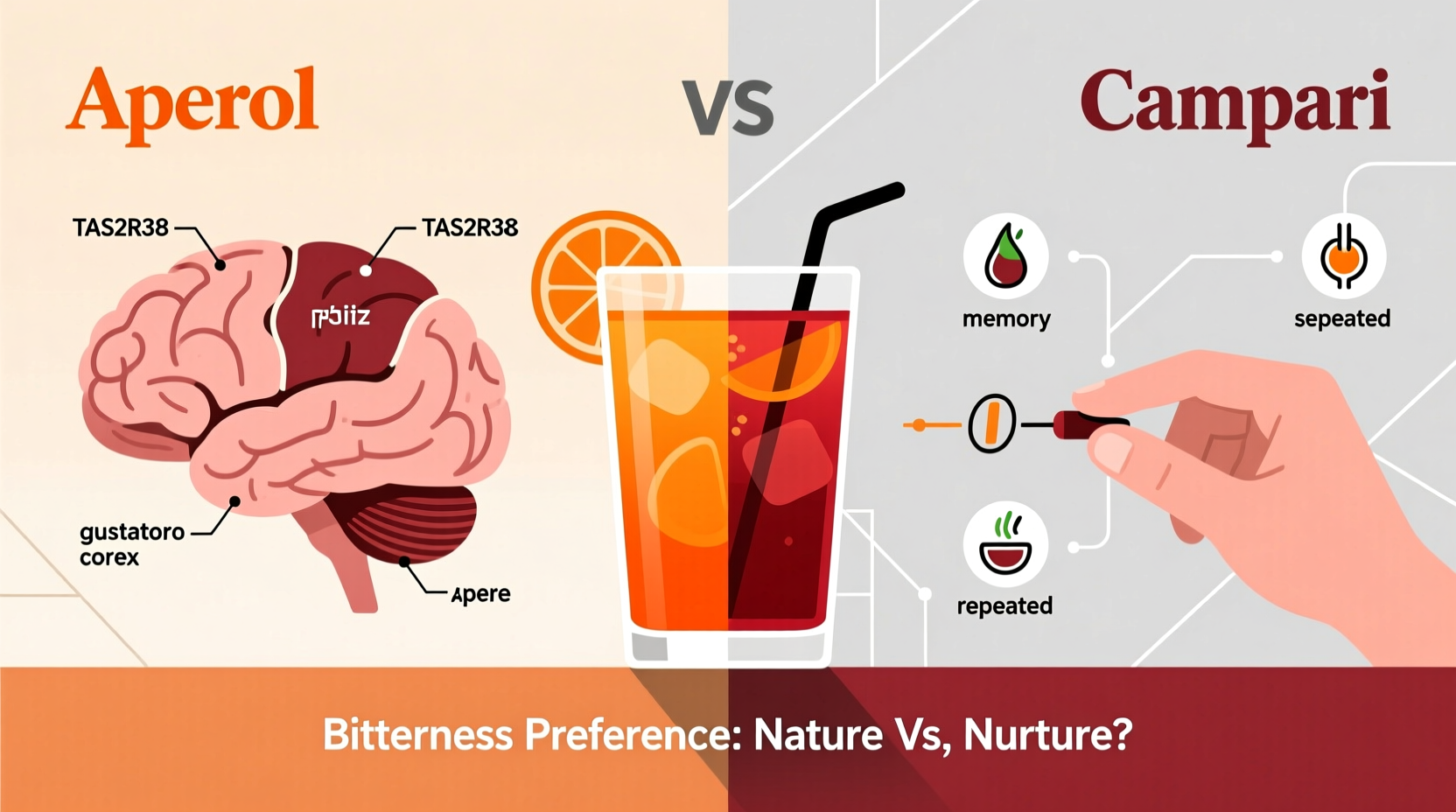
Aperol and Campari are both Italian aperitifs rooted in the same tradition—stimulating appetite and easing the transition from day to evening—but they diverge sharply in composition and sensory impact. Campari, created in 1860 by Gaspare Campari in Novara, contains over 60 botanicals including chinotto, cascarilla bark, and quinine—giving it its signature sharp, medicinal bitterness and pronounced citrus-herbal backbone. Its ABV sits at 20.5–28.5%, depending on market, and its bitterness intensity scores around 900–1,100 IBUs (International Bitterness Units) on a scale where unsweetened espresso registers ~300 and grapefruit peel ~600.
Aperol, launched in 1919 in Padua, was explicitly designed as a gentler alternative. It uses gentian root, rhubarb, and cinchona bark—but in lower concentrations—and balances them with bright orange zest, caramel, and sugar (11% ABV, ~7 g sugar per 100 ml). Its bitterness clocks in at roughly 300–400 IBUs—comparable to a well-brewed black tea. That difference isn’t trivial. It’s the gap between a firm handshake and a full-body hug.
Culturally, this divide maps onto regional habits: Venetians lean toward Aperol for its approachability; Milanese and Turinese bartenders often default to Campari for its structural integrity in complex cocktails. But individual preference rarely follows geography. One friend orders Campari Spritzes daily—even though she “hated” her first sip at age 22. Another avoids Aperol entirely, calling it “too sweet and artificial,” despite having grown up in Verona, where Aperol’s production hub sits just 30 minutes away.
Tip: Don’t judge a bitter liqueur by its first sip. Dilute 1 part Campari with 3 parts chilled sparkling water and a twist of orange peel—then taste it slowly over 5 minutes. Your perception will shift as salivary proteins interact with the compounds.The Genetics of Bitter Perception: TAS2R38 and Beyond
Yes, genetics play a role—most notably through the TAS2R38 gene, which encodes a bitter taste receptor responsive to phenylthiocarbamide (PTC) and propylthiouracil (PROP). Roughly 25% of people are “supertasters”: highly sensitive to these compounds due to two dominant alleles (PAV/PAV). Another 25% are “nontasters” (AVI/AVI), and 50% fall somewhere in between (“medium tasters”). Supertasters report Campari as intensely harsh, sometimes even painful—while nontasters describe it as “mildly herbal” or “just tangy.”
But here’s what the headlines miss: TAS2R38 explains only about 25–30% of variation in bitterness perception. A 2021 study in Nature Human Behaviour analyzed genome-wide data from over 10,000 participants and identified 12 additional loci linked to bitter sensitivity—including genes involved in saliva composition, trigeminal nerve signaling (which detects burn and pungency), and even dopamine regulation. In other words, whether you recoil from Campari depends not just on your tongue’s receptors, but on how your brain interprets irritation, how quickly your mouth clears bitter molecules, and even how reward pathways respond to novelty.
Crucially, PROP sensitivity doesn���t perfectly predict Campari or Aperol response. Some supertasters adore Campari’s complexity once acclimated; some nontasters find Aperol cloying—not because of bitterness, but due to its high sucrose-to-acid ratio triggering a different aversion pathway. As Dr. Danielle Reed, geneticist and Deputy Director at the Monell Chemical Senses Center, explains:
“Bitterness isn’t a single channel—it’s a symphony of receptors, neural feedback loops, and learned associations. Calling someone a ‘bitter hater’ based on one gene is like diagnosing a musician’s skill by counting their fingers.” — Dr. Danielle Reed, Monell Chemical Senses Center
Neuroplasticity and Palate Training: How Habit Rewires Taste
The human gustatory system is remarkably plastic. Between ages 2 and 12, we’re biologically primed to reject bitterness—a protective mechanism against plant toxins. But by adolescence, that aversion begins softening—if exposure is repeated, voluntary, and contextually positive. This is where spritz culture becomes unintentional training ground.
Consider the ritual: a chilled glass, golden hour light, low-stakes social setting, and the promise of refreshment. When bitterness arrives alongside carbonation (which masks harshness), cold temperature (which suppresses receptor activation), and citrus oil (which adds volatile top notes that distract from base bitterness), the brain begins associating the sensation not with danger—but with pleasure, anticipation, and belonging. Over time, dopamine release shifts from the *relief* of finishing the drink to the *anticipation* of its first sip.
Neuroimaging studies confirm this. A 2022 fMRI trial at the University of Bologna tracked 42 adults who consumed Campari Spritzes three times weekly for eight weeks. By week six, activity in the amygdala (fear/aversion center) decreased by 37%, while the ventral striatum (reward center) showed 22% increased response to Campari aroma alone—before any liquid touched the tongue. Crucially, those who drank mindfully—focusing on aroma, temperature, texture, and aftertaste—showed twice the neural adaptation versus passive drinkers.
A Practical Palate-Training Protocol for Bitter Liqueurs
Want to expand your tolerance—or even develop genuine appreciation—for Campari, or refine your Aperol discernment? It’s not about “toughing it out.” It’s about structured, sensory-led exposure. Follow this four-week protocol—designed with input from sommeliers and sensory scientists:
- Week 1: Deconstruct & Dilute — Taste Campari and Aperol separately, neat, at room temperature. Note aroma (citrus? herbs? medicine?), mouthfeel (burn? viscosity?), and finish (lingering? drying?). Then dilute each 1:4 with chilled sparkling water. Repeat daily.
- Week 2: Contextual Pairing — Serve each diluted version alongside specific foods: Campari with aged pecorino (fat cuts bitterness); Aperol with grilled radicchio (bitter-on-bitter amplifies nuance). Track how food changes perception.
- Week 3: Temperature & Texture Play — Serve Campari slightly colder (6°C) with a larger ice cube (slower melt = cleaner evolution). Serve Aperol at 8°C with a splash of tonic (quinine bridges the bitterness-sweetness gap).
- Week 4: Build the Spritz Mindfully — Make your own: 3 parts prosecco, 2 parts liqueur, 1 part soda. Stir gently. Taste before and after stirring—note how integration changes balance. Keep a brief journal: “Today, Campari’s gentian note felt earthy, not sharp.”
| Factor | Effect on Bitter Perception | Practical Adjustment |
|---|---|---|
| Cold temperature | Reduces TRPM5 receptor activation (responsible for bitter/sweet signaling) | Chill glasses 15 min before serving; avoid freezer-burned ice |
| Carbonation | Mechanically disrupts bitter compound binding; triggers mild trigeminal stimulation that distracts from taste | Use freshly opened prosecco; pour gently to preserve bubbles |
| Fat content (in food pairing) | Coats oral mucosa, slowing bitter molecule diffusion; enhances mouthfeel contrast | Pair Campari with marinated olives or burrata; Aperol with salted almonds |
| Salivary flow | Higher flow clears bitter compounds faster; stimulated by sour/citrus elements | Always garnish with expressed orange oil—not just a wedge |
Mini Case Study: From “Campari Avoider” to Bar Program Director
Marco Rossi, now beverage director at a Michelin-starred Milanese enoteca, refused Campari until age 29. “My father drank it straight every night,” he recalls. “I’d smell it and gag—like licking a battery.” His turning point wasn’t epiphany, but necessity: tasked with redesigning his bar’s aperitivo menu, he committed to tasting Campari daily for 30 days using the protocol above. He started with 5 ml diluted in 100 ml sparkling water, focusing solely on the orange oil aroma. By day 12, he noticed the bitterness “had a rhythm”—sharp upfront, then floral, then dry. By day 27, he ordered his first Campari Spritz without hesitation. Today, he trains staff using a “bitter ladder”: starting with Aperol, progressing to Select (a mid-bitter Venetian aperitif), then Cynar (artichoke-based, vegetal bitterness), and finally Campari. “It’s not about conquering bitterness,” he says. “It’s about learning its grammar—so you can read the sentence, not just flinch at the punctuation.”
FAQ: Your Bitter Questions, Answered
Can children learn to like bitter drinks—or is it strictly adult development?
Children under 10 show heightened bitter sensitivity due to evolutionary protection, but early, low-pressure exposure matters. Serving small sips of diluted Aperol Spritz (1:8 ratio) alongside meals—framed as “grown-up lemonade”—builds neutral associations. Avoid forcing or labeling it “good for you.” Consistency and context trump dosage.
If I love Aperol but hate Campari, does that mean my palate will never change?
No. Preference is not fixed. A 2023 longitudinal study followed 127 Aperol-only drinkers for 18 months. Those who engaged in mindful tasting (not just drinking) showed a 68% increase in Campari acceptance rate—defined as ordering it unprompted at least once monthly. The key wasn’t frequency, but attention: noticing how bitterness evolved across the sip, not just the initial shock.
Does adding more soda to a Campari Spritz make it “better”—or just weaker?
More soda reduces perceived bitterness, yes—but also flattens aromatic complexity and weakens structural balance. Optimal dilution is 3:2:1 (prosecco:Campari:soda). If Campari still overwhelms, try lowering the temperature first, then adjust soda incrementally—no more than +0.5 parts. Better yet: add a pinch of flaky sea salt to the glass before pouring. Sodium ions directly inhibit bitter receptor signaling.
Conclusion: Bitterness Is a Language—Not a Barrier
Bitterness in aperitifs isn’t a test of toughness or sophistication. It’s a sensory dialect shaped by biology, culture, memory, and daily habit. Whether you reach for Aperol’s sunny accessibility or Campari’s uncompromising depth, your preference reflects a living, breathing relationship with flavor—not a static genetic destiny. The real magic happens not in the bottle, but in the moments between sips: when you pause to smell the orange oil, feel the prickle of bubbles, notice how the dryness lingers just a second longer than yesterday. That’s where training lives—not in willpower, but in attention.
So next time you order a spritz, skip the reflexive choice. Try the one that makes you hesitate. Take it slow. Write down one thing you notice—just one—that you didn’t last time. Your palate isn’t broken. It’s bilingual. And it’s been waiting for you to start practicing the second language.
💬 Your turn: Did your bitterness preference shift over time? Share your “bitter breakthrough” moment in the comments—we’ll feature the most vivid stories in next month’s tasting roundtable.








