The Aperol Spritz—vibrant orange, effervescent, approachable—has become a global symbol of Italian aperitivo culture. Its bolder cousin, the Campari Spritz, remains a rarer order: sharper, drier, more confrontational. Yet both share the same core ritual: bitter liqueur, prosecco, soda, and an orange slice. Why do some drinkers gravitate instantly toward one and recoil from the other? Is that aversion or attraction written into our DNA—or learned over time, like language or music? The answer lies not in a single gene, but at the intersection of inherited biology, repeated exposure, cultural framing, and even childhood diet.
The Bitterness Divide: Aperol and Campari Compared
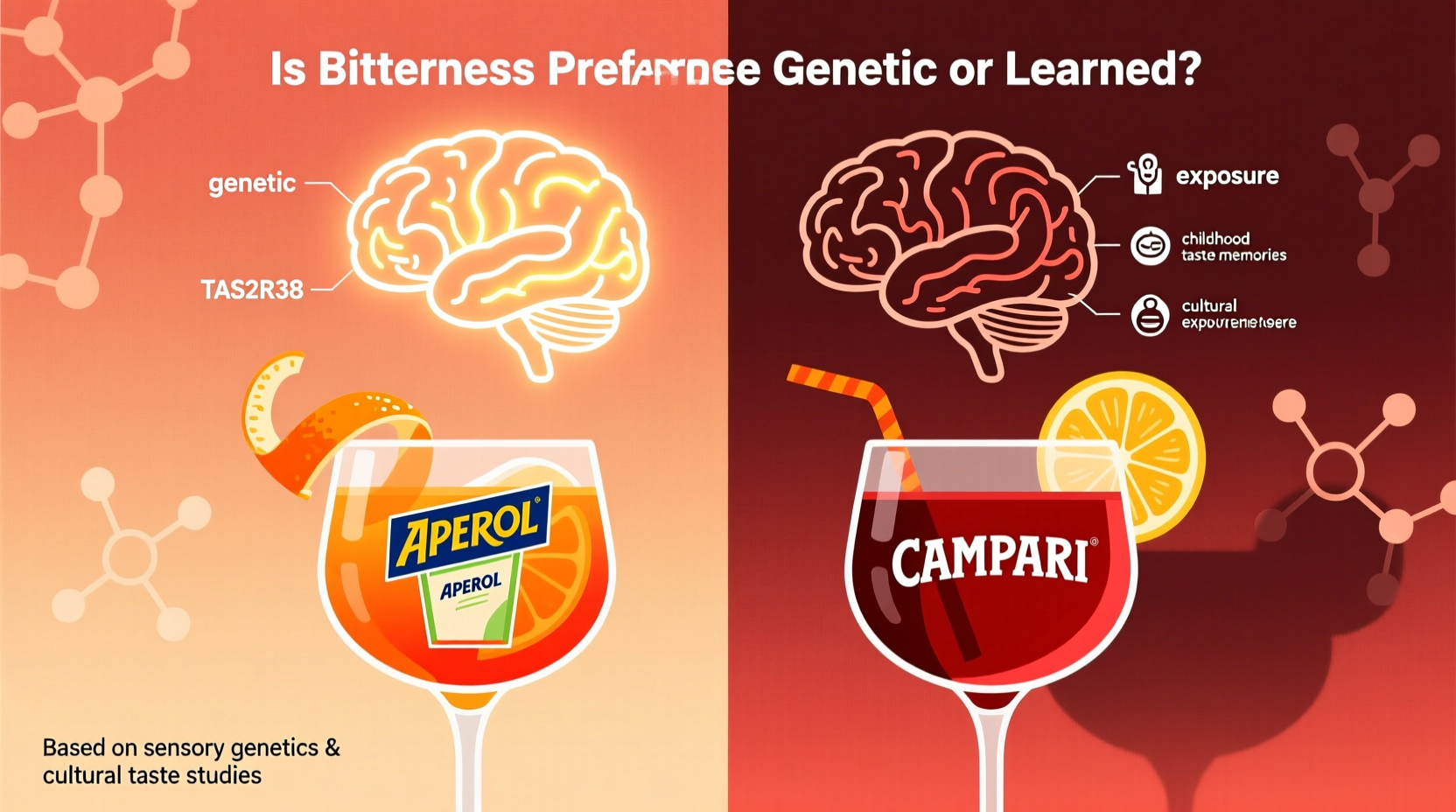
Aperol and Campari are both Italian aperitifs, but they occupy opposite ends of the bitterness spectrum—and not just subjectively. Chemically, Campari contains approximately 25–30 grams per liter of quinine, along with high concentrations of gentian root, rhubarb, and orange peel extracts. Its alcohol content (20.5–28.5% ABV) further amplifies its assertive character. Aperol, by contrast, clocks in at just 11% ABV and contains only about 5–7 g/L of quinine. Its sweetness (140–160 g/L residual sugar) and pronounced orange-vanilla notes soften its bitterness to a gentle, almost floral edge.
| Characteristic | Aperol | Campari |
|---|---|---|
| ABV | 11% | 20.5–28.5% |
| Bitterness Intensity (Scale of 1–10) | 3–4 | 7–9 |
| Sugar Content (g/L) | 140–160 | ~100 |
| Key Botanicals | Orange, gentian, rhubarb, cinchona | Gentian, quinine, cascarilla, orange peel, herbs |
| Typical Spritz Ratio (Liqueur:Prosecco:Soda) | 3:2:1 | 1:2:1 or 1:3:1 |
This isn’t merely stylistic variation—it’s biochemistry meeting perception. Bitterness detection begins on the tongue’s TAS2R receptors, a family of 25 genes encoding proteins that bind specific bitter compounds. One variant, TAS2R38, strongly influences sensitivity to phenylthiocarbamide (PTC) and propylthiouracil (PROP)—chemicals structurally similar to compounds found in gentian and quinine. Roughly 25% of people are “supertasters” (highly sensitive), 50% “medium tasters,” and 25% “non-tasters.” Supertasters report Campari as intensely harsh—even burning—while non-tasters often describe it as “just spicy” or “complex.” But genetics alone don’t predict final preference. As Dr. Beverly Cowart, sensory scientist at the Monell Chemical Senses Center, explains:
“Genetics sets the starting volume on your bitterness radio—but experience, context, and repetition determine whether you turn the dial up or down. A supertaster can learn to love Campari, just as a non-taster can find Aperol cloying if served too sweet or too warm.” — Dr. Beverly Cowart, Sensory Biologist, Monell Chemical Senses Center
How Exposure Rewires Taste Perception
Repeated exposure changes neural response—not just behavior. Functional MRI studies show that after 8–12 exposures to a previously disliked bitter food (like coffee or dark chocolate), activity in the brain’s amygdala (associated with aversion) decreases, while reward-center activation increases. This neuroplasticity applies directly to aperitifs. In northern Italy—particularly Veneto and Friuli—children are routinely offered diluted Aperol Spritz (often 1 part Aperol to 4 parts prosecco and soda) during family aperitivo hours. That early, low-intensity exposure builds familiarity before the palate matures. Campari, meanwhile, is rarely introduced before adolescence—and then usually in small, ritualized doses, often paired with food.
A 2022 ethnographic study across 12 Italian cities found that adults who reported “always preferring Campari” were 3.2× more likely to recall sharing their first sip with a parent or grandparent who modeled appreciation—not just consumption. They didn’t just drink it; they discussed its aroma (“like alpine herbs”), noted its dry finish, and linked it to the transition from day to evening. Context matters: bitterness interpreted as “refreshing” or “cleansing” feels different than when labeled “harsh” or “medicinal.”
Tip: Start Campari exposure at lower strength (1:4 Campari:prosecco, no soda) and serve well-chilled. Warmth exaggerates bitterness; cold suppresses it and highlights citrus top notes.A Real-World Shift: From Rejection to Ritual
Marco Rossi, a 34-year-old graphic designer from Turin, recalls his first Campari Spritz at age 22: “I took one sip and put it down. My friend laughed and said, ‘It’s not supposed to be easy. It’s supposed to wake you up.’ I didn’t get it—until I tried it again six months later, after drinking espresso every morning for weeks. Suddenly, the bitterness felt familiar. Not pleasant yet—but intelligible.”
Over the next year, Marco adopted a structured approach: he began with Campari neat, chilled, in a small glass—just half an ounce, sipped slowly before dinner. Then he moved to 1:3 Campari:prosecco. By month five, he was ordering Campari Spritzes confidently—and noticed something unexpected: Aperol now tasted thin and overly sweet. His palate hadn’t just adapted; it had recalibrated its reference point for balance. He wasn’t “getting used to bitterness”—he was developing a new framework for what complexity means in a drink.
Your Personal Bitterness Journey: A 4-Step Framework
Preference isn’t fixed—and it doesn’t require years of trial. With intention, most adults can expand their tolerance and even develop genuine preference within 3–6 weeks. Here’s how:
- Baseline Assessment (Day 1): Taste both Aperol and Campari neat, chilled, in separate small glasses. Note immediate reactions—not just “like/dislike,” but physical descriptors: “burning,” “drying,” “tingling,” “lingering,” “citrusy,” “earthy.” Write them down.
- Controlled Exposure (Days 2–14): Choose one liqueur—the one you find less off-putting. Dilute it 1:3 with chilled prosecco. Drink one 90ml serving daily, 30 minutes before a meal. No soda yet. Focus on texture and finish—not flavor alone.
- Contextual Pairing (Days 15–28): Add a small bite of food *before* each sip: olives for Campari (salt cuts bitterness), marinated artichokes for Aperol (acidity balances sweetness). Note how the food changes the perception.
- Integration & Comparison (Day 29+): Prepare both spritzes using identical ratios (e.g., 2 oz prosecco, 1 oz liqueur, 1 oz soda). Serve side-by-side, chilled. Ask: Which feels more refreshing? Which cleanses the palate better? Which leaves a longer, more interesting aftertaste?
Cultural Framing: How Language Shapes Taste
Words carry physiological weight. In English-speaking markets, Campari is often described as “bracing,” “punishing,” or “an acquired taste”—phrases that prime expectation of difficulty. In Italian, it’s amaro (bitter), yes—but also digestivo (digestive), stimolante (stimulating), and tonico (tonic). These terms imply function, not flaw. Similarly, Aperol’s marketing leans heavily on “sunshine,” “vibrancy,” and “easy”—which reinforces its accessibility but risks flattening its herbal depth.
A 2023 cross-cultural tasting panel demonstrated this effect vividly. Two groups tasted identical Campari Spritzes. Group A received neutral descriptors (“contains gentian root, quinine, orange peel”). Group B heard emotionally loaded terms (“intense,” “challenging,” “not for beginners”). Group B rated bitterness 37% higher and enjoyment 41% lower—even though the drink was identical. Framing doesn’t change chemistry—but it changes perception at the neural level.
FAQ: Addressing Common Misconceptions
Does being a “supertaster” mean I’ll never enjoy Campari?
No. Supertasting increases initial sensitivity—but repeated exposure reduces aversive response through habituation and cognitive reframing. Many professional bartenders and sommeliers are supertasters who now prefer Campari for its clarity and structure. What matters more than genetic status is consistency of exposure and contextual support (e.g., pairing, temperature, social modeling).
Can childhood diet influence adult bitter tolerance?
Yes—significantly. Children regularly exposed to bitter vegetables (kale, broccoli rabe, endive) or unsweetened herbal teas develop greater tolerance for complex bitterness in adulthood. A longitudinal study published in Appetite found that adults who ate ≥3 servings/week of bitter greens before age 12 were 2.8× more likely to rate Campari as “balanced” rather than “harsh” at age 30.
Why does Aperol taste sweeter in Italy than abroad?
It’s not the liqueur—it’s the prosecco. Italian producers typically use drier (brut or extra dry) prosecco with 10–12 g/L residual sugar. Many export-market proseccos are dry or off-dry (17–32 g/L sugar), making the same Aperol Spritz perceptibly sweeter and less balanced. Always check the prosecco’s dosage label—or ask for brut.
What This Means for Your Next Spritz Order
Choosing between Aperol and Campari isn’t about picking a side in a binary debate. It’s about understanding your own sensory history—and recognizing that preference is dynamic, not destiny. Genetics may load the gun, but environment pulls the trigger. If you’ve dismissed Campari as “too much,” consider whether that judgment was formed during a hot afternoon, with lukewarm prosecco, and no food nearby—or whether it was reinforced by someone else’s offhand comment years ago. Likewise, if Aperol feels like the only safe choice, ask whether its familiarity has begun to dull its nuance.
The spritz is more than a cocktail—it’s a ritual of transition, a moment of pause, a shared gesture. Neither liqueur is “better.” But one may serve you better *right now*, depending on where you are in your relationship with bitterness. That relationship can evolve. It has for thousands of drinkers—from Milanese nonnas who stirred Campari into their grandchildren’s first spritzes, to Tokyo bartenders who deconstruct Aperol’s botanicals to highlight its gentian backbone, to Australian sommeliers who pair Campari with grilled kingfish to echo its marine bitterness.
💬 Your palate is yours to explore—not fix. Try one intentional spritz this week using the 4-step framework. Then tell us: Did your perception shift? What changed—and what stayed the same? Share your experience in the comments.








