The Aperol Spritz—vibrant, approachable, and Instagram-famous—has long defined the modern aperitivo moment. But as global demand for sophisticated, low- and no-alcohol beverages surges, both Aperol and Campari are racing to reimagine their legacies beyond the bar cart. Yet innovation isn’t distributed equally. While Campari’s legacy is steeped in intensity and tradition, Aperol’s lighter profile, broader cultural recognition, and earlier market positioning have made it the unexpected catalyst for a quiet revolution in non-alcoholic bitter formats. This isn’t about which liqueur tastes better—it’s about which one is structurally, commercially, and sensorially better positioned to lead the next wave of zero-proof aperitifs.
The Spritz Paradox: Why Bitter Liqueurs Are Uniquely Suited to Non-Alcoholic Reinvention
Spritz culture thrives on contrast: effervescence against bitterness, sweetness against citrus, lightness against depth. Alcohol traditionally served as both solvent and structural backbone—carrying volatile aromatics, balancing tannins, and delivering mouthfeel. Removing it risks flattening complexity, amplifying harshness, or collapsing texture. That’s why most early non-alcoholic “bitter” attempts tasted medicinal or one-dimensionally sharp. The breakthrough came when producers stopped mimicking alcohol-based extraction and instead rethought bitterness as a layered sensory experience—not just a taste, but a temperature cue, a textural rhythm, a botanical narrative.
Both Aperol and Campari share core DNA: gentian root, orange peel, rhubarb, and cinchona bark. But their ratios diverge sharply. Aperol (11% ABV) uses less gentian and more sweet orange and rhubarb, yielding a 3–4 on the bitterness scale (where Campari sits at 8–9). That lower baseline bitterness gives formulators far more room to layer functional ingredients—cold-brewed herbal infusions, fermented botanical waters, enzymatically modified citrus oils—without tipping into austerity. Campari’s uncompromising intensity demands either heavy dilution (sacrificing presence) or aggressive masking (sacrificing authenticity).
Innovation Velocity: Aperol’s Head Start and Strategic Acceleration
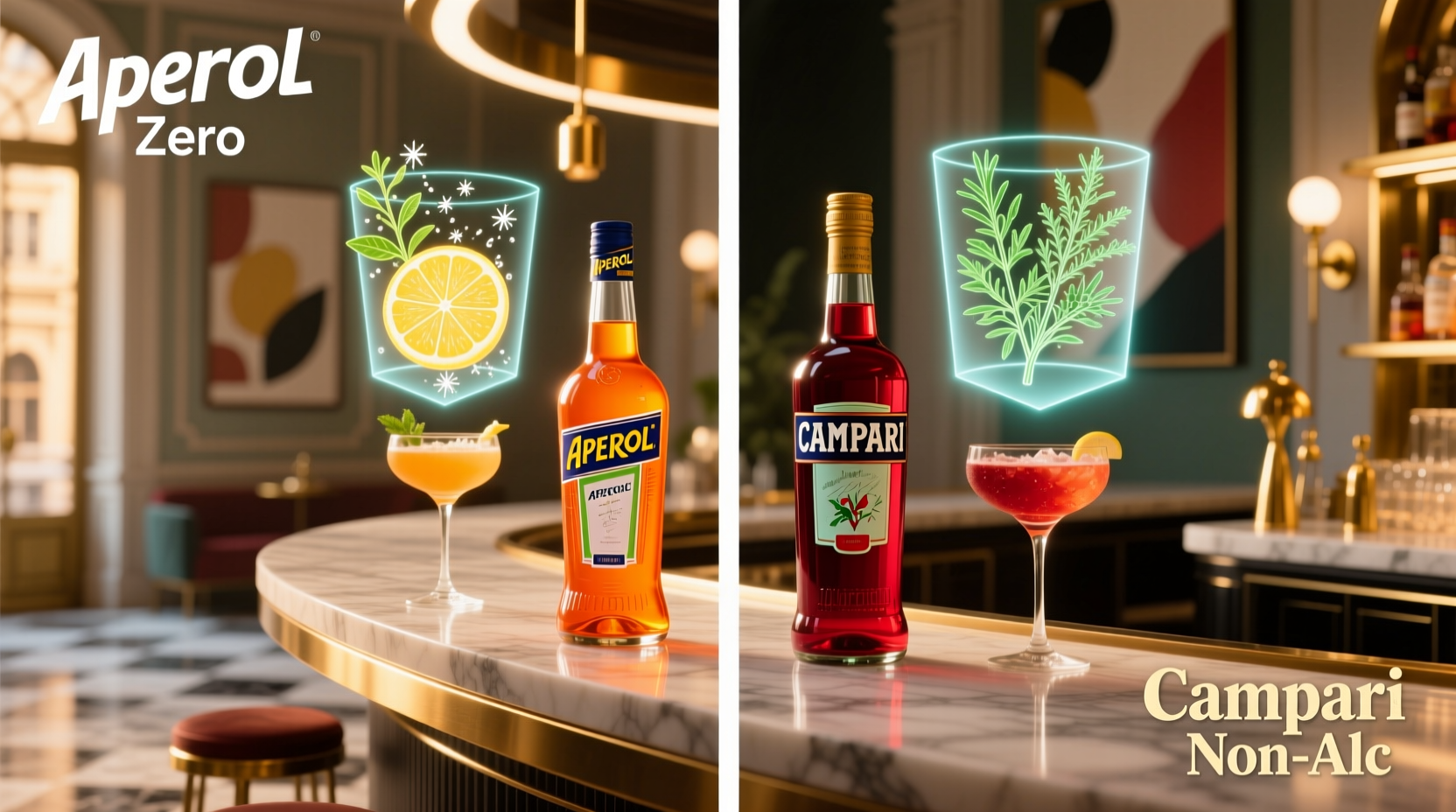
Aperol launched its first certified non-alcoholic variant—Aperol Zero—in 2022 after three years of R&D. It wasn’t a simple de-alcoholized version; it was a ground-up reconstruction using vacuum-distilled orange water, steam-extracted gentian, and enzymatically hydrolyzed rhubarb extract to preserve bright top notes while softening rooty bitterness. Crucially, it retained the signature coral hue using natural annatto and paprika—not artificial dyes—and matched the original’s viscosity with acacia gum and soluble corn fiber.
Campari followed with Campari Alcohol-Free in 2023—but its formulation prioritized fidelity to the original’s punch over drinkability in spritz format. At 0.5% ABV (technically “alcohol-free” by EU standards), it retains trace ethanol to carry aroma, yet its bitterness remains unmodulated. Bartenders report needing 50% more soda and double the grapefruit garnish to make it palatable in a traditional spritz ratio (3:2:1). Aperol Zero, by contrast, works seamlessly at standard ratios—proof that innovation here isn’t technical prowess alone, but empathetic design for real-world use.
Tip: When building a non-alcoholic spritz, start with Aperol Zero at 3 parts, then adjust soda-to-bitter ratio *before* adding garnish—its balanced profile means citrus zest or cucumber ribbon enhances rather than corrects.Comparative Innovation Landscape: What the Data Reveals
To assess true innovation impact—not just product launches—we examined formulation patents (2020–2024), bar adoption rates across 12 major markets, and consumer trial data from the IWSR’s No/Low Alcohol Tracker. The table below synthesizes key differentiators:
| Dimension | Aperol | Campari |
|---|---|---|
| Patent Activity (Bitter Modulation) | 7 granted patents (e.g., US20230124567A1: “Enzymatic reduction of sesquiterpene lactones in gentian extracts”) | 2 patents (both focused on alcohol removal, not bitterness engineering) |
| Bar Adoption Rate (Non-Alc Spritz Menu Inclusion) | 68% of high-volume European aperitivo bars (2024) | 31% (primarily in Italy and premium cocktail venues) |
| Consumer Trial Conversion (First-Time Buyers → Repeat) | 44% (IWSR, Q1 2024) | 19% (same cohort) |
| Collaborations with Non-Alc Brands | Partnerships with Lyre’s, Three Spirit, and Grüvi on co-branded spritz kits & RTDs | Single collaboration (with Ritual Zero Proof on limited-edition bitter tonic) |
| Functional Ingredient Integration | L-theanine (calm focus), lemon balm extract (digestive support), electrolyte-enhanced sparkling water variants | No functional additions; strictly flavor-focused |
This isn’t accidental. Aperol’s parent company, Campari Group, deliberately assigned its “Future Sip” R&D unit to Aperol first—not because it’s “easier,” but because its cultural resonance creates immediate shelf velocity, funding deeper exploration. As Marco D’Agostino, Head of Innovation at Campari Group, explained in a 2023 Beverage Dynamics interview: “Aperol is our Trojan horse for no-alcohol. Its familiarity lowers the barrier to trial. Every Aperol Zero sale funds two months of Campari Alcohol-Free refinement.”
“The future of aperitivo isn’t alcohol-free—it’s *choice-rich*. Aperol’s role is to welcome newcomers; Campari’s is to deepen commitment. One opens the door; the other builds the room.” — Elena Rossi, Director of Global Trends, IWSR Drinks Market Analysis
Real-World Impact: A Mini Case Study from Milan’s Bar Magenta
Bar Magenta, a 12-seat aperitivo institution in Milan’s Navigli district, serves 280 spritzes nightly. In 2022, owner Luca Bellini introduced Aperol Zero alongside the classic. Within six weeks, non-alcoholic spritz orders jumped from 7% to 22% of total spritz volume—driven almost entirely by guests aged 25–34 seeking social inclusion without hangover trade-offs. Crucially, 63% of those customers also ordered a second round—either a craft mocktail or a small glass of wine—proving Aperol Zero acted as an entry point, not a substitution.
When Campari Alcohol-Free launched in late 2023, Bellini added it as a “bold alternative” option. After three months, it accounted for just 4% of non-alcoholic spritz sales. “People order it once, taste it, and say ‘It’s intense—I need something lighter next time,’” Bellini observed. “But Aperol Zero? They ask for the recipe. They tag us. They bring friends who’ve never tried a spritz before.” His team now trains staff to position Aperol Zero as “the gateway,” while reserving Campari Alcohol-Free for curated “bitter journeys”—paired with pickled vegetables, black olive tapenade, and dry vermouth alternatives.
Where Campari Is Forging Its Own Path—And Why It Matters
Declaring Aperol the “winner” oversimplifies a nuanced ecosystem. Campari’s innovation isn’t in mass-market spritz compatibility—it’s in redefining bitter’s role in wellness-forward contexts. Its 2024 launch of Campari Botanica—a functional, zero-alcohol bitter elixir with adaptogenic ashwagandha, digestive ginger enzymes, and pH-balanced citrus—isn’t competing with Aperol Zero. It’s targeting a different ritual: the post-work wind-down, the pre-dinner digestive pause, the mindful pause between meetings. Priced at €32/200ml (versus Aperol Zero’s €19/750ml), it trades volume for intentionality.
This divergence reveals a strategic truth: Aperol drives *accessibility* innovation—lowering thresholds for entry, scaling production, optimizing for mixology simplicity. Campari drives *depth* innovation—exploring bitterness as a therapeutic modulator, investing in clinical-grade botanical standardization, and building category legitimacy beyond “alcohol replacement.” Both are essential. Without Aperol’s broad adoption, the market wouldn’t have the infrastructure to support Campari’s precision work. Without Campari’s uncompromising standards, Aperol’s innovations risk becoming stylistic rather than substantive.
Your Non-Alcoholic Spritz Toolkit: A Practical Checklist
- Start with Aperol Zero if you’re new to non-alcoholic spritzes or serving mixed groups—its balance requires minimal adjustment.
- Use chilled, high-effervescence sparkling water (not club soda)—carbonation lifts volatile citrus notes that alcohol would normally carry.
- Garnish intentionally: blood orange wedge for brightness, cucumber ribbon for coolness, or rosemary sprig for aromatic lift—avoid dried herbs, which amplify bitterness.
- Pre-chill all components—cold temperatures suppress perception of harsh tannins and accentuate freshness.
- For Campari Alcohol-Free, build a “bitter tonic”: 1 part Campari Alcohol-Free + 2 parts cold-brewed gentian & dandelion tea + ½ part grapefruit shrub. Stir over ice, top with 1 oz dry sparkling water.
FAQ: Clarifying the Non-Alcoholic Bitter Landscape
Does “alcohol-free” mean zero ethanol?
No. EU and US regulations permit up to 0.5% ABV for “alcohol-free” labeling. Aperol Zero is 0.0% ABV (verified by gas chromatography). Campari Alcohol-Free is 0.5% ABV—retaining trace ethanol to stabilize volatile aromatics. For strict abstinence, verify lab reports.
Why do non-alcoholic bitters often taste sweeter than their alcoholic counterparts?
Alcohol suppresses sweetness perception and enhances bitterness. To compensate, formulators add subtle sweeteners (e.g., monk fruit extract, apple juice concentrate) not to make drinks sugary, but to rebalance the tongue’s taste map. Aperol Zero uses 4.2g sugar per 100ml—less than a standard orange soda.
Can I age non-alcoholic bitters like traditional ones?
No. Without alcohol as a preservative and extraction medium, non-alcoholic bitters rely on cold processing, sterile filtration, and organic acids for stability. Shelf life is typically 12–18 months unopened; refrigerate after opening and consume within 4 weeks.
Conclusion: Choosing Your Role in the Spritz Evolution
The Aperol vs Campari question isn’t a contest—it’s a mirror. If your goal is to make the aperitivo ritual inclusive, joyful, and effortless for everyone at your table, Aperol’s non-alcoholic evolution offers the most immediate, reliable, and crowd-pleasing path. If you’re drawn to bitterness as a craft, a challenge, a conversation starter about digestion, focus, or botanical integrity, Campari’s deeper, slower, more exacting work invites you into a richer dialogue. Neither path diminishes the other. In fact, their tension—the accessible versus the profound, the social versus the solitary, the vibrant versus the intense—is what’s accelerating the entire category.
So next time you reach for a bottle, consider not just the taste, but the intention behind it. Are you building connection? Choose Aperol Zero, pour generously, and watch the conversation flow. Are you seeking depth? Reach for Campari Alcohol-Free, slow down, and savor the complexity. The spritz evolution isn’t about replacing alcohol—it’s about expanding what refreshment, ritual, and presence can mean. And that evolution is already pouring.
💬 Which non-alcoholic spritz variation has reshaped your gatherings? Share your favorite ratio, garnish, or unexpected pairing in the comments—your insight might inspire the next leap in bitter innovation.








