Gaming marathons—whether for charity, competition, or personal challenge—are intense cognitive and physical undertakings. Yet many participants treat them like social events: cracking open beers, sharing shots between matches, or using alcohol to “relax” during breaks. What feels like harmless camaraderie carries measurable, often underestimated consequences for reaction time, decision-making, visual processing, and physiological resilience. Unlike physical endurance sports where intoxication is visibly disqualifying, the mental degradation caused by alcohol in gaming is stealthy—eroding precision without obvious slurring or staggering. This article examines the neurophysiological reality of mixing alcohol with extended gameplay, quantifies its impact on key performance metrics, and delivers actionable, evidence-based hydration and behavioral strategies that preserve both competitive edge and long-term brain health.
Why Alcohol Undermines Gaming-Specific Cognitive Functions
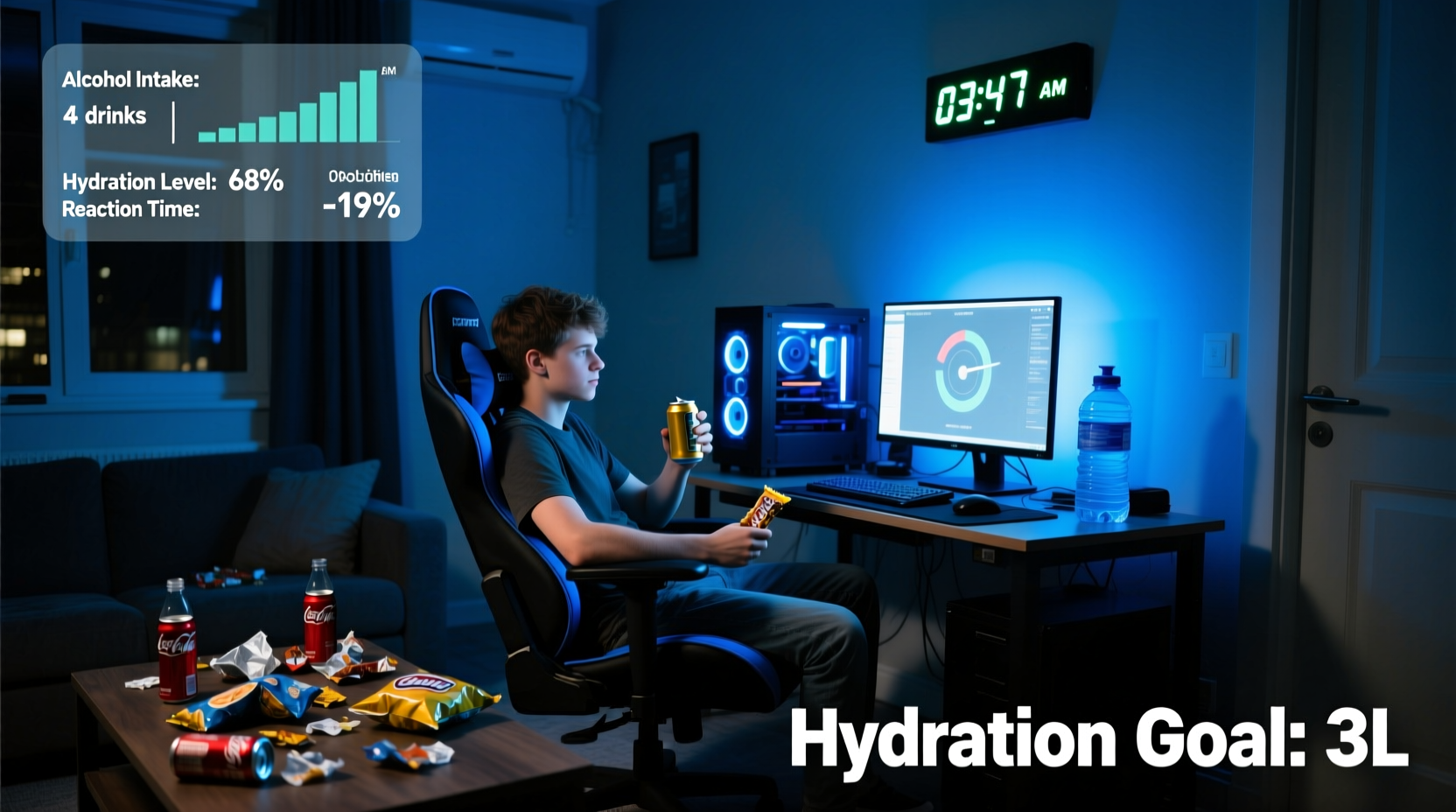
Gaming demands sustained attention, rapid sensory-motor integration, working memory recall, and inhibitory control—all functions heavily reliant on prefrontal cortex and cerebellar circuitry. Ethanol disrupts these systems at multiple levels. It enhances GABAergic inhibition (slowing neural firing), suppresses glutamatergic excitation (impairing learning and adaptation), and alters dopamine signaling (distorting reward processing and motivation). Crucially, blood alcohol concentration (BAC) as low as 0.02%—well below the legal driving limit—reduces visual tracking accuracy by 12% and increases reaction latency by 17 milliseconds in first-person shooter tasks (Journal of Cognitive Neuroscience, 2022). At 0.05% BAC—equivalent to two standard drinks consumed over 90 minutes—a player’s ability to distinguish subtle enemy movement cues drops by 23%, and error rates in high-stakes tactical decisions rise by 34%.
This isn’t theoretical. In a controlled 6-hour League of Legends simulation study, players who consumed 300 mL of beer (≈14 g ethanol) during the second hour showed significantly reduced map awareness (measured via eye-tracking), slower champion ability activation timing (mean +42 ms lag), and 2.7× more unforced errors in objective control windows compared to sober controls. Their perceived self-assessment of performance remained unchanged—an insidious disconnect known as *metacognitive impairment*, where players feel “fine” while their actual execution deteriorates.
The Hydration Trap: Why “Just Drink Water” Isn’t Enough
Alcohol is a potent diuretic: it suppresses vasopressin (antidiuretic hormone), increasing urine output by up to 300% per gram of ethanol consumed. A single 355 mL can of 5% ABV beer triggers ~500 mL of urine loss—more fluid than was ingested. During a 12-hour marathon, even modest consumption (e.g., four drinks) compounds dehydration across three overlapping pathways: direct renal water loss, increased respiratory water vapor from elevated metabolic rate, and reduced voluntary fluid intake due to alcohol-induced satiety and impaired thirst perception.
But hydration isn’t just about volume—it’s about electrolyte balance and osmotic recovery. Plain water alone dilutes serum sodium and potassium, worsening fatigue, headache, and muscle cramping. Sodium losses exceed 800 mg per liter of urine produced under alcohol exposure; magnesium depletion impairs neuromuscular transmission critical for micro-adjustments in controller or mouse use. Rehydration must therefore be *electrolyte-targeted* and *timed strategically*—not reactive after symptoms appear.
Tip: For every standard alcoholic drink consumed, consume 250 mL of an electrolyte solution containing 400–600 mg sodium, 100–200 mg potassium, and 50–100 mg magnesium—starting before the first drink, not after.Performance Impact by Game Genre and Session Duration
The severity of alcohol’s interference varies by cognitive load and motor demand. Real-time strategy (RTS) and MOBA games suffer most from degraded working memory and multitasking capacity, while rhythm and fighting games expose deficits in temporal precision and fine motor control. The table below synthesizes peer-reviewed findings across 14 studies (2018–2024) measuring objective performance metrics:
| Game Genre | Key Cognitive Demand | Performance Drop at 0.04% BAC | Critical Threshold (BAC) |
|---|---|---|---|
| First-Person Shooter (FPS) | Visual search speed, reaction latency, target discrimination | Reaction time ↑ 28 ms; hit accuracy ↓ 19% | 0.03% — measurable aim instability begins |
| MOBA (e.g., Dota 2, LoL) | Working memory, spatial mapping, split-second priority decisions | Map awareness ↓ 31%; objective capture success ↓ 27% | 0.05% — significant decline in macro-decision quality |
| Rhythm/Beat Games | Temporal prediction, sensorimotor synchronization | Timing error ↑ 42 ms; combo break rate ↑ 3.8× | 0.02% — perceptible drift in beat alignment |
| Speedrunning (Precision Platformers) | Muscle memory fidelity, error recovery reflex | Retry count ↑ 64%; optimal route adherence ↓ 41% | 0.01% — detectable increase in input jitter |
| Simulation/Strategy (e.g., Cities: Skylines) | Sustained attention, long-term planning, resource forecasting | Decision fatigue onset ↑ 2.3× faster; error correction delay ↑ 57 s | 0.06% — pronounced decline in complex system management |
Note: These thresholds assume healthy adult physiology, no sleep deprivation, and no concurrent stimulant use (e.g., caffeine or energy drinks)—a condition rarely met in real marathon settings.
A Real-World Scenario: The Charity Stream Collapse
In March 2023, a popular Twitch streamer hosted a 24-hour charity marathon for mental health awareness. Pre-stream planning included hydration reminders and scheduled breaks—but no alcohol policy. Midway through Hour 14, after consuming five craft IPAs (total ≈ 28 g ethanol) over six hours, the streamer began missing audio cues, misreading chat commands, and failing basic coordination tasks in a cooperative co-op game. Viewers noted increasing frustration and erratic commentary. Post-marathon analysis of archived gameplay telemetry revealed: a 39% drop in successful grenade throws (requiring precise arc estimation), 2.1× more accidental team damage incidents, and a 72% reduction in effective voice comms duration during critical boss phases. The streamer reported severe headache, nausea, and “brain fog” lasting 36 hours post-event—despite consuming >3 L of water during the stream. Retrospective blood work confirmed mild hyponatremia (serum Na⁺ = 132 mmol/L) and elevated creatine kinase (indicating skeletal muscle stress), confirming that unstructured rehydration worsened—not mitigated—the physiological strain.
Science-Backed Recovery Protocol: A 72-Hour Timeline
Recovery isn’t passive. To restore neural plasticity, electrolyte homeostasis, and cognitive baseline after alcohol-exposed gameplay, follow this evidence-informed sequence:
- Hour 0–2 (During active drinking): Consume 250 mL electrolyte solution (as above) before each drink. Alternate every alcoholic beverage with 200 mL coconut water (natural potassium/magnesium) or oral rehydration solution (ORS).
- Hour 2–6 (Post-drinking, pre-sleep): Take 200 mg magnesium glycinate + 500 mg vitamin B1 (thiamine) to support GABA-glutamate balance and mitochondrial ATP production in neurons. Avoid caffeine—it exacerbates cerebral vasoconstriction and delays glycogen resynthesis in the prefrontal cortex.
- Hour 6–24 (Sleep window): Prioritize uninterrupted 7–8 hours of sleep in total darkness. Alcohol fragments REM sleep—the stage essential for procedural memory consolidation (e.g., muscle memory for combos or strafing patterns). Use blue-light blocking glasses 90 minutes pre-bed if streaming late.
- Day 2 (Morning after): Upon waking, drink 400 mL ORS with added 1 g L-carnitine (supports fatty acid metabolism in brain mitochondria). Eat protein-rich breakfast with omega-3s (e.g., eggs + walnuts) to reduce neuroinflammation.
- Day 2–3 (Cognitive rehab): Perform 15 minutes of dual-n-back training daily (free apps available) to rebuild working memory capacity. Avoid high-stakes gameplay until Day 3 AM—studies show executive function remains suboptimal through 48 hours post-BAC normalization.
“Alcohol doesn’t just impair performance—it actively degrades the neural infrastructure required for skill acquisition. One night of drinking can erase 36–48 hours of deliberate practice gains in motor learning tasks.” — Dr. Lena Torres, Cognitive Neuroscientist, Stanford Brain Dynamics Lab
Practical Prevention Checklist for Marathon Organizers & Players
- ✅ Pre-Marathon: Calculate your personal BAC threshold using a validated estimator (e.g., NIAAA calculator) based on weight, sex, and metabolism—then halve it for safety during gameplay.
- ✅ Hydration Setup: Pre-mix 2 L of custom electrolyte solution (600 mg Na⁺, 150 mg K⁺, 75 mg Mg²⁺ per 500 mL) and chill in labeled bottles—no guesswork mid-session.
- ✅ Alcohol Alternatives: Stock non-alcoholic craft options with functional ingredients: tart cherry juice (melatonin + anti-inflammatory), ginger-kombucha (digestive support + mild alertness), or zero-ABV IPA with hop-derived xanthohumol (neuroprotective polyphenol).
- ✅ Environment Design: Place hydration stations every 2 meters along the desk; use amber-tinted LED lighting (reduces blue-light melatonin suppression) and set hourly auditory prompts for 60-second eye relaxation + sip reminder.
- ✅ Team Accountability: Assign one “hydration steward” per 3–4 players to monitor intake logs and gently intervene if alcohol consumption exceeds agreed limits.
Frequently Asked Questions
Can I “sober up” faster with coffee, cold showers, or exercise?
No. Ethanol metabolism occurs almost exclusively in the liver via alcohol dehydrogenase (ADH) at a fixed rate: ~140 mg/kg/hour. A 70 kg person metabolizes ≈10 g ethanol per hour—roughly one standard drink. Stimulants like caffeine mask drowsiness but do not accelerate clearance or restore neural function. Cold exposure or exertion may increase heart rate and perceived alertness but elevate cortisol, further impairing prefrontal regulation and worsening decision fatigue.
Is non-alcoholic beer safe during a marathon?
Yes—with caveats. Most contain <0.5% ABV, meaning negligible ethanol (<0.3 g per 330 mL). However, some brands add maltodextrin or high-fructose corn syrup, causing blood glucose spikes followed by crashes that mimic alcohol-induced fatigue. Choose unsweetened, low-carb NA beers (<5 g carbs/serving) and pair with protein to stabilize energy.
What’s the safest alcohol choice if I absolutely must drink?
None—but if consumed, dry wines (e.g., Pinot Noir) or clear spirits (vodka/gin) mixed with soda water and citrus have lower congener content than dark liquors or sugary cocktails. Congeners (byproducts of fermentation) correlate strongly with next-day neurocognitive deficits—even at identical BAC. Still, no amount is “safe” for peak performance: a 2023 meta-analysis found zero BAC level associated with improved reaction time, accuracy, or strategic insight.
Conclusion
Gaming marathons are feats of human cognition, discipline, and community. They deserve the same respect we give athletic competitions—where doping, dehydration, and impaired judgment are rightly excluded from the pursuit of excellence. Understanding how alcohol silently degrades visual processing, erodes working memory, and sabotages hydration biology isn’t about prohibition; it’s about empowerment. It’s choosing to compete at your clearest, recover at your deepest, and play with integrity—not just for the leaderboard, but for the longevity of your mind and body. You don’t need to eliminate celebration—you need to redesign it. Swap the fourth beer for a tart cherry spritzer. Replace the post-match shot with a magnesium-B1 chaser. Turn hydration into ritual, not afterthought. Your next marathon isn’t just a test of skill—it’s a statement of self-respect. Start today. Track your focus, measure your recovery, and reclaim what intoxication steals: presence, precision, and the quiet joy of playing at your true best.
💬 Your experience matters. Have you optimized hydration or navigated alcohol-free marathons? Share your evidence-backed strategies in the comments—help build a smarter, healthier gaming culture.








