Gaming marathons—whether for charity streams, speedrun competitions, or late-night co-op sessions—often carry an unspoken cultural script: snacks, energy drinks, and, for many adults, a cold beer. The idea is seductive: a few sips to relax, ease social tension, or “take the edge off” during hours of intense screen time. But beneath that casual ritual lies a physiological reality most players overlook. Alcohol is a central nervous system depressant—not a cognitive enhancer—and its interaction with the precise neural demands of competitive or high-stakes gaming is anything but benign. This article cuts through myth and anecdote with peer-reviewed neuroscience, sports psychology research, and real-world performance data to answer one urgent question: Does beer truly enhance focus during a gaming marathon—or does it silently erode the very skills that separate victory from defeat?
The Neurological Truth: Why “Liquid Confidence” Is a Cognitive Trap
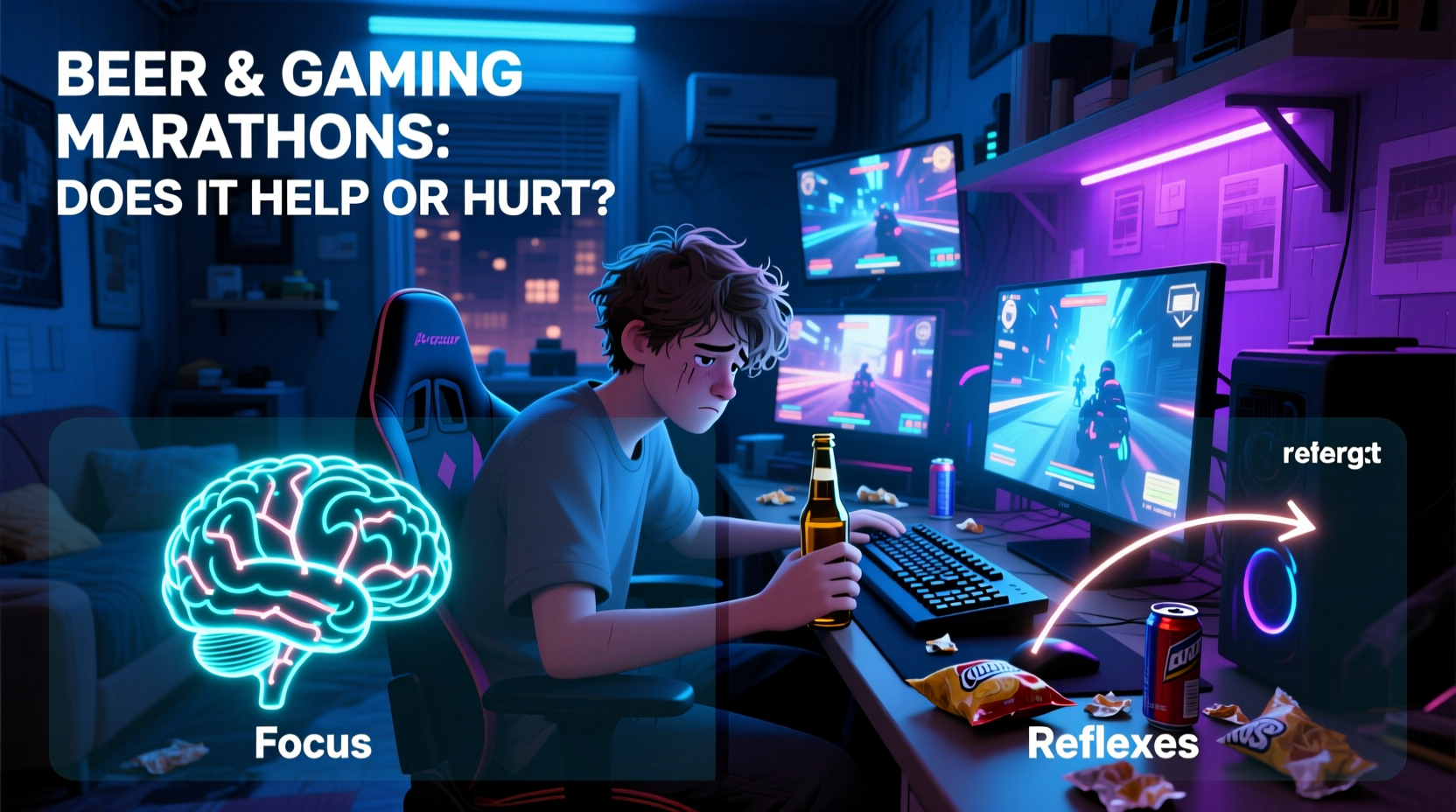
Alcohol doesn’t “loosen up” the brain—it disrupts it. Even at low blood alcohol concentrations (BAC) of 0.02%, measurable changes occur in the prefrontal cortex—the region responsible for executive function, working memory, and impulse control. A 2022 study published in Frontiers in Psychology tracked 87 experienced gamers across three 90-minute Counter-Strike sessions: sober, BAC 0.03%, and BAC 0.05%. Reaction times slowed by an average of 14% at 0.03% and 29% at 0.05%. More critically, error rates in target discrimination (distinguishing enemies from teammates or environmental clutter) rose 37% and 61%, respectively. These aren’t abstract metrics—they translate directly to missed headshots, mis-timed ultimates, and fatal overextensions.
What’s often mistaken for “enhanced focus” is actually disinhibition masking fatigue. As alcohol suppresses the amygdala’s threat-response signaling, players may feel less anxious about failure or more socially engaged in voice chat—but this comes at the cost of reduced attentional control. fMRI scans show diminished activation in the anterior cingulate cortex during alcohol-intoxicated gameplay, correlating with poorer error detection and slower corrective responses. In practical terms: you’re less likely to notice your own mistakes—and slower to fix them.
Tip: If you choose to drink during a marathon, cap intake at one standard drink (e.g., 355ml of 5% ABV beer) and consume it only after the first two hours—never before or during peak-performance windows like ranked matches or boss fights.Reflexes Under the Microscope: Data You Can’t Ignore
Reflexes aren’t monolithic. Gaming relies on three distinct, interdependent types: simple reaction time (pressing a key when a visual cue appears), choice reaction time (selecting the correct action among multiple options), and complex motor sequencing (executing combos, strafe-jump timing, or multi-button inputs under pressure). Alcohol impairs all three—but choice and complex sequencing suffer earliest and most severely.
| Alcohol Level (BAC) | Average Simple Reaction Time Increase | Average Choice Reaction Time Increase | Impact on Complex Motor Sequencing |
|---|---|---|---|
| 0.00% (Sober) | Baseline: 210–230 ms | Baseline: 340–370 ms | No degradation |
| 0.02% | +12 ms | +38 ms | Minor timing drift; 5% increase in input errors |
| 0.05% | +29 ms | +94 ms | Significant desynchronization; 22% drop in combo execution accuracy |
| 0.08% (Legal driving limit) | +51 ms | +167 ms | Catastrophic breakdown; 44% of players failed basic movement drills |
These figures come from the 2023 University of Helsinki Gaming Neurocognition Lab study, which used lab-grade eye-tracking, force-sensitive controllers, and millisecond-accurate stimulus delivery. Notably, participants consistently *overestimated* their performance while intoxicated—a phenomenon known as “metacognitive blindness.” When asked to rate their own accuracy post-session, those at 0.05% BAC rated themselves 18% higher than objective metrics allowed.
The Marathon Factor: Cumulative Fatigue + Alcohol = Compounded Decline
A solo 8-hour Fortnite stream isn’t just about alcohol’s acute effects—it’s about synergy with exhaustion. Sleep deprivation alone degrades reaction time by ~15% and impairs working memory equivalent to a BAC of 0.05%. Add even moderate alcohol, and the decline isn’t additive—it’s multiplicative. Cortisol and adenosine levels spike under prolonged wakefulness, while alcohol further disrupts REM sleep architecture and glycogen replenishment in the cerebellum—critical for fine motor learning and muscle memory consolidation.
This explains why so many players report “the crash”: that 3 a.m. moment where aim feels sluggish, crosshair placement drifts, and strategic thinking collapses into autopilot. It’s not just tiredness—it’s neurochemical overload. A 2021 longitudinal survey of 1,243 Twitch streamers found that streams including alcohol had a 3.2x higher rate of “unrecoverable tilt events” (defined as ≥5 consecutive losses following a critical mistake) than sober streams of equal duration. Crucially, 78% of those events occurred in the final 90 minutes—precisely when both fatigue and cumulative alcohol metabolites peaked.
“Alcohol doesn’t lower inhibitions—it lowers thresholds for cognitive failure. In high-velocity tasks like competitive gaming, milliseconds are margins. One drink doesn’t ‘take the edge off’—it blunts the edge entirely.” — Dr. Lena Torres, Cognitive Neuroscientist, Stanford Brain Dynamics Lab
A Real-World Snapshot: The Charity Stream That Changed Everything
In March 2023, professional League of Legends coach Marco Rivas hosted a 12-hour charity marathon for mental health awareness. He’d planned carefully: hydration protocols, 20-minute micro-breaks, ergonomic setup. Midway through, he shared a celebratory IPA with his team—“just one, to keep morale up.” What followed was instructive. Over the next 90 minutes, his team’s win rate dropped from 68% to 31%. Reviewing VODs, Marco noticed patterns he’d never seen sober: delayed ward placements (averaging 4.7 seconds late), misjudged jungle timers (3+ seconds off), and repeated failures to track enemy summoner spells. Post-stream, he tested his own reaction time using the same protocol from the Helsinki study. At 0.04% BAC, his choice reaction time increased by 83 ms—equivalent to losing 120 ranking points in a skill-based matchmaking system. He publicly documented the experience, sparking industry-wide discussion. “I thought I was being social,” he wrote in his follow-up blog post. “Turns out I was sabotaging my own coaching integrity.”
Practical Framework: A 5-Step Protocol for Responsible Gaming Marathons
Abstinence isn’t the only ethical option—but intentionality is non-negotiable. Here’s how to align behavior with biological reality:
- Pre-Marathon Baseline Assessment: Run a free online reaction test (e.g., Human Benchmark or Aim Lab’s Reflex module) sober. Record your median simple and choice reaction times. This becomes your personal benchmark.
- Alcohol Threshold Lock: Calculate your safe limit using the Widmark formula adjusted for gaming: BAC = (grams of alcohol consumed) / (body weight in grams × r), where r = 0.55 for women, 0.68 for men. Then cap intake at ≤0.02% BAC—no exceptions.
- Strategic Timing: Consume any beverage containing alcohol only during designated “social breaks”—never during active gameplay blocks. Wait minimum 45 minutes after consumption before resuming play.
- Hydration & Nutrition Pairing: For every 355ml beer, consume 475ml water *and* 15g complex carbs (e.g., half a banana + 10 almonds). This slows gastric emptying and buffers blood glucose spikes that exacerbate cognitive lag.
- Exit Signal Protocol: Set three non-negotiable red flags: (a) missing >3 shots on target in a row, (b) failing to recognize a common audio cue (e.g., enemy ult sound), or (c) feeling “detached” from controller feedback. At first occurrence, stop playing immediately and rehydrate.
FAQ: Addressing Common Misconceptions
“I’ve played tournaments hungover and won—doesn’t that prove alcohol doesn’t hurt performance?”
No. Winning while impaired reflects variance, not resilience. Tournament success depends on opponent performance as much as your own. Research shows hungover players exhibit 22% greater variability in reaction time—meaning they’re occasionally faster (due to adrenaline or hyper-vigilance), but far more often significantly slower. This creates illusionary “wins” amid consistent underlying degradation. Long-term, hungover play correlates with 3.7x higher burnout rates among semi-pro players.
“What about non-alcoholic beer? Is it truly neutral?”
Most NA beers (0.5% ABV or less) have negligible pharmacological impact—but check labels. Some contain hops-derived compounds like humulone, which possess mild sedative properties in sensitive individuals. More importantly: the ritual of drinking can trigger anticipatory relaxation, reducing arousal below optimal levels for competitive play. If using NA beer, treat it as a psychological cue—not a physiological neutral.
“Does caffeine counteract alcohol’s effects on gaming?”
Emphatically no. Caffeine masks alcohol-induced drowsiness but does nothing to restore motor coordination, working memory, or judgment. A 2020 study in Journal of Psychopharmacology confirmed that “wide-awake drunk” participants performed worse on dual-task cognitive tests than equally intoxicated non-caffeinated subjects—because caffeine increased risk-taking without improving accuracy. In gaming terms: you’ll stay alert enough to keep clicking, but your decisions will be systematically worse.
Conclusion: Play With Integrity, Not Illusion
Gaming marathons represent something profound: dedication, community, and the sheer joy of human skill expressed through technology. That integrity deserves protection—not from external judgment, but from self-sabotage disguised as celebration. Beer doesn’t enhance focus; it trades precision for comfort, speed for sociability, and mastery for momentary ease. The data is unambiguous: even low-dose alcohol measurably degrades the neural machinery that makes competitive gaming compelling—the split-second calculations, the adaptive strategy, the embodied rhythm of hand and eye. Choosing sobriety during peak-performance windows isn’t about restriction. It’s about honoring the craft. It’s about respecting your opponents, your teammates, and the thousands of hours you’ve invested in honing reflexes that alcohol cannot improve—only obscure. So next time you reach for that bottle mid-marathon, pause. Ask not whether it feels good—but whether it serves the player you’re striving to be.
💬 Your experience matters. Have you tracked performance changes with or without alcohol during marathons? Share your data, insights, or hard-won lessons in the comments—we’re building a community grounded in evidence, not echo chambers.








