
The jump from HD to 4K brought a dramatic improvement in picture clarity, color depth, and overall immersion. Now, manufacturers are pushing 8K TVs into the mainstream—boasting four times the resolution of 4K and sixteen times that of Full HD. But with such high specs comes a critical question: Is there actually enough native 8K content available to justify the upgrade? And how does an 8K TV truly compare to a high-end 4K model when real-world viewing is considered?
While 8K televisions have been on the market since 2019, their practical value remains limited by content availability, bandwidth constraints, and the human eye’s ability to perceive such fine detail at typical viewing distances. This article dives deep into the current state of 8K content, compares 4K and 8K performance, and helps you decide whether investing in 8K now is forward-thinking or premature.
Understanding Resolution: What Does 8K Actually Mean?
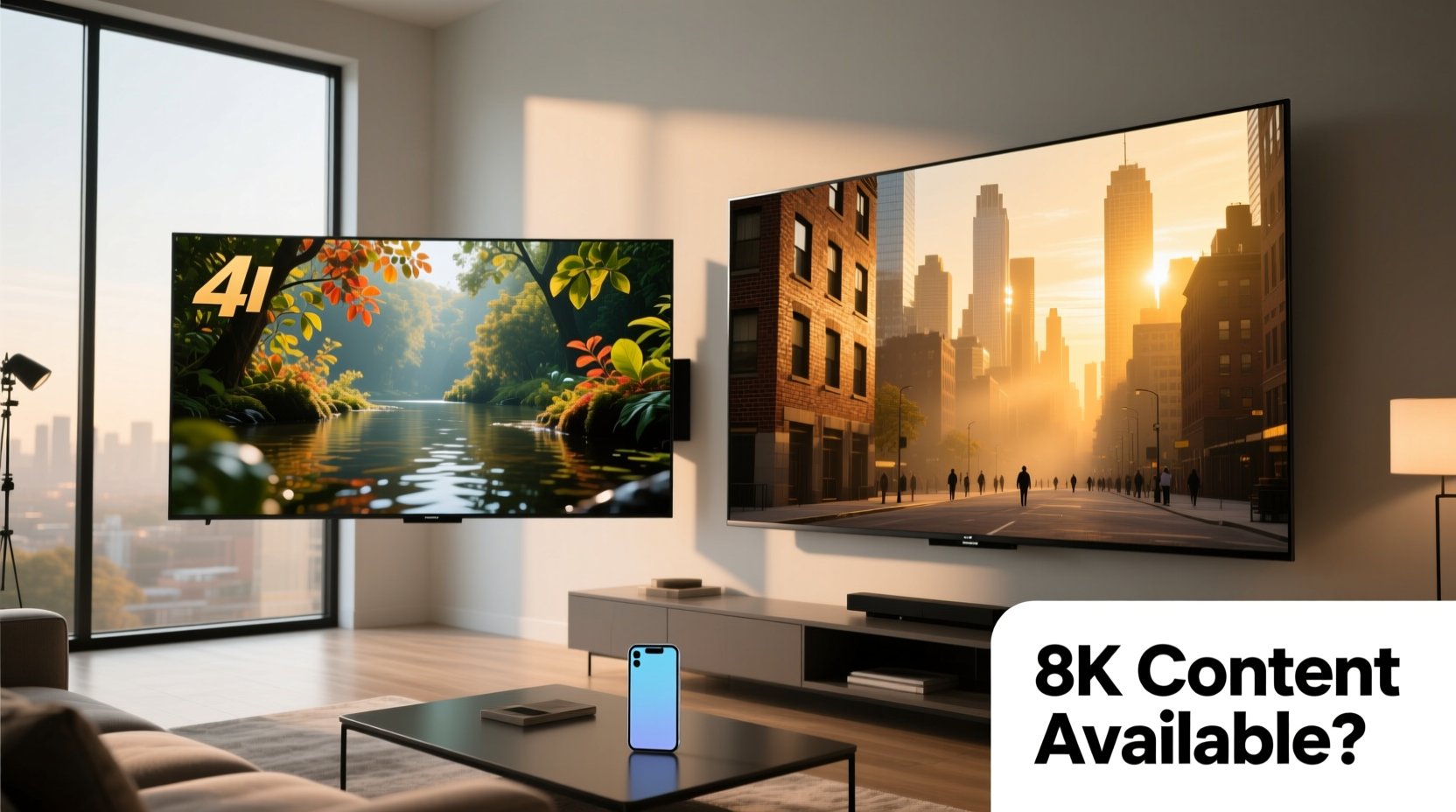
Resolution refers to the number of pixels displayed on a screen. The higher the pixel count, the more detail an image can hold. Here's how the formats stack up:
- Full HD (1080p): 1920 x 1080 pixels
- 4K UHD (Ultra HD): 3840 x 2160 pixels (~8.3 million pixels)
- 8K UHD: 7680 x 4320 pixels (~33.2 million pixels)
An 8K display quadruples the pixel count of 4K, offering significantly finer textures and smoother gradients. In theory, this means crisper landscapes, more lifelike skin tones, and reduced pixelation even on massive screens. However, realizing these benefits depends heavily on screen size, viewing distance, and—most importantly—the source material.
Tip: You need to sit much closer to an 8K TV than a 4K set to perceive the full resolution benefit—typically within 1.5 times the screen height.Current State of 8K Content Availability
Despite aggressive marketing from brands like Samsung, LG, and Sony, native 8K content remains extremely scarce. Most consumers assume that buying an 8K TV grants access to a new tier of visual fidelity, but the reality is that very little programming is produced or distributed in true 8K.
Streaming services, which dominate home entertainment, do not currently offer 8K content. Netflix, Amazon Prime Video, Disney+, and Hulu cap out at 4K HDR. Even YouTube, one of the few platforms hosting user-uploaded 8K videos, sees minimal traffic in that format due to upload complexity and lack of viewer demand.
Broadcast television has made no move toward 8K. ATSC 3.0, the next-generation broadcast standard in the U.S., supports 4K but not 8K. Similarly, satellite and cable providers have no plans to deliver 8K signals due to bandwidth limitations.
The only notable sources of native 8K content are:
- Professional film shoots using 8K-capable cameras (e.g., RED, ARRI)
- Limited demo reels and nature documentaries shown at trade shows
- A handful of experimental short films and art installations
- Some gaming engines capable of rendering at 8K (though few consoles support it)
“While 8K capture is becoming more common in cinema, distribution hasn’t caught up. We’re years away from 8K being a consumer-ready format.” — David Chen, Senior Imaging Engineer at Dolby Laboratories
How 8K TVs Handle the Content Gap
Faced with a near-total absence of native 8K material, manufacturers rely on advanced AI upscaling to enhance lower-resolution content. Modern 8K TVs use machine learning algorithms to analyze 4K, 1080p, or even SD footage and predict what additional detail should be added.
Brands like Samsung (with its Quantum Processor 8K) and Sony (with Cognitive Processor XR) claim their upscalers can produce “near-8K” images. While results vary, many reviewers acknowledge that well-upscaled 4K content on an 8K panel can look slightly smoother and more refined—especially on large screens above 75 inches.
However, upscaling has limits. It cannot create detail that isn’t implied in the original signal. An upscaled 1080p movie will not look like a natively shot 8K production. The enhancement is subtle and often indistinguishable without direct A/B comparisons under controlled conditions.
Upscaling Performance Comparison
| TV Brand | Upscaler Technology | Effective 4K-to-8K Results | Limitations |
|---|---|---|---|
| Samsung | Quantum Processor 8K | Good edge refinement, natural texture | Can oversharpen low-bitrate streams |
| Sony | Cognitive Processor XR | Scene-aware enhancement, balanced output | Limited availability in 8K models |
| LG | α9 Gen 5 AI Processor | Strong noise reduction, smooth motion | Less aggressive detail synthesis |
| TCL / Hisense | Proprietary AI engines | Moderate improvement, cost-effective | Inconsistent across price tiers |
Ultimately, upscaling bridges the gap but doesn’t eliminate it. If your primary goal is watching existing streaming libraries, Blu-rays, or live TV, the difference between a premium 4K OLED and an 8K LCD may be negligible to most viewers.
Where 8K Might Make Sense Today
Despite the lack of content, there are niche scenarios where 8K TVs offer tangible advantages:
Large Screen Viewing (85 Inches and Above)
On screens larger than 85 inches, the increased pixel density helps maintain image sharpness at closer viewing distances. In home theaters or dedicated media rooms where seating is optimized, 8K can reduce the visibility of individual pixels and improve image cohesion.
Future-Proofing for High-End Setups
For tech enthusiasts building long-term home theater systems, purchasing an 8K TV now may seem like a strategic investment. As production tools become cheaper and distribution standards evolve, early adopters hope to avoid obsolescence.
Photography and Digital Art Display
Some professionals use 8K monitors and TVs as digital canvases. Photographers shooting in 8K resolution (from high-megapixel DSLRs or mirrorless cameras) can view full-detail previews without cropping or scaling. Artists and designers also benefit from the expanded workspace and precision.
Gaming (With Caveats)
The PlayStation 5 and Xbox Series X support 4K at up to 120Hz but do not output native 8K. PC gamers with top-tier GPUs (like NVIDIA RTX 4090) can render select games at 8K, but performance is often limited to 20–30 fps even in less demanding titles. True 8K gaming remains impractical for most.
Tip: If you're considering 8K for gaming, ensure your GPU supports HDMI 2.1 and check game compatibility—very few titles offer stable 8K performance.Mini Case Study: John’s Home Theater Upgrade
John, a film enthusiast in Austin, upgraded his 65-inch 4K OLED to a 75-inch 8K QLED in early 2023. He expected a transformative leap in picture quality. After testing Netflix originals, Blu-ray rips, and YouTube 8K demos, he found mixed results.
Native 8K samples—like a BBC Earth documentary filmed with an 8K camera—showed remarkable depth in fur textures and distant mountain ranges. But everyday content, including 4K HDR streams, looked only marginally better. Upscaling helped reduce compression artifacts but didn’t add meaningful detail.
After three months, John concluded that the upgrade was premature. “The screen is beautiful,” he said, “but I’m paying a 60% price premium for features I can’t fully use. I’d have been better off sticking with a newer 4K OLED with better contrast and viewing angles.”
4K vs 8K: Practical Comparison Table
| Feature | 4K TV | 8K TV |
|---|---|---|
| Native Content Availability | Widely available (streaming, UHD Blu-ray, broadcast) | Nearly nonexistent |
| Streaming Support | Netflix, Prime, Disney+, Hulu, YouTube | No major platform offers 8K streaming |
| Blu-ray Discs | Yes (UHD Blu-ray standard) | No 8K disc format exists |
| Recommended Screen Size | 55–85 inches | 75 inches and above |
| Viewing Distance for Full Benefit | 6–10 feet | 4–6 feet |
| Price Range (65–75 inch) | $500–$3,000 | $2,000–$6,000+ |
| Upscaling Importance | Moderate | Critical (due to lack of native content) |
| Future-Proof Potential | High (still evolving with HDR, Dolby Vision) | Speculative (depends on industry adoption) |
FAQ: Common Questions About 8K Readiness
Will 8K eventually replace 4K?
Possibly, but not anytime soon. Industry transitions take time—4K took nearly a decade to become mainstream. Widespread 8K adoption depends on content creation, internet infrastructure, and consumer demand, none of which are aligned yet.
Can I watch 8K content on a 4K TV?
You can play an 8K video file on a 4K TV, but it will be downscaled to fit the screen. You won’t see the full resolution benefit, though some metadata (like dynamic HDR) might still enhance the image.
Do any cameras record in 8K?
Yes. Several professional and prosumer cameras—including models from Canon, Panasonic, Sony, and Blackmagic—can record 8K video. However, files are enormous (often 1+ GB per minute), requiring high-end storage and editing systems.
Checklist: Should You Buy an 8K TV in 2024?
Use this checklist to evaluate whether an 8K TV suits your needs:
- ✅ Do you plan to buy a TV larger than 75 inches?
- ✅ Will you sit within 6 feet of the screen?
- ✅ Are you invested in future-proofing your setup regardless of current content?
- ✅ Do you work with high-resolution photography or video?
- ✅ Are you comfortable with limited native 8K content for the next 3–5 years?
- ✅ Is budget not a primary concern?
If you answered “yes” to most of these, an 8K TV could be a reasonable choice. Otherwise, a high-quality 4K OLED or QLED model delivers excellent performance today with full content support.
Conclusion: Balancing Hype and Reality
8K technology represents the bleeding edge of display engineering. It promises unparalleled clarity and prepares for a future where ultra-high-resolution content becomes standard. But in 2024, that future remains distant. Without native content, robust streaming support, or affordable production pipelines, 8K TVs operate largely on potential rather than practicality.
Meanwhile, 4K continues to evolve—with better HDR, wider color gamuts, improved refresh rates, and smarter processing. For most households, a top-tier 4K TV delivers a superior viewing experience today. The incremental gains of 8K don’t outweigh its steep cost and content limitations.
🚀 Ready to make an informed decision? Share your thoughts on 8K readiness—have you tried it, or are you waiting for real content to catch up? Join the conversation below.








