
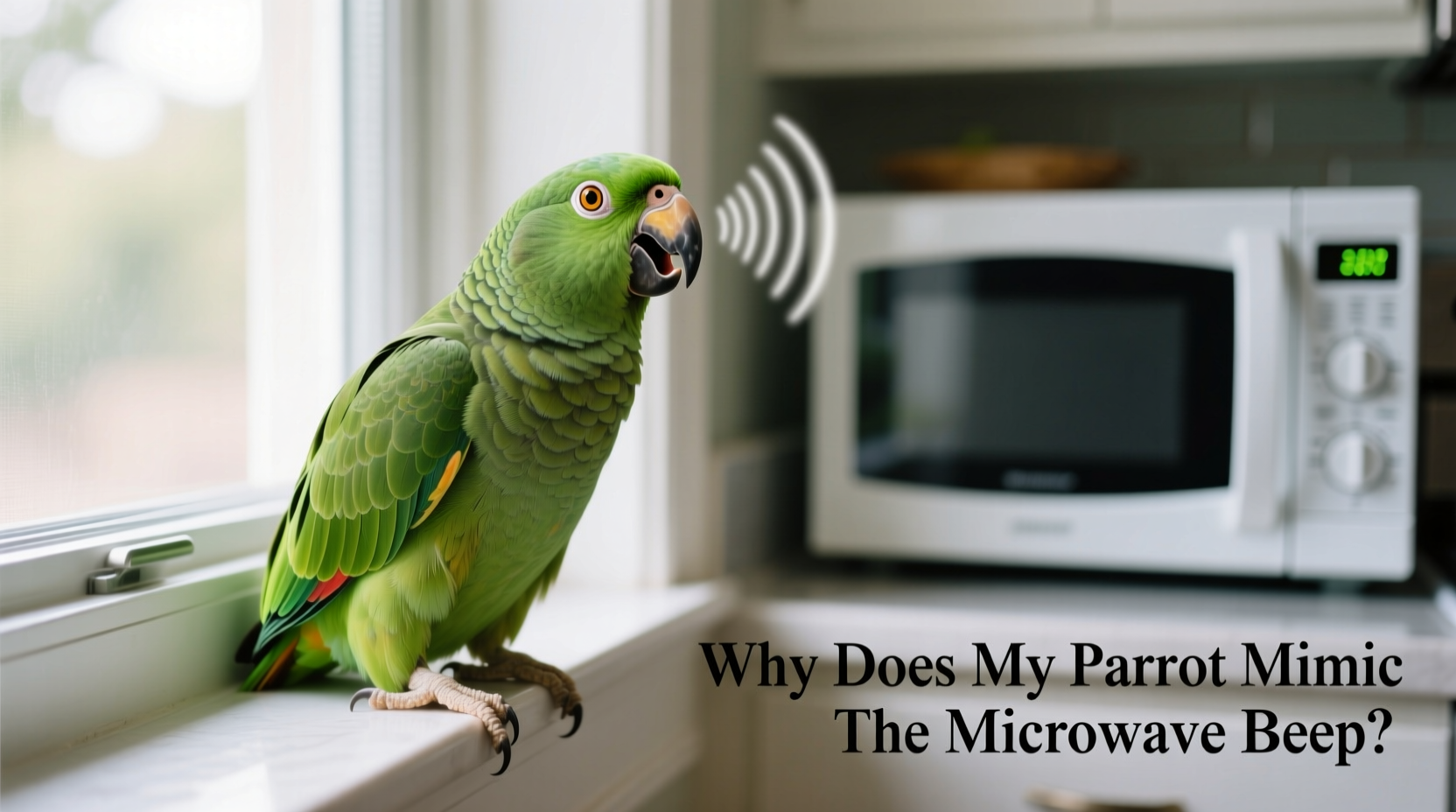
Parrots are among the most intelligent and socially complex birds in the animal kingdom. Their ability to imitate sounds—ranging from human speech to household appliances—is both fascinating and often puzzling to owners. One of the more common yet curious behaviors is a parrot mimicking the microwave beep. While it might seem random or even comical, this behavior is rooted in deep evolutionary instincts, cognitive processing, and social dynamics. Understanding why your parrot repeats that high-pitched \"beep-beep-beep\" can offer valuable insight into its mental state, emotional needs, and relationship with you.
The Science Behind Avian Vocal Mimicry
Unlike humans, who produce sound using vocal cords, parrots generate noise through a specialized organ called the syrinx, located at the base of the trachea. This structure allows them to create an extraordinary range of sounds with remarkable precision. But the physical ability to mimic is only half the story. The real driver lies in their advanced brain structures, particularly the song nuclei—clusters of neurons involved in vocal learning and auditory memory.
Research shows that parrots, especially species like African Greys, Amazons, and Cockatoos, possess neural pathways similar to those found in humans and songbirds that learn vocalizations. These pathways enable not just repetition, but contextual understanding. A 2016 study published in PLOS ONE demonstrated that parrots can associate specific sounds with events—like the microwave beep signaling food preparation—and reproduce them at relevant moments.
“Parrots don’t mimic randomly. They select sounds that carry social significance or predict important outcomes.” — Dr. Irene Pepperberg, Comparative Psychologist and Author of *The Alex Studies*
This means when your parrot repeats the microwave beep, it’s not merely copying noise—it may be attempting to participate in a routine, express anticipation, or gain attention.
Social Bonding and Environmental Integration
In the wild, parrots live in tight-knit flocks where vocal communication strengthens social bonds. Calls are used to maintain contact, signal danger, and coordinate group movement. Captive parrots transfer this instinct to their human families, viewing them as their flock. Mimicking household sounds becomes a way to “talk” with the group and assert belonging.
The microwave beep, though artificial, is often tied to predictable and positive events—mealtime. To a parrot, this sound may represent not just food, but interaction, activity, and attention from caregivers. By reproducing it, the bird may be trying to initiate the same sequence: beep → human action → food → social engagement.
Tip: Observe when your parrot mimics the beep. If it happens before meals or when you enter the kitchen, it’s likely linked to anticipation and learned association.Additionally, parrots thrive on routine. Repetitive sounds that occur at consistent times become part of their environmental map. The microwave beep is often short, sharp, and repeated—qualities that make it highly memorable and easy to replicate. It stands out from background noise, making it a prime candidate for mimicry.
Cognitive Engagement and Mental Stimulation
A parrot’s brain demands constant stimulation. In captivity, without the challenges of foraging, navigating terrain, or evading predators, they turn to alternative forms of mental exercise. Sound imitation is one such outlet. Learning and reproducing new noises activates problem-solving centers in the brain, offering a sense of accomplishment.
The microwave beep, being a clear, digital tone, is acoustically simple compared to human speech. For a young or inexperienced mimic, it serves as a “gateway sound”—easy to master and rewarding to perform. Once mastered, the bird may repeat it frequently to reinforce the skill or elicit a response from humans.
Moreover, parrots are inherently playful. Some individuals mimic sounds purely for fun, especially if they’ve received laughter, applause, or surprise reactions in the past. Positive reinforcement—even unintentional—can turn a one-time imitation into a habitual performance.
Case Study: Milo the Blue-Fronted Amazon
Milo, a 7-year-old Blue-Fronted Amazon, began mimicking his owner’s microwave beep after observing kitchen routines for several months. Initially, the behavior occurred sporadically. However, after the owner laughed and said, “Did you hear that? He sounds just like the microwave!” during one instance, Milo began reproducing the sound multiple times daily—especially when alone.
A behavioral assessment revealed that Milo’s mimicry spiked during periods of isolation. The beep had become a tool for engagement. When family members responded, even negatively, Milo perceived it as interaction. After implementing scheduled play sessions and introducing puzzle toys, the frequency of the beep mimicry decreased by 70% over six weeks, while overall vocal variety increased.
This case illustrates how mimicry can serve as a coping mechanism for boredom or loneliness—and how environmental enrichment can redirect the behavior positively.
When Mimicry Signals Stress or Overstimulation
While most mimicry is harmless or even beneficial, it can sometimes reflect underlying stress. Parrots exposed to excessive noise, irregular schedules, or social neglect may develop repetitive behaviors, including sound looping. If your parrot mimics the microwave beep incessantly—especially outside meal contexts—or appears agitated while doing so, it may be a sign of anxiety.
Other red flags include:
- Repeating the sound for extended periods (e.g., 10+ minutes nonstop)
- Feather plucking or self-harm during mimicry
- Aggression or withdrawal after performing the sound
- Loss of appetite or disrupted sleep patterns
In such cases, the beep may have become a displacement behavior—a way to cope with unmet needs. Just as humans might tap their fingers or hum when nervous, parrots use familiar sounds to self-soothe.
Checklist: Assessing Your Parrot’s Mimicry Behavior
- ✅ Note the time of day and context when the mimicry occurs.
- ✅ Record whether it’s followed by attention, food, or no response.
- ✅ Check for signs of distress (panting, fluffed feathers, aggression).
- ✅ Evaluate daily enrichment: foraging, toys, social time.
- ✅ Determine if the behavior increases during loneliness or loud environments.
- ✅ Consult an avian behaviorist if the mimicry becomes obsessive.
Encouraging Healthy Vocalization Habits
Instead of discouraging mimicry outright, guide it toward positive expression. Parrots should feel safe to communicate, but their environment must support balanced development. Here’s how to foster healthy vocal behavior:
1. Provide Structured Training Sessions
Dedicate 10–15 minutes daily to teach desirable sounds or words. Use treats and praise to reinforce attempts. This gives your parrot a constructive outlet for vocal learning.
2. Introduce Sound Variety
Play recordings of nature sounds, soft music, or spoken phrases. Rotate auditory stimuli weekly to prevent fixation on a single noise like the microwave beep.
3. Use Environmental Cues Mindfully
If possible, minimize exposure to repetitive electronic sounds. For example, disable chimes on appliances or use silent modes when the bird is nearby. Alternatively, pair the beep with a verbal cue (“Dinner’s ready!”) so the parrot learns a more meaningful association.
4. Avoid Reinforcing Undesirable Repetition
If your parrot beeps nonstop, do not respond with attention—even scolding counts as interaction. Instead, wait for a pause, then reward quiet behavior with a treat or affection.
| Behavior | Likely Cause | Recommended Response |
|---|---|---|
| Mimics beep before meals | Anticipation & learned association | Acknowledge positively; reinforce with food + gentle praise |
| Beeps repeatedly when alone | Boredom or loneliness | Increase enrichment; schedule regular interaction |
| Obsessively repeats beep for hours | Stress or sensory overload | Consult avian vet or behaviorist; assess environment |
| Uses beep to get attention | Learned operant behavior | Ignore the sound; reward silence or alternate vocalizations |
Frequently Asked Questions
Is it normal for my parrot to mimic appliance sounds?
Yes. Parrots naturally imitate prominent, recurring sounds in their environment. Appliance beeps, doorbells, phones, and alarms are common due to their clarity and predictability. As long as the behavior isn’t obsessive or stressful, it’s a sign of a mentally active bird.
Can mimicry indicate intelligence?
Absolutely. The ability to memorize, reproduce, and contextually apply sounds reflects advanced cognitive function. Parrots that mimic a wide range of noises often demonstrate better problem-solving skills and social awareness than those with limited vocal repertoires.
Should I stop my parrot from mimicking the microwave?
Not unless it’s causing distress or disrupting household peace. Instead of suppression, redirect the behavior. Teach alternative sounds, increase mental stimulation, and ensure your parrot feels socially fulfilled. Punishment can damage trust and lead to anxiety.
Conclusion: Listening Beyond the Beep
The next time your parrot emits a perfect replica of the microwave beep, take a moment to listen—not just to the sound, but to what it represents. That tiny electronic chirp has been absorbed, processed, and re-expressed by a creature with sophisticated social instincts and a craving for connection. It’s a testament to your parrot’s intelligence, adaptability, and desire to be part of your world.
By understanding the behavioral roots of mimicry, you can transform seemingly odd habits into opportunities for deeper bonding. Respond with curiosity, not frustration. Encourage variety, provide enrichment, and celebrate your bird’s unique voice—whether it speaks in words, whistles, or beeps.
💬 Have a story about your parrot’s surprising mimicry? Share your experience in the comments and help fellow bird owners appreciate the complexity behind every copied sound.








