
It’s a common scene in households with pet hamsters: the quiet of the night broken only by the rhythmic spinning of a wheel, hour after hour. You peek into the cage and see your tiny companion running with relentless energy, seemingly without pause. While this behavior might seem excessive or even concerning, it’s actually a natural expression of your hamster’s instincts, biology, and environment. Understanding why your hamster runs so much at night is key to ensuring its well-being and distinguishing between healthy activity and potential stress.
Hamsters are crepuscular and nocturnal animals—meaning they're most active during twilight hours and throughout the night. In the wild, this activity pattern helps them avoid predators while maximizing foraging time under low-light conditions. When kept as pets, these ingrained behaviors don’t disappear. The wheel becomes a substitute for long-distance travel, offering both physical exercise and mental stimulation. But when the running appears obsessive or continues for abnormally long stretches, it may signal underlying issues that deserve attention.
The Biological Drive Behind Nighttime Activity
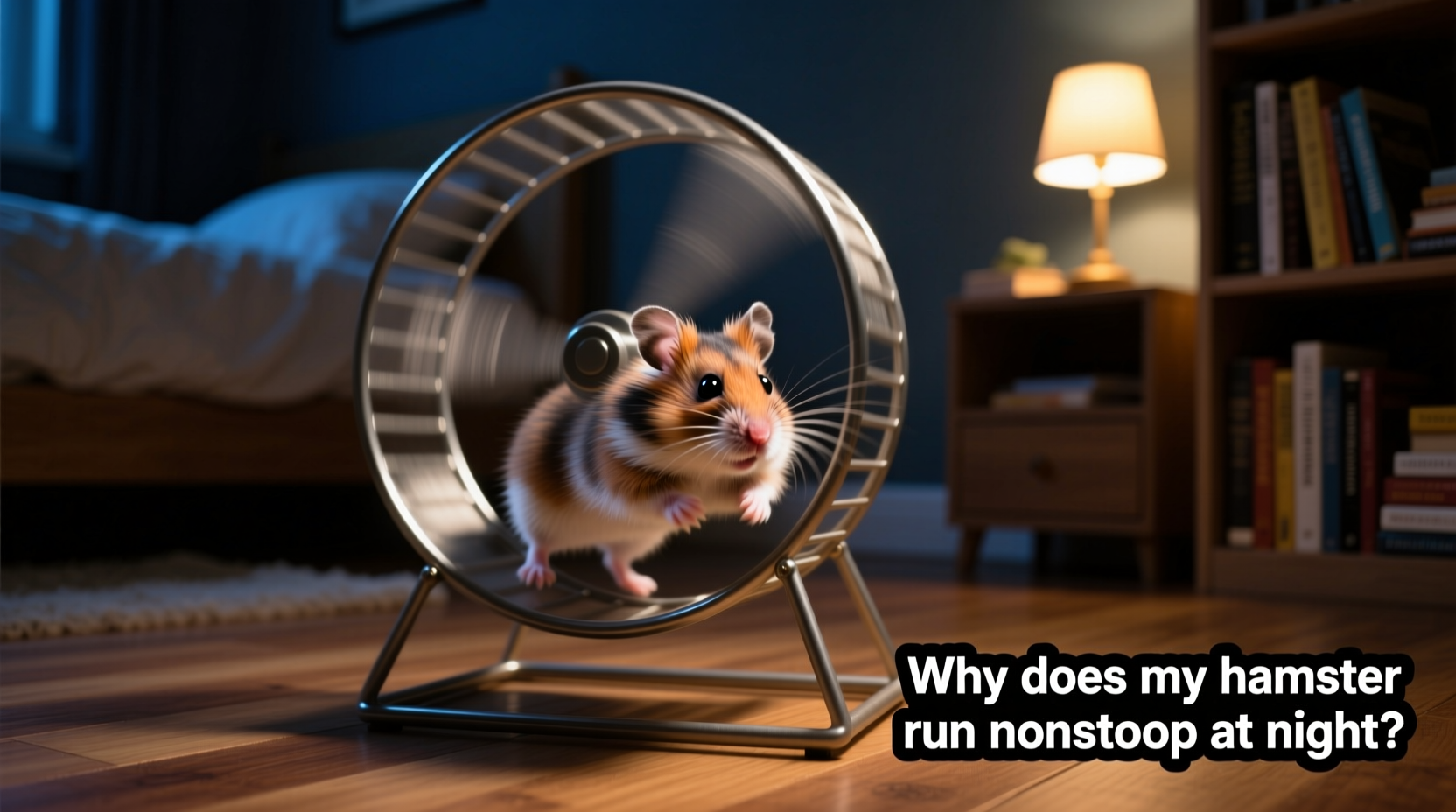
Hamsters evolved in arid regions such as Syria (in the case of the Syrian hamster) and northern China (for dwarf species), where survival depended on covering large distances each night in search of food and shelter. Wild hamsters can travel up to 5–6 miles per night. This deep-rooted instinct remains strong in domesticated hamsters, even though their needs are met within the confines of a cage.
At night, your hamster’s internal clock—its circadian rhythm—triggers heightened alertness and energy. Hormonal changes, particularly in melatonin and cortisol levels, promote wakefulness during dark hours. Combined with natural curiosity and high metabolism, this leads to bursts of activity soon after dusk and often lasting until dawn.
The wheel satisfies multiple biological needs:
- Exercise requirement: Small bodies with fast metabolisms need regular movement to maintain cardiovascular health and prevent obesity.
- Mental engagement: Running provides sensory feedback and goal-oriented behavior, reducing boredom.
- Instinctual fulfillment: Even if not truly “going” anywhere, the motion mimics migration and exploration patterns essential to their survival in nature.
Is Nonstop Wheel Running Normal or a Sign of Stress?
Occasional marathon sessions on the wheel—especially early in the night—are perfectly normal. However, persistent, uninterrupted running that spans several hours with little rest may indicate psychological distress. Known as \"barbering\" or \"stereotypic behavior,\" excessive wheel use can develop when a hamster lacks sufficient mental stimulation, space, or environmental variety.
Stereotypies are repetitive, functionless behaviors caused by frustration, boredom, or inability to perform natural actions. In laboratory and captive settings, animals deprived of complex environments often display such behaviors—like pacing, over-grooming, or compulsive wheel running.
“While wheel running is natural, when it becomes compulsive, it reflects an unmet need. Enrichment is not optional—it’s critical for rodent welfare.” — Dr. Lena Torres, Veterinary Ethologist, University of Edinburgh
Signs that your hamster’s wheel use may be problematic include:
- Running for more than 6 consecutive hours nightly
- Limited interaction with other parts of the cage (tunnels, nesting areas, food)
- Visible signs of fatigue, such as labored breathing or trembling
- Neglecting eating, drinking, or grooming during active periods
- Foot injuries or raw patches from prolonged contact with the wheel surface
Environmental Factors That Influence Wheel Behavior
Your hamster’s surroundings play a major role in shaping its activity levels. A poorly designed habitat can amplify stress-related behaviors, while a thoughtfully enriched one encourages balanced activity.
Common environmental contributors to excessive wheel use include:
| Factor | Potential Issue | Solution |
|---|---|---|
| Cage Size | Too small (e.g., under 450 sq. inches floor space) | Upgrade to a larger enclosure or connect multiple bins |
| Enrichment Level | Lack of tunnels, chew toys, hiding spots | Add cardboard tubes, wooden hides, and foraging puzzles |
| Wheel Type | Wire mesh or too-small diameter causing discomfort | Switch to solid-surface, appropriately sized wheel (8–12 inches) |
| Noise & Light | Exposure to bright lights or loud sounds at night | Place cage in quiet, dimly lit room during sleep hours |
| Routine Disruptions | Frequent handling or cleaning during rest times | Minimize disturbances between 7 PM – 9 AM |
A well-designed setup redirects some of the hamster’s energy toward diverse activities. For example, scattering food across the cage instead of placing it in a bowl encourages natural foraging, which can reduce dependency on the wheel for stimulation.
Mini Case Study: Reducing Compulsive Running in a Captive Dwarf Hamster
Sophie, a pet owner in Manchester, noticed her Campbell’s dwarf hamster, Pip, was running continuously from 8 PM to 3 AM every night. Despite appearing healthy, Pip rarely left the wheel except to drink briefly. Concerned, Sophie consulted a small-animal vet who suggested evaluating environmental enrichment.
She upgraded Pip’s 200 sq. inch cage to a 600 sq. inch bin setup with layered bedding, multiple hideouts, paper towel rolls, and a ceramic digging dish. She also introduced daily scatter feeding and replaced the old wire wheel with a silent, 9-inch plastic wheel. Within two weeks, Pip’s wheel usage decreased to about 2–3 hours per night, interspersed with tunnel exploration and nest-building. The change highlighted how simple modifications could restore behavioral balance.
How to Promote Healthy Exercise Habits
Preventing unhealthy fixation on the wheel involves proactive management of your hamster’s physical and psychological environment. The goal isn’t to stop wheel use—but to encourage varied, naturalistic behaviors.
Step-by-Step Guide to a Balanced Hamster Routine
- Assess current housing: Measure floor space. Aim for minimum 450 sq. inches for dwarfs, 600+ for Syrians.
- Choose the right wheel: Solid surface, no gaps, correct size (8\" for dwarfs, 12\" for Syrians). Test for wobble and noise.
- Add complexity: Include vertical levels, tunnels, climbing elements, and rotating toys.
- Introduce foraging: Hide kibble in shredded paper or puzzle feeders to stimulate hunting behavior.
- Rotate enrichment weekly: Swap toys, rearrange cage layout, add safe chewables like willow sticks.
- Monitor behavior: Keep a log of wheel use duration and note any changes in appetite or posture.
- Provide downtime: Avoid loud noises, flashing lights, or handling during core rest periods (daytime).
Frequently Asked Questions
Can hamsters run themselves to death on a wheel?
While rare, extreme exhaustion can occur in cases of severe stress or inadequate care. More commonly, hamsters self-regulate and stop when tired. However, continuous access to a poorly designed wheel increases injury risk. Always provide a safe, appropriately sized wheel and monitor for signs of overuse.
Should I cover my hamster’s cage at night?
Covering the entire cage isn’t recommended—it can restrict airflow and trap moisture. Instead, ensure the room is quiet and dimly lit. If ambient light disrupts their cycle, use a breathable fabric draped partially over one side to create a darker zone without compromising ventilation.
Do all hamsters need a wheel?
Yes. Wheels are considered essential equipment for all pet hamsters. Without them, they’re at higher risk of obesity, muscle atrophy, and behavioral issues. Even in large enclosures with ample space to roam, a wheel fulfills specific locomotive needs that free movement alone cannot replicate.
Checklist: Is Your Hamster’s Wheel Use Healthy?
- ✅ Wheel is solid-surfaced and appropriately sized
- ✅ Cage offers at least 450 sq. inches of floor space
- ✅ Multiple enrichment items beyond the wheel (tunnels, hides, chew toys)
- ✅ Food is occasionally scattered to encourage foraging
- ✅ No signs of foot injuries or limping
- ✅ Hamster eats, drinks, and grooms regularly
- ✅ Runs in intervals, not nonstop for 6+ hours
- ✅ Environment is quiet and undisturbed during nighttime hours
Conclusion: Balance Is Key to a Happy Hamster
Your hamster’s nighttime wheel running is rooted in millions of years of evolutionary adaptation. It’s not inherently harmful—in fact, it’s often a sign of vitality and good health. But when that natural behavior crosses into compulsion, it’s time to reevaluate the bigger picture. A hamster that runs nonstop may be trying to tell you something: it needs more space, better stimulation, or a quieter world.
By combining proper housing, thoughtful enrichment, and attentive observation, you can support a lifestyle that honors your hamster’s instincts while safeguarding its well-being. The goal isn’t to eliminate wheel use, but to ensure it’s part of a rich, varied behavioral repertoire—not the only option available.
💬 Have you noticed changes in your hamster’s wheel habits after adjusting their environment? Share your experience in the comments—your insight could help another pet owner create a healthier home for their tiny runner.








