
Dogs are social creatures whose behaviors often reflect deep emotional connections with their human companions. One of the most common yet puzzling behaviors many dog owners experience is their pet’s tendency to lie directly on them—on their lap, chest, or even feet. While it may seem inconvenient at times, this act is rarely random. It stems from a combination of instinct, emotional need, and learned behavior. Understanding why your dog chooses to lie on you can deepen your bond and improve your ability to meet their psychological and physical needs.
The Bonding Instinct: A Pack Animal’s Nature
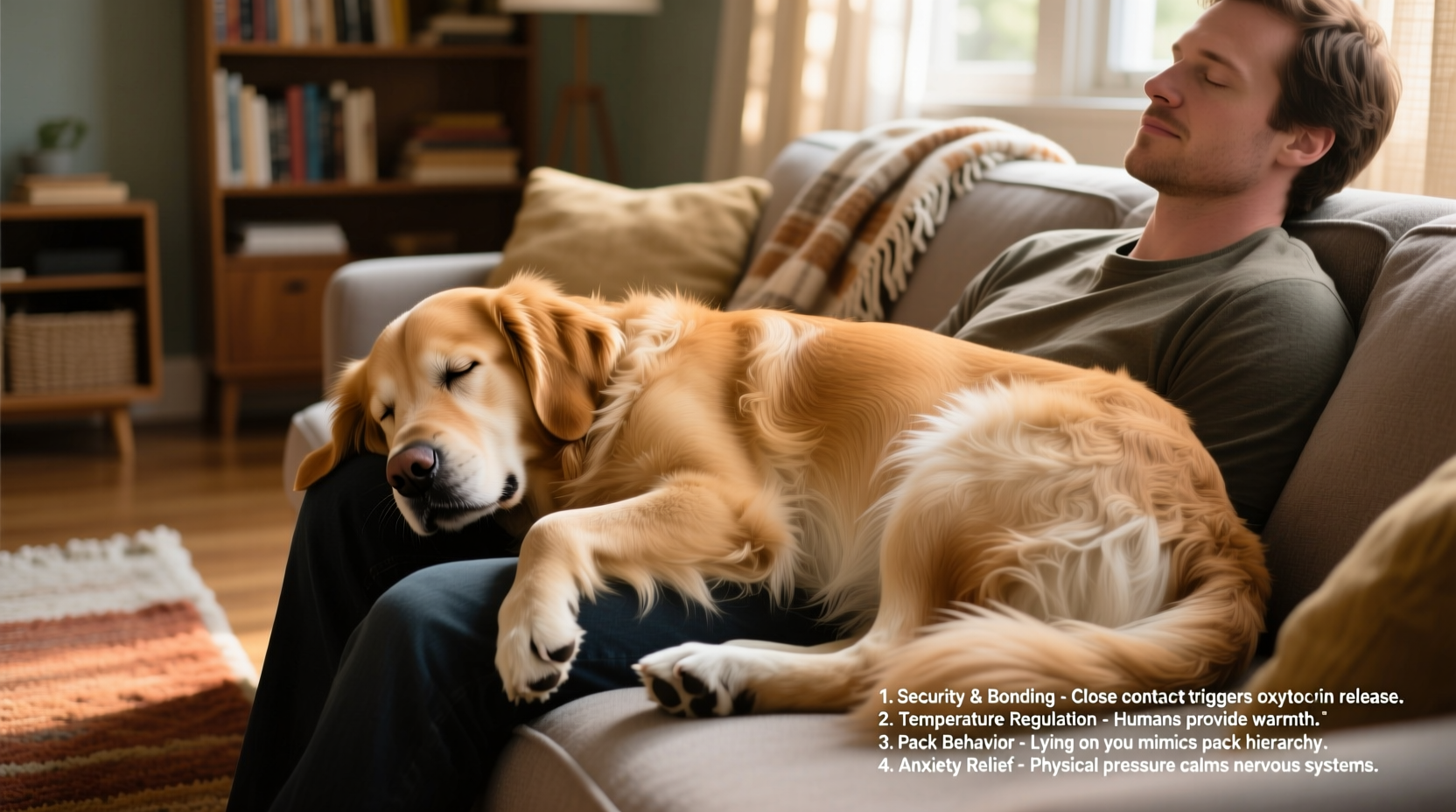
Dogs evolved from wolves, animals that live in tightly knit social groups. In the wild, pack members huddle together for warmth, protection, and reassurance. This instinct hasn’t disappeared—it has simply adapted to domestic life. When your dog lies on you, they’re not just seeking comfort; they’re reinforcing their place within what they perceive as their pack: your family.
Physical contact releases oxytocin, often referred to as the \"love hormone,\" in both humans and dogs. A 2015 study published in *Science* found that mutual gaze and touch between dogs and their owners significantly increased oxytocin levels, mirroring the biological bonding seen between parents and infants. Lying on you amplifies this connection, serving as a nonverbal affirmation of trust and attachment.
“Dogs don’t distinguish between emotional and physical closeness. For them, being physically on top of or next to you is a direct expression of belonging.” — Dr. Patricia McConnell, Certified Applied Animal Behaviorist
Warmth and Comfort: The Practical Side
Beyond emotional reasons, there’s a simple physiological explanation: body heat. Dogs, especially smaller breeds or those with short coats, lose heat quickly. Human bodies radiate consistent warmth, making us ideal living heaters. If your dog seeks out your lap during colder months—or curls up on your chest under a blanket—they’re likely drawn by thermal comfort.
This behavior is particularly common in puppies and older dogs. Puppies are still developing temperature regulation, while senior dogs may suffer from arthritis or reduced circulation, making warmth essential. By lying on you, they efficiently maintain their body temperature without expending extra energy.
Tip: If your dog frequently lies on you for warmth, consider providing a heated orthopedic bed, especially in winter or for aging pets.Security and Anxiety Reduction
For some dogs, lying on their owner is a coping mechanism for anxiety. Dogs with separation anxiety, noise phobias (like fear of thunderstorms or fireworks), or general nervousness often seek physical proximity to feel safe. Your presence acts as a grounding force, and direct contact enhances that sense of security.
This is especially noticeable during stressful events. A dog might jump onto your lap during a storm, press against your side during a crowded party, or lie on your chest when strangers visit. In these moments, your body becomes a shield—a familiar anchor in an overwhelming environment.
It’s important not to discourage this behavior abruptly if it’s anxiety-driven. Doing so could increase stress. Instead, gradually build confidence through positive reinforcement training and, if needed, consult a veterinary behaviorist.
Attention-Seeking and Learned Behavior
Sometimes, dogs lie on their owners because they’ve learned it works. If every time your dog climbs onto your lap you pet them, talk to them, or give them treats, they associate the action with reward. Over time, this becomes a reinforced habit.
This doesn’t mean the behavior lacks emotional significance—it often begins authentically—but it can become exaggerated due to conditioning. Owners who enjoy the closeness inadvertently encourage frequent or persistent mounting.
| Behavior Trigger | Likely Motivation | Appropriate Response |
|---|---|---|
| Dog lies on you after returning home | Bonding, excitement | Allow brief contact, then redirect to bed |
| Dog climbs on you during storms | Anxiety, fear | Provide comfort, consider calming aids |
| Dog lies on you whenever you sit down | Attention-seeking | Reinforce alternative behaviors (e.g., “go to mat”) |
| Puppy sleeps on your chest nightly | Warmth, security | Ensure safe sleeping space nearby |
Establishing Boundaries Without Damaging Trust
While it’s natural to feel flattered by your dog’s affection, constant physical contact isn’t always practical or healthy—for either of you. Over-reliance on physical closeness can lead to separation distress or dominance-related issues if not managed properly.
The key is teaching your dog that love and safety aren’t conditional on physical position. You can do this by creating appealing alternatives and reinforcing independence.
Step-by-Step Guide: Teaching Your Dog to Respect Personal Space
- Designate a cozy personal space – Choose a soft bed or mat near your usual seating area. Make it inviting with toys and treats.
- Use positive reinforcement – Reward your dog generously when they choose their bed over your lap.
- Practice “place” command – Train your dog to go to their mat on cue using verbal prompts and treats.
- Gradually phase out access – Gently redirect your dog when they attempt to lie on you, guiding them to their spot.
- Maintain connection – Continue petting and talking to them while they’re on their bed so they don’t feel rejected.
Mini Case Study: Max, the Rescue Terrier
Max, a three-year-old Jack Russell Terrier mix, was adopted after spending nine months in a shelter. His new owner, Sarah, noticed he would immediately climb onto her lap every time she sat down—even interrupting phone calls or meals. Initially endearing, the behavior became disruptive.
After consulting a trainer, Sarah learned that Max’s clinginess stemmed from past instability. He had no consistent routine in the shelter and associated human contact with safety. The trainer recommended setting up a plush bed beside the couch and rewarding Max each time he chose it. Within three weeks, Max began opting for his bed more often, especially when Sarah used the “go to your spot” cue. He still occasionally joins her, but now it’s a choice—not a compulsion.
Frequently Asked Questions
Is it bad if my dog lies on me all the time?
Not inherently, but if it interferes with daily activities or seems compulsive, it may indicate over-dependence. Balance affection with independent play and rest spaces to promote emotional resilience.
Why does my dog lie on my chest or face?
This behavior often reflects intense bonding or a desire for close sensory contact (smell, heartbeat). However, if it feels intrusive, gently roll to the side and guide them down while offering praise when they comply.
Can this behavior be a sign of dominance?
Rarely. Most experts agree that dogs lying on people are seeking comfort, not asserting control. True dominance displays involve stiff posture, guarding, or resource protection—not cuddling.
Checklist: Is Your Dog’s Behavior Healthy?
- ✅ They have a comfortable, designated sleeping area
- ✅ They can relax independently for short periods
- ✅ Their affection doesn’t come with signs of anxiety (panting, pacing, whining)
- ✅ You can set boundaries without triggering distress
- ✅ They respond positively to redirection
Conclusion: Embrace the Closeness—Mindfully
Your dog lying on you is a powerful testament to the bond you’ve built. It’s rooted in biology, emotion, and trust—a silent declaration that you are their safe place. Rather than viewing it as an inconvenience, recognize it as one of the purest forms of canine affection.
At the same time, fostering healthy boundaries ensures your dog remains confident and well-adjusted. With patience and consistency, you can enjoy the warmth of their presence—whether they’re curled on your lap or peacefully resting on their own bed nearby.
💬 Does your dog have a favorite spot on you? Share your story or questions in the comments—let’s learn from each other’s experiences!








