
Dog owners often witness a curious post-poop ritual: their pet squats, finishes, then suddenly kicks backward with rapid, almost frantic motions—scattering dirt, grass, or mulch behind them. This behavior, while common, raises questions. Is your dog trying to cover their waste like a cat? Are they marking territory? Or is this simply an inherited instinct with no real purpose today?
The truth lies in a mix of biology, evolution, and canine communication. Understanding why dogs kick after defecating offers insight into their natural instincts and social behaviors. It’s not just a quirky habit—it’s a form of nonverbal messaging embedded deep in their DNA.
The Science Behind the Scratch: What Triggers This Behavior?
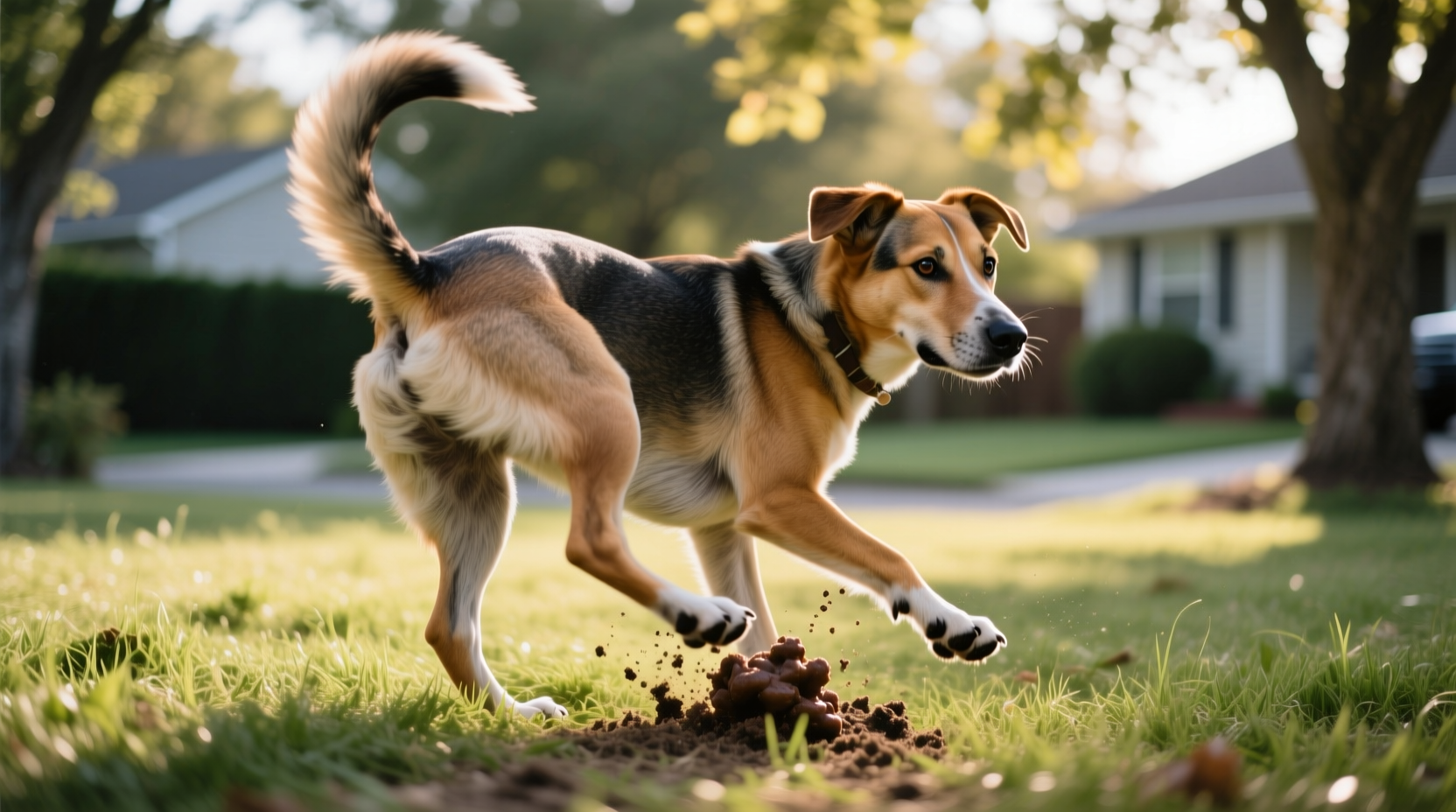
When a dog kicks after pooping, they’re engaging in a behavior known as “ground scratching.” This isn’t random; it’s a deliberate action rooted in scent communication. Dogs possess scent glands in their paws—specifically between the pads—that release pheromones when pressure is applied. As they scrape the ground, they deposit these chemical signals alongside the visual disturbance of disturbed soil.
This dual-layered message—olfactory (scent) and visual—functions as a territorial announcement. The feces themselves already carry information about the dog’s identity, diet, and health. By kicking, the dog amplifies that signal, spreading both scents and creating a visible signpost other dogs can detect long after the original droppings are gone.
“Ground scratching is a multimodal signal. It’s not just about smell—it’s also about leaving a physical mark that says, ‘I was here.’” — Dr. Sarah Carter, Canine Ethologist, University of Bristol
In wild canids like wolves and coyotes, such behaviors help establish boundaries and reduce direct confrontations. A wolf may avoid another’s marked area altogether, preventing conflict. Domestic dogs retain this instinct even if they live in apartments and never meet other dogs off-leash.
Marking vs. Instinct: What’s Really Going On?
It’s tempting to categorize this behavior strictly as “marking,” but that oversimplifies it. While scent marking is involved, the act of kicking is more accurately described as **instinct-driven communication** rather than active territorial defense in most household settings.
True territorial marking typically involves urination—especially in males who lift their leg to spray vertical surfaces. Fecal marking occurs too, but the kicking afterward enhances the message rather than creates it. Think of it as adding emphasis to a sentence already written.
So, is your dog marking? In a broad sense, yes—but not in the way humans might assume. They’re not claiming ownership like posting a flag. Instead, they’re participating in a species-wide tradition of passive communication, using every available tool—including paw glands and visual cues—to say, “A dog passed through here.”
Tip: If your dog kicks aggressively after eliminating, consider softening the surface in their preferred spot (e.g., use sand or mulch) to prevent paw injuries or lawn damage.Evolutionary Roots: Why Did This Behavior Develop?
To understand why dogs kick after pooping, we must look back to their ancestors. Wild canids lived in complex social hierarchies where minimizing physical conflict was essential for survival. Direct fights over resources could lead to injury or death, so indirect methods of communication evolved.
Ground scratching served multiple purposes:
- Scent Amplification: Paw gland secretions mixed with fecal odor created a stronger, longer-lasting signal.
- Visual Signaling: Disturbed earth is noticeable to other animals, especially in open terrain.
- Temporal Information: Freshly kicked soil indicates recent activity, helping other animals assess immediacy of presence.
These signals helped regulate movement patterns within packs and across territories. For example, a subordinate wolf might leave a scratched site near a trail to signal deference without confrontation. Similarly, a dominant animal might reinforce boundaries subtly.
Domestication hasn’t erased these behaviors. Even well-socialized pets perform them instinctively, regardless of whether other dogs will ever encounter the site. It’s a self-reinforcing routine—like spinning before lying down or barking at squirrels—rooted in ancient survival strategies.
Behavioral Variations: Not All Dogs Kick the Same Way
While many dogs exhibit post-defecation kicking, the frequency and intensity vary widely based on breed, personality, environment, and social exposure.
| Dog Type | Kicking Frequency | Potential Influences |
|---|---|---|
| Terriers & Scent Hounds | High | Bred for tracking; heightened scent awareness |
| Herding Breeds (e.g., Border Collie) | Moderate | Focused on tasks; less emphasis on marking |
| Northern Breeds (e.g., Husky, Malamute) | Very High | Close genetic ties to wolves; strong instinctual drives |
| Toy Breeds (e.g., Chihuahua, Pomeranian) | Low to Moderate | Smaller size; less need to assert presence |
| Socialized Urban Dogs | Variable | Less opportunity; may suppress behavior due to leash routines |
Interestingly, some dogs only kick when off-leash or in familiar areas. Others do it consistently, even indoors on carpet—a clear sign the behavior is hardwired rather than situational.
Mini Case Study: Max the Siberian Husky
Max, a three-year-old Siberian Husky living in suburban Colorado, routinely digs and kicks after every outdoor elimination. His owner, Lisa, initially thought he was trying to bury his waste. She even tried training him to stop, using redirection techniques. But Max persisted.
After consulting a canine behaviorist, Lisa learned that Max wasn’t attempting concealment—he was communicating. Living near trails frequented by other dogs, Max’s kicks left scent markers that likely reduced anxiety during future walks. Once she reframed the behavior as natural rather than problematic, she adjusted her expectations. She now allows him time to complete his ritual, recognizing it as part of his emotional regulation and environmental engagement.
“Understanding that this isn’t defiance—it’s instinct—changed how I see Max’s walks,” Lisa said. “He’s not misbehaving. He’s being a dog.”
Should You Allow or Discourage This Behavior?
For most owners, allowing the kicking behavior poses no harm. However, there are scenarios where management may be necessary:
- Lawn Damage: Repeated kicking in the same spot can kill grass and create bare patches.
- Paw Health: Rough surfaces like gravel or concrete can cause pad abrasions.
- Public Spaces: In shared parks, excessive digging may be discouraged by local rules.
Rather than suppressing the behavior entirely, consider redirecting it:
- Designate a Marking Zone: Create a specific area (e.g., a sandbox or mulched bed) where kicking is encouraged.
- Use Soft Substrates: Fill elimination zones with loose, forgiving materials that allow scratching without injury.
- Provide Time: Give your dog a moment after going to follow through naturally—don’t rush them back inside immediately.
- Avoid Punishment: Never scold your dog for kicking; it’s instinctive and not under conscious control.
Checklist: Managing Post-Poop Kicking Responsibly
- ✅ Observe your dog’s pattern—do they kick every time or only in certain locations?
- ✅ Assess the surface—ensure it won’t injure their paws.
- ✅ Provide a designated scratching zone if lawn damage is a concern.
- ✅ Avoid interrupting the behavior unless safety or hygiene is compromised.
- ✅ Consult a behaviorist if the behavior seems obsessive or paired with signs of stress.
FAQ: Common Questions About Dog Kicking After Pooping
Is my dog trying to bury their poop?
No—not in the way cats do. Cats bury waste to hide their presence from predators. Dogs, however, want their scent noticed. The kicking spreads scent rather than conceals it. Any soil displacement is incidental to communication, not camouflage.
Do female dogs kick after pooping too?
Yes. While male dogs are often more overt in territorial behaviors, females also engage in ground scratching. Hormonal cycles, confidence levels, and breed tendencies influence frequency more than gender alone.
Could excessive kicking indicate a medical issue?
Rarely. The behavior itself is normal. However, if your dog shows signs of discomfort while squatting, licks their rear excessively, or suddenly changes elimination habits, consult a veterinarian. These could signal anal gland issues, infections, or gastrointestinal problems—but the kicking is likely coincidental.
Conclusion: Embracing Natural Canine Communication
The next time your dog kicks up dirt after relieving themselves, resist the urge to interpret it as mischief or confusion. Instead, recognize it for what it is: a deeply ingrained, biologically meaningful act of communication. Your dog isn’t breaking rules—they’re speaking a language older than domestication.
By understanding the instinct behind the scratch, you foster empathy and patience. You begin to see your pet not just as a companion, but as a creature shaped by thousands of years of evolution. Their actions aren’t random; they’re rich with meaning, even when silent.
Instead of correcting nature, support it wisely. Guide the behavior toward appropriate spaces, protect your dog’s well-being, and appreciate the complexity behind a simple backward scratch. In doing so, you honor both your dog’s heritage and your role as a thoughtful guardian.
💬 Have a story about your dog’s post-poop rituals? Share your experience in the comments—your insights might help fellow dog owners better understand their furry friends!








