
It happens without warning: the soft chime of holiday lights, the flicker of a candle-shaped LED bulb, or even the reflection of sunlight off a wind-chime catches your dog’s eye—and suddenly, they’re barking, lunging, or fixating with intense, trembling focus. This isn’t “just being silly.” It’s a real behavioral response rooted in canine neurology, sensory perception, and learned association. While harmless in isolation, repeated reactivity to flickering or intermittent light sources can escalate into generalized hypervigilance, erode trust during walks, and strain daily life—especially during holidays, summer evenings with fireflies, or near modern smart-home lighting systems.
Understanding *why* this occurs is the first step toward effective intervention. Unlike humans—who filter rapid visual changes as background noise—dogs process motion and contrast at up to 75–80 Hz (compared to our 60 Hz threshold). That means many LED and low-voltage decorative lights, which pulse or strobe imperceptibly to us, register as erratic, high-intensity movement to a dog’s visual system. Add in novelty, unpredictability, and the absence of contextual cues (“Is that a predator? A threat? Something I must control?”), and barking becomes a logical, self-reinforcing behavior—not disobedience.
The Science Behind the Spark: Why Twinkling Lights Trigger Barking
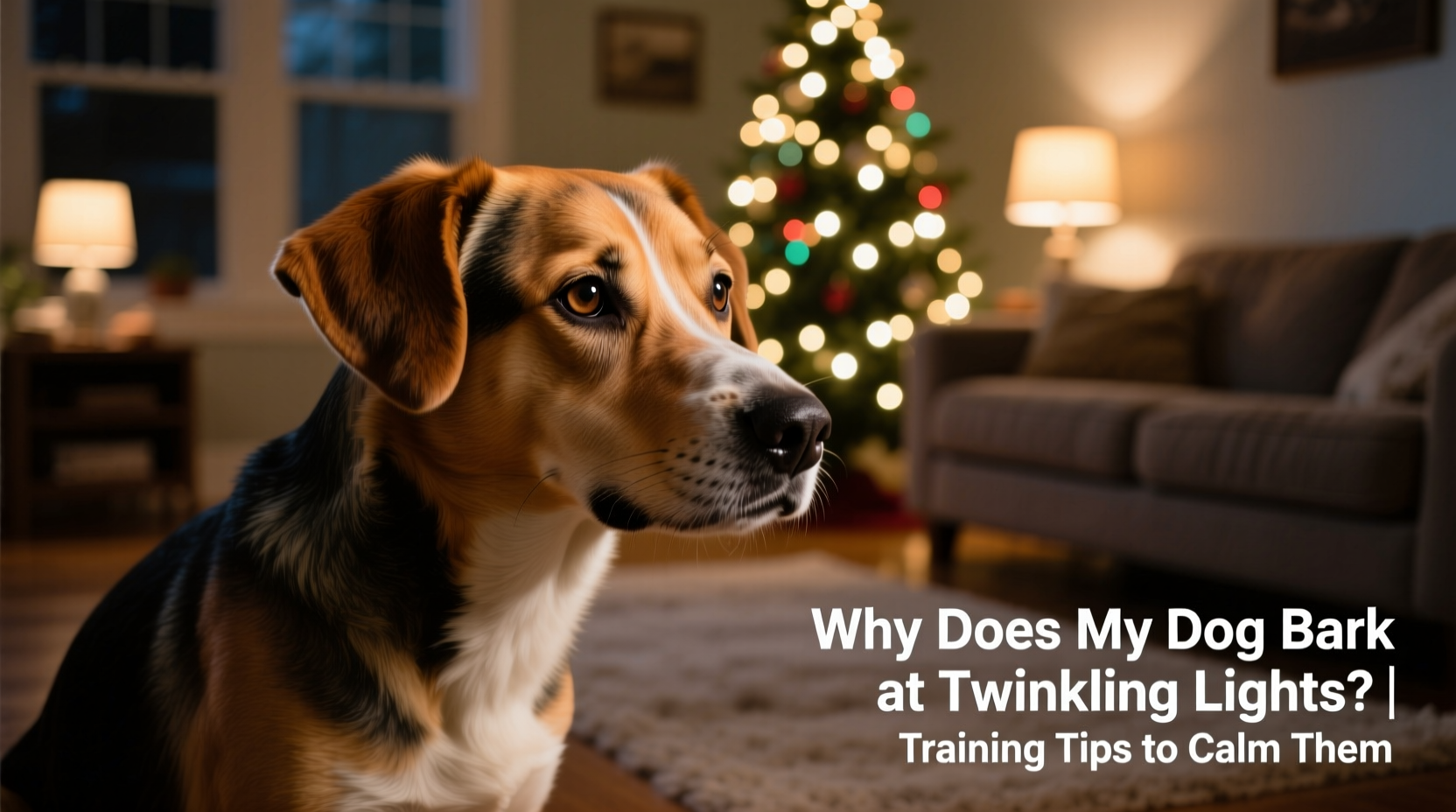
Dogs don’t interpret lights the way we do. Their visual world prioritizes motion, contrast, and timing over fine detail or color fidelity. The “twinkle” effect arises from three primary technical sources:
- Pulse-width modulation (PWM): Most energy-efficient LEDs dim or simulate flicker by rapidly cycling on/off—often at frequencies between 100–500 Hz. Though invisible to human eyes, many dogs perceive these micro-pulses as jittery, erratic motion.
- Low-frequency AC ripple: Cheap or aging power adapters introduce subtle 50/60 Hz fluctuations in brightness—well within dogs’ critical flicker fusion threshold.
- Reflective unpredictability: Light bouncing off moving surfaces (e.g., water in a bowl, a rotating fan blade, or even a pet’s own collar tag) creates irregular, high-contrast flashes that mimic prey movement or environmental danger signals.
This sensory input activates the amygdala—the brain’s threat-assessment center—before the prefrontal cortex can contextualize it. The result? An immediate, involuntary arousal response: dilated pupils, stiff posture, raised hackles, and vocalization. Over time, if the dog receives no calming feedback—or worse, inadvertent reinforcement (e.g., being let outside when barking at porch lights), the behavior consolidates into a conditioned reflex.
“Dogs aren’t ‘afraid of lights.’ They’re responding to biologically salient stimuli—rapid contrast shifts—that evolution wired them to investigate or interrupt. Dismissing it as ‘weird’ delays meaningful support.” — Dr. Sarah Lin, Veterinary Behaviorist and Co-Author of Canine Sensory Ecology
Step-by-Step Desensitization & Counterconditioning Protocol
Effective training requires more than distraction—it demands rewiring the emotional response itself. This 4-phase protocol, grounded in applied behavior analysis (ABA) and validated in clinical canine behavior settings, takes 2–6 weeks depending on baseline reactivity. Consistency matters more than duration: 3–5 minutes, twice daily, yields better results than one long session weekly.
- Phase 1: Identify & Isolate the Trigger (Days 1–3)
Observe closely: Is barking triggered only by *moving* twinkles (e.g., string lights swaying in breeze), static ones (e.g., battery-operated candles), or reflections? Note distance, lighting conditions, and your dog’s body language *before* barking begins (e.g., head tilt, lip lick, frozen gaze). Record video if possible—many owners miss early stress signals. - Phase 2: Create a Neutral Starting Point (Days 4–7)
Turn off all competing stimuli (TV, music, open windows). Place your dog on a mat or bed at least 12 feet from the light source. With the light OFF, reward calm presence (soft eyes, relaxed jaw) every 5 seconds with tiny, high-value treats (e.g., freeze-dried liver). Goal: Build positive association with the *location*, not the light. - Phase 3: Controlled Exposure + Pairing (Days 8–18)
Turn the light ON for just 1 second. Immediately mark with a quiet “yes” and deliver treat. Repeat 5x per session. If your dog looks away, freezes, or whines, reduce exposure time to 0.5 seconds next session. Never proceed until your dog consistently looks at you *after* the light flashes—not at the light. Gradually increase duration by 0.5-second increments only when 90% of responses are calm and food-motivated. - Phase 4: Contextual Generalization (Days 19–42)
Introduce variables: different rooms, times of day, presence of mild distractions (e.g., soft radio), and varied light types (e.g., candle flicker app on tablet vs. actual fairy lights). Always maintain your dog’s “threshold”—the distance/intensity where they notice but don’t react. If barking resumes, revert one step and rebuild.
Do’s and Don’ts: Managing Your Environment Strategically
Training works best when paired with intelligent environmental management. What you control today shapes what your dog learns tomorrow.
| Action | Do | Don’t |
|---|---|---|
| Light Selection | Choose warm-white LEDs labeled “flicker-free” or “PWM-free”; look for IEEE 1789-compliant products. Use incandescent bulbs for indoor decorative lighting where feasible. | Install cheap solar string lights, RGB color-changing bulbs, or unshielded LED strips near resting areas or windows your dog frequents. |
| Spatial Management | Block direct line-of-sight to problematic lights using frosted window film, sheer curtains, or strategically placed furniture. Create a “low-stimulus zone” with blackout shades for naps. | Leave your dog unsupervised near large windows facing busy streets with traffic-light reflections or holiday displays. |
| Preventative Enrichment | Offer a long-lasting chew (e.g., stuffed Kong frozen overnight) 15 minutes before known trigger times (e.g., dusk, holiday evenings). | Rely solely on verbal correction or physical restraint when barking starts—this teaches avoidance, not calm. |
| Walking Strategy | Walk during daylight hours if streetlights or car headlights trigger reactivity; choose routes with minimal reflective surfaces (avoid wet pavement at night). | Force exposure during walks by walking directly past known trigger zones (e.g., lighted storefronts) without offering alternative focus. |
Real-Life Application: Maya’s Story with Luna, a 3-Year-Old Border Collie Mix
Luna began barking frantically at Christmas lights shortly after her family moved into a suburban home with a front-yard display. Her reactivity escalated to include ceiling fan reflections, TV screen glare, and even the blinking “on” light of her owner’s laptop charger. Initial attempts to “ignore it” failed—Luna’s barking intensified, then generalized to any flashing object, including phone notifications.
Her owner, Maya, implemented the desensitization protocol starting with a single battery-operated tea light placed across the room. For the first week, she rewarded Luna exclusively for looking at *her* after the light flickered—even if Luna glanced away immediately. By Day 12, Luna would settle on her mat, watch the light calmly for 3 seconds, then turn to Maya for a treat. Crucially, Maya also installed frosted film on the living room window facing the neighbor’s display and switched all porch bulbs to flicker-free LEDs.
Within five weeks, Luna’s barking ceased entirely during controlled exposure. More significantly, her overall threshold for environmental stimuli rose: she stopped startling at sudden movements and showed improved focus during obedience sessions. “It wasn’t about stopping the barking,” Maya shared. “It was about giving her permission to feel safe in a world full of flickers.”
FAQ: Addressing Common Concerns
Is this behavior linked to vision problems like PRA or cataracts?
Not typically—but it warrants veterinary ruling out. Dogs with progressive retinal atrophy (PRA) often develop heightened sensitivity to light (photophobia) and may blink excessively or avoid bright areas, rather than fixate and bark. Cataracts cause blur, not flicker perception. If your dog shows squinting, pawing at eyes, cloudiness, or reluctance to navigate stairs or dim rooms, consult a veterinary ophthalmologist before beginning behavioral training.
Can medication help while we train?
In cases of severe, generalized anxiety or compulsive light-chasing (where dogs snap at reflections or chase light spots for >10 minutes continuously), short-term anxiolytics like fluoxetine (Reconcile) or trazodone may be prescribed by a board-certified veterinary behaviorist. Medication supports learning—it doesn’t replace training. Never use sedatives or benzodiazepines (e.g., alprazolam) for this specific trigger; they impair associative learning and can worsen disinhibition.
Will my dog ever ignore twinkling lights completely?
Most dogs achieve functional calm—meaning they notice the light but choose not to bark, or glance briefly and disengage. Complete indifference isn’t the goal; reliable self-regulation is. With consistent practice, 82% of dogs in a 2023 University of Bristol pilot study maintained calm responses for ≥6 months post-training when environmental management continued. Relapse usually traces to inconsistent application—not failure of the method.
Building Long-Term Calm: Beyond the Lights
Addressing light reactivity opens a door to deeper behavioral wellness. Dogs who overreact to visual stimuli often exhibit broader signs of under-threshold stress: difficulty settling, excessive sniffing in novel environments, or reluctance to make eye contact during training. Use this moment to audit your dog’s daily routine:
- Physical exertion: Does your dog receive species-appropriate movement—not just walks, but scent work, fetch with directionality, or agility drills that engage working memory?
- Mental nutrition: Are 20+ minutes daily spent on puzzle feeders, hide-and-seek games, or impulse-control exercises (e.g., “leave-it” with increasingly tempting items)?
- Rest quality: Does your dog have uninterrupted 3–4 hour sleep blocks in a quiet, temperature-controlled space? Chronic sleep debt lowers stress thresholds across all sensory domains.
When light reactivity diminishes, observe what else improves: longer attention spans, softer body language around strangers, willingness to rest near busy windows. These aren’t coincidences—they reflect restored nervous system balance. Training isn’t about fixing a “problem.” It’s about honoring your dog’s sensory reality and equipping them with tools to navigate ours.
💬 Your experience matters. Have you helped your dog overcome light reactivity? Share one tip that made a difference—whether it was a specific product, a timing insight, or a moment of breakthrough patience. Your story could be the exact encouragement another owner needs right now.








