
Christmas lights—twinkling, pulsing, flickering—evoke warmth and nostalgia for many people. For dogs, however, they can trigger alarm, confusion, or even fear. You’re not imagining it: your dog isn’t “just being dramatic.” Their barking is a genuine stress response rooted in sensory biology, learned experience, and evolutionary wiring. Unlike humans, dogs don’t interpret blinking LEDs as festive decoration. To them, erratic light patterns resemble movement—potentially signaling predators, intruders, or environmental instability. This article explains the *why* with scientific clarity and delivers actionable, force-free training strategies you can begin tonight—not after the tree goes up, but before the first bulb blinks.
The Science Behind the Barking: Why Lights Trigger Alarm
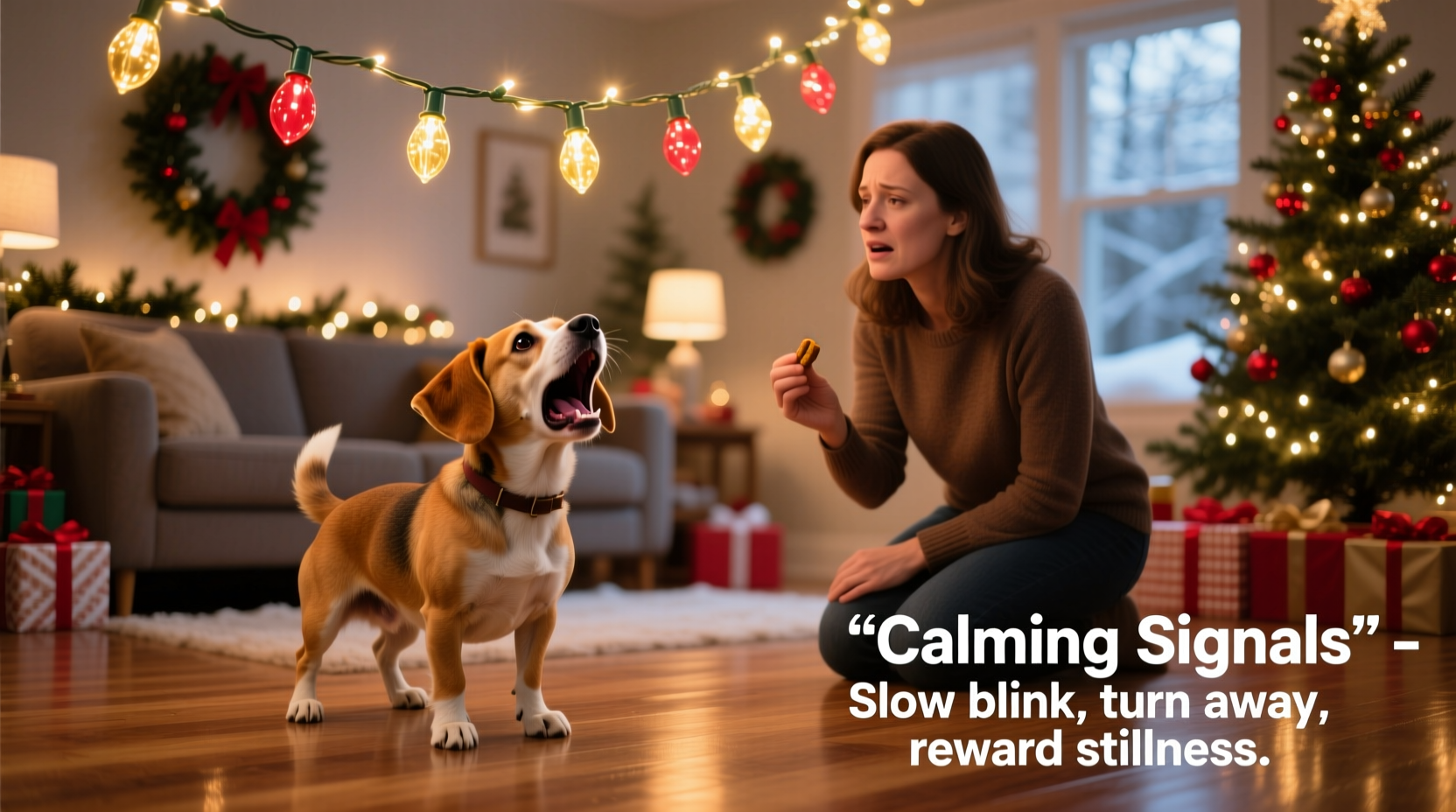
Dogs perceive light differently than we do. Their retinas contain a higher density of rod photoreceptors—cells optimized for motion detection and low-light vision. This gives them superior night vision but also makes them hyper-aware of rapid visual changes. A string of LED lights that strobes, fades, or alternates patterns creates what veterinary behaviorist Dr. Karen Overall calls “visual noise”: unpredictable, non-biological movement that violates a dog’s expectation of how the world should behave.
Add to that their acute hearing: many LED strings emit high-frequency electromagnetic hums (often above 20 kHz) that humans can’t hear—but dogs can. Combined with the subtle crackle of older incandescent wiring or the intermittent buzz of faulty adapters, this auditory layer compounds the visual disturbance. The result? A multi-sensory mismatch that signals potential danger—even when logic tells us it’s harmless.
This isn’t about “bad behavior.” It’s neurobiological vigilance. In the wild, sudden light shifts often precede threats: fire, lightning, or predator eyes reflecting moonlight. Your dog’s bark is a functional alert system—now misfiring in a domestic setting.
5 Evidence-Based Training Strategies That Work
Effective intervention doesn’t mean suppressing the bark—it means changing how your dog *feels* about the stimulus. Below are five field-tested methods, each grounded in classical and operant conditioning principles and validated by certified applied animal behaviorists (CAABs) and veterinary behaviorists.
1. Desensitization + Counterconditioning (DS/CC): The Gold Standard
This two-part protocol rewrites your dog’s emotional response. First, you present the light stimulus at such a low intensity that your dog notices it—but remains relaxed (no lip licking, no whale eye, no stiffening). Then, you pair it instantly with something deeply positive: a high-value treat (like freeze-dried liver), gentle praise, or play. Over time, the brain learns: *“Lights = good things happen.”*
Tip: Start with a single, dim, non-blinking bulb placed across the room—turned on for just 2 seconds. Reward calmly *before* your dog looks away. Increase duration and brightness only when your dog consistently leans in or wags softly during exposure.2. Environmental Management: Reduce Triggers Without Punishment
You wouldn’t ask someone with arachnophobia to sit next to a terrarium full of tarantulas and “just relax.” Similarly, expecting your dog to tolerate a wall of flashing lights while you sip eggnog sets them up for failure. Strategic management isn’t coddling—it’s compassion backed by behavioral science.
- Position your tree or light displays away from windows your dog frequents.
- Use sheer curtains or frosted window film to diffuse outdoor light glare.
- Designate a quiet, low-stimulus “calm zone” (e.g., a crate draped with a breathable blanket, or a corner with a white-noise machine) where your dog can retreat without pressure to “join the fun.”
- Turn off decorative lights during peak dog activity hours—especially at dawn and dusk, when canine visual sensitivity peaks.
3. Teach a Reliable “Look Away” Cue
This isn’t distraction—it’s empowerment. Teaching your dog to voluntarily disengage from an overstimulating sight builds impulse control and self-regulation. Begin indoors with a neutral object (a coffee mug), then progress to a stationary lamp, and finally to controlled light exposure.
- Hold a treat near your dog’s nose.
- Slowly move it sideways—just far enough that their eyes follow.
- The moment their gaze breaks from the target, mark (“Yes!”) and reward.
- Add the verbal cue *after* reliability: say “Look away” *as* their eyes shift.
- Practice daily in 60-second sessions—never to fatigue.
When lights appear, use the cue to redirect focus *before* arousal escalates. This transforms reactivity into choice.
4. Enrichment Anchoring: Pair Lights With Predictable, Positive Routines
Dogs learn through association—not logic. Anchor light exposure to activities they already love: mealtime, chew sessions, or gentle massage. For example, turn on one strand of warm-white, non-blinking lights *only* when you hand your dog a stuffed Kong. Within days, the lights become a reliable predictor of comfort—not chaos.
This technique leverages what ethologist Dr. Patricia McConnell terms “emotional contagion”: dogs read our calm presence as safety. If you’re relaxed and engaged in a soothing ritual, your dog’s nervous system follows suit.
5. Body Language Literacy: Recognize Early Stress Signals
Barking is a late-stage signal. By the time your dog is vocalizing, their sympathetic nervous system is already flooded with cortisol and adrenaline. Prevention hinges on spotting subtler cues:
| Early Warning Sign | What It Means | Immediate Response |
|---|---|---|
| Lip licking (not after eating) | Mild anxiety or uncertainty | Gently increase distance from lights; offer a low-value treat |
| Yawning (outside sleep context) | Self-soothing attempt | Pause interaction; lower light intensity or turn off temporarily |
| Hard stare or “whale eye” | Conflict or discomfort | Redirect with a known cue (“Touch” or “Find it”) and reward calm refocus |
| Shifting weight backward | Preparing to flee or freeze | Remove from situation without scolding; reinforce calm in safer space |
Tracking these signals builds your observational fluency—and prevents escalation.
A Real Example: How Maya Calmed Her Reactive Terrier Mix
Maya adopted Finn, a 3-year-old terrier mix, in November. He’d bark, pace, and whine whenever her neighbor strung lights across their fence—even though he’d never been outside during installation. At first, Maya tried covering his crate and playing music, but Finn’s stress only worsened. She consulted a certified dog trainer who observed Finn’s body language: every time the neighbor’s blue LED icicle lights pulsed, Finn’s ears flattened and he’d lick his lips repeatedly—signs she’d missed before.
They began DS/CC using a single, warm-white LED bulb on a timer set to blink once every 10 seconds—far slower than commercial lights. For three days, Maya turned it on for 5 seconds, tossed Finn a piece of chicken, and turned it off. On day four, she extended to 8 seconds—and noticed Finn’s tail begin to wag slightly during the light-on phase. By week three, she added a second bulb and introduced the sound of a quiet adapter hum via phone speaker. By December 10th, Finn was napping 6 feet from the living room tree—lights on—while chewing a marrow bone. No sedation. No punishment. Just patience, precision, and respect for his perception.
Expert Insight: What Veterinary Behaviorists Emphasize
“Dogs don’t generalize well. ‘Christmas lights’ aren’t one stimulus—they’re dozens: color temperature, pulse rate, proximity, sound signature, and whether they’re reflected in glass or moving in wind. Effective training must isolate variables—not overwhelm. Rushing desensitization is the most common reason owners give up. Progress isn’t linear—it’s logarithmic: slow at first, then accelerating once neural pathways shift.”
— Dr. Sarah Wess, DACVB, Board-Certified Veterinary Behaviorist, Cornell University College of Veterinary Medicine
Step-by-Step Holiday Light Readiness Timeline
Begin preparation early—ideally by mid-November—to avoid last-minute stress. Follow this phased approach:
- Week 1 (Assessment & Baseline): Observe your dog around existing indoor lights (lamps, TVs, chargers). Note triggers, duration of reaction, and recovery time. Record baseline behaviors in a notebook or app.
- Week 2 (Low-Intensity Exposure): Introduce one static, warm-white LED bulb at low intensity. Practice DS/CC for 3–5 minutes twice daily. Track calm indicators (soft eyes, relaxed mouth, voluntary proximity).
- Week 3 (Add Complexity): Introduce gentle movement (e.g., hold bulb steady while slowly waving hand nearby) OR add faint hum sound. Never combine both new variables at once.
- Week 4 (Context Expansion): Move exposure to different rooms. Practice “Look Away” near windows with distant light views. Introduce one strand—unplugged—then plugged in for 10-second intervals.
- Week 5 (Integration & Maintenance): Gradually incorporate lights into daily routines (meals, walks, play). Continue brief reinforcement sessions 2x/week—even after apparent success—to prevent spontaneous recovery.
FAQ: Addressing Common Concerns
Can I use a calming vest or pheromone diffuser instead of training?
Calming vests (like Thundershirts) and Adaptil diffusers may reduce *generalized* anxiety—but they don’t address the root cause: the dog’s learned association between lights and threat. Used alone, they mask symptoms without building resilience. When paired *with* DS/CC, however, they can lower the threshold for learning—making training more effective. Think of them as supportive tools, not solutions.
My dog only barks at red and green lights—is that normal?
Yes—and biologically significant. Dogs see red and green as muted yellowish or grayish tones due to dichromatic vision (they have only two cone types vs. our three). But red LEDs often emit stronger infrared leakage, and green LEDs frequently pulse at frequencies that mimic insect wingbeats—both evolutionarily salient stimuli. This isn’t “preference”; it’s heightened perceptual relevance.
Should I punish the barking?
No. Punishment (yelling, squirt bottles, shock collars) teaches your dog that *you* are unpredictable or threatening—damaging trust and often worsening anxiety. Worse, it suppresses the warning bark without resolving the underlying fear, potentially leading to bite incidents later when your dog feels cornered. Humane, science-based training builds long-term confidence—not compliance through fear.
Conclusion: Reclaim the Season With Compassion and Clarity
Your dog’s barking at Christmas lights isn’t defiance. It’s communication—in a language we’re only beginning to fully translate. Every lip lick, every wary glance, every startled bark is data: a window into how your dog experiences the world. When you respond with curiosity instead of correction, with patience instead of pressure, you do more than quiet the noise—you deepen the bond. You teach your dog that home is not just safe, but predictable. That light isn’t threat—it’s part of the rhythm of life, shared and understood.
Start small. Choose one strategy from this article—not all five. Commit to just three 90-second sessions this week. Notice what changes—not in your dog’s silence, but in their softness. In the way they rest their chin on your knee when the tree glows. In the quiet confidence that grows when fear is met not with force, but with fidelity to their needs.
💬 Your experience matters. Have you helped your dog overcome light-related anxiety? Share one tip—or one moment of breakthrough—in the comments below. Your story could be the exact encouragement another pet parent needs this holiday season.








