
Christmas lights shimmer with festive cheer for humans—but for many dogs, they’re a source of confusion, alarm, or overstimulation. That sudden, sharp barking at a string of twinkling LEDs isn’t “naughty” behavior; it’s communication. Dogs don’t perceive light the same way we do. Their visual system prioritizes motion detection and low-light sensitivity over color fidelity, and their auditory and nervous systems process environmental novelty with heightened vigilance. When your dog barks at holiday lights—whether outdoors on the neighbor’s roof or indoors on the mantel—it’s rarely about the lights alone. It’s about what those lights represent: unpredictability, perceived movement, sensory overload, or even a disruption in routine. Understanding the root causes—not just labeling it as “excitement” or “annoyance”—is the first step toward compassionate, effective intervention.
The Science Behind the Sparkle: Why Lights Trigger Barking
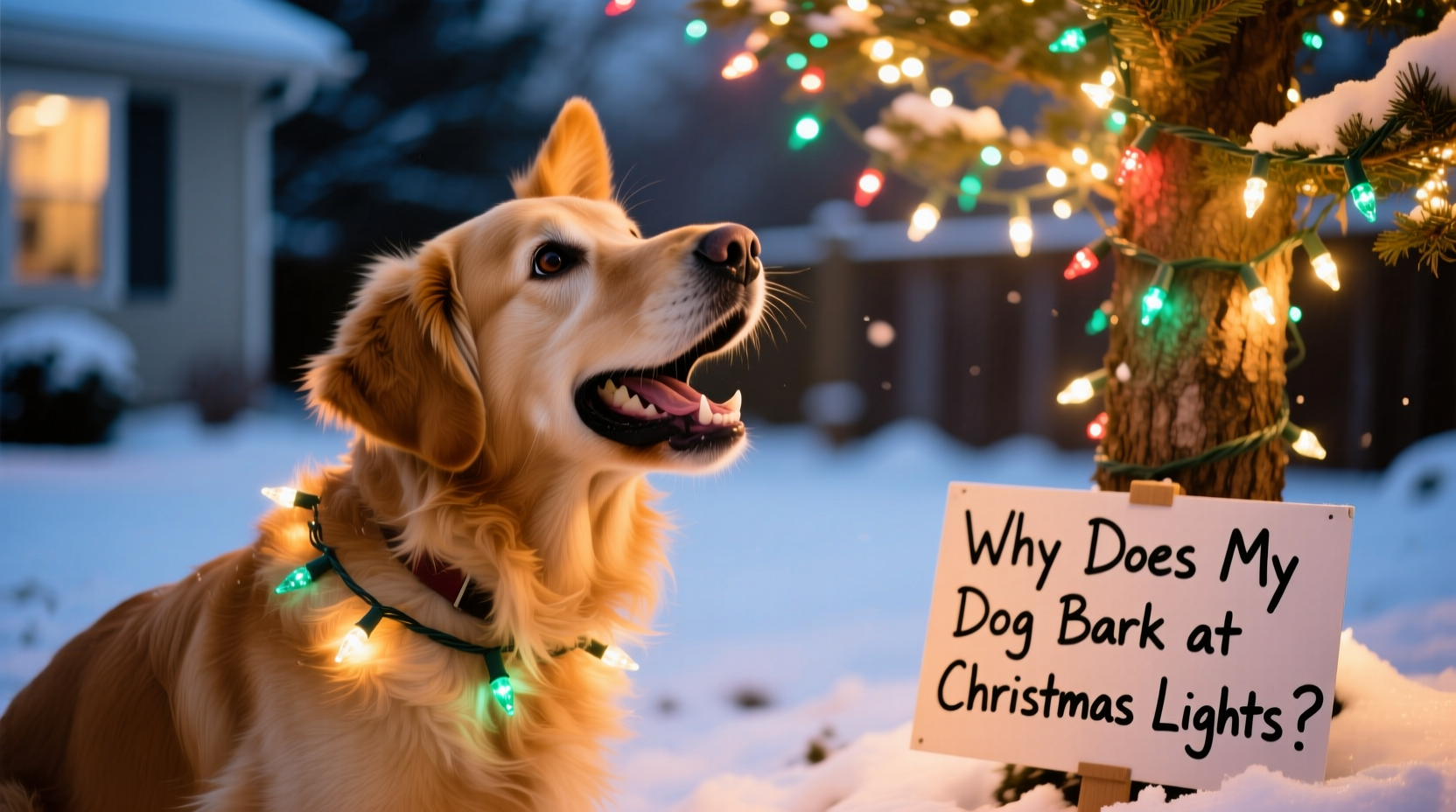
Dogs see the world through a different sensory lens. Their retinas contain far more rod cells than humans—making them exceptionally adept at detecting motion in dim light—but fewer cone cells, meaning they perceive less color (primarily blues, yellows, and grays) and lower visual acuity. This doesn’t make them “blind to beauty,” but it does mean flickering, pulsing, or rapidly changing LED patterns register as erratic movement—even when stationary. A string of warm-white LEDs that pulses slowly may appear to a dog as a cluster of darting, shimmering objects. Add to that the subtle high-frequency hum emitted by many LED transformers (inaudible to most humans but clearly perceptible to dogs’ sensitive hearing), and you have a multisensory trigger.
Compounding this is the seasonal context. Christmas lights rarely appear in isolation—they arrive alongside other dramatic changes: unfamiliar decorations, altered household routines, increased foot traffic, new scents (pine, cinnamon, roasted food), and elevated human energy levels. For dogs who thrive on predictability, this convergence can tip their stress threshold. Barking becomes both an alert response (“Something’s changed!”) and a coping mechanism (“I’m trying to control this uncertainty”). Neurologically, the amygdala—the brain’s threat-detection center—can activate more readily when novelty and sensory input collide, especially in dogs with prior sensitivities to sound or motion.
Four Common Behavioral Drivers (and How to Tell Them Apart)
Not all light-barking is equal. Accurately identifying the underlying driver determines whether your response should prioritize desensitization, environmental modification, or confidence-building. Here’s how to distinguish them:
| Behavior Pattern | Most Likely Driver | Telltale Clues |
|---|---|---|
| Intense, rapid barking only when lights are *on*, especially near windows or doors | Fear or startle response | Body lowered, ears back, tail tucked, avoidance after barking, panting, or lip-licking before onset |
| Barking accompanied by pacing, whining, or attempts to “herd” or paw at lights | Prey drive or motion sensitivity | Stiff posture, intense focus, forward weight shift, “stalking” gait, no signs of fear—just fixation |
| Intermittent barking, often during quiet moments, escalating when lights blink or change pattern | Sensory overload or frustration | Yawning, blinking excessively, turning away mid-bark, seeking attention or escape, restlessness before triggers |
| Barking only when guests are present near lit areas or during evening gatherings | Barrier frustration or territorial alerting | Focus on people near lights rather than lights themselves, barking directed outward, stiff tail wag, alert stance |
Observation is non-negotiable. Spend 5–10 minutes daily noting not just *when* your dog barks, but *what happens immediately before and after*: body language, location, time of day, presence of people or other animals, and the specific light pattern (steady vs. flashing, warm vs. cool white, proximity). Journaling these details reveals patterns invisible in real time.
A Step-by-Step Desensitization & Counterconditioning Protocol
This evidence-based approach—used successfully for noise phobias, vet visits, and novel stimuli—rewires your dog’s emotional response to lights from alarm or arousal to calm curiosity. It requires consistency, patience, and strict adherence to thresholds (never pushing past your dog’s comfort level).
- Establish Baseline Calm Distance: Identify the farthest point from any light source where your dog remains relaxed (no staring, no tension, normal breathing). Mark this spot with tape or a mat.
- Introduce Light at Sub-Threshold Intensity: Start with the dimmest, most static light possible—a single, non-blinking LED bulb in a lamp, placed well outside baseline distance. Observe for 30 seconds. If your dog notices but remains neutral (glances, looks away, resumes resting), proceed.
- Pair with High-Value Reinforcement: While the light is on, offer tiny, irresistible treats (e.g., cooked chicken, cheese) every 2–3 seconds—*only* while the light is visible and your dog is calm. Stop offering the instant they show tension. The light predicts “good things,” not pressure.
- Gradually Increase Exposure: Only after 3–5 successful sessions at one distance/intensity, move the light 6 inches closer—or switch to a slightly brighter or slower-pulsing light—*but never both at once*. If your dog tenses, retreat to the previous successful step for 2 more days.
- Introduce Movement and Sound Gradually: Once steady lights are neutral, add gentle movement (e.g., swaying a corded string light by hand) at maximum distance. Later, introduce the transformer hum using a recording played at low volume. Always pair with reinforcement.
Environmental Management: Practical Adjustments You Can Make Today
Training takes time. Meanwhile, reduce your dog’s daily stress load with smart environmental tweaks. These aren’t “band-aids”—they’re essential support for neurological regulation.
- Control visual access: Use opaque curtains or frosted window film on frequently used rooms instead of sheer drapes. Close blinds during peak light hours if outdoor displays trigger barking.
- Redirect sensory focus: Offer long-lasting chews (e.g., stuffed Kongs frozen with yogurt and kibble) or scent games (hide treats in a snuffle mat) during evening light viewing times. This engages the olfactory system—which calms the nervous system—and occupies the mouth.
- Neutralize the hum: Place transformers for indoor lights in closets, cabinets, or behind furniture. If humming persists, consider switching to battery-operated LED strings (many now offer 100+ hours of runtime).
- Maintain routine rigorously: Walks, meals, and bedtime should occur at the same time daily. Predictability buffers against seasonal chaos. Even 15 minutes of structured play before dark helps dissipate excess energy that might otherwise fuel reactivity.
Mini Case Study: Luna, a 3-Year-Old Border Collie Mix
Luna lived in a suburban neighborhood where houses began installing elaborate light displays in early November. By Thanksgiving, she’d started barking frantically at the living room window each evening, pacing, whining, and refusing to settle until lights were turned off. Her owners assumed it was excitement—until they noticed her pupils were dilated and she’d avoid the room entirely when lights were on, even unlit ones.
A veterinary behaviorist observed Luna’s reactions and identified classic fear-based reactivity: tail tucked, whale eye, and refusal of treats near the window. They implemented the step-by-step protocol above, starting with a single, dim nightlight in the hallway—far from the window—and gradually moving it closer over 12 days. Simultaneously, Luna’s owners installed blackout shades and began evening walks earlier to avoid peak display hours. Within four weeks, Luna no longer reacted to the window area. By Christmas Eve, she rested calmly on her bed while the neighborhood sparkled outside—occasionally glancing out, then returning to her chew toy.
Crucially, her owners didn’t eliminate the lights—they changed Luna’s relationship to them. That distinction is transformative.
Expert Insight: What Veterinary Behaviorists Emphasize
“Barking at lights is rarely about the lights themselves. It’s a symptom of a dysregulated nervous system responding to novelty, unpredictability, or sensory mismatch. Punishment or suppression—like yelling ‘quiet’ or using spray collars—doesn’t resolve the underlying anxiety or confusion. It only teaches the dog that expressing discomfort is unsafe. True resolution comes from building safety, predictability, and choice.” — Dr. Lena Torres, DACVB, Veterinary Behaviorist and Founder of Canis Resilience Institute
FAQ: Addressing Real Concerns
Can I use calming supplements or CBD oil to help during the holidays?
Some dogs benefit from short-term, veterinarian-approved options like prescription anxiolytics (e.g., trazodone) or nutraceuticals containing L-theanine and alpha-casozepine. However, these support tools—not solutions. They work best *alongside* behavioral strategies, not instead of them. Never administer CBD without consulting your vet: quality control is poor, dosing is unstandardized, and interactions with other medications are poorly understood.
My dog only barks at red and blue lights—why?
Dogs see red and blue as distinct, high-contrast hues against darker backgrounds. Red appears as a dull brownish-gray, while blue registers vividly. Combined with flicker or motion, these colors create stronger visual “pop” in a dog’s field of view. It’s not preference—it’s neurology. Prioritize desensitization to these specific wavelengths first.
Will this behavior go away on its own after the holidays?
Unlikely—and potentially counterproductive. If barking is consistently reinforced (even unintentionally, by attention or the lights “going away” when they bark), the behavior strengthens. Worse, repeated exposure without positive association can deepen negative associations. Addressing it proactively builds resilience for future novel stimuli—not just holiday lights.
Conclusion: Beyond the Twinkles
Your dog’s barking at Christmas lights isn’t a quirk to be tolerated or suppressed. It’s data—a window into their perception, their stress thresholds, and their need for security in a world that moves faster and shines brighter than their evolutionary wiring anticipates. The most powerful tool you possess isn’t a treat pouch or a curtain rod—it’s your understanding. When you replace judgment with curiosity, correction with compassion, and frustration with observation, you shift from managing symptoms to nurturing trust. Every calm glance at a light, every relaxed sigh beside a glowing tree, every moment your dog chooses rest over reactivity—that’s not just holiday peace. It’s proof that with patience, precision, and respect for their canine nature, you can turn seasonal overwhelm into shared serenity.
💬 Your experience matters. Have you helped your dog feel safe around holiday lights? Share your most effective strategy—or your biggest challenge—in the comments. Your insight could be the exact encouragement another pet parent needs this season.








