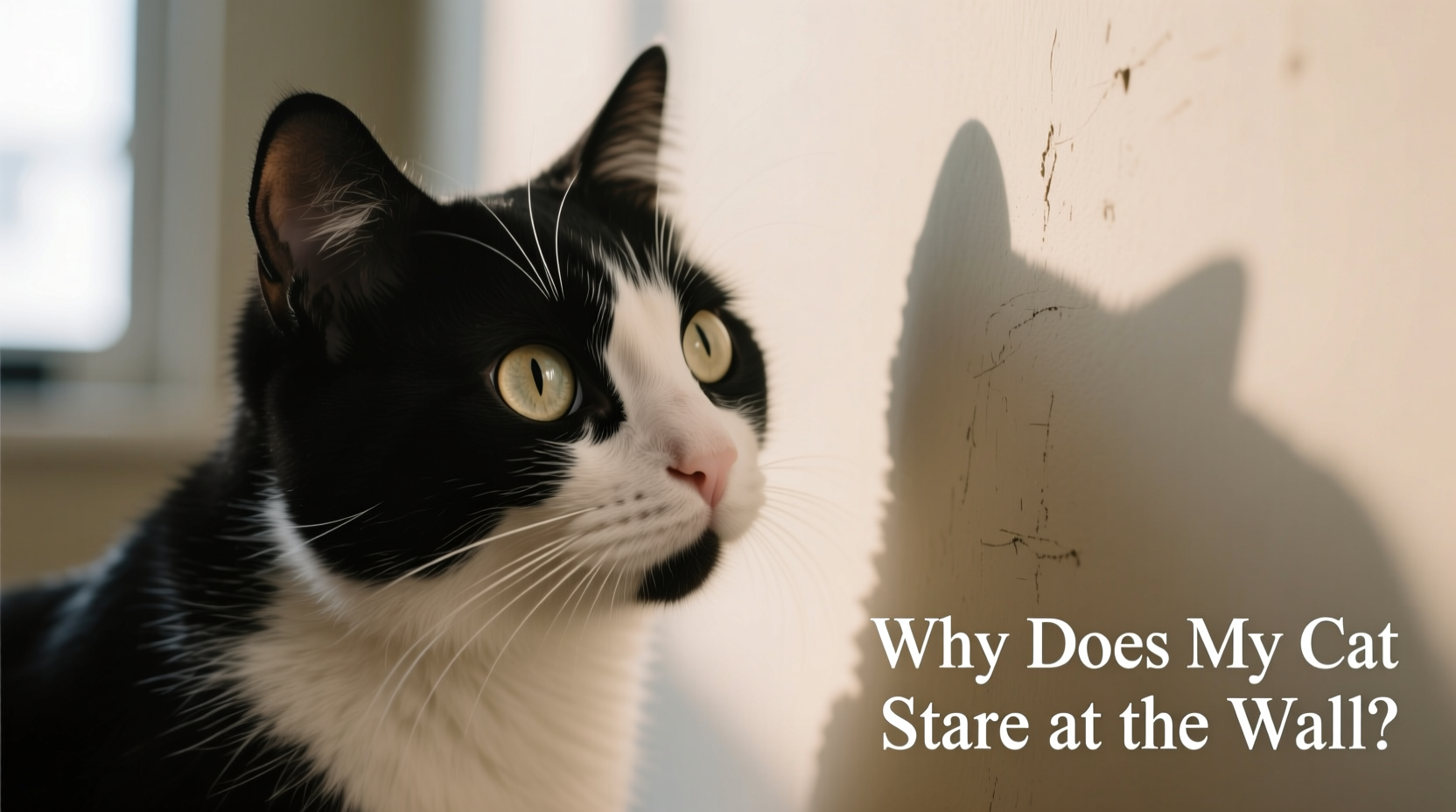
Cats are enigmatic creatures. One moment they’re curled up in your lap, purring contentedly; the next, they’re locked in an intense gaze with a blank stretch of drywall. If you’ve ever caught your cat motionless, pupils dilated, staring intently at nothing in particular, you’re not alone. This behavior, while unsettling to some owners, is more common than you might think. But what drives it? Is it instinct, boredom, or something more concerning? Understanding why your cat stares at the wall requires insight into feline senses, psychology, and potential medical conditions.
Cats perceive the world differently than humans. Their vision, hearing, and even sense of vibration allow them to detect stimuli we can’t. A flicker of light, a subtle movement behind wallpaper, or high-frequency sounds from electrical devices may capture their attention—even if invisible to us. While occasional wall-staring is typically harmless, persistent or repetitive fixation could indicate underlying issues ranging from neurological disorders to cognitive decline. The key lies in distinguishing normal quirks from warning signs.
The Feline Sensory World: Seeing Beyond the Surface
Cats have evolved as predators with highly tuned sensory systems. Their eyes, ears, and whiskers work in concert to detect minute changes in their environment. What appears to be an empty wall to a human may be teeming with activity through a cat’s perception.
Feline vision excels in low-light conditions due to a high concentration of rod cells in the retina. However, cats don’t see fine details or colors as vividly as humans. Instead, they are particularly sensitive to motion. Even the tiniest shadow—caused by dust motes drifting in a sunbeam or a fly crawling behind baseboards—can trigger a hunting response. Additionally, cats can detect ultraviolet light, which may reveal patterns on surfaces invisible to us, such as urine trails or reflective residues.
Hearing also plays a role. Cats hear frequencies up to 64 kHz, far beyond the human range (20 kHz). Electrical outlets, refrigerators, or HVAC systems often emit faint buzzing or humming noises that go unnoticed by people but may intrigue or agitate a cat. These auditory cues could explain why your pet suddenly fixates on a specific corner or outlet.
Tip: Observe the time of day and environmental conditions when your cat stares. Is there sunlight casting shadows? Is an appliance running? Context can reveal hidden triggers.Instinctual Behavior: Hunting, Play, and Environmental Monitoring
Staring is a natural component of the feline predatory sequence: orient → stare → stalk → pounce → bite. When your cat locks onto a spot on the wall, it may be mentally rehearsing a hunt. Even indoor cats retain strong instincts. A moving shadow or irregular texture on the wall can simulate prey-like movement, prompting focused observation.
In multi-cat households, one cat may stare at a wall simply to monitor territory. Cats are territorial animals, and visual surveillance helps them maintain situational awareness. A seemingly blank wall might mark a boundary zone or a vantage point overlooking shared space.
Some cats develop idiosyncratic behaviors over time. A kitten that once saw a spider near a certain wall may return to that spot repeatedly, expecting a repeat encounter. Others may associate a location with positive reinforcement—perhaps treats were dropped nearby, or playtime began in that area. Over time, these associations become ingrained habits.
“Cats live in a state of perpetual environmental scanning. What looks like vacant staring is often active information gathering.” — Dr. Sarah Thompson, Veterinary Ethologist
When Wall-Staring Signals a Health Concern
While many instances of wall-gazing are benign, prolonged or repetitive episodes may point to medical or neurological issues. Owners should pay close attention to frequency, duration, and accompanying symptoms.
One serious condition linked to this behavior is feline hyperesthesia syndrome, a poorly understood disorder involving abnormal skin sensations and neurological misfires. Affected cats may exhibit sudden bursts of activity, tail twitching, or self-mutilation, often preceded by a trance-like stare at walls or ceilings.
Seizure disorders are another possibility. Cats experiencing partial (focal) seizures may appear dazed, unresponsive, or visually fixated without moving. These episodes can last seconds to minutes and may be followed by disorientation or excessive grooming.
Cognitive dysfunction syndrome (CDS), similar to dementia in humans, affects older cats. Symptoms include confusion, altered sleep cycles, litter box avoidance, and vacant staring. A 2020 study published in *Veterinary Journal* found that over 50% of cats aged 11–15 years show at least one sign of cognitive decline.
| Behavior | Normal? | Potential Red Flag |
|---|---|---|
| Occasional short stares (under 30 sec) | Yes | No |
| Repetitive head bobbing with staring | No | Possible neurological issue |
| Staring accompanied by vocalization | Rarely | Pain or anxiety |
| Post-stare disorientation or falling | No | Seizure or vestibular disease |
| Increased frequency with age | Possibly | Cognitive dysfunction |
Environmental and Psychological Triggers
Boredom and stress are significant contributors to unusual feline behaviors. Indoor cats without adequate mental stimulation may resort to repetitive actions, including wall-watching, as a form of self-entertainment or displacement behavior.
A lack of vertical space, interactive toys, or daily engagement can leave cats under-stimulated. In such cases, wall-staring may evolve into a compulsive habit. Similarly, changes in household dynamics—new pets, moving furniture, or construction noise—can heighten anxiety, leading to hypervigilance and fixation on static objects.
Some cats react strongly to pheromones or scents left by previous animals. Residual odors in walls or baseboards from former pets or pests may prompt prolonged investigation. Even cleaning products containing citrus or ammonia can trigger aversive reactions, causing a cat to stare at recently cleaned areas.
Mini Case Study: Luna, the Window-Wall Watcher
Luna, a 7-year-old domestic shorthair, began staring at a corner of her owner’s bedroom wall every evening around 7 PM. Her owner, concerned about possible seizures, recorded the behavior and brought it to a veterinary behaviorist. Upon inspection, the specialist noticed that at precisely 7:02 PM each night, the neighbor’s motion-sensor security light would reflect off a glass picture frame, casting a flickering shadow on the wall.
Luna, positioned on her favorite perch, was reacting to the intermittent light pattern—likely interpreting it as insect-like movement. After repositioning the frame and adding scheduled laser play sessions during that hour, the staring ceased entirely within a week. This case illustrates how environmental subtleties, imperceptible to humans, can drive seemingly odd feline behavior.
Step-by-Step Guide to Assessing and Responding to Wall-Staring
If your cat frequently stares at walls, follow this structured approach to determine whether intervention is needed:
- Observe and Document: Note the time, duration, frequency, and location of the behavior. Use a journal or voice memo app to track patterns over 7–10 days.
- Eliminate Environmental Triggers: Check for flickering lights, drafts, insects, or appliance hums. Cover outlets or use white noise to mask sounds.
- Assess for Medical Signs: Look for drooling, tremors, loss of balance, or changes in appetite. Film the episode if possible for your vet.
- Enhance Enrichment: Introduce puzzle feeders, window perches, rotating toys, and daily interactive play (at least 15 minutes twice a day).
- Consult Your Veterinarian: If the behavior persists or worsens, schedule a full physical and neurological exam. Bloodwork and imaging may be recommended for older cats.
FAQ: Common Questions About Cat Wall-Staring
Is it normal for cats to stare at walls?
Yes, occasional staring is normal, especially if triggered by movement, light, or sound. However, frequent or prolonged episodes warrant closer observation and possibly veterinary consultation.
Can stress cause my cat to stare at walls?
Absolutely. Stress or anxiety can lead to obsessive behaviors. Cats in unpredictable environments may fixate on static points as a coping mechanism. Providing safe spaces, consistent routines, and calming aids like Feliway diffusers can help reduce such behaviors.
Should I stop my cat from staring at the wall?
Interrupting brief episodes isn’t necessary. However, if the behavior seems compulsive or is disrupting sleep or eating, redirect your cat gently with a toy or treat. Avoid startling or punishing them, as this can increase anxiety.
Action Plan: Checklist for Cat Owners
- ✅ Record at least three instances of wall-staring with timestamps and surroundings
- ✅ Inspect the area for light reflections, drafts, or insect activity
- ✅ Evaluate your cat’s daily enrichment and play routine
- ✅ Rule out recent household changes or stressors
- ✅ Schedule a vet visit if episodes last longer than 2 minutes or occur multiple times daily
- ✅ Consider a veterinary behaviorist for complex or persistent cases
“Owners often underestimate how much cats notice. That ‘blank’ wall might be a sensory hotspot. The real question isn’t why they stare—but what they’re seeing that we’re missing.” — Dr. Lena Patel, Feline Neurology Specialist, Cornell University College of Veterinary Medicine
Conclusion: From Curiosity to Care
Your cat’s wall-staring may never fully lose its mystery, and that’s part of living with a creature shaped by millions of years of evolutionary precision. In most cases, the behavior is a harmless expression of curiosity, instinct, or environmental sensitivity. But because cats cannot verbalize discomfort, subtle shifts in behavior serve as their primary communication tool.
By combining attentive observation with proactive care, you can ensure that your cat’s moments of stillness remain within the realm of normal feline quirks—not signals of distress. Invest in environmental enrichment, maintain regular veterinary checkups, and trust your instincts as a caregiver. If something feels off, it’s always better to investigate early.
💬 Have you figured out why your cat stares at the wall? Share your story or questions in the comments—your experience could help another pet owner decode their cat’s silent language.








