
Cats are naturally curious creatures, and their behaviors often leave owners puzzled—especially when they fixate on something as seemingly uninteresting as a blank wall. If your cat frequently stares into space or appears transfixed by nothing at all, you're not alone. Many cat owners have observed this behavior and wondered whether it's harmless quirk or a sign of something more serious. Veterinarians, animal behaviorists, and neurologists offer insight into why cats engage in this behavior, ranging from instinctual hunting patterns to potential neurological issues. Understanding the full spectrum of possibilities can help you determine when to relax and when to seek professional advice.
The Role of Feline Senses in Wall-Staring Behavior
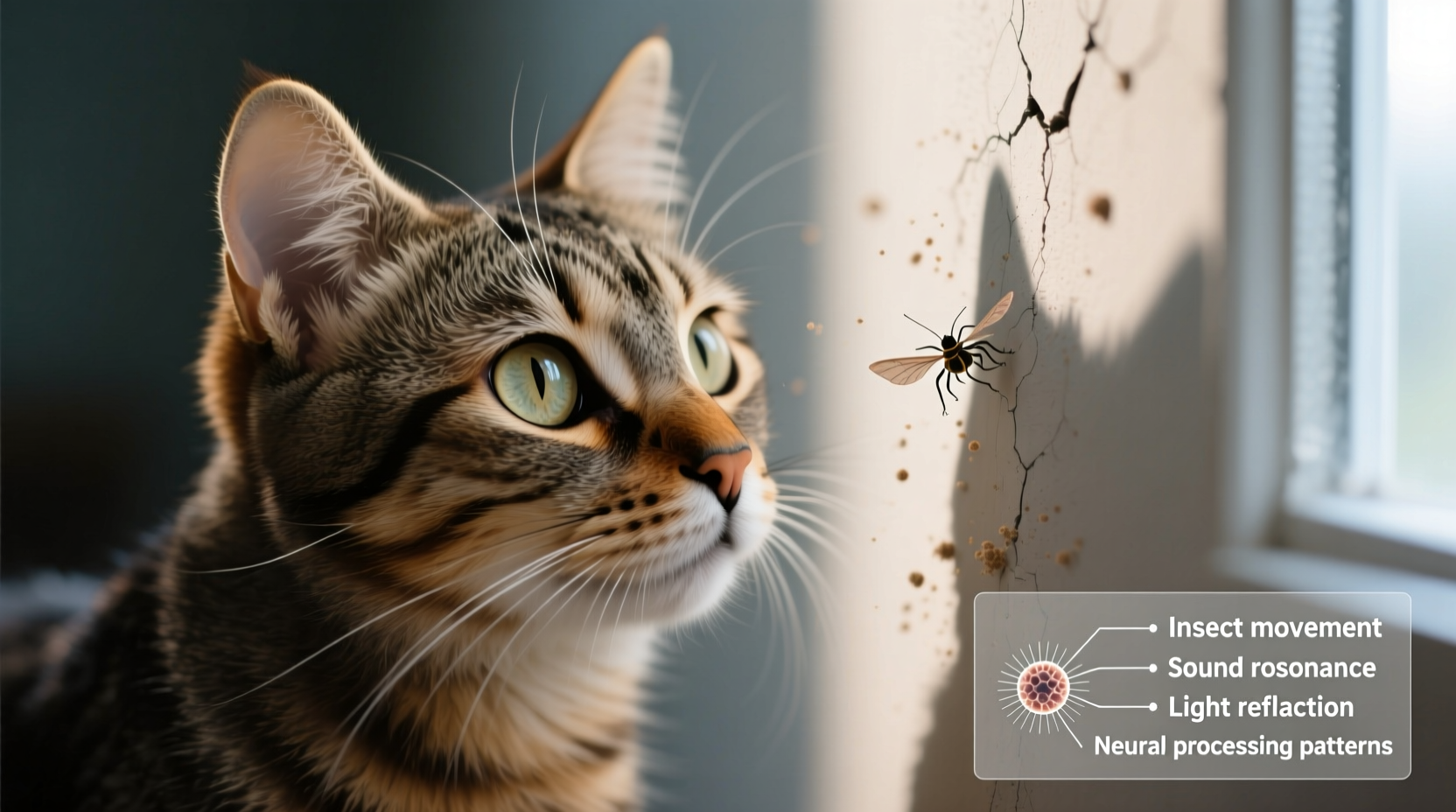
Cats possess sensory capabilities far beyond those of humans. Their hearing, vision, and even whisker sensitivity allow them to detect stimuli we can't perceive. A cat staring at a wall may actually be responding to subtle cues invisible or inaudible to us.
For instance, high-frequency sounds such as rodents scurrying inside walls, insects crawling behind baseboards, or even electrical buzzing from outlets can capture a cat’s attention. These noises fall within the upper range of feline hearing (up to 64,000 Hz), well above human detection limits. Similarly, minute movements—like dust particles drifting in a sunbeam or shadows shifting with changing light—can trigger a cat’s predatory focus.
“Cats don’t just look at things—they scan environments for micro-movements and auditory shifts that signal prey or danger. What looks like blank-wall fixation may be intense sensory processing.” — Dr. Lydia Chan, Veterinary Ethologist
This hyper-awareness is rooted in evolutionary survival. In the wild, success depends on noticing the slightest twitch in grass or flicker of shadow. Even domesticated cats retain these instincts, making them prone to sudden stillness and focused observation.
Tip: Observe the timing of your cat’s wall-staring. Does it happen at night? During quiet hours? This could indicate they’re reacting to nocturnal pests or low-light visual stimuli.Potential Medical Causes Behind Prolonged Staring
While occasional wall-gazing is normal, persistent or repetitive episodes may point to underlying health conditions. One major concern is feline cognitive dysfunction (FCD), especially in senior cats over 10 years old. Similar to dementia in humans, FCD can cause disorientation, vacant stares, confusion, and altered sleep-wake cycles.
Another critical medical explanation is seizures—specifically psychomotor or partial complex seizures. Unlike generalized seizures involving convulsions, these episodes may manifest only as motionless staring, lip-smacking, or tail-chasing. The cat remains conscious but detached, often unaware of surroundings for several seconds to minutes.
- Signs of seizure-related staring include dilated pupils, unresponsiveness, drooling, or subtle muscle twitching.
- Episodes typically last 30 seconds to 2 minutes and may be followed by disorientation or excessive grooming.
- Vets may recommend an EEG, MRI, or blood panel to rule out brain lesions, infections, or metabolic imbalances.
Other possible medical contributors include hypertension-induced retinal detachment, which affects vision and may lead to misinterpretation of spatial cues, and hyperthyroidism, which increases nervous system activity and anxiety.
When to See a Veterinarian
If your cat exhibits any of the following, consult a vet promptly:
- Staring spells lasting longer than two minutes
- Frequent recurrence (multiple times per week)
- Loss of balance, tremors, or collapse after an episode
- Sudden changes in litter box habits, appetite, or interaction levels
Behavioral and Environmental Explanations
Not all wall-staring indicates illness. Often, it reflects natural curiosity or environmental enrichment needs. Indoor cats, particularly those without sufficient mental stimulation, may develop repetitive behaviors due to boredom. Watching light reflections, air currents moving curtains, or even the hum of appliances becomes a form of entertainment.
In multi-cat households, one cat may stare at a wall simply because another cat did first—social learning plays a role in feline behavior. Additionally, cats are highly attuned to routine. If a certain time of day brings specific sounds (e.g., HVAC kicking on, neighbor activity), your cat may anticipate and fixate on the source location.
| Behavioral Cause | Description | What You Can Do |
|---|---|---|
| Prey Drive Activation | Responding to unseen movement or sound (insects, drafts) | Inspect walls for pest entry; use white noise to mask erratic sounds |
| Boredom | Lack of toys, climbing structures, or interactive play | Introduce puzzle feeders, rotating toys, daily play sessions |
| Stress or Anxiety | Changes in home environment, new pets, loud noises | Provide safe zones, pheromone diffusers, consistent routines |
| Habit Formation | Repetition turns random glances into ritualized behavior | Avoid reinforcing with attention; redirect gently with toys |
It’s important not to anthropomorphize this behavior. A cat isn’t “zoning out” in the human sense. Instead, they’re actively processing sensory input—even if the output seems minimal.
Real-Life Example: Bella the Siamese
Bella, a 7-year-old Siamese cat, began spending increasing amounts of time sitting near the living room wall, staring intently for up to ten minutes at a stretch. Her owner initially dismissed it as quirks of her breed’s vocal and active nature. But when Bella started having episodes late at night and appeared dazed afterward, concern grew.
After a veterinary workup—including blood pressure testing, thyroid screening, and neurological evaluation—Bella was diagnosed with mild hypertension leading to early-stage retinal changes. Though not fully blind, her distorted vision caused her to misinterpret light patterns on the wall as moving objects. With medication and dietary adjustments, the staring episodes decreased significantly within six weeks.
This case underscores how subtle symptoms can signal treatable medical issues. Early intervention prevented further complications, including complete vision loss.
Expert-Recommended Checklist: Assessing Your Cat’s Staring Habits
To determine whether your cat’s wall-staring is benign or concerning, follow this practical checklist:
- Record the frequency: Note how many times per day the behavior occurs.
- Time each episode: Use a stopwatch or timer app to track duration.
- Observe body language: Look for twitching, drooling, stiff posture, or lack of response to calls.
- Check the environment: Are there drafts, lights, or sounds near where the cat stares?
- Review recent changes: New furniture, pets, construction, or household stressors?
- Monitor other behaviors: Changes in appetite, grooming, elimination, or sociability?
- Consult your vet: Share your notes and request a full physical and neurological screen if patterns persist.
Common Misconceptions About Cat Staring
Several myths persist about cats staring at walls, often fueled by pop culture or anecdotal reports. One common belief is that cats see spirits or ghosts. While this idea makes for entertaining stories, there is no scientific evidence supporting paranormal perception in animals.
Another misconception is that all repetitive behaviors are signs of intelligence or deep thought. In reality, prolonged immobility can indicate discomfort, pain, or neurological disruption rather than contemplation.
Lastly, some assume that if a cat eats and uses the litter box normally, everything must be fine. However, cats are masters at hiding illness. Behavioral changes like staring are often the earliest warning signs long before physical symptoms emerge.
FAQ: Frequently Asked Questions
Is it normal for cats to stare at walls?
Yes, occasional brief staring is normal, especially if triggered by sound, light, or movement. However, frequent, prolonged, or trance-like episodes warrant closer observation and possibly veterinary consultation.
Can stress cause my cat to stare at the wall?
Yes. Stress alters brain chemistry and can lead to obsessive or repetitive behaviors. Cats under chronic stress may fixate on objects as a displacement behavior—a way to cope with anxiety when they can’t flee or fight.
Do indoor cats stare more than outdoor cats?
Indoor cats may appear to stare more simply because their environment is more controlled and observable. Limited stimulation increases the likelihood of focusing on minor stimuli like shadows or air vents. Providing enrichment reduces this tendency.
Conclusion: Understanding Your Cat’s Silent Language
Cat behavior rarely lacks meaning—even when it baffles us. Staring at a wall isn’t inherently alarming, but understanding the context transforms it from a mystery into a communication tool. Whether driven by sharp senses, environmental factors, or hidden health issues, your cat’s gaze offers clues about their inner world and physical state.
By combining careful observation with professional guidance, you can ensure your cat’s well-being and strengthen your bond through deeper understanding. Don’t ignore persistent changes in behavior. At the same time, appreciate that some moments of stillness are simply part of being a cat—an elegant predator finely tuned to a world we barely perceive.
💬 Have you noticed your cat staring at walls? What did you discover? Share your experience in the comments to help fellow cat owners recognize normal quirks versus warning signs.








