It’s a scene familiar to many cat owners: you’re winding down for the night, lights dimmed, when you notice your cat sitting perfectly still—eyes locked on a blank stretch of wall. No movement. No sound. Just an unblinking gaze that seems to pierce through the surface. You check the wall yourself. Nothing there. Yet your cat remains transfixed. Is it seeing spirits? Hunting invisible prey? Or is something more grounded in biology and instinct at play?
Cats are naturally enigmatic creatures. Their behaviors often appear mysterious because they operate on sensory inputs and instincts that humans simply don’t share. Staring at walls—especially at night—is one such behavior that can alarm or intrigue owners. But in most cases, it’s not a sign of illness or supernatural perception. Instead, it’s a window into how cats perceive and interact with their environment.
This article explores the real reasons behind your cat’s wall-staring episodes, from heightened senses to neurological quirks, and offers guidance on when it’s normal—and when it might signal a deeper issue.
The Science Behind Feline Night Vision and Hearing
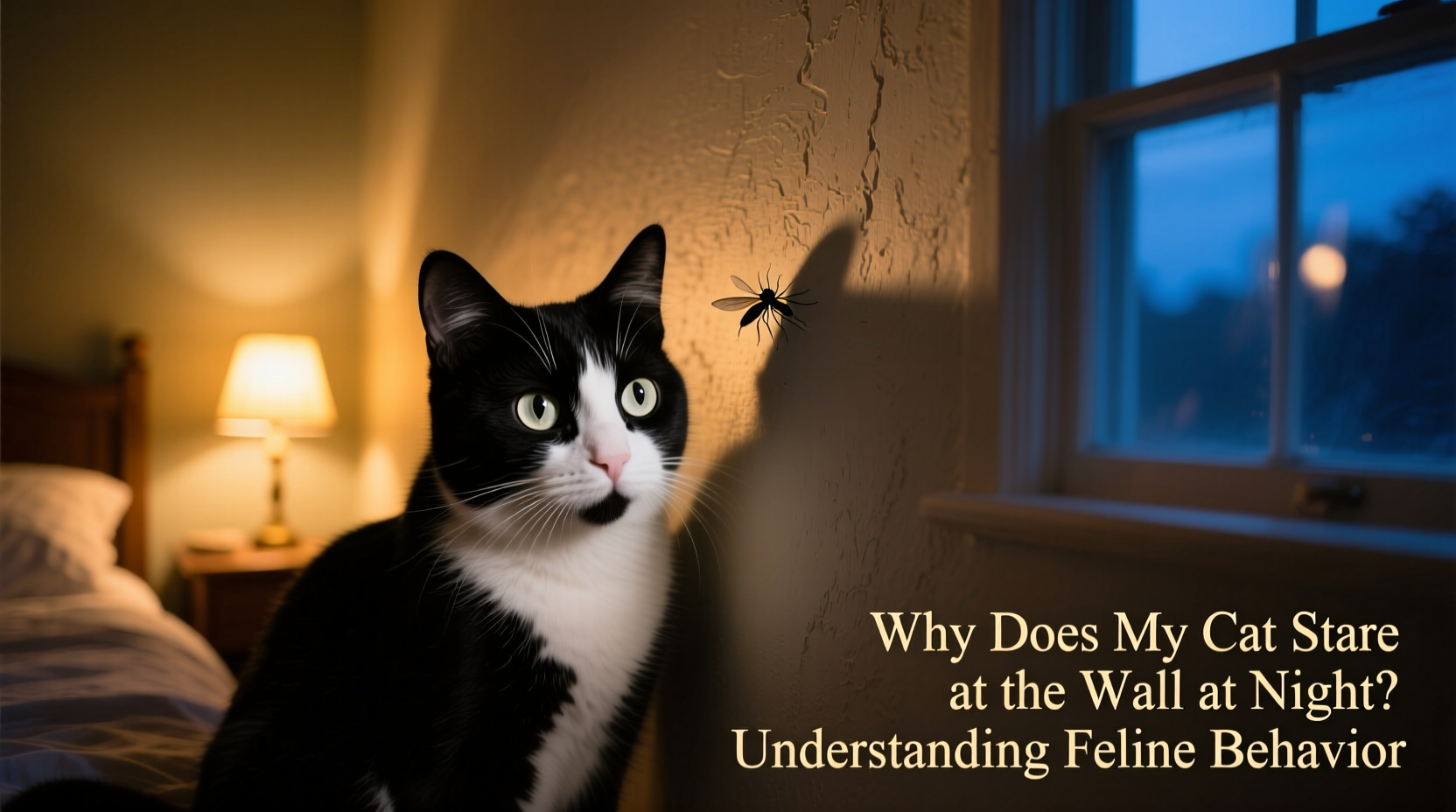
Cats are crepuscular animals, meaning they are most active during dawn and dusk. This evolutionary adaptation helped wild ancestors hunt when prey was most abundant and visibility was low. As a result, domestic cats retain exceptional night vision and acute hearing—far beyond human capabilities.
A cat’s eyes contain a high concentration of rod cells, which detect motion and function well in low light. They also possess a reflective layer behind the retina called the *tapetum lucidum*, which amplifies available light. This allows cats to see in conditions that would appear pitch-black to us. What looks like a blank wall to you might reveal subtle shifts in shadows, dust motes floating in moonlight, or faint reflections from outside sources.
Similarly, cats can hear frequencies up to 64 kHz—nearly double the upper limit of human hearing (20 kHz). They may detect sounds we cannot: the scurrying of insects inside walls, electrical hums from appliances, or even ultrasonic signals from rodents. These imperceptible stimuli could trigger intense focus, leading to what appears as vacant wall-staring.
Tip: Use a flashlight to scan the area your cat is staring at. You might spot tiny movements, cracks, or light reflections that explain their fixation.Possible Explanations for Wall-Staring Behavior
While some theories about cats “seeing ghosts” persist in popular culture, veterinary science offers more plausible explanations. Here are the most common causes:
- Motion detection: Even slight air currents can move dust or curtain fibers, catching a cat’s attention.
- Insect activity: Rodents, spiders, or bugs moving within walls produce vibrations and sounds only cats can sense.
- Light and shadow play: Streetlights, passing cars, or digital clocks can create flickering patterns on walls.
- Residual hunting instinct: Cats may fixate on imagined prey, especially if under-stimulated during the day.
- Habit or routine: Some cats develop repetitive behaviors out of boredom or mild anxiety.
Dr. Sarah Thompson, a veterinary behaviorist at the American College of Veterinary Behaviorists, explains:
“Cats don’t stare without reason. Even if we can’t perceive the stimulus, there’s usually something triggering their focus. It’s part of their survival wiring—they’re built to notice the subtlest cues.” — Dr. Sarah Thompson, DVM, Diplomate ACVB
When Wall-Staring Might Signal a Health Concern
Occasional staring is normal. But persistent, blank-eyed gazing—especially when paired with other symptoms—can indicate medical or neurological issues. Conditions to consider include:
- Epilepsy or partial seizures: Cats may exhibit ‘absence-like’ episodes where they freeze and stare, sometimes accompanied by twitching or disorientation.
- Cognitive dysfunction syndrome (CDS): Older cats with CDS may appear confused, stare into space, or vocalize at night.
- Vision problems: Retinal degeneration or glaucoma can cause hallucinations or misinterpretation of visual input.
- Pain or discomfort: A cat in pain may withdraw and fixate on one spot as a coping mechanism.
If your cat displays any of the following, consult your veterinarian:
- Staring for extended periods (more than several minutes) without response to stimuli.
- Loss of balance, circling, or head tilting.
- Unusual vocalizations, especially loud meowing at night.
- Sudden changes in litter box use, appetite, or social interaction.
- Repetitive blinking, squinting, or eye discharge.
Mini Case Study: Bella, the Night Watcher
Bella, a 7-year-old tabby, began staring at the bedroom wall every night around 2 a.m. Her owner, Mark, initially thought she was reacting to noises from the attic. After setting up a camera, he noticed Bella would sit upright, pupils dilated, tracking nothing visible. Concerned, he brought her to the vet.
Neurological exams revealed no seizures, but blood work indicated mild hyperthyroidism—a condition common in middle-aged cats that can cause restlessness and altered behavior. After starting medication, Bella’s nighttime episodes decreased significantly. The vet later suggested that her original staring may have been triggered by subtle muscle twitches or internal sensations related to the thyroid imbalance.
This case highlights how seemingly odd behaviors can stem from underlying medical issues—even when external triggers aren’t obvious.
Environmental Enrichment: Reducing Boredom-Driven Behaviors
Indoor cats, especially those left alone for long stretches, often develop repetitive habits due to lack of stimulation. Staring at walls can be a form of displacement behavior—a way to occupy themselves when natural outlets like hunting or exploration are limited.
Providing environmental enrichment helps redirect this energy. Consider the following strategies:
| Activity | Benefit | Implementation Tips |
|---|---|---|
| Interactive toys | Simulates hunting and engages focus | Use wand toys, motorized mice, or treat puzzles daily |
| Vertical space | Expands territory and observation points | Install shelves, cat trees, or window perches |
| Scheduled play | Reduces nocturnal activity spikes | Engage in 10–15 minute sessions before bedtime |
| Sensory variety | Prevents fixation on single stimuli | Rotate toys, introduce safe scents (catnip, silver vine), play nature sounds |
Step-by-Step Guide: Assessing and Responding to Wall-Staring
If your cat frequently stares at walls, follow this logical process to determine the cause and appropriate response:
- Observe the context: Note the time of day, duration, body language (ears forward? tail twitching?), and whether anything precedes the behavior.
- Inspect the environment: Look for drafts, light sources, insect signs (droppings, scratching sounds), or appliance hums near the wall.
- Rule out medical causes: Schedule a vet visit if the behavior is new, worsening, or accompanied by other symptoms.
- Increase daytime engagement: Provide at least 20 minutes of interactive play spread over two sessions.
- Modify the space: Block access to the area temporarily or add distractions like a bird feeder outside a nearby window.
- Monitor changes: Keep a brief log for a week to track frequency and potential triggers.
This methodical approach helps distinguish between normal feline quirks and signs of distress or illness.
Do’s and Don’ts of Responding to Unusual Cat Behavior
How you react matters. Misunderstanding your cat’s actions can lead to unnecessary stress—for both of you.
| Do | Don’t |
|---|---|
| Stay calm and observe quietly | Yell, clap, or startle your cat abruptly |
| Document patterns and symptoms | Assume it’s “just weird cat behavior” without investigation |
| Consult your vet with specific examples | Self-diagnose or search symptom lists obsessively online |
| Enhance mental stimulation | Ignore sudden behavioral shifts |
| Respect your cat’s sensory world | Dismiss their perceptions as imaginary |
Frequently Asked Questions
Is it normal for cats to stare at walls at night?
Yes, occasional staring is normal, especially if triggered by unseen movement, sound, or light. Cats are highly attuned to their environment. However, frequent or prolonged episodes—particularly in older cats—should be evaluated by a veterinarian to rule out medical causes.
Can cats see things we can’t?
They can detect stimuli beyond human perception. While they don’t “see ghosts,” their superior night vision, motion detection, and hearing allow them to notice dust particles, infrared heat patterns, and high-frequency sounds. What seems like nothing to us may be a dynamic sensory experience for them.
Should I be worried if my cat stares and meows at the wall?
Yes, especially if this is new behavior. Vocalizing while staring can indicate confusion, pain, or cognitive decline. Senior cats with dementia often cry at night and appear disoriented. Contact your vet promptly if this behavior emerges suddenly or escalates.
Checklist: What to Do If Your Cat Stares at Walls
- ✅ Observe the behavior without interfering
- ✅ Check for environmental triggers (light, sound, insects)
- ✅ Note duration, frequency, and accompanying symptoms
- ✅ Increase daily play and mental stimulation
- ✅ Schedule a vet appointment if behavior is persistent or abnormal
- ✅ Avoid punishing or startling your cat during episodes
- ✅ Maintain a consistent routine to reduce anxiety
Conclusion: Understanding, Not Fear
Your cat’s wall-staring habit isn’t a riddle from another dimension—it’s a glimpse into a finely tuned predator’s mind. Whether tracking invisible prey, responding to undetectable sounds, or coping with understimulation, the behavior almost always has a logical root. By approaching it with curiosity rather than concern, you deepen your understanding of your cat’s unique perception of the world.
Most importantly, know when to act. Normal feline quirks require patience and enrichment. Medical red flags demand prompt attention. With observation, empathy, and proactive care, you can ensure your cat’s nighttime rituals remain harmless expressions of instinct—not signs of distress.
💬 Have a story about your cat’s mysterious behavior? Share your experience in the comments—your insight might help another pet owner feel less alone.








