
Cats have a reputation for being enigmatic, graceful, and occasionally destructive. One of the most common yet baffling behaviors pet owners report is their cat deliberately knocking objects off tables, shelves, and counters. A pen here, a glass there—suddenly it's on the floor, shattered or rolling away, while your cat sits nearby, seemingly proud. Is this mischievousness? A cry for attention? Or something deeper rooted in feline biology? The truth lies at the intersection of instinct, sensory exploration, and communication.
Understanding why cats engage in this behavior isn’t just about preventing broken vases—it’s about understanding your cat’s mind. When we interpret these actions through the lens of natural feline instincts rather than human concepts like \"spite\" or \"naughtiness,\" we gain insight into their world and can respond with empathy and effectiveness.
The Evolutionary Roots of Object-Knocking Behavior
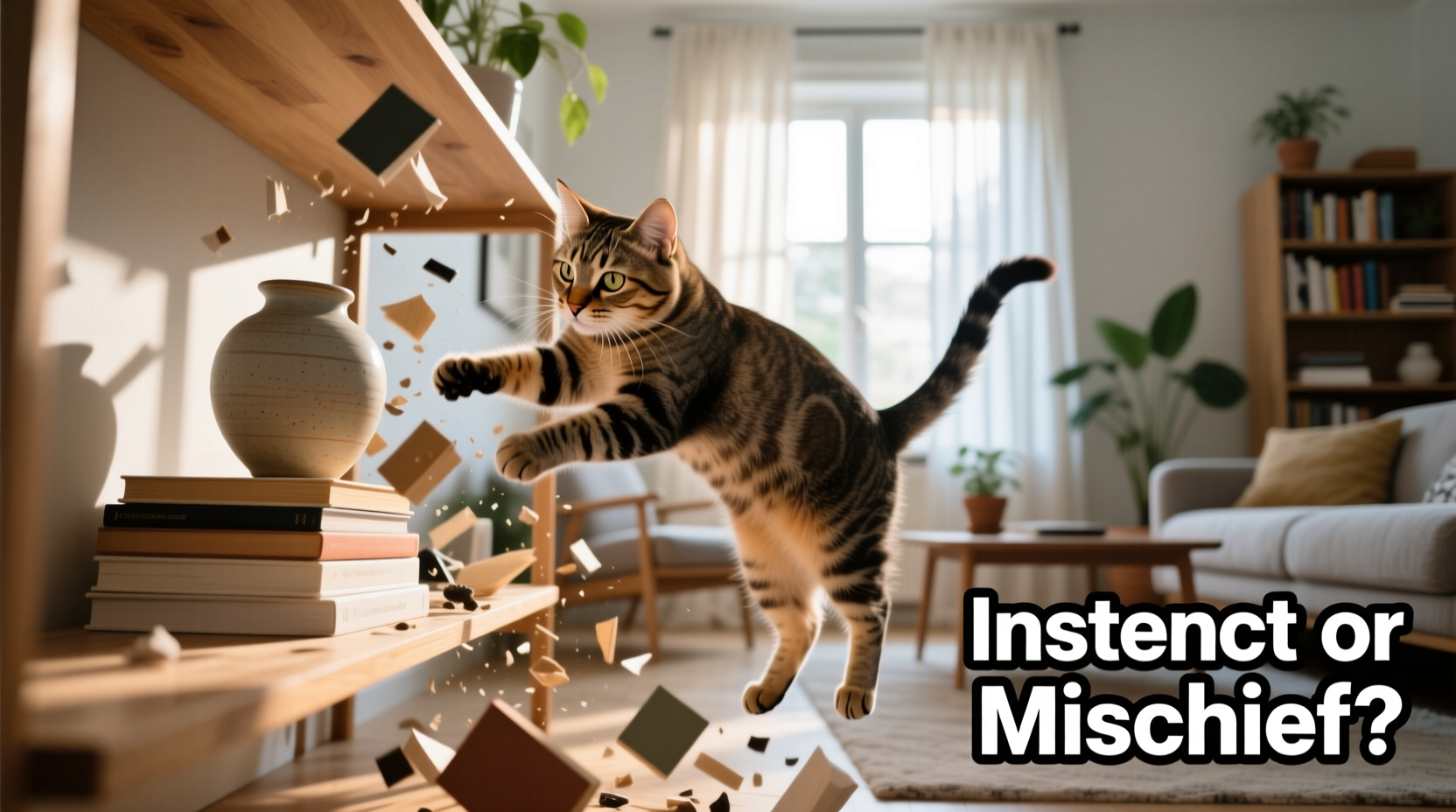
To understand why your cat bats items off surfaces, we must look back to their wild ancestors. Domestic cats (Felis catus) evolved from solitary hunters who relied on stealth, precision, and acute sensory awareness to survive. In the wild, movement often signals life—a twitching leaf could mean prey, a shifting shadow might indicate danger. Cats are hardwired to investigate motion, sound, and change in their environment.
When a cat knocks an object off a shelf, the fall creates noise, motion, and unpredictability—all stimuli that trigger their predatory instincts. Even if they don’t eat the object, the act of causing it to move satisfies a deep-seated need to interact with and assess potential threats or opportunities in their territory.
“Cats don’t knock things over out of malice—they’re conducting environmental research with their paws.” — Dr. Sarah Ellis, Feline Behavior Scientist, University of Lincoln
This behavior mimics hunting sequences: stalk, paw, strike, observe. The falling object becomes a stand-in for prey, triggering the same neurological pathways involved in real hunts. For indoor cats especially, who lack daily opportunities to hunt live prey, such actions serve as mental enrichment and physical stimulation.
Sensory Exploration and Communication
Cats experience the world differently than humans. While we rely heavily on vision, cats integrate touch, hearing, smell, and even vibration to build a complete picture of their surroundings. Their paws are highly sensitive, packed with nerve endings that allow them to \"feel\" textures, temperatures, and movements.
When a cat taps or swats an object, they’re gathering information:
- Texture: Is it smooth, rough, cold?
- Movement: Does it roll, slide, or fall?
- Sound: Does it make noise when it hits the ground?
- Reaction: How do humans respond?
Each interaction provides feedback. If knocking something down results in attention—even negative attention like scolding—the cat learns it’s an effective way to communicate. This doesn’t mean they’re being defiant; it means they’ve discovered a reliable method to influence their environment and engage with their human companions.
Tip: Rotate toys and interactive puzzles weekly to satisfy your cat’s curiosity and reduce random object-knocking.Attention-Seeking vs. Boredom: What’s Really Driving the Behavior?
While instinct plays a major role, psychological factors also contribute. Indoor cats, particularly those without sufficient mental or physical stimulation, may resort to knocking things over simply because they’re bored. Without outlets for natural behaviors like climbing, stalking, and capturing, they invent their own games.
In many cases, object-knocking escalates when cats realize it gets a reaction. A sudden shout, a rush to clean up, or even playful laughter reinforces the action. To the cat, this is engagement—proof that their behavior has power.
A 2020 study published in *Applied Animal Behaviour Science* found that cats living in environments with limited enrichment were significantly more likely to exhibit repetitive or disruptive behaviors, including pushing objects off edges. The researchers concluded that “environmental predictability and lack of control” were key contributors to such actions.
Mini Case Study: Luna and the Coffee Table Trinkets
Luna, a three-year-old domestic shorthair, lived with her owner Emma in a small apartment. Over several months, Emma noticed that every morning, at least one item from her coffee table—remote controls, books, candles—had been knocked onto the floor. She assumed Luna was being “annoying” and began covering surfaces with clutter-free strictness.
After consulting a veterinary behaviorist, Emma realized Luna wasn’t acting out of spite. Instead, she was under-stimulated. Working from home, Emma spent hours typing, rarely interacting with Luna during the day. The only time Luna consistently got attention was when she disrupted something.
By introducing scheduled play sessions with wand toys, food puzzles, and rotating sensory stations (like cardboard boxes with crinkly paper), Emma redirected Luna’s energy. Within three weeks, the shelf-knocking incidents dropped by over 80%. The behavior hadn’t vanished completely—but now it occurred mostly during designated playtime, indicating a shift from frustration to fun.
Do’s and Don’ts: Managing Shelf-Knocking Behavior
| Do | Don't |
|---|---|
| Provide daily interactive play using wand toys that mimic prey movement | Punish your cat for knocking things over—it increases anxiety and confusion |
| Use stable furniture and secure valuables with museum putty or adhesive strips | Leave tempting objects (like dangling cords or wobbly cups) within paw’s reach |
| Offer puzzle feeders and treat-dispensing toys to stimulate problem-solving | Ignore your cat for long stretches, then react dramatically to misbehavior |
| Create vertical spaces like cat trees and shelves for safe exploration | Assume the behavior will stop on its own without environmental changes |
Step-by-Step Guide to Reducing Unwanted Knocking
If your cat frequently sends items tumbling, consider this five-step approach to address both cause and effect:
- Assess the Environment: Walk through each room from your cat’s eye level. Identify high-risk zones where objects sit near edges. Remove fragile or hazardous items.
- Increase Daily Stimulation: Dedicate two 10-minute sessions per day to active play using feather wands, laser pointers (followed by a tangible reward), or motorized toys.
- Introduce Enrichment Tools: Use treat balls, snuffle mats, or DIY puzzle boxes filled with kibble to keep your cat mentally engaged when you're busy.
- Redirect, Don’t React: If you catch your cat mid-swipe, calmly interrupt with a toy toss in another direction. Never yell or physically punish.
- Secure Valuables: Use clear silicone putty (like Museum Wax) to stabilize photo frames, lamps, or decor. Install shelf barriers or acrylic edge guards where needed.
When Instinct Meets Interior Design: Coexisting Peacefully
It’s unrealistic to expect a cat to never bat at anything on a surface. Rather than trying to eliminate the behavior entirely, aim to manage it sustainably. Think of your home not as a pristine showroom but as a shared habitat—one that accommodates both human aesthetics and feline needs.
Designate certain areas as “cat-safe zones” where lightweight, durable, and non-valuable objects can be placed intentionally for interaction. For example, a low shelf with ping pong balls, empty toilet paper rolls, or plastic bottle caps gives your cat a legal outlet for batting and chasing.
Meanwhile, reserve higher shelves and main living surfaces for secured or immovable items. This balance respects your cat’s nature while protecting your belongings.
Frequently Asked Questions
Is my cat knocking things over to get back at me?
No. Cats don’t operate on revenge or spite. Their actions are driven by instinct, curiosity, or learned outcomes—not moral judgment. If your cat seems to target items after you’ve left the room, it’s more likely due to boredom or residual energy than emotional retaliation.
Why does my cat only knock things off in front of me?
This is often a form of social interaction. Your cat has learned that knocking something down elicits a response—whether it’s picking it up, talking to them, or playing. They’re not being manipulative; they’re using the tools they know to connect with you.
Could this behavior signal a health problem?
In rare cases, obsessive or sudden-onset knocking behavior could indicate underlying issues like hyperesthesia, cognitive dysfunction (in older cats), or neurological conditions. If the behavior is accompanied by vocalization, tail flicking, self-mutilation, or disorientation, consult your veterinarian.
Conclusion: Understanding Over Correction
Your cat isn’t being malicious when they send your keys flying off the side table. They’re exploring, hunting, communicating, and sometimes just having fun. Labeling this behavior as “mischief” anthropomorphizes a complex instinctual drive. By reframing it as natural expression rather than defiance, we open the door to compassionate solutions.
Instead of asking, “How do I stop my cat from doing this?” try asking, “What does my cat need right now?” More play? Better toys? More vertical space? A predictable routine? Addressing the root causes leads to lasting peace—for both your shelves and your relationship with your cat.
💬 Have a story about your cat’s favorite thing to knock down? Share it in the comments below—let’s celebrate the chaos with empathy and humor!








