Every holiday season, millions of households bring home an artificial Christmas tree—valued for its convenience, reusability, and low maintenance. But one surprising side effect often catches people off guard: the sudden zap of static electricity when touching the tree or nearby ornaments. This seemingly minor annoyance isn’t just uncomfortable—it can damage delicate decorations, startle children and pets, and even pose a fire risk in rare cases. Understanding why this happens and how to prevent it is essential for a safe and enjoyable holiday setup.
The root cause lies in the materials used to make artificial trees and the environmental conditions common during winter months. Most artificial trees are constructed from synthetic plastics like PVC (polyvinyl chloride) and polyester, both of which are excellent at generating and holding static charges. When combined with dry indoor air—a hallmark of heated homes in cold weather—the stage is set for frequent electrostatic discharges. The good news? With targeted interventions, you can significantly reduce or eliminate static buildup on your artificial tree.
The Science Behind Static Buildup on Artificial Trees
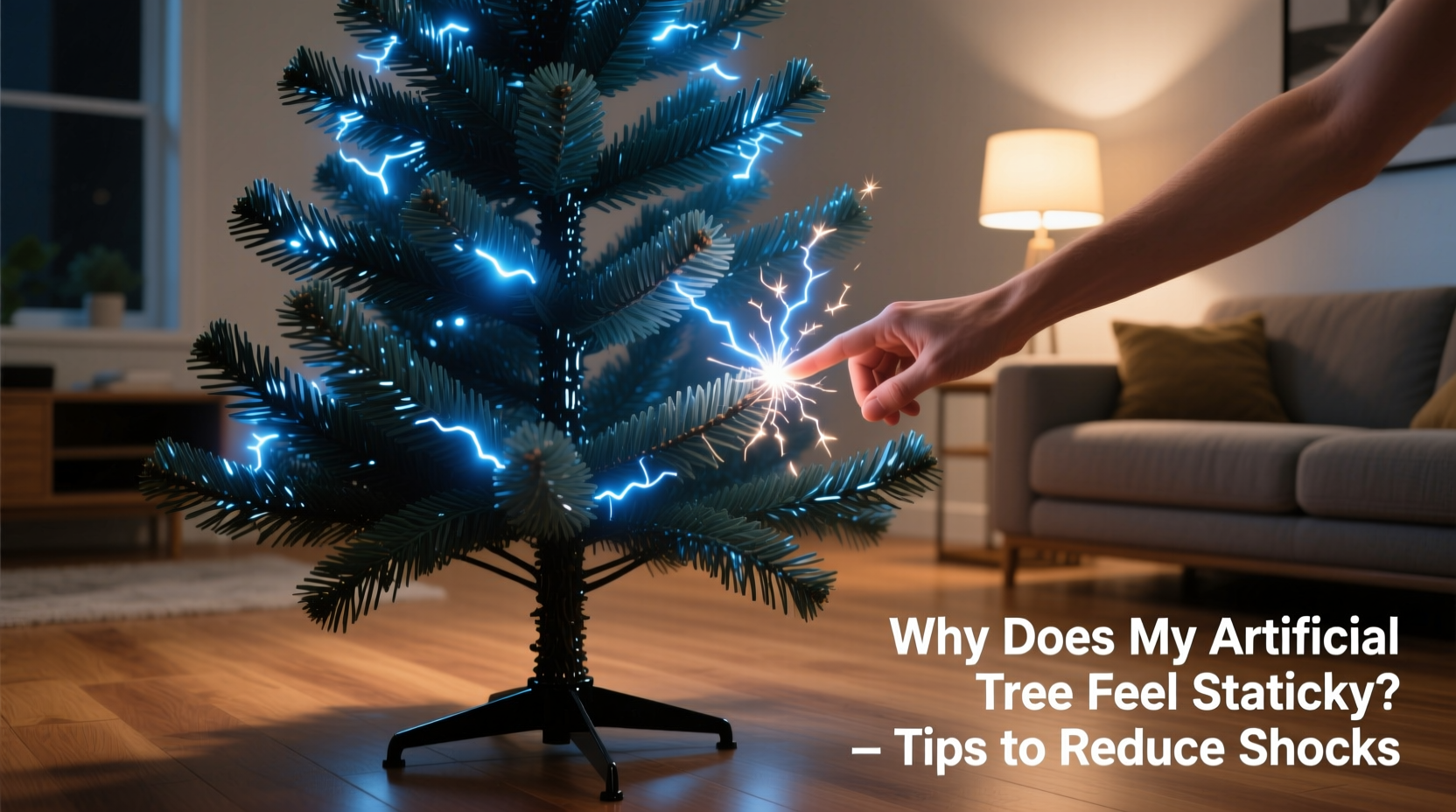
Static electricity occurs when electrons transfer between two surfaces through friction, contact, or separation—a process known as triboelectric charging. In the case of artificial trees, this commonly happens when:
- Dry air passes over the plastic needles.
- People brush against the branches while decorating.
- Ornaments made of metal or glass touch synthetic foliage.
- Pet fur rubs against the tree during exploration.
The plastic components of artificial trees rank high on the triboelectric series, meaning they readily give up or accept electrons when interacting with other materials. Once charged, the tree holds onto that electrical potential until it finds a path to ground—often through a person’s finger, resulting in a small but noticeable shock.
Indoor humidity plays a crucial role. During winter, indoor relative humidity frequently drops below 30%, sometimes as low as 10–15% in tightly sealed, heated homes. Dry air is a poor conductor of electricity, so charges accumulate instead of dissipating naturally. This creates ideal conditions for static buildup on non-conductive surfaces like plastic trees.
“Low humidity is the primary driver of static issues in homes during winter. Without adequate moisture in the air, synthetic materials become electrified easily.” — Dr. Alan Reeves, Environmental Physicist and Indoor Air Quality Researcher
Effective Ways to Reduce Static Shocks from Your Artificial Tree
Reducing static on your artificial tree involves increasing conductivity, minimizing charge generation, and safely dissipating existing charges. Below are proven methods to neutralize static and prevent shocks.
1. Increase Indoor Humidity
Maintaining indoor humidity between 40% and 60% is one of the most effective ways to combat static electricity. Moisture in the air allows charges to dissipate gradually rather than building up to shock-inducing levels.
Tip: Use a hygrometer to monitor room humidity. Many affordable digital models provide real-time readings and alerts.Run a humidifier near the tree, especially in rooms where heating systems dry the air aggressively. Cool-mist humidifiers are generally safer around electronics and decorations. For larger spaces, consider a whole-house humidifier integrated into your HVAC system.
2. Treat the Tree with Anti-Static Spray
Commercial anti-static sprays work by leaving a thin, conductive residue on surfaces that helps dissipate electrical charges. Apply a light mist to the tree branches from about 12 inches away, focusing on high-contact areas. Avoid oversaturating, as excess moisture could damage lights or metal components.
You can also make a DIY anti-static solution using:
- 1 cup distilled water
- 1 tablespoon fabric softener
Mix in a spray bottle and lightly mist the outer branches. Test on a small area first to ensure no discoloration or stickiness occurs. Reapply every few weeks if needed.
3. Ground the Tree
Grounding provides a safe path for static charges to discharge without shocking anyone. While you can't \"plug in\" a tree like an appliance, you can create a grounding point using simple materials.
Attach a bare copper wire (16–18 gauge) to a metal part of the tree stand or trunk frame. Run the other end to a grounded source such as:
- A grounded metal pipe (e.g., radiator or faucet)
- The ground pin of a properly wired electrical outlet (use caution and consult an electrician if unsure)
This method works best in older homes with metal plumbing systems. Always verify grounding safety before connecting any conductive material to household utilities.
4. Use Natural Fiber Skirts and Rugs
Synthetic tree skirts made from polyester or acrylic can contribute to static buildup. Replace them with natural materials like cotton, burlap, or wool. These fibers absorb moisture better and generate less static when touched.
Similarly, placing a cotton or wool rug under the tree improves local humidity retention and reduces charge accumulation from foot traffic.
5. Choose Low-Static Ornaments and Lighting
Metal and glass ornaments conduct electricity more readily than plastic ones, increasing the chance of a shock when touching them after brushing the tree. Opt for lightweight plastic, felt, or wood decorations where possible.
LED lights produce less heat and are less likely to dry out surrounding air compared to incandescent bulbs. They’re also safer overall due to lower voltage operation.
Step-by-Step Guide: How to De-Static Your Artificial Tree
Follow this timeline-based approach to eliminate static shocks before and during the holiday season.
- Week 1: Assess and Prepare
Measure room humidity with a hygrometer. If below 40%, plan to use a humidifier. Inspect the tree for dust, which exacerbates static. Clean branches with a microfiber cloth. - Day of Assembly: Pre-Treat
Before assembling, lightly mist the tree with a commercial or homemade anti-static spray. Let dry completely. Assemble the tree away from carpeted areas if possible. - After Setup: Control Environment
Position a humidifier within 6 feet of the tree. Set target humidity to 45%. Monitor daily for the first week. - Ongoing Maintenance: Weekly Check
Reapply anti-static spray every 2–3 weeks. Dust branches gently with a dryer sheet to neutralize residual charge. Check grounding wire (if used) for continuity. - Holiday End: Storage Prep
Before packing, wipe down all sections with a dryer sheet. Store in a breathable fabric bag (not plastic), ideally in a climate-controlled space to prevent future static-prone drying.
Do’s and Don’ts: Managing Static on Artificial Trees
| Do’s | Don’ts |
|---|---|
| Use a humidifier to maintain 40–60% humidity | Allow humidity to drop below 30% |
| Clean branches with a microfiber cloth or dryer sheet | Wipe with wet paper towels that leave residue |
| Apply anti-static spray before decorating | Use excessive amounts of spray that could damage wiring |
| Choose cotton or wool tree skirts | Use synthetic fabrics that generate more static |
| Store tree in a breathable container | Keep tree in sealed plastic bags that trap dry air |
Real-Life Example: A Family’s Static-Free Holiday Transformation
The Thompson family in Minneapolis had struggled for years with their 7-foot artificial tree zapping everyone who approached. Their two young children dreaded decorating because of the frequent shocks, and one incident caused a LED string to flicker erratically after a discharge.
In November 2023, they decided to take action. They purchased a digital hygrometer and discovered their living room humidity was only 22%. They invested in a cool-mist humidifier and placed it near the tree. They cleaned the tree with a microfiber cloth, then lightly sprayed it with a mixture of water and fabric softener. They replaced their polyester tree skirt with a burlap one and switched to plastic ornaments for the lower branches.
The difference was immediate. Over the next four weeks, not a single shock occurred. The children decorated freely, and the lights remained stable. By maintaining humidity at 48%, they enjoyed a static-free holiday season for the first time in years.
Frequently Asked Questions
Can static electricity from my artificial tree start a fire?
While extremely rare, a large static discharge near flammable materials (like loose insulation or aerosol sprays) could potentially ignite a fire. Modern artificial trees are designed to be flame-retardant, and standard holiday lights operate at low enough power to minimize risk. However, it's still wise to reduce static buildup as a precaution.
Why do I only get shocked when I touch certain parts of the tree?
Static tends to concentrate on isolated conductive elements like metal hooks, ornament hangers, or light sockets. When your body (a conductor) bridges the gap between these charged points and ground, the stored energy releases quickly, causing a localized shock. Areas with more friction—like densely packed branches—are also more prone to charge accumulation.
Are some artificial trees more static-prone than others?
Yes. Trees made primarily of PVC tend to generate more static than those using PE (polyethylene) or blended materials. Higher-quality trees often include anti-static additives during manufacturing. Cheaper models, especially those shipped in compressed plastic packaging, are more likely to retain static charge due to prolonged contact and drying.
Checklist: Prevent Static on Your Artificial Tree This Season
- ✅ Measure room humidity with a hygrometer
- ✅ Run a humidifier to maintain 40–60% RH
- ✅ Clean tree branches before assembly
- ✅ Apply anti-static spray or DIY solution
- ✅ Use natural fiber tree skirt and rug
- ✅ Replace metal/glass ornaments on lower branches
- ✅ Consider grounding the tree stand (optional)
- ✅ Store tree in breathable bag after holidays
Conclusion: Enjoy a Shock-Free Holiday Experience
Static shocks from artificial trees are a common but solvable problem. By understanding the interplay between synthetic materials and dry winter air, you can take proactive steps to create a safer, more comfortable environment for your family. Simple changes—like adding moisture to the air, using anti-static treatments, and choosing natural textiles—can transform your holiday decor from a source of discomfort to a symbol of warmth and joy.
Start preparing now, before the tree comes out of storage. Monitor your indoor climate, inspect your materials, and apply the strategies outlined here. Not only will you reduce annoying shocks, but you’ll also protect your decorations and extend the life of your tree.
💬 Have a tip that worked for your staticky tree? Share your experience in the comments and help others enjoy a smoother, spark-free holiday season!








