
Squirrels are a common sight in parks, backyards, and forests across much of the world. Their sudden leaps, zigzag sprints, and abrupt stops often seem chaotic—almost comical—to human observers. But beneath this erratic behavior lies a sophisticated system of survival strategies refined through evolution. What appears to be random movement is, in fact, a calculated response to constant threats from predators such as hawks, foxes, and domestic cats. These unpredictable patterns are not signs of confusion or playfulness; they are essential adaptations that dramatically increase a squirrel’s chances of escaping with its life.
Their jerky, stop-start motion isn’t just instinctual—it’s a finely tuned combination of physical agility, environmental awareness, and cognitive decision-making. By understanding the science behind their movements, we gain insight into how small prey animals navigate dangerous environments with remarkable efficiency.
The Science Behind Erratic Movement: Predator Confusion
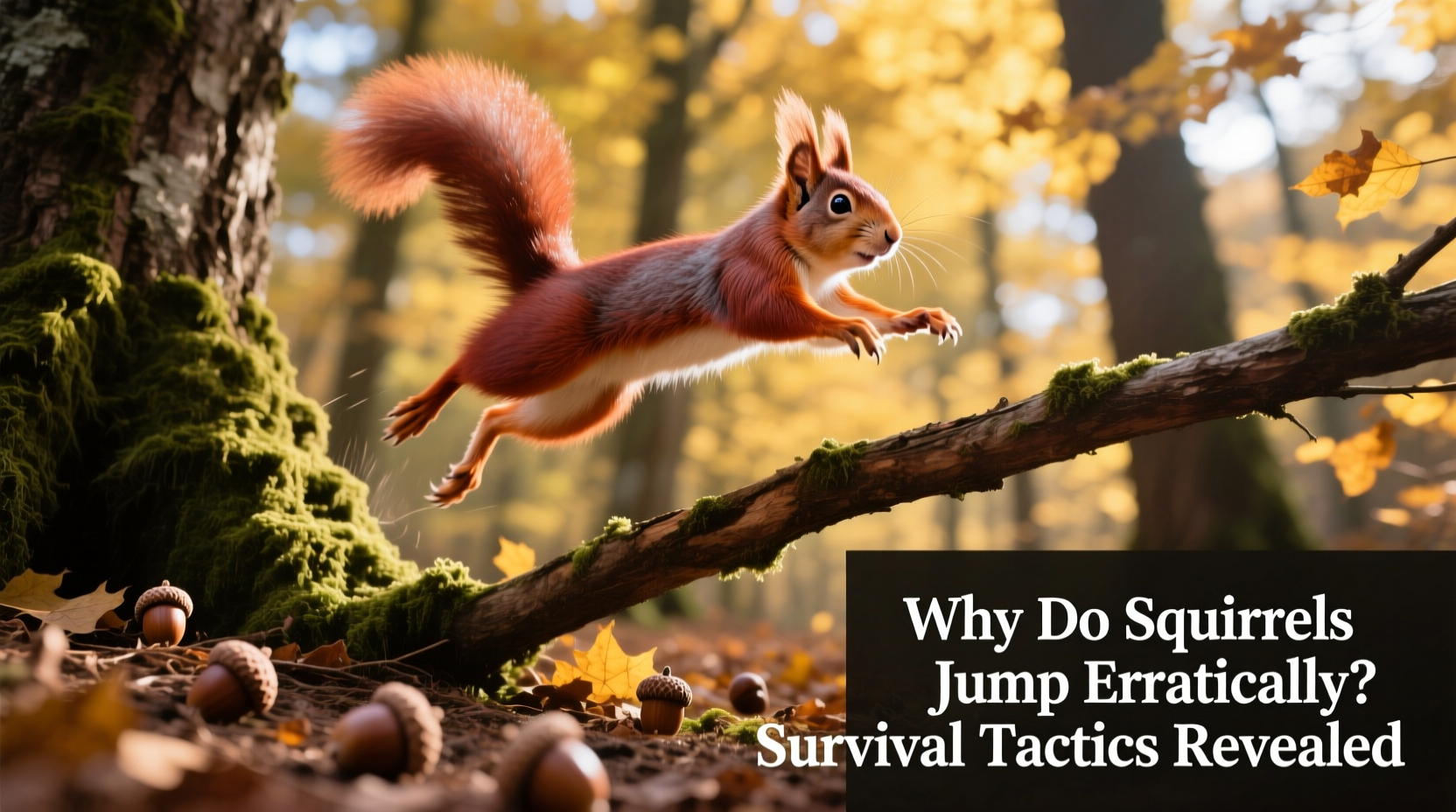
Predators rely on prediction. Whether it's a red-tailed hawk diving from above or a house cat stalking from the bushes, successful hunting depends on the ability to anticipate an animal’s path. Squirrels disrupt this process by making their trajectories nearly impossible to forecast.
This strategy, known as **motion dazzle** or **protean behavior**, involves sudden changes in speed, direction, and pattern. Unlike camouflage, which hides an animal, protean behavior doesn't prevent detection—it makes capture difficult even after the predator has locked onto its target.
A 2017 study published in *Animal Behaviour* analyzed the escape routes of eastern gray squirrels (*Sciurus carolinensis*) when pursued by simulated predators. The researchers found that squirrels consistently used sharp turns, mid-leap pivots, and pauses followed by explosive bursts of speed. These actions reduced the predator’s success rate by over 60% compared to linear escape attempts.
“Squirrels don’t run away in straight lines because nature rewards unpredictability. Their erratic jumps aren’t random—they’re anti-predator algorithms executed in real time.” — Dr. Lena Torres, Behavioral Ecologist at the University of AlbertaTip: When observing squirrels, notice how they freeze before darting off—this pause allows them to assess threat direction and choose the most effective escape route.
Physical Adaptations That Enable Rapid Maneuvering
Erratic jumping isn’t just about behavior—it requires specialized anatomy. Squirrels possess several physical traits that make their acrobatic escapes possible:
- Highly flexible spine: Allows for quick mid-air twists and directional shifts.
- Sharp claws: Provide grip on bark, concrete, and metal surfaces, enabling rapid acceleration and last-second turns.
- Powerful hind legs: Generate explosive bursts of speed, reaching up to 20 mph in short sprints.
- Excellent depth perception: Forward-facing eyes give binocular vision crucial for judging distances during leaps between branches.
- Lightweight bodies: Reduce inertia, allowing quicker stops and starts.
These features work together to turn the squirrel into a highly maneuverable escape artist. For example, when fleeing across open ground, a squirrel may leap three feet forward, pivot 180 degrees, then scurry sideways under a bush—all within two seconds. This kind of agility overwhelms a predator’s sensory processing, especially aerial hunters like owls and hawks that rely on smooth pursuit trajectories.
Tree-to-Ground Transitions: A Tactical Advantage
One of the most effective survival tactics is the squirrel’s ability to transition seamlessly between vertical and horizontal planes. They exploit three-dimensional space far more effectively than most terrestrial predators can follow.
When threatened in a tree, a squirrel will often spiral down the trunk headfirst—a feat few mammals can perform—then dash across the ground in a series of unpredictable hops before leaping back up another tree at a different location. This “drop-and-dart” tactic breaks visual continuity and forces the predator to reacquire the target, wasting precious seconds.
Environmental Awareness and Risk Assessment
Squirrels don’t react blindly to danger. They constantly scan their surroundings using both vision and hearing. Their large, mobile ears detect subtle sounds like rustling leaves or wingbeats, while their eyes remain alert for shadows overhead—a key indicator of raptor presence.
Before initiating any movement, squirrels often engage in what scientists call **risk-assessment freezing**. During this brief pause, they analyze the type of threat (aerial vs. ground-based), distance, and available escape routes. This moment of stillness enhances their next move’s effectiveness.
For instance, if a squirrel detects a cat creeping along a fence, it may retreat upward into the canopy where the cat cannot follow. If a hawk circles above, the squirrel might flatten itself against a thick branch or dive into dense foliage, minimizing visibility.
Memory and Route Planning Enhance Survival
Contrary to popular belief, squirrels don’t flee randomly. Research shows they use spatial memory to recall safe pathways, shelter locations, and food caches. Urban squirrels, in particular, learn traffic patterns and pedestrian flows, timing their crossings to avoid collisions and exposure.
A study conducted in Chicago observed that city-dwelling squirrels crossed roads primarily during lulls in traffic and preferred routes near trees or lampposts that offered immediate climbing options. This demonstrates not only adaptability but also advanced environmental cognition.
Do’s and Don’ts: How Squirrel Tactics Compare to Other Prey Animals
| Tactic | Squirrels | Rabbits | Birds (e.g., sparrows) |
|---|---|---|---|
| Escape Pattern | Zigzag jumps, sudden stops, tree transitions | Linear sprint with sharp turns | Direct flight to nearest cover |
| Predator Confusion | High – uses erratic motion | Moderate – relies on speed | Low – prioritizes distance |
| Use of Vertical Space | Extensive – climbs and leaps | Limited – mostly ground-level | Full flight capability |
| Risk Assessment | Long pauses, scanning | Short freeze, then bolt | Immediate takeoff |
| Memory Use | High – remembers escape routes | Moderate – knows burrow locations | Seasonal migration memory |
This comparison highlights how squirrels uniquely combine terrain versatility with behavioral unpredictability, giving them an edge in fragmented habitats like urban parks and suburban neighborhoods.
Mini Case Study: The Park Squirrel and the Neighborhood Cat
In a residential neighborhood in Portland, Oregon, a local gray squirrel became known among residents for evading the same outdoor cat for over six months. Security camera footage captured multiple encounters, revealing a consistent pattern:
- The cat would stalk slowly toward the squirrel while it foraged.
- The squirrel would freeze, flick its tail (a signal of alertness), and assess the cat’s position.
- Instead of fleeing immediately, it would wait until the cat was within 10 feet—close enough to commit to an attack.
- Then, the squirrel would dart sideways, run five feet, leap onto a picnic table, and vanish into a nearby oak tree via a low-hanging branch.
Remarkably, the squirrel never used the same escape path twice in succession. It alternated between climbing routes and ground dashes, sometimes doubling back to confuse scent trails. Wildlife biologists reviewing the footage noted that the delay in escape was strategic: launching too early would have allowed the cat to anticipate the direction, while waiting until the last moment maximized surprise.
This case illustrates how individual squirrels can refine their survival tactics through experience, adapting not just to species-wide threats but to specific predators in their environment.
Step-by-Step: How a Squirrel Executes an Escape Sequence
Understanding the precise sequence of actions during a threat reveals the sophistication behind seemingly chaotic behavior. Here's a breakdown of a typical squirrel escape:
- Detection: Ears twitch and body freezes as the squirrel registers movement or sound.
- Assessment: Head swivels to locate the threat; determines whether it’s airborne or ground-based.
- Decision: Chooses optimal escape path—up a tree, under a shed, or across open ground.
- Initiation: Launches into motion with a burst of speed, often at an angle to avoid direct pursuit.
- Disruption: Mid-run, performs a sharp turn, hop, or pause to break rhythm.
- Transition: Reaches safety (tree, hole, or dense vegetation) and remains still to avoid further attention.
- Vigilance: Continues monitoring the area for several minutes before resuming normal activity.
Each step happens rapidly—often within 5–10 seconds—but represents a complex interplay of sensory input, memory, and motor control. The entire process is optimized for energy efficiency and maximum evasion success.
Frequently Asked Questions
Why do squirrels flick their tails when they see a predator?
Tail-flicking serves multiple purposes: it signals to the predator that it has been detected (discouraging pursuit), alerts other squirrels in the area, and can act as a decoy by drawing attention to a moving part of the body while the head remains still and hidden.
Are baby squirrels as good at escaping as adults?
No. Juvenile squirrels are less coordinated and lack experience. They tend to panic and run in straight lines, making them more vulnerable. Survival rates increase significantly once they mature and refine their escape techniques through trial and observation.
Can squirrels recognize individual predators?
Yes. Studies suggest squirrels can distinguish between different types of threats and even recognize specific animals. Urban squirrels have been observed reacting more calmly to humans who regularly pass by without threatening them, while remaining highly alert to dogs or cats they’ve encountered before.
Expert Insight: The Evolutionary Edge of Unpredictability
Dr. Marcus Reed, a neuroethologist specializing in small mammal behavior, explains that squirrels’ erratic movements are not simply reflexive but involve higher-order brain functions.
“The squirrel’s brain processes risk in real time. It weighs speed versus stealth, chooses routes based on past outcomes, and even factors in wind conditions when leaping between trees. This isn’t randomness—it’s dynamic problem-solving under pressure.” — Dr. Marcus Reed, Neuroethology Lab, UC Davis
He adds that squirrels raised in high-predation environments develop more complex escape behaviors than those in protected areas, proving that these tactics are both innate and learned.
Conclusion: Nature’s Master of Misdirection
The erratic jumps and zigzag sprints of squirrels are far more than amusing quirks of backyard wildlife. They represent millions of years of evolutionary refinement aimed at one goal: survival. Every twist, pause, and leap is a deliberate act designed to outwit faster, stronger, and often deadlier adversaries.
By combining anatomical advantages with intelligent decision-making and environmental mastery, squirrels exemplify how even the smallest creatures can thrive in hostile landscapes. Observing their behavior offers not just entertainment, but a lesson in resilience, adaptability, and the power of strategic unpredictability.
🚀 Next time you see a squirrel darting wildly across your lawn, take a moment to appreciate the precision behind the chaos. Share this insight with others and deepen your understanding of nature’s ingenious survival tactics!








