
If you've ever watched squirrels darting across your yard, leaping from tree to tree in a blur of motion, you may have noticed them chasing one another in tight, looping patterns. At first glance, it looks like playful behavior—perhaps even a game of tag. But these chases are rarely about fun. Instead, they're driven by powerful biological impulses tied to reproduction and dominance. Understanding why squirrels engage in this behavior requires distinguishing between two primary motivations: mating season dynamics and territorial disputes. While both scenarios involve pursuit, the underlying causes, timing, participants, and outcomes differ significantly.
The Science Behind Squirrel Chasing Behavior
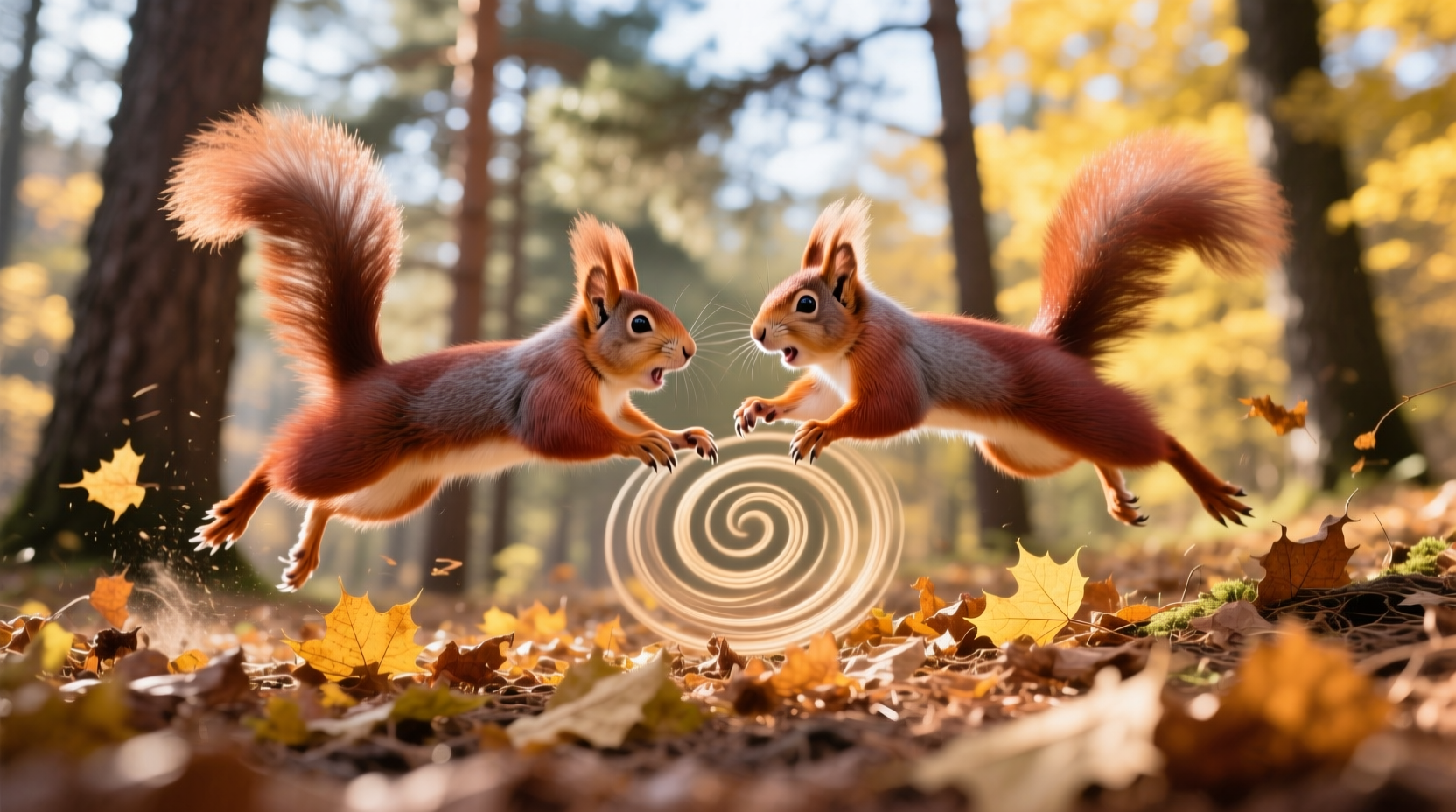
Squirrels are highly active, social rodents that rely on visual and vocal communication to navigate their environment. Their chases are not random; they follow predictable patterns based on context. The circular or zigzagging pursuit often seen in backyards and parks is typically an expression of either reproductive competition or resource defense. These behaviors are deeply ingrained in their evolutionary biology and serve essential functions in survival and species propagation.
Eastern gray squirrels (Sciurus carolinensis), the most commonly observed species in urban and suburban North America, exhibit particularly noticeable chasing patterns. These animals are diurnal and highly visible, making their interactions frequent subjects of curiosity. Researchers studying squirrel behavior have identified key differences in body language, duration, and group composition during chases depending on whether the motivation is sexual or territorial.
Mating Season Chases: A Race for Reproduction
During mating season, squirrel chases are primarily driven by reproductive urgency. Female squirrels enter estrus for only a few hours once or twice a year—typically in late winter (January–February) and mid-summer (June–July). When a female is receptive, she releases pheromones that attract multiple males from surrounding areas. This triggers competitive pursuit, where several males chase the female through trees and across lawns in an attempt to mate.
This type of chase is often described as a \"mating convoy.\" It can involve three to ten males following a single female in rapid succession. The dominant male usually wins mating rights, though females may exercise some choice in the process. These pursuits are fast-paced, acrobatic, and cover large distances. They are less likely to be strictly circular but may appear so due to repeated loops around trees or structures.
“Mating chases are among the most intense displays of squirrel athleticism. Males will travel hundreds of meters in pursuit, showing remarkable agility and endurance.” — Dr. Laura Bennett, Wildlife Ethologist at the University of VermontTip: If you observe a squirrel chase during January or June, especially involving multiple males following one female, it’s almost certainly related to mating season.
Territorial Fights: Defending Resources and Space
In contrast, territorial chases occur year-round but peak when food sources are scarce or nesting sites are contested. Unlike mating chases, which are largely one-sided pursuits led by a receptive female, territorial conflicts involve direct confrontation between two squirrels of similar size—often same-sex individuals. These chases are shorter, more aggressive, and frequently include physical contact such as biting, tail flicking, and vocal scolding.
A typical territorial dispute arises when one squirrel encroaches on another's core area—the zone within its home range containing vital resources like food caches, nests (dreys), or safe travel routes. The resident squirrel responds with a warning call followed by pursuit. The chase may loop around a tree trunk repeatedly, creating the illusion of aimless circling. This circular pattern serves a functional purpose: it allows the defender to maintain visual contact while using the tree as a shield.
These altercations are not always resolved quickly. In some cases, subordinate squirrels are driven out of the area entirely, while others learn to avoid certain zones. Over time, a loose hierarchy emerges, minimizing constant conflict.
Key Differences Between Mating and Territorial Chases
To accurately interpret squirrel behavior, it helps to compare the characteristics of mating versus territorial chases side by side. The table below outlines critical distinctions:
| Feature | Mating Season Chase | Territorial Fight |
|---|---|---|
| Timing | January–February and June–July | Year-round, peaks in fall/winter |
| Participants | One female + multiple males | Two similar-sized squirrels (often same sex) |
| Behavior | Fast, acrobatic, long-distance pursuit | Short bursts, circling trees, physical contact |
| Vocalizations | Minimal; occasional chirps | Frequent scolding, growling, alarm calls |
| Outcome | Mating success for dominant male | Establishment of dominance or displacement |
| Body Language | Fluid movement, tail held high | Aggressive posturing, arched back, puffed tail |
This comparison highlights how context shapes behavior. Observers who understand these cues can begin to “read” squirrel interactions much like interpreting bird songs or bee dances.
How to Tell Which Type of Chase You’re Watching
Distinguishing between mating and territorial chases in real time requires attention to detail. Here’s a practical step-by-step guide to help identify what’s happening in your backyard:
- Note the time of year: Late winter or early summer suggests mating activity.
- Count the number of squirrels: A single female being pursued by multiple males points to mating.
- Observe the path: Long, winding chases across lawns and rooftops indicate mating. Tight loops around a single tree suggest territorial defense.
- Listen for sounds: Harsh scolds and growls accompany fights; mating chases are relatively quiet.
- Watch for physical contact: Biting, grappling, and fur-pulling signal aggression, not courtship.
- Check for nesting signs: Active dreys nearby increase the likelihood of territorial behavior.
Mini Case Study: Urban Squirrel Dynamics in Chicago Parks
In a 2022 observational study conducted in Lincoln Park, Chicago, researchers monitored squirrel interactions over six months. They recorded 147 distinct chasing events across five park zones. Of those, 68% occurred during the spring mating window and involved mixed-sex groups. The remaining 32% were same-sex confrontations, mostly between adult females competing for nesting cavities in oak trees.
One notable observation involved a dominant female who aggressively defended a hollow limb in a mature maple tree. Over three weeks, she repelled seven intrusions through short, circular chases ending in vocal standoffs. Meanwhile, during the February mating surge, a younger female was pursued by nine males over a 40-minute period, covering nearly half a mile of combined distance before mating occurred.
The study concluded that while both types of chases serve adaptive purposes, mating chases are more energetically costly and riskier due to exposure to predators like hawks and domestic cats. Territorial chases, though less dramatic, play a crucial role in stabilizing local populations by reducing conflict over limited space.
Expert Insight: What Biologists Say About Squirrel Social Structure
Squirrel societies are more complex than traditionally assumed. Though not truly social like prairie dogs or meerkats, they maintain intricate spatial relationships governed by scent marking, vocal signals, and memory.
“Squirrels aren’t just reacting instinctively—they’re making strategic decisions. They remember who chased them, where boundaries lie, and which trees hold the best nuts. This cognitive map influences every chase.” — Dr. Marcus Tran, Behavioral Ecologist, University of Toronto
Recent studies using GPS tracking collars have shown that individual squirrels develop personalized patrol routes and adjust their behavior based on past encounters. For example, a squirrel that lost a fight may avoid a rival’s territory for weeks, even if no immediate threat is present. Similarly, males that fail to mate during one season may alter their approach in the next—either by starting earlier or focusing on less competitive areas.
Common Misconceptions About Squirrel Chasing
Several myths persist about why squirrels chase each other. Addressing these misconceptions improves public understanding and reduces unnecessary concern:
- Myth: They’re playing. While young squirrels do engage in play-fighting, adult chases are functionally serious and rarely recreational.
- Myth: All chases end in violence. Most mating chases conclude without injury. Even territorial disputes often resolve with bluffing rather than combat.
- Myth: Only males fight. Female squirrels are just as territorial, especially when protecting offspring or prime nesting sites.
- Myth: Chasing means overcrowding. High squirrel density doesn’t necessarily cause more chases. Well-resourced areas can support stable hierarchies with minimal conflict.
FAQ: Frequently Asked Questions About Squirrel Chasing
Do squirrels ever chase for no reason?
No. Every chase has a functional purpose—whether it’s securing a mate, defending territory, practicing juvenile skills, or escaping a perceived threat. What appears random to humans is usually goal-directed behavior.
Can you stop squirrels from chasing each other?
It’s neither necessary nor advisable. Chasing is a natural part of squirrel ecology. Interfering (e.g., shooing them, removing trees) can disrupt their social balance and lead to greater stress or displacement. If nuisance behavior occurs near homes, focus on humane deterrents like sealing entry points or managing food sources instead.
Are circular chases a sign of illness or distress?
Generally no. Repetitive looping is a tactical maneuver, not a neurological issue. However, if a squirrel exhibits disorientation, stumbling, or lack of fear of humans, it may be ill and should be reported to local wildlife authorities.
Actionable Checklist: How to Observe and Support Healthy Squirrel Behavior
You don’t need to intervene in squirrel chases—but you can become a better observer and steward of urban wildlife. Use this checklist to deepen your understanding and promote coexistence:
- ✅ Keep a journal of chase sightings: Note date, time, number of squirrels, and behavior type.
- ✅ Identify seasonal patterns in your area using a calendar tracker.
- ✅ Avoid feeding squirrels regularly, as this can distort natural foraging and social behaviors.
- ✅ Preserve mature trees and dead limbs where possible—they provide essential shelter and chase terrain.
- ✅ Share observations with citizen science platforms like iNaturalist or Project Squirrel.
- ✅ Educate neighbors about normal squirrel behavior to reduce fear-based interventions.
Conclusion: Appreciating the Complexity Behind the Chase
The next time you see squirrels spiraling around a tree or racing across the grass, take a moment to appreciate the intricate story unfolding before you. That seemingly chaotic chase could be a high-stakes bid for reproductive success or a calculated assertion of dominance. Either way, it reflects millions of years of evolutionary refinement. By learning to distinguish between mating season drives and territorial instincts, we gain deeper insight into the hidden lives of these agile, intelligent creatures.
💬 Have you witnessed a dramatic squirrel chase? Share your experience in the comments below—and help others decode the secret language of backyard wildlife.








