If you’ve ever sat on your porch or looked out your kitchen window, you’ve likely seen two squirrels darting across your lawn, zigzagging up trees, and spinning in tight circles around trunks. This seemingly chaotic game of tag is more than just random energy—it’s a complex display of instinctual behavior shaped by survival, reproduction, and social dynamics. While it might look like pure play, squirrel chasing serves multiple biological purposes, many of which are invisible to the casual observer.
Squirrels—particularly the Eastern gray squirrel (*Sciurus carolinensis*), common across North American backyards—are highly active, intelligent rodents with intricate social systems. Their chases aren’t aimless; they’re messages written in motion. Whether it's a male pursuing a female during breeding season or a dominant squirrel enforcing boundaries, these interactions communicate status, intent, and readiness.
Understanding why squirrels chase each other requires stepping into their world—a world where every leap, dash, and vocal chirp has meaning. Below, we break down the science and behavior behind this fascinating phenomenon, offering insight into what you're really seeing when squirrels spiral through your yard.
Mating Season: The Most Common Reason for Circular Chasing
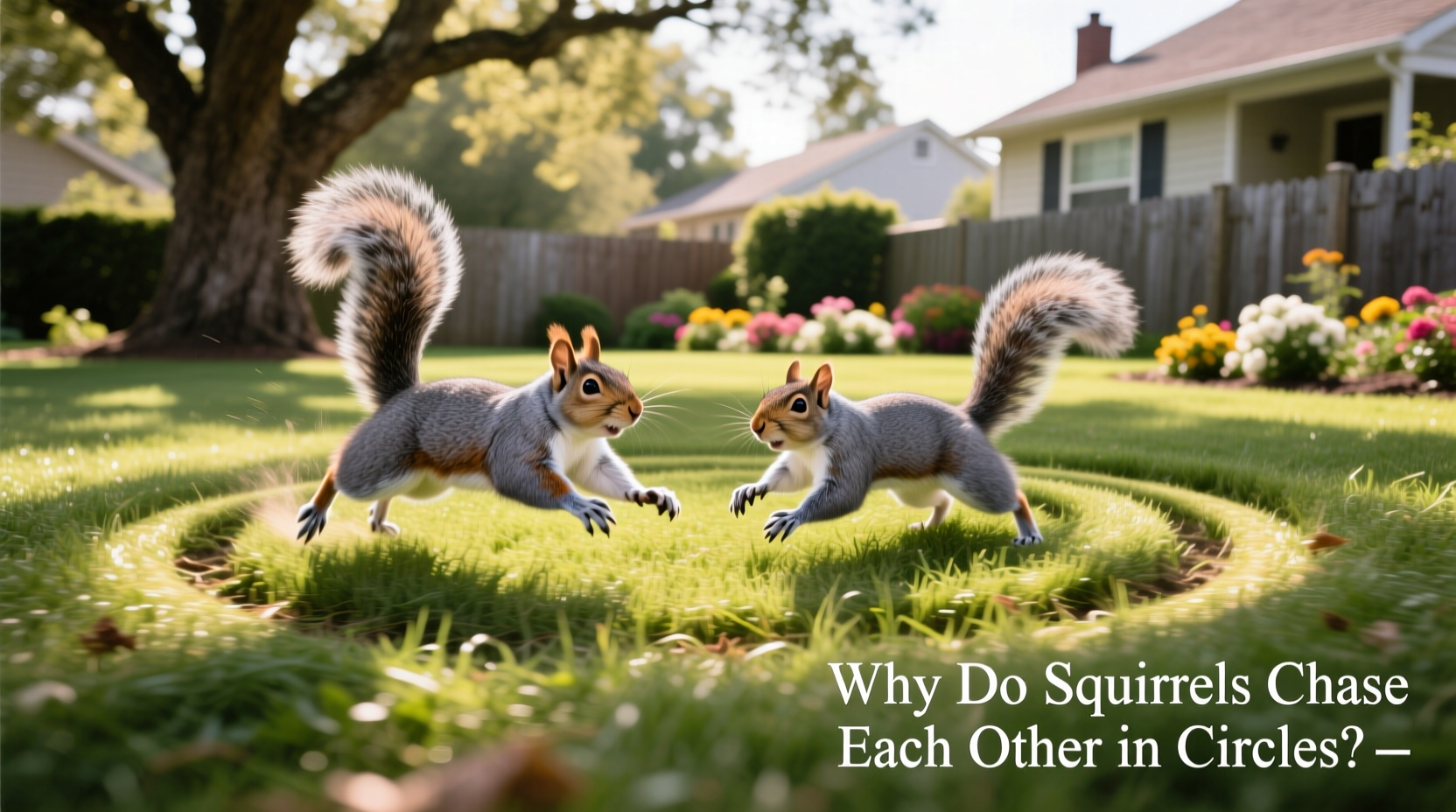
The most frequent cause of intense, looping chases among squirrels occurs during the breeding season. Eastern gray squirrels typically have two breeding periods per year: one from mid-December to February and another from June to July. During these windows, females enter estrus for just a few hours, making timing critical for males.
When a female is ready to mate, she releases pheromones detectable by nearby males. This triggers a pursuit involving multiple suitors, often three to five males, who race after the female in rapid succession. These chases can last several minutes and cover large distances, frequently circling trees and doubling back across lawns.
The circular pattern emerges not from confusion but strategy. Squirrels use trees as central points to monitor movement, gain elevation, and assess competition. A male may loop around a trunk to cut off another suitor or reposition himself closer to the female. The female isn’t passive—she often leads the chase deliberately, testing stamina and agility before choosing a mate.
“Squirrel mating chases are less about romance and more about endurance. The male that stays closest for the longest period usually wins reproductive rights.” — Dr. Laura Bennett, Wildlife Biologist, University of Vermont
This selection process ensures stronger genetics are passed on, as only the fittest males succeed. Interestingly, the female may mate with more than one male during her brief fertile window, leading to litters with multiple paternities—a natural form of genetic diversification.
Tip: If you see squirrels chasing in late winter or early summer, especially with multiple males following one female, it’s almost certainly related to mating activity.Territorial Disputes and Dominance Displays
While squirrels don’t maintain rigidly defined territories like some animals, they do defend core areas—especially those containing food caches, nesting sites (dreys), or access to mates. When an unfamiliar squirrel enters this zone, the resident may respond with aggressive displays, including chasing.
These confrontations often follow circular paths because squirrels use vertical space strategically. A dominant squirrel will pursue an intruder up a tree, around the trunk, and sometimes back down, using height and speed to assert superiority. The goal isn’t necessarily to harm but to communicate: You’re not welcome here.
In urban and suburban environments, where food sources are concentrated (bird feeders, compost bins, ornamental nut trees), competition intensifies. Two squirrels may engage in repeated chases over days, reinforcing dominance hierarchies without physical contact. Vocalizations—sharp barks and chatters—often accompany these pursuits, amplifying the message.
Unlike mating chases, territorial disputes tend to involve fewer participants (usually two) and occur year-round. They also lack the erratic, high-speed looping typical of breeding season. Instead, the movements are more direct, though still punctuated by sudden turns and climbs.
Key Differences Between Mating and Territorial Chases
| Feature | Mating Chase | Territorial Chase |
|---|---|---|
| Number of Participants | One female, multiple males (3–5) | Two squirrels (resident vs. intruder) |
| Time of Year | Late winter, early summer | Year-round, peaks in fall |
| Chase Pattern | Erratic, looping, fast-paced | More linear, focused on escape/defense |
| Vocalizations | Minimal; occasional squeaks | Frequent barking and chattering |
| Outcome | Mating or exhaustion | Retreat of intruder |
Social Play Among Juvenile Squirrels
Not all chases are driven by sex or conflict. Young squirrels—typically between 8 and 16 weeks old—engage in playful chasing as part of their development. After leaving the nest in spring or summer, juveniles spend weeks refining motor skills, spatial awareness, and social cues through mock pursuits.
Playful chases resemble adult behaviors but lack aggression or urgency. The movements are looser, with frequent pauses, role reversals (the chaser becomes the chased), and acrobatic leaps that serve no immediate survival purpose. These sessions strengthen muscles, improve coordination, and help young squirrels learn how to interpret body language—critical for avoiding predators and navigating group dynamics later in life.
Because juvenile squirrels look similar in size and fur density, it can be hard to distinguish them from adults at a glance. However, their behavior is often telltale: if the chase looks like a game, with no clear leader or urgency, and involves frequent climbing attempts followed by clumsy drops, it’s likely play.
“Juvenile play is essential for cognitive development in squirrels. It’s how they learn the rules of engagement before real stakes arrive.” — Dr. Alan Reyes, Behavioral Ecologist, Oregon State University
Food Competition and Cache Defense
In autumn, squirrels become hyper-focused on gathering and storing nuts, seeds, and other food for winter. Each squirrel may bury thousands of items across a home range, relying on spatial memory and scent to retrieve them later. When one squirrel suspects another of pilfering its stash—or even approaching a hidden cache—it may initiate a chase.
These food-related pursuits are typically short bursts rather than extended loops. The defending squirrel will dart toward the perceived thief, attempt to displace it, then return to guard the site. In some cases, the chase escalates into a circular route if both squirrels continue to circle a contested tree or feeder, neither willing to back down.
Bird feeders in residential yards often become hotspots for such conflicts. A well-fed squirrel may dominate access, chasing away newcomers or subordinates. Over time, a hierarchy forms, reducing the need for constant confrontation—but any disruption (a new squirrel, a change in food supply) can reignite chasing behavior.
Tip: To reduce squirrel conflicts around feeders, use squirrel-resistant designs or place feeding stations away from trees and fences to limit quick escape routes.Step-by-Step: How to Interpret Squirrel Chasing in Your Yard
Next time you witness a squirrel chase, you can decode what’s happening with careful observation. Follow this timeline to analyze the behavior:
- Observe the number of squirrels. Is it one chasing another, or is there a cluster following a single individual? Multiple males following one suggest mating activity.
- Note the time of year. December–February and June–July point strongly to mating. Fall chases are more likely tied to food or territory.
- Watch the movement pattern. Erratic, looping chases with rapid direction changes indicate high motivation—common in mating. More direct pursuits suggest territorial defense.
- Listen for sounds. Constant barking and scolding? Likely a territorial dispute. Quiet or minimal noise? Possibly mating or play.
- Check the age of the squirrels. Fluffy tails, smaller bodies, and clumsy movements suggest juveniles playing. Adults are sleeker and more agile.
- Look for environmental triggers. Are they near a bird feeder, a drey, or a known nut-burying spot? Context helps identify whether food or shelter is at stake.
Mini Case Study: The Feeder Wars of Maple Street
In a quiet suburb of Columbus, Ohio, homeowner Maria Thompson installed a sunflower seed feeder in March to attract cardinals. Within days, she noticed daily chases between two gray squirrels—one larger and darker, the other smaller and lighter. The encounters lasted under a minute, always ended with the smaller squirrel retreating, and occurred near the feeder.
Over four weeks, the pattern repeated each morning. By May, the smaller squirrel stopped appearing entirely. Maria assumed it had moved on—until a neighbor mentioned seeing it on the other side of the block.
What Maria witnessed was a classic case of resource-based dominance. The larger squirrel had established control over the feeder, using short, targeted chases to enforce exclusivity. The absence of looping patterns and limited vocalizations ruled out mating. No juveniles were involved, eliminating play as a cause. This was a straightforward case of competitive exclusion—nature’s way of managing limited resources.
FAQ: Common Questions About Squirrel Chasing
Do squirrels ever get hurt during these chases?
Serious injuries are rare. Most chases end with one squirrel retreating. Physical fights do happen—especially between males during mating season—but prolonged combat is uncommon due to the risk of attracting predators. Bites and scratches occur occasionally but rarely prove fatal.
Why do squirrels run in circles around tree trunks?
Circling a tree allows squirrels to maintain visual contact while gaining height, changing direction quickly, and assessing competitors. Trees act as both refuge and strategic vantage points. In mating chases, the female may circle to prolong the test of endurance; in territorial disputes, the defender uses the trunk to block access.
Can you stop squirrels from chasing each other in your yard?
Not—and shouldn’t—you try to stop natural behavior unless it’s causing damage. However, you can reduce frequency by minimizing attractants: use squirrel-proof feeders, remove fallen nuts promptly, and avoid feeding wildlife directly. Providing multiple feeding zones can also diffuse competition.
Expert Insight: What Scientists Have Learned
Decades of field research have revealed that squirrel social behavior is far more nuanced than once believed. Once thought to be solitary and asocial, squirrels are now understood to live in loose colonies with complex communication networks.
“We used to think squirrels were loners. Now we know they recognize individuals, remember past interactions, and even form temporary alliances. Chasing is just one piece of a rich behavioral puzzle.” — Dr. Naomi Chen, Urban Wildlife Researcher, Cornell Lab of Ornithology
Studies using radio telemetry and camera traps show that squirrels develop “neighborhood familiarity,” often tolerating known individuals while aggressively repelling strangers. This reduces unnecessary energy expenditure and increases survival rates in high-density areas.
Conclusion: Appreciating the Complexity Behind the Chase
The next time you see squirrels spinning through your backyard like tiny, furry whirlwinds, take a moment to appreciate what’s really unfolding. That dizzying chase could be a high-stakes mating ritual, a silent negotiation of territory, or a young squirrel’s first lesson in survival. Each dash, turn, and leap carries meaning shaped by millions of years of evolution.
Instead of shooing them away or dismissing them as pests, consider observing them with curiosity. Keep a journal of when chases occur, how many squirrels are involved, and what follows. You might begin to notice seasonal rhythms, returning individuals, and even personalities.
🚀 Start watching your backyard with fresh eyes. Share your observations in the comments or with local wildlife groups—your notes could contribute to citizen science efforts and deepen our understanding of these clever, resilient creatures.








