If you've ever spent time observing wildlife in your backyard, local park, or wooded trail, you’ve likely seen it: two squirrels darting up a tree, spiraling around the trunk, leaping to branches, and racing through the canopy in what looks like an endless game of tag. At first glance, it might seem playful—like nature’s version of hide-and-seek. But beneath this energetic display lies a complex web of instinctual behaviors driven by survival, reproduction, and territorial dynamics. Understanding why squirrels chase each other around trees requires peeling back the layers of their social structure, communication methods, and seasonal motivations.
Squirrels are highly active, intelligent rodents belonging to the family Sciuridae. With over 200 species worldwide, the most commonly observed chasers in urban and suburban areas are eastern gray squirrels (*Sciurus carolinensis*), red squirrels (*Tamiasciurus hudsonicus*), and fox squirrels (*Sciurus niger*). These animals are not just cute—they’re strategic, with behaviors finely tuned by evolution. The chasing you observe is rarely random; it's purposeful, often urgent, and deeply rooted in biological imperatives.
Mating Season Rivalries and Courtship Chases
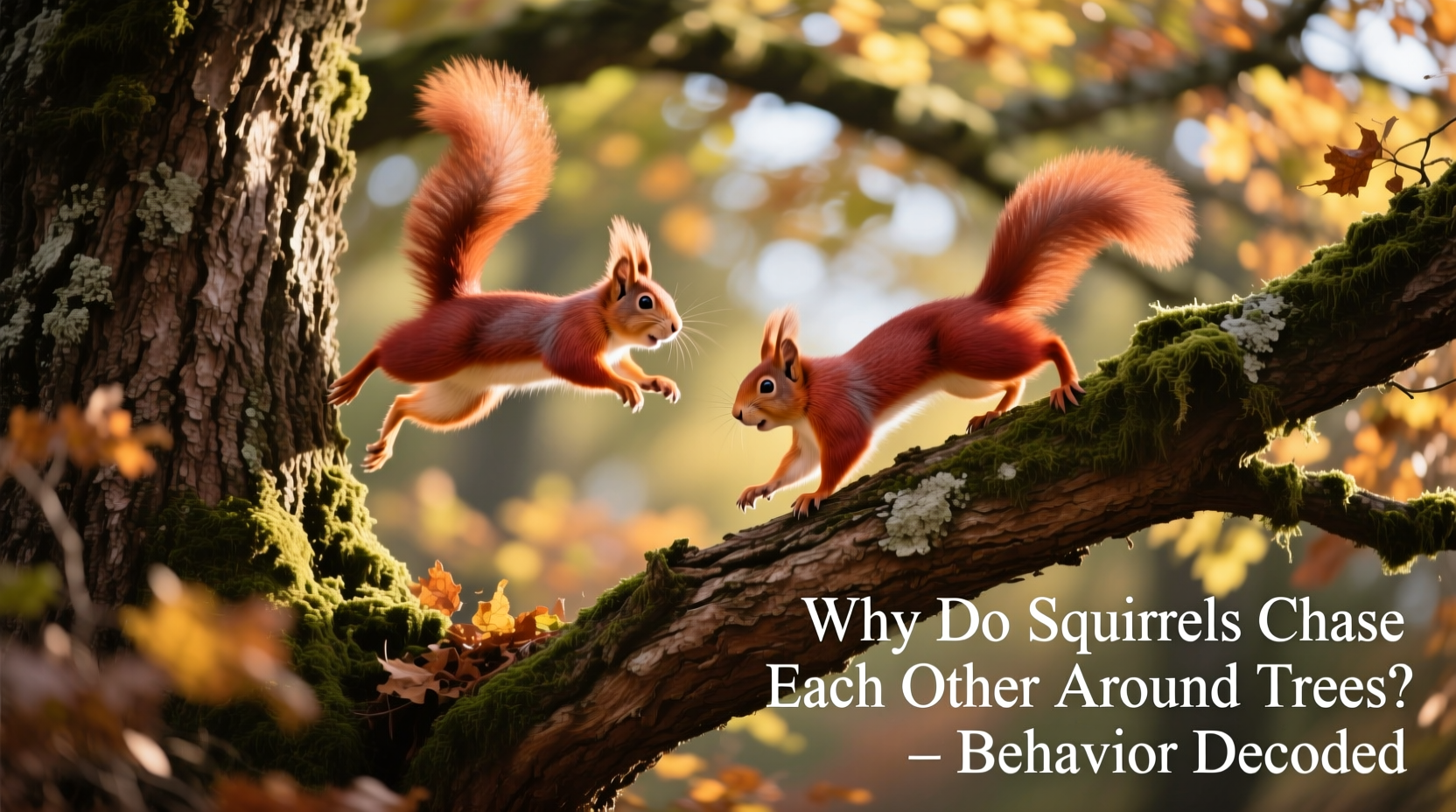
One of the most frequent reasons for intense squirrel chases occurs during breeding seasons. Squirrels typically have two mating periods per year—one in late winter (December to February) and another in mid-summer (June to July). During these windows, female squirrels enter estrus for just a few hours, broadcasting their readiness through scent signals known as pheromones. This brief fertility window triggers a surge in male activity.
When a male detects a receptive female, he approaches cautiously. However, he is rarely alone. Multiple males often pick up the same scent trail, leading to competitive pursuit. What follows is a high-speed chase—not between mates, but among rival suitors. The fastest, most persistent male usually wins mating rights, though females retain some choice in the matter and may evade unwanted partners.
In some cases, the female herself becomes the pursuer in a “courtship chase,” leading males on a test of endurance and agility. This behavior serves dual purposes: it ensures only the fittest males reproduce, and it allows the female to assess stamina and health before mating. Observers often mistake this for play, but every twist and turn is part of a reproductive strategy millions of years in the making.
Tip: If you see squirrels chasing in late winter or early summer, especially with multiple males involved, it’s likely tied to mating season.Territorial Defense and Dominance Displays
Squirrels are not particularly social animals. While they may tolerate others in shared environments—especially where food is abundant—they maintain loose territories centered around nesting sites and key resources. When a squirrel perceives an intruder near its core area, it may respond with aggressive displays, including tail flicking, vocal chattering, and pursuit.
Chasing serves as both a warning and enforcement mechanism. A dominant squirrel will pursue an interloper to assert control, often using vertical terrain—trees—to its advantage. By forcing the rival upward, the defender can cut off escape routes or use height to intimidate. These pursuits are typically short but intense, ending when one animal retreats or flees the area entirely.
Interestingly, dominance isn’t always size-based. Smaller squirrels familiar with the landscape often outmaneuver larger intruders, using knowledge of branch stability, nearby escape paths, and cover to win confrontations. Juvenile squirrels dispersing from their mothers’ territories are especially vulnerable to such chases, as they navigate unfamiliar zones and challenge established residents.
“Squirrel chases are less about aggression and more about information exchange. Each pursuit communicates fitness, intent, and boundaries.” — Dr. Laura Hemingway, Behavioral Ecologist, University of Alberta
Play Behavior in Juvenile Squirrels
Not all chases are serious. Young squirrels—typically under six months old—engage in play that closely resembles adult conflict behaviors. They leap, pounce, chase, and wrestle, often spiraling around trunks or tumbling through leaf litter. While it looks frivolous, this activity is critical for development.
Play helps juveniles build muscle coordination, spatial awareness, and predator evasion skills. It also teaches social cues: how hard to bite, when to retreat, and how to interpret body language. Because young squirrels haven’t yet established territories or breeding status, their chases are lower-stakes and more reciprocal. One individual may lead, then switch roles moments later.
Researchers have noted that play peaks in spring and early summer, coinciding with the emergence of new litters. As these juveniles mature, their movements become more purposeful, and play gradually declines by autumn. So if you notice seemingly carefree chases in May or June, especially involving smaller squirrels with bushy, unmarked tails, it’s likely developmental play rather than competition.
Food Competition and Resource Guarding
While squirrels are primarily scatter-hoarders—burying nuts and seeds across wide areas—they still defend concentrated food sources. Bird feeders, fruit trees, fallen acorns under an oak, or even pet food left outdoors can trigger competitive behavior.
When one squirrel discovers a rich patch, others quickly take notice. Rather than share, dominant individuals may initiate chases to drive competitors away. These pursuits often follow predictable patterns: the defender circles the resource while the challenger attempts flanking maneuvers. Trees become tactical assets—offering vantage points, quick escapes, or ambush opportunities.
In urban settings, this behavior is amplified. Artificial feeding stations create unnatural densities of squirrels, increasing competition. What begins as a quiet foraging session can escalate into repeated chases as animals attempt to monopolize easy calories. Unlike mating or territorial disputes, food-related chases may occur year-round, peaking in late fall when energy demands are highest.
| Chase Type | Primary Cause | Time of Year | Duration & Intensity |
|---|---|---|---|
| Courtship Chase | Mating competition | Late winter, mid-summer | High intensity, 5–15 minutes |
| Territorial Chase | Boundary enforcement | Year-round, peaks in spring | Moderate to high, short bursts |
| Play Chase | Youth development | Spring to early summer | Lower intensity, recurring |
| Resource Chase | Food defense | Fall, near feeding sites | Variable, repetitive |
Communication Through Movement: What the Chase Signals
Beyond immediate goals like mating or eating, squirrel chases function as a form of non-vocal communication. Their bodies convey messages through speed, direction, posture, and persistence. A slow, meandering follow may signal mild annoyance, while a rapid, direct ascent indicates serious confrontation.
Tail position plays a crucial role. A raised, flicking tail signals agitation or alertness. During chases, squirrels often hold their tails high, possibly to keep them visible to rivals or to aid balance during sharp turns. Some researchers suggest the tail also acts as a \"follow me\" signal during mating chases, helping maintain contact without constant visual tracking.
Vocalizations frequently accompany movement. The familiar \"kuk-kuk-kuk\" chatter is a distress or warning call, often emitted mid-chase. A softer \"quaa\" call may be used post-pursuit to signal retreat or de-escalation. Together, sound and motion create a dynamic dialogue between individuals, allowing them to negotiate space, status, and intent without physical combat.
Mini Case Study: The Oak Tree Standoff
In a residential neighborhood in Ann Arbor, Michigan, a homeowner observed daily chases between two gray squirrels around a large white oak. For weeks, the same pair engaged in near-identical patterns: one squirrel would emerge at dawn, climb the north side, and begin foraging. Within minutes, a second squirrel would appear, triggering an immediate spiral chase upward.
Local wildlife volunteers monitored the interaction and discovered the first squirrel was an older female defending a drey (nest) containing newborn kits. The challenger was a juvenile male from a neighboring yard, likely displaced by spring dispersal. His repeated attempts were not predatory but exploratory—he was seeking unoccupied territory.
The chases never turned violent. Instead, they served as boundary reinforcement. Over time, the juvenile adjusted his route, avoiding the oak between 7–9 AM. By mid-April, the encounters ceased altogether. This case illustrates how chases regulate population density and reduce actual conflict through ritualized behavior.
How to Observe Squirrel Chases Responsibly
For nature enthusiasts, squirrel chases offer a front-row seat to animal behavior. However, observation should not interfere with natural patterns. Here’s how to watch without disrupting:
- Maintain distance—use binoculars instead of approaching.
- Avoid feeding squirrels, which distorts natural foraging and increases aggression.
- Limit noise and sudden movements that could alter outcomes.
- Record observations in a journal to track patterns over time.
Checklist: Decoding a Squirrel Chase You Witness
- Note the season: Is it breeding time (Dec–Feb or Jun–Jul)?
- Count the participants: Are both adults? Is one noticeably smaller?
- Observe the pattern: Is it circular and repetitive (territorial), or erratic and playful?
- Listen for sounds: Chattering suggests conflict; silence may indicate focused pursuit.
- Look for context: Is there a nest nearby? A bird feeder? Recent food source?
- Watch duration: Brief chases may be warnings; long ones suggest high stakes.
Frequently Asked Questions
Do squirrels ever get hurt during chases?
Physical injury is rare. Most chases are ritualized and end before contact escalates. Falls can happen, especially in urban areas with slippery surfaces, but squirrels are adapted to absorb impacts from heights. Serious fights—biting, scratching—are uncommon and usually involve direct competition for dens or mates.
Can I tell if a chase is playful or aggressive?
Yes, with practice. Playful chases involve role reversal, pauses, and soft movements. Aggressive chases are one-directional, faster, and accompanied by vocalizations like rapid \"kuk\" calls. Play is mostly seen in juveniles; adults chase with clear objectives.
Why do they run around the tree instead of just up and over?
Spiraling around the trunk provides multiple advantages: it maintains visual contact, tests agility, and uses the tree as a barrier. It also allows the pursued squirrel to monitor the pursuer’s position while conserving energy. Sharp turns help weaker climbers stay ahead by exploiting tighter turning radiuses.
Final Thoughts: Appreciating the Complexity Behind the Chase
The next time you see squirrels racing around a tree, resist the urge to label it as mere playfulness. That whirlwind of fur and motion is a sophisticated interaction shaped by millions of years of evolution. Whether it's a bid for reproductive success, a claim to territory, a lesson in survival, or a defense of resources, each chase carries meaning.
Understanding these behaviors enriches our connection to the natural world, even in urban backyards. Squirrels are not just pests or comic relief—they are resilient, intelligent creatures navigating complex social landscapes. By observing with curiosity and respect, we gain insight into the subtle rules that govern animal life all around us.
💬 Have you witnessed a memorable squirrel chase? Share your story in the comments—your observation could help others decode nature’s hidden dramas.








