Parrots have long fascinated humans with their uncanny ability to repeat words, phrases, and even full conversations. Unlike most animals that communicate through instinctual calls, parrots can learn to reproduce complex human sounds—sometimes with startling clarity. But why do they do it? Is it mere imitation, or does this behavior reflect deeper cognitive abilities? The answer lies at the intersection of biology, evolution, and social intelligence. Far from being simple mimics, parrots use vocal learning as a sophisticated tool for bonding, problem-solving, and navigating their social worlds.
The Science Behind Vocal Learning
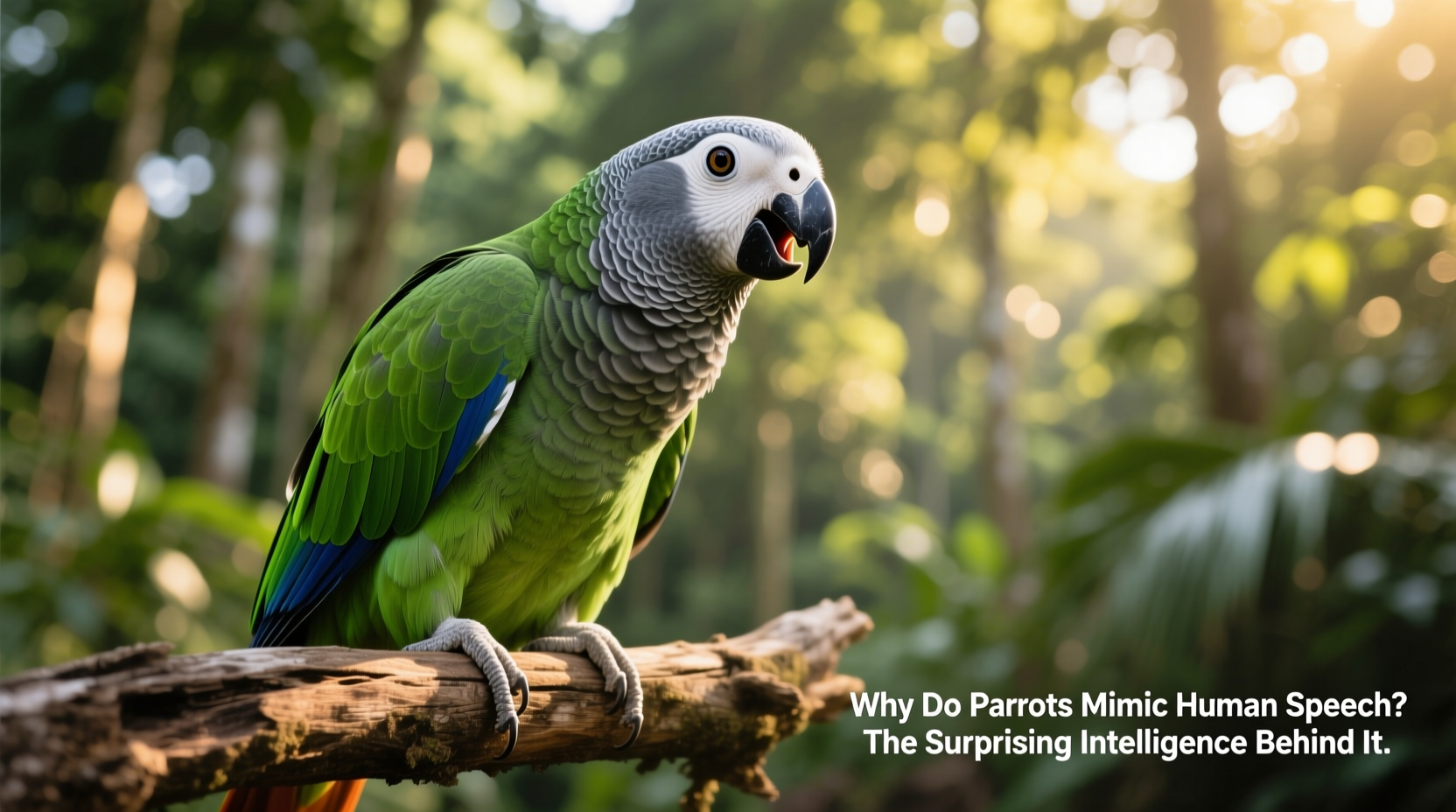
One of the most remarkable aspects of parrot communication is their capacity for vocal learning—the ability to acquire new sounds by listening and imitating. This trait is rare in the animal kingdom. Among mammals, only humans, dolphins, whales, elephants, and some bats demonstrate true vocal learning. In birds, only three groups possess this skill: songbirds, hummingbirds, and parrots.
Neurological studies reveal that parrots have a unique brain structure known as the \"core and shell\" system—a specialized network of neural pathways dedicated to sound processing and vocal production. This dual-layered system is more advanced than that found in songbirds and may explain why parrots can produce a wider range of sounds and learn them more rapidly.
“Parrots aren’t just repeating sounds—they’re actively processing, storing, and retrieving auditory information in ways that mirror human language acquisition.” — Dr. Irene Pepperberg, Comparative Psychologist and Avian Cognition Researcher
This neurological sophistication allows parrots not only to mimic but also to associate words with meanings, contexts, and emotions—an ability once thought exclusive to primates.
Social Bonding and Identity Formation
In the wild, parrots live in tight-knit flocks where vocalizations play a crucial role in maintaining group cohesion. Each bird develops a unique contact call—a kind of “name”—used to identify itself to others. Young parrots learn these calls from their parents and peers, reinforcing social bonds.
When kept as pets, parrots often transfer this social need to their human caregivers. Mimicking human speech becomes a way to integrate into their adopted “flock.” A parrot saying “Hello!” when you enter the room isn’t just performing—it’s greeting its social group. Similarly, repeating phrases like “I love you” or “Where are you?” may reflect an attempt to maintain connection or express separation anxiety.
Tip: Respond to your parrot’s vocalizations as you would a toddler’s babbling—acknowledge the effort. This reinforces positive communication and strengthens your bond.Researchers have observed that parrots modify their vocalizations depending on the audience. For example, a study published in *Animal Cognition* found that African grey parrots increased their use of learned human words when alone compared to when other birds were present—suggesting intentional communication tailored to human listeners.
Problem-Solving and Cognitive Flexibility
Mimicry in parrots goes beyond social interaction; it’s also linked to cognitive flexibility and environmental adaptation. Parrots are among the few non-human animals capable of understanding abstract concepts such as same/different, quantity, and even basic elements of syntax.
Dr. Irene Pepperberg’s decades-long work with Alex, an African grey parrot, demonstrated that parrots can use words meaningfully. Alex could identify objects by color, shape, and material, request specific items, and even refuse to answer when bored—indicating self-awareness and intentionality.
For instance, when presented with a tray of differently colored blocks, Alex could correctly answer, “Green triangle,” showing he understood both categories and attributes. He also coined novel phrases, like calling an apple a “banerry” (a blend of banana and cherry), suggesting conceptual blending akin to early language development in children.
Parrot Intelligence Compared to Other Animals
| Species | Vocal Learning Ability | Problem-Solving Skills | Social Complexity | Tool Use |
|---|---|---|---|---|
| African Grey Parrot | Exceptional (can learn 1,000+ words) | High (understands concepts like same/different) | Very High (flock-based, long-term bonds) | Limited (but shows object manipulation) |
| Bottlenose Dolphin | High (uses signature whistles) | High (recognizes mirror self) | Very High (complex pods) | Yes (uses sponges for foraging) |
| Chimpanzee | Low (cannot mimic speech) | Very High (uses tools, learns symbols) | Very High (hierarchical societies) | Yes (extensive tool use) |
| Blue-Fronted Amazon | High (excellent mimics) | Moderate to High (learns routines, solves puzzles) | High (social learners) | No |
The table highlights that while parrots may not match chimpanzees in physical tool use, their vocal learning and symbolic comprehension rival those of many primates. Their intelligence is specialized—not inferior.
Environmental Enrichment and Learned Behavior
Parrots in captivity often mimic sounds not because they understand them, but because they are highly stimulated by their environment. Televisions, phones, doorbells, and household appliances all contribute to the auditory landscape a pet parrot absorbs.
This mimicry serves multiple purposes:
- Attention-seeking: A parrot learns that saying “Phone’s ringing!” results in human reaction—even if no phone is present.
- Routine reinforcement: Repeating phrases tied to feeding or playtime helps anchor daily rhythms.
- Stress relief: Some parrots vocalize excessively when anxious, using familiar sounds as comfort.
However, not all mimicry is beneficial. Parrots exposed to aggressive language or loud environments may replicate negative behaviors. This underscores the importance of mindful interaction.
Mini Case Study: Bella the Eclectus Parrot
Bella, a female Eclectus parrot living in Melbourne, Australia, began mimicking her owner’s morning alarm after just two weeks of exposure. Initially amusing, the behavior escalated—Bella started setting off the imitation alarm at 3 a.m., disrupting the household.
Her owner consulted an avian behaviorist who suggested a structured enrichment plan:
- Introduce puzzle feeders to occupy morning hours.
- Replace the real alarm tone with a less stimulating sound.
- Reinforce quiet behavior with treats and praise.
Within six weeks, Bella stopped mimicking the alarm and instead began requesting breakfast with a polite “Want food?” This case illustrates how mimicry is context-driven and can be redirected through positive reinforcement and environmental control.
Why Parrots Outperform Other Birds in Mimicry
Not all birds that sing can mimic human speech. What sets parrots apart?
Anatomically, parrots possess a highly developed syrinx (the avian vocal organ) and superior motor control over their vocal muscles. They can independently modulate sound production in each bronchial tube, allowing them to create layered or harmonized sounds—something most birds cannot do.
Additionally, parrots have large brains relative to body size, particularly in areas associated with learning and memory. The nidopallium, a region involved in higher-order thinking, is especially well-developed in parrots. This supports not just mimicry, but decision-making, anticipation, and emotional regulation.
Unlike songbirds, which typically learn songs during a narrow developmental window, parrots remain vocal learners throughout life. This lifelong plasticity enables them to pick up new words, accents, and even languages well into adulthood.
Tip: Introduce new words slowly and consistently. Pair each word with a clear action or object to help your parrot form associations.Checklist: Encouraging Healthy Vocal Development in Pet Parrots
- ✅ Speak clearly and calmly around your bird.
- ✅ Use consistent phrases tied to routines (e.g., “Time for dinner!”).
- ✅ Avoid exposing your parrot to harsh language or chaotic noise.
- ✅ Reward meaningful attempts at communication with attention or treats.
- ✅ Provide daily mental stimulation through toys, puzzles, and interaction.
- ✅ Monitor for signs of stress-related vocalization (e.g., screaming at night).
- ✅ Schedule regular check-ins with an avian-savvy veterinarian or behaviorist.
Frequently Asked Questions
Can all parrots learn to talk?
No, not all parrots develop speech. While species like African greys, Amazon parrots, and budgerigars are renowned for their talking ability, others—such as pionus or pyrrhura conures—are less likely to mimic human speech. Individual personality, early exposure, and social interaction also play critical roles.
Do parrots understand what they’re saying?
Some do—especially those trained in contextual use. While many parrots start by mimicking without comprehension, research shows they can learn to associate words with meanings, objects, and actions. However, understanding varies widely by individual and training.
How many words can a parrot learn?
The average talking parrot knows 10–50 words. Exceptional individuals, like Dr. Pepperberg’s Alex, learned over 100 labels. The record holder, a budgerigar named Puck, was reported to have a vocabulary of 1,728 words, according to the *Guinness Book of World Records*.
Conclusion: More Than Just Echoes
The ability of parrots to mimic human speech is far more than a party trick. It is a window into their advanced cognitive architecture, emotional depth, and social complexity. These birds don’t merely echo—they interpret, adapt, and engage. Their mimicry reflects a desire to connect, understand, and participate in the world around them.
Recognizing this transforms how we care for them. Instead of treating parrots as decorative pets, we should see them as intelligent companions deserving of mental stimulation, respectful interaction, and enriched environments. When we listen to a parrot speak, we’re not hearing a recording—we’re witnessing a living testament to nature’s capacity for intelligence beyond the primate lineage.
💬 Have a story about your talking parrot? Share your experience in the comments and join the conversation on avian intelligence and responsible pet ownership.








