
Parrots have long fascinated humans with their uncanny ability to imitate not just sounds from nature but full sentences, laughter, phone ringtones, and even sarcasm-laced remarks. Unlike most animals, parrots don’t merely vocalize instinctively���they learn, adapt, and reproduce complex auditory signals with striking accuracy. But what drives this behavior? Is it intelligence, instinct, or something deeper rooted in their biology and social needs? The answer lies at the intersection of neuroscience, evolution, and social psychology. This article explores the scientific underpinnings of why parrots mimic human speech and how their unique cognitive architecture enables them to become some of the most accomplished vocal mimics in the animal kingdom.
The Anatomy of a Vocal Virtuoso
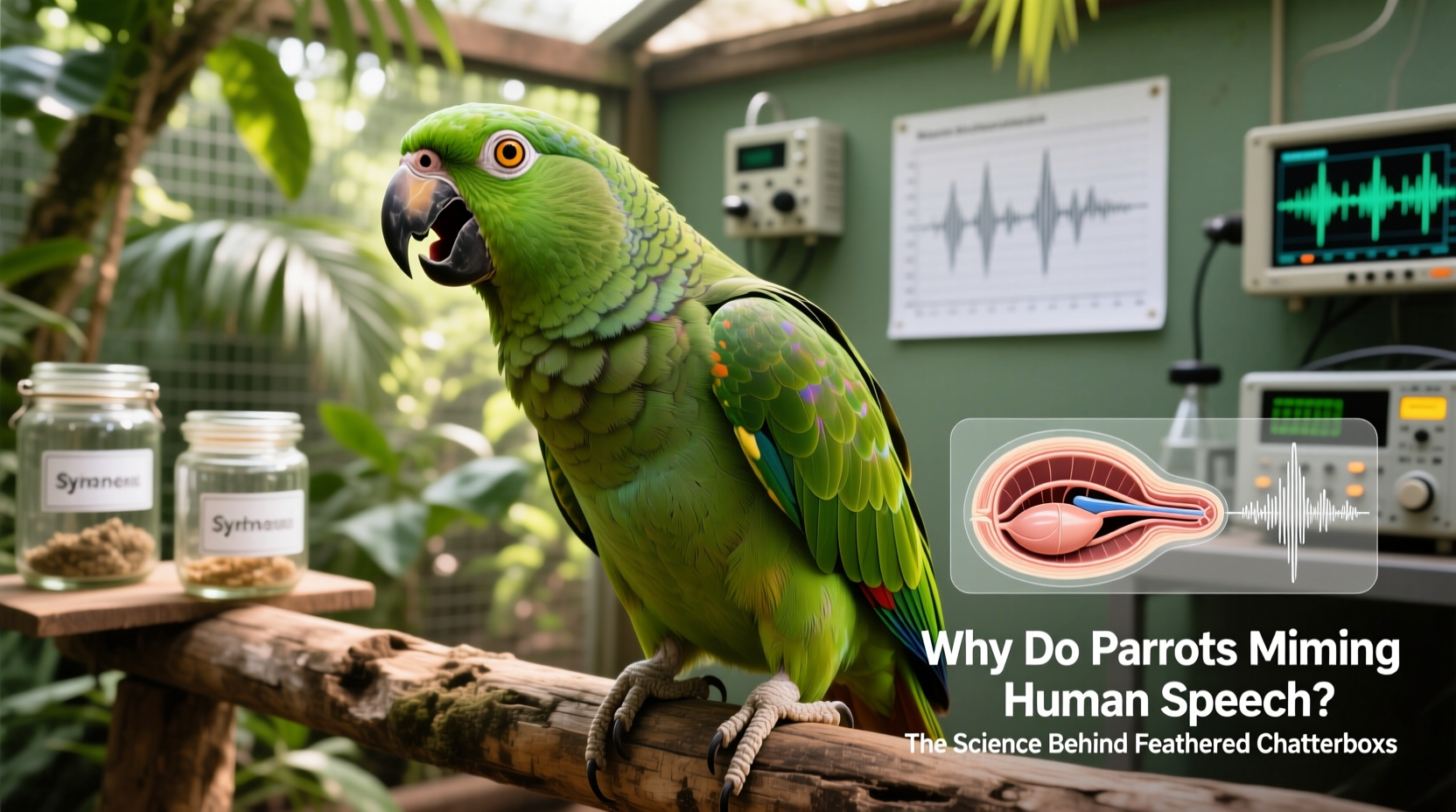
At first glance, a parrot’s voice box might seem similar to that of other birds, but its internal structure reveals extraordinary adaptations. Parrots possess a specialized organ called the syrinx, located at the base of the trachea where it splits into the bronchi. Unlike humans, who produce sound using vocal cords in the larynx, parrots generate sound deep within their chest cavity, allowing for greater control over pitch, tone, and volume.
What sets parrots apart is not just the syrinx but also the neural circuitry controlling it. Research has shown that parrots have a unique “core-and-shell” structure in their brains—two concentric layers of song nuclei responsible for vocal learning. This dual-layer system is absent in non-mimicking birds and even in songbirds like canaries, which can only learn a limited repertoire early in life.
“Parrots have evolved a brain pathway for vocal learning that mirrors the human capacity for speech acquisition—a rare trait in the animal world.” — Dr. Erich Jarvis, Neurobiologist, Rockefeller University
This neural architecture allows parrots to process, memorize, and reproduce sounds they hear—even those far outside their natural vocal range. African grey parrots, Amazon parrots, and budgerigars consistently outperform other species in vocal mimicry tasks, thanks to this advanced neurological setup.
Social Bonding Through Sound Imitation
Mimicry in parrots isn’t random noise-making—it serves a vital social function. In the wild, parrots live in tight-knit flocks where individual recognition and group cohesion are essential for survival. Each bird develops a unique contact call, akin to a name, used to identify itself to others. Young parrots learn these calls by imitating their parents and flock mates, reinforcing social bonds.
When kept as pets, parrots transfer this instinctual behavior to their human caregivers. A parrot doesn’t mimic speech because it understands language per se, but because it perceives humans as part of its social group. By repeating words, phrases, or household sounds (like doorbells or microwaves), the parrot attempts to integrate itself into the \"flock.\" This explains why many pet parrots call out their owner’s name when left alone—it’s not just repetition; it’s a form of communication and reassurance.
Tip: Respond positively when your parrot uses words appropriately—this reinforces their sense of belonging and encourages meaningful vocalization.Cognitive Capabilities Behind the Mimicry
While mimicry itself doesn’t require comprehension, certain parrot species demonstrate remarkable cognitive depth. The most famous example is Alex, an African grey parrot studied by animal psychologist Dr. Irene Pepperberg for over 30 years. Alex could identify objects, colors, shapes, and quantities up to six. He could ask for items (“Want nut”), refuse requests (“No”), and even express frustration (“Wanna go back”). Most astonishingly, he appeared to grasp abstract concepts like same/different and category membership.
Pepperberg’s work challenged the long-held belief that only primates possess advanced cognition. Her research demonstrated that parrots use vocalizations not just as rote echoes but as tools for interaction. When Alex said “Banana?” while looking at an apple, he wasn’t confused—he was testing whether the label applied across categories. This suggests that for some parrots, mimicry is a gateway to symbolic thinking.
| Species | Vocal Range | Cognitive Complexity | Notable Abilities |
|---|---|---|---|
| African Grey Parrot | Extensive vocabulary (200+ words) | High – object labeling, categorization | Understands context, asks questions |
| Budgerigar | Numerous phrases, songs | Medium – pattern recognition | Fast learners, excellent memory |
| Amazon Parrot | Rich, expressive speech | Medium-high – emotional association | Uses words situationally (e.g., “hello” at arrival) |
| Cockatoo | Moderate speech, strong whistles | Medium – social referencing | Imitates tones and emotions effectively |
Evolutionary Roots of Vocal Learning
Why did parrots evolve such sophisticated mimicry abilities while most other birds did not? One theory centers on environmental complexity. Parrots typically inhabit dense rainforests or variable ecosystems where visual cues are limited. In such settings, accurate auditory signaling becomes crucial for maintaining contact over distance, avoiding predators, and coordinating group movements.
Vocal flexibility allowed ancestral parrots to adapt their calls based on changing environments and social dynamics. Over time, this led to the development of enhanced auditory processing and memory systems. Interestingly, vocal learning has evolved independently in only a few animal groups: humans, cetaceans (dolphins and whales), bats, elephants, hummingbirds, songbirds, and parrots. This convergent evolution suggests that complex communication offers significant survival advantages in highly social or acoustically complex niches.
Another factor may be longevity. Parrots often live decades, forming long-term relationships within flocks. The ability to remember and recognize individual voices over extended periods supports stable social structures—an advantage mirrored in human societies.
How Parrots Learn: A Step-by-Step Process
Parrot vocal learning follows a developmental timeline similar to human infants. Understanding this process helps explain both their capabilities and limitations.
- Listening Phase (0–6 months): Young parrots spend weeks absorbing sounds around them, especially from primary caregivers. They show preference for human voices over background noise.
- Babbling Stage (6–12 months): Like babies, juvenile parrots begin producing unstructured vocalizations—squeaks, chirps, and distorted syllables—as they experiment with sound production.
- Imitation Emergence (12–18 months): Clear mimicry begins. Words are repeated inconsistently, often out of context, but gradually become more precise.
- Contextual Use (18+ months): With reinforcement, parrots start associating sounds with outcomes—e.g., saying “step up” when asked to move, or “want food” near feeding time.
- Refinement Over Time: Continued exposure and interaction lead to improved clarity, intonation, and situational appropriateness.
Unlike one-time learners, parrots remain capable of acquiring new sounds throughout life, though early exposure yields the best results. Consistency, repetition, and positive feedback accelerate learning.
Common Misconceptions About Talking Parrots
- Misconception: All parrots can talk fluently.
Reality: Only certain species excel at mimicry, and individual variation is significant. Some birds never speak despite ideal conditions. - Misconception: If a parrot says a word, it understands it.
Reality: Most mimicry is associative rather than semantic. However, with training, some parrots can link words to meanings. - Misconception: Male parrots are better talkers.
Reality: Gender plays minimal role in vocal ability among most species. Socialization and environment matter far more.
Mini Case Study: N’kisi, the Philosophical Parrot
N’kisi, a male African grey parrot owned by artist Aimee Morgana, gained attention in the early 2000s for his apparent use of spontaneous, contextually appropriate language. On one occasion, upon seeing a photo of a man with a bald head and long hair on the sides, N’kisi remarked, “You got ugly haircut.” Another time, when Morgana pretended to cough, he responded, “Trouble?” and later added, “I’m sorry.”
In a formal study, researchers observed N’kisi using verbs correctly, combining words creatively, and commenting on events without prompting. While skeptics argue these instances could result from coincidence or subtle cueing, the consistency of N’kisi’s responses under controlled observation suggests a level of linguistic awareness previously undocumented in non-humans.
Though not conclusive proof of human-like thought, N’kisi’s case illustrates how enriched environments and attentive caregiving can unlock latent cognitive potential in parrots—pushing the boundaries of what we consider possible in animal communication.
Tips for Encouraging Healthy Vocal Development
Tip: Speak clearly and repeat key phrases daily. Parrots respond best to consistent, emotionally expressive speech.- Engage in daily conversation—even simple statements like “Good morning, Rio!” help build familiarity.
- Use treats or praise immediately after desired vocalizations to reinforce learning.
- Avoid shouting or negative reactions to unwanted noises; instead, redirect with a preferred phrase.
- Play recordings of clear speech sparingly—live interaction is far more effective.
- Provide mental stimulation through toys and puzzles to support overall cognitive health, which enhances vocal learning.
FAQ
Can all parrot species learn to talk?
No. While many parrots can produce sounds, only specific species—such as African greys, Amazons, budgies, and some cockatoos—are known for extensive speech mimicry. Others, like lovebirds or quaker parrots, may learn a few words but rarely develop fluent vocabularies.
Do parrots know what they’re saying?
Most parrots do not understand language in the way humans do. However, some individuals, particularly African greys trained using referential methods, can associate words with objects, actions, or emotions. Their understanding is limited but demonstrably present in select cases.
How long does it take for a parrot to start talking?
It varies by species and individual. Budgies may begin mimicking within a few months, while larger parrots like macaws or Amazons may not utter their first words until 12–18 months old. Full fluency can take several years with consistent interaction.
Checklist: Supporting Your Parrot’s Communication Skills
- ✅ Spend at least 30 minutes daily interacting verbally with your bird.
- ✅ Use short, clear phrases with emotional inflection (e.g., “Hello, sweetie!”).
- ✅ Reinforce correct vocalizations with immediate rewards (treats, affection).
- ✅ Minimize exposure to TV or radio if you want clearer, more intentional speech.
- ✅ Monitor for signs of stress—excessive screaming may indicate poor welfare, not just mimicry.
- ✅ Rotate toys and introduce novelty to keep the brain engaged.
- ✅ Record your parrot’s progress to track vocabulary growth and clarity improvements.
Conclusion: Listening Beyond the Words
The phenomenon of parrots mimicking human speech is far more than a quirky party trick. It reflects millions of years of evolutionary refinement, intricate brain design, and a profound need for social connection. Whether echoing a greeting, naming an object, or offering comfort with a well-timed “I love you,” parrots communicate in ways that challenge our assumptions about animal minds.
Understanding the science behind their chatter doesn’t diminish the wonder—it deepens it. These birds aren’t simply repeating sounds; they are reaching out, trying to belong, and sometimes, in their own avian way, attempting to converse. By recognizing the intelligence and emotional depth behind their mimicry, we can foster more empathetic, enriching relationships with our feathered companions.
💬 Have a story about your talking parrot? Share your experience below—your insights could help others appreciate the true depth of avian communication.








