Siberian Huskies are among the most visually captivating dog breeds, known for their thick double coats, wolf-like appearance, and often, their piercing blue eyes. While many dogs have brown eyes, a significant number of huskies display one or two bright blue eyes—sometimes even with heterochromia, where each eye is a different color. This unique trait has fascinated dog lovers, scientists, and breeders alike. But what causes this phenomenon? The answer lies in genetics, pigmentation, and evolutionary history.
Unlike most mammals, where eye color is determined by multiple genes interacting in complex ways, the blue eyes of huskies stem from a specific mutation that affects melanin production in the iris. This article explores the science behind this rare trait, the role of the ALX4 gene, and why it’s more common in huskies than in other breeds.
The Science of Canine Eye Color
In mammals, eye color is primarily determined by the amount and distribution of melanin in the iris. Melanin is the pigment responsible for coloring skin, hair, and eyes. Brown eyes result from high melanin concentration, while lighter colors like blue, green, or gray occur when there is less melanin.
Dogs typically have brown eyes because their irises contain sufficient melanocytes—cells that produce melanin. However, certain genetic variations can suppress melanin development during early growth, leading to blue eyes. In most dog breeds, blue eyes are rare and often associated with coat color patterns such as merle or white spotting. But huskies are an exception: they can have blue eyes regardless of coat pattern, thanks to a distinct genetic mechanism.
The ALX4 Gene Mutation
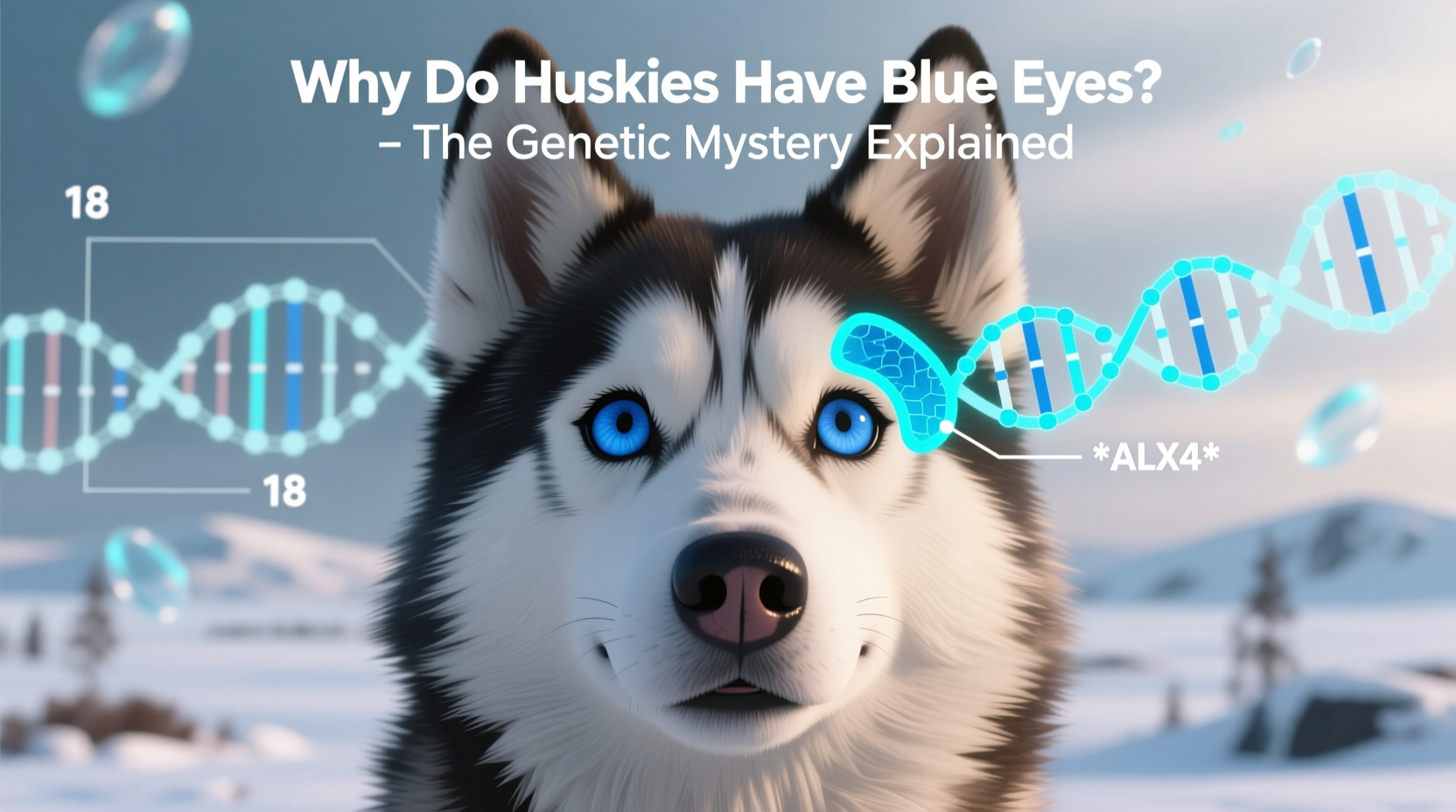
A groundbreaking study published in 2018 by Embark Veterinary analyzed over 6,000 dogs and identified a key genetic variant linked to blue eyes in Siberian Huskies. Researchers discovered that a 98.6-kilobase duplication near the ALX4 gene on chromosome 18 plays a central role in regulating iris pigmentation.
This duplication does not affect overall health but reduces melanin production specifically in the iris. It's inherited in a dominant manner, meaning only one copy of the mutated gene (from either parent) is needed for a husky to express blue eyes. However, the presence of the mutation doesn’t guarantee blue eyes in every case—other modifying genes and developmental factors also influence the final outcome.
“Huskies offer a unique model for studying eye color genetics because their blue eyes aren't tied to coat color or hearing issues, unlike in merle-patterned breeds.” — Dr. Adam Boyko, Cornell University College of Veterinary Medicine
Heterochromia: When One Eye Is Blue and the Other Isn’t
Approximately 15% of huskies exhibit complete heterochromia—having one blue eye and one brown eye. Even more intriguing, some display sectoral heterochromia, where part of the iris is blue and another part is brown within the same eye.
This occurs due to uneven distribution of melanocytes during embryonic development. The ALX4-related mutation may affect one eye more than the other, or random developmental variation leads to asymmetrical pigmentation. Importantly, heterochromia in huskies is not linked to vision problems or deafness, which distinguishes them from some other breeds where white coat patterns correlate with sensory deficits.
Tip: If your husky has blue eyes and sudden changes in eye color, cloudiness, or redness, consult a veterinarian—these could indicate uveitis or other ocular conditions unrelated to natural pigmentation.Evolutionary Origins: Why Did Blue Eyes Develop?
The exact evolutionary reason behind the persistence of blue eyes in huskies remains speculative, but researchers believe it may be a byproduct of selection for other traits. Originally bred by the Chukchi people of northeastern Siberia for sledding and endurance in extreme cold, huskies were selected for temperament, stamina, and coat quality—not eye color.
However, the genes influencing eye color might be located near those affecting sociability or circadian rhythms. Some scientists suggest that reduced pigmentation could enhance communication through eye contact in low-light Arctic environments, though no direct evidence supports this yet.
Modern breeding practices have amplified the frequency of blue eyes due to aesthetic preferences. Despite being non-functional, blue eyes are now considered a hallmark of the breed, increasing demand among pet owners and show enthusiasts.
How Common Are Blue Eyes in Huskies?
According to breed surveys, about 40% of Siberian Huskies have at least one blue eye. Of these:
- 20% have two blue eyes
- 15% have one blue and one brown eye (complete heterochromia)
- 5% have partial blue coloring (sectoral heterochromia)
- The remaining 60% have two brown eyes
This variation underscores the complexity of the trait—it’s not exclusive to light-coated or purebred huskies, nor is it a sign of mixed ancestry.
Blue Eyes vs. Other Breeds: A Comparative Look
| Breed | Typical Eye Color | Blue Eye Cause | Associated Health Risks |
|---|---|---|---|
| Siberian Husky | Blue, brown, or mixed | ALX4 gene mutation | None directly linked |
| Australian Shepherd | Brown or amber | Mutation in MITF gene (merle pattern) | Potential deafness or blindness if homozygous merle |
| Weimaraner | Amber-gray | Dilution gene affecting pigmentation | Rarely, minor vision sensitivity |
| Dalmatian | Brown or blue | White spotting gene (S locus) | Higher risk of congenital deafness |
This comparison highlights that while blue eyes appear across several breeds, the underlying mechanisms and health implications differ significantly. In huskies, the trait is largely benign and genetically isolated.
Debunking Myths About Blue-Eyed Huskies
Several misconceptions persist about huskies with blue eyes. Let’s clarify the facts:
- Myth: Blue eyes mean the dog isn’t purebred.
Fact: Blue eyes are fully recognized in the American Kennel Club (AKC) breed standard and occur naturally in purebred huskies. - Myth: Blue-eyed huskies are more aggressive or wild.
Fact: Eye color has no correlation with temperament. Behavior depends on socialization, training, and genetics related to personality, not pigmentation. - Myth: All white dogs with blue eyes are prone to deafness.
Fact: While true for some breeds (e.g., Dalmatians), this link does not apply to huskies. Their blue eyes arise independently of coat-related deafness genes.
Can You Predict a Puppy’s Eye Color?
All husky puppies are born with blue eyes due to underdeveloped melanin pathways. True adult eye color begins to emerge around 5–7 weeks of age and stabilizes by 12–16 weeks.
Breeding two blue-eyed huskies increases the likelihood of blue-eyed offspring, but it’s not guaranteed. Since the ALX4 mutation behaves dominantly but incompletely, and other modifiers exist, genetic testing offers the most accurate prediction.
“We’ve seen litters where both parents had blue eyes, yet half the pups developed brown eyes. Genetics is rarely straightforward—even with a known mutation.” — Lena Torres, Certified Canine Genetic Counselor
Step-by-Step Guide to Monitoring Your Husky’s Eye Development
- Weeks 0–4: Observe initial blue hue—normal in all newborn huskies.
- Weeks 5–7: Watch for subtle darkening around the pupil indicating melanin activation.
- Weeks 8–12: Note any flecks of gold, brown, or gray spreading outward from the center.
- Weeks 13–16: Final eye color should stabilize. Take photos weekly to track changes.
- After 16 weeks: Consult a vet if eyes remain cloudy, unequal in size, or show discharge.
Frequently Asked Questions
Do blue-eyed huskies see differently than brown-eyed ones?
No. There is no scientific evidence that blue eyes affect visual acuity, night vision, or color perception in huskies. The structure of the retina and optic nerve remains unchanged.
Can a husky’s eye color change after puppyhood?
Generally, no. Once eye color stabilizes around 4 months, it remains consistent throughout life. Slight shifts in shade due to lighting or mood are normal, but major changes may signal illness.
Are blue eyes eligible in conformation shows?
Yes. The AKC standard explicitly allows blue, brown, or combination eyes in Siberian Huskies. Eye color does not disqualify a dog from competition.
Conclusion: Embracing the Genetic Wonder
The blue eyes of Siberian Huskies are more than just a striking aesthetic feature—they represent a fascinating interplay of genetics, evolution, and human preference. Thanks to advances in canine genomics, we now understand that a small DNA duplication near the ALX4 gene is largely responsible for this mesmerizing trait. Unlike in other breeds, it carries no inherent health risks and stands as a testament to nature’s diversity.
Whether you’re a breeder, owner, or admirer of this majestic breed, appreciating the science behind their gaze deepens the connection between humans and animals. The next time you lock eyes with a blue-eyed husky, remember—you're witnessing a rare genetic story written in DNA, shaped by thousands of years of adaptation and affection.
💬 Have a husky with stunning eyes? Share your experience or questions below—let’s celebrate the beauty and science of this incredible breed together.








