
It’s a moment nearly every dog owner has experienced: you speak to your dog in a gentle or curious tone, and instantly, their head tilts to one side—ears perked, eyes wide, expression full of intent. This universally endearing gesture often feels like a sign of deep understanding, empathy, or even confusion. But what’s really going on behind that adorable tilt? Is it instinct? Intelligence? Or simply an evolved trick to win more treats and affection?
For years, the head tilt was dismissed as a quirky canine habit with no real function. Today, thanks to advances in veterinary neuroscience and animal behavior research, experts are decoding the true motivations behind this behavior. From auditory processing to social bonding, the reasons are both complex and fascinating.
The Science Behind Canine Head Tilting
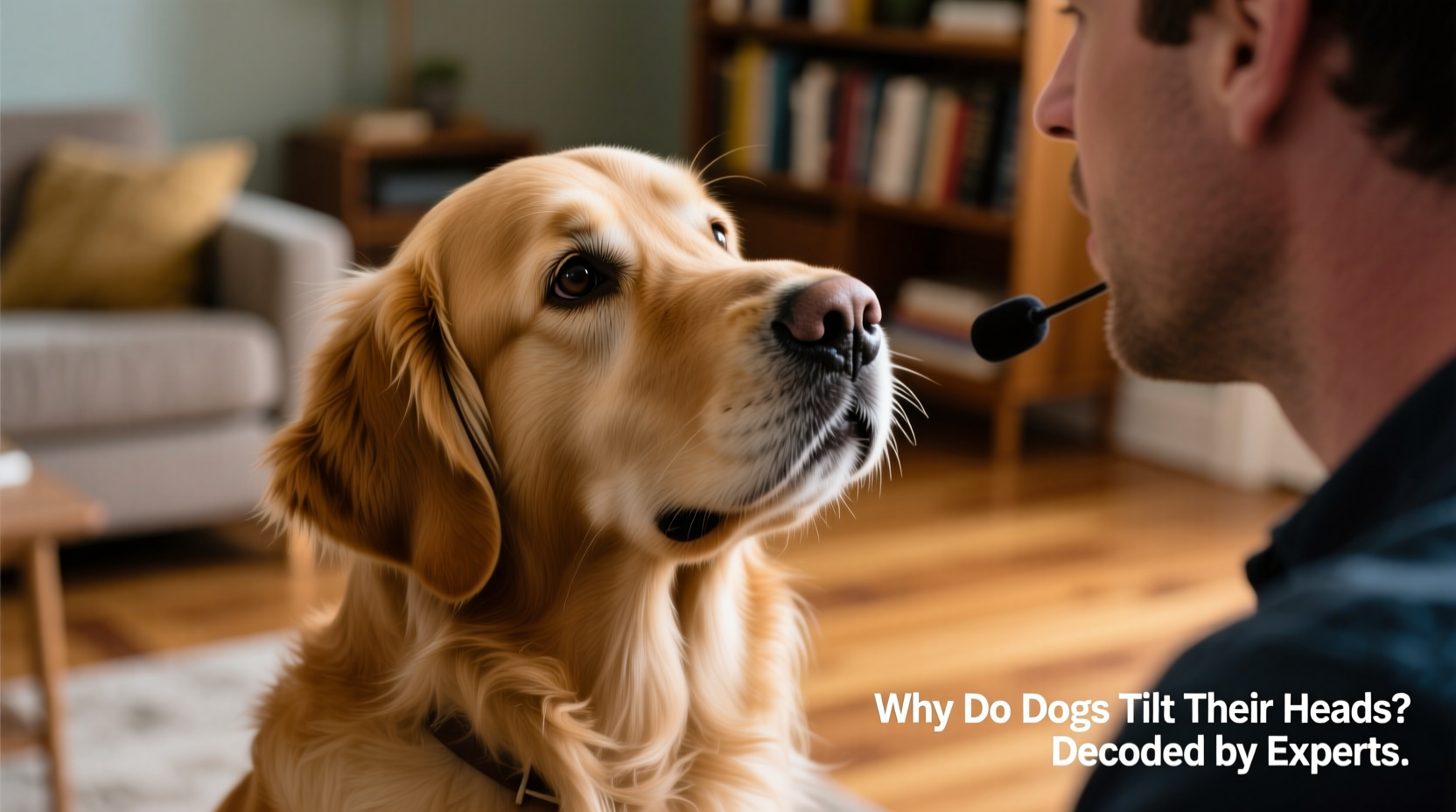
Dogs don’t just tilt their heads for attention—though they’ve certainly mastered how to use it effectively. According to Dr. Alexandra Horowitz, a cognitive scientist at Barnard College and author of Inside of a Dog, “The head tilt is not random. It’s a functional adjustment rooted in anatomy and cognition.”
One primary explanation lies in canine ear structure. Dogs have highly mobile pinnae (outer ears), which allow them to funnel sound more efficiently. When a dog hears an unfamiliar or high-pitched sound—especially human speech—they may tilt their head to reposition their ears and improve sound localization. This helps them better identify the source, pitch, and emotional tone of the voice.
A 2022 study published in *Animal Cognition* observed 40 dogs across multiple breeds during verbal interactions. Researchers found that dogs tilted their heads significantly more often when hearing novel words or emotionally inflected tones, particularly in higher frequencies. The tilt was less frequent when commands were delivered in flat, familiar tones.
This suggests that the head tilt isn’t just passive curiosity—it’s an active listening strategy. By shifting their skull slightly, dogs adjust how sound waves enter their ear canals, enhancing clarity much like a person might cup their ear to hear better.
Vision and Facial Recognition Play a Role Too
Beyond hearing, vision contributes to the head tilt phenomenon. Many dog breeds, especially those with long muzzles like Collies or Labradors, have limited peripheral vision directly in front of their snouts. When a dog looks at a human face, their muzzle can partially obstruct their view of the lower half—particularly the mouth.
Tilting the head allows them to see around their own snout and get a clearer visual of facial expressions. Since dogs rely heavily on human facial cues to interpret emotion and intent, this small adjustment enhances their ability to read lips, smiles, frowns, and other subtle signals.
“Dogs are masters of cross-modal perception—they integrate what they hear with what they see. The head tilt is part of that multisensory effort to understand us.” — Dr. Brian Hare, Director of the Duke Canine Cognition Center
Breed Differences and Frequency of Head Tilting
Not all dogs tilt their heads equally. Some seem to do it constantly; others rarely if ever. Research indicates that breed, skull shape, and even individual personality influence how often a dog exhibits this behavior.
| Breed | Skull Type | Average Head Tilt Frequency* | Possible Reasons |
|---|---|---|---|
| Golden Retriever | Mesocephalic (balanced) | High | High social engagement, strong desire to please |
| Poodle | Dolichocephalic (long-nosed) | Very High | Long muzzle obstructs vision; intelligent and attentive |
| Bulldog | Brachycephalic (short-nosed) | Low | Less visual obstruction; different ear orientation |
| German Shepherd | Mesocephalic | Moderate | Focused listening during training contexts |
| Shih Tzu | Brachycephalic | Low to Moderate | Less need to adjust for sight/sound, but may respond to tone |
*Based on observational data from the Family Dog Project (2021–2023)
The table shows a clear trend: dogs with longer muzzles tend to tilt more frequently, likely due to the need to compensate for visual limitations. Brachycephalic breeds, while still responsive to human speech, don’t require the same physical adjustment to see our faces clearly.
Tip: If your dog tilts their head only when you use certain words (like “walk” or “treat”), they’re likely associating that sound pattern with positive outcomes—proof of advanced auditory learning.Emotional Connection and Social Reinforcement
While anatomy explains the mechanics, psychology reveals another layer: social conditioning. Dogs are exceptionally attuned to human reactions, and they learn quickly which behaviors elicit positive responses.
If a dog tilts their head and receives laughter, petting, or verbal praise (“Oh, are you thinking hard?”), they’re likely to repeat the action. Over time, this becomes a learned social signal—a way to engage, communicate, and strengthen bonds.
In fact, a 2020 study conducted at Eötvös Loránd University in Hungary found that dogs who received consistent positive feedback for head tilting performed the behavior up to 37% more often in social settings than those who didn’t. This doesn’t mean the behavior is “fake,” but rather that it’s been reinforced because it works.
Think of it as a canine version of smiling. Just as humans smile not only when happy but also to build rapport, dogs may tilt their heads both to process information and to connect emotionally.
Mini Case Study: Bella the Border Collie
Bella, a six-year-old Border Collie from Colorado, began tilting her head dramatically whenever her owner said, “Do you want to go to the park?” Her owner, Sarah, noticed that over time, Bella started tilting her head even before the full sentence was spoken—sometimes after just the word “park.”
Curious, Sarah recorded several interactions and shared them with a local animal behaviorist. Analysis revealed that Bella wasn’t just responding to the word, but to the rising intonation her owner used when excited. The head tilt coincided with increased ear movement and pupil dilation—signs of focused attention.
What made Bella’s case notable was that she rarely tilted her head during routine commands like “sit” or “stay.” The behavior was reserved for emotionally charged, unpredictable moments. This supports the theory that head tilting is most prevalent when dogs are processing ambiguous or rewarding stimuli.
When Head Tilting Might Signal a Health Issue
While occasional head tilting is normal and healthy, persistent or uncontrolled tilting—especially when accompanied by other symptoms—can indicate underlying medical problems.
A constant head tilt, where the dog cannot hold their head upright, may be a sign of vestibular disease, ear infections, neurological disorders, or even brain tumors. Unlike the brief, situational tilt seen during conversation, pathological tilting is continuous and often paired with loss of balance, circling, nausea, or abnormal eye movements.
Veterinarians emphasize that context matters. A dog who tilts their head while listening but walks normally and responds appropriately is likely just being attentive. One who holds their head crooked for hours, appears dizzy, or refuses food should be evaluated immediately.
- ✅ Normal: Brief, intermittent tilts during interaction
- ✅ Normal: Tilting only in response to sounds or speech
- ❌ Concerning: Constant tilt lasting hours or days
- ❌ Concerning: Accompanied by stumbling, vomiting, or disorientation
- ❌ Concerning: Sudden onset without prior history
“If a dog starts tilting their head nonstop and seems off-balance, don’t wait. It could be a simple ear infection—or something more serious. Early diagnosis saves lives.” — Dr. Linda Katz, Veterinary Neurologist, University of Pennsylvania
Checklist: When to Seek Veterinary Advice
- Observe duration: Does the tilt last longer than a few minutes outside of social interaction?
- Check for balance issues: Is your dog leaning, falling, or walking in circles?
- Note changes in appetite or behavior: Has your dog become lethargic or nauseous?
- Inspect the ears: Look for redness, odor, discharge, or excessive scratching.
- Contact your vet: If two or more warning signs are present, schedule an appointment promptly.
Decoding the Emotional Language of Dogs
The head tilt is just one piece of a broader communication system dogs use to interact with humans. Over thousands of years of domestication, dogs have evolved specialized skills for reading human gestures, tones, and emotions. The tilt may be a blend of biological adaptation and emotional intelligence—an instinct refined by co-evolution.
Interestingly, wolves—the closest wild relatives of dogs—rarely exhibit head tilting in response to human speech. This suggests the behavior may have been amplified through selective breeding for sociability. Dogs bred for companionship, such as Poodles or Cavalier King Charles Spaniels, show higher rates of head tilting than working or guard breeds.
Moreover, dogs who live in verbally rich environments—with owners who talk to them frequently—are more likely to develop nuanced listening behaviors, including head tilting. They aren’t just hearing words; they’re parsing emotional context, tone shifts, and predictive patterns.
Step-by-Step: How to Encourage Healthy Communication (Without Overusing the Tilt)
You can nurture your dog’s natural curiosity and responsiveness without reinforcing potentially misleading behaviors. Here’s how:
- Use clear, consistent verbal cues – Train commands with steady tone and repetition so your dog learns meaning, not just melody.
- Pair words with gestures – Combine verbal cues with hand signals to reduce reliance on tone alone.
- Observe natural reactions – Let your dog respond organically instead of encouraging constant head tilting for photos or videos.
- Monitor for overuse – If your dog tilts their head at every sound, consider whether they’re anxious or hyper-vigilant.
- Reinforce calm focus – Reward eye contact and relaxed posture, not just exaggerated reactions.
Frequently Asked Questions
Is head tilting a sign of intelligence in dogs?
Not directly. While intelligent dogs may tilt their heads more often due to heightened curiosity and problem-solving tendencies, the behavior itself isn’t a measure of IQ. It’s more about sensory processing and social learning than raw intelligence.
Can I train my dog to stop tilting their head?
You can reduce the frequency through redirection. If your dog tilts excessively in response to certain tones, avoid using those tones unnecessarily. Instead, reward neutral listening behavior. However, there’s no need to eliminate the tilt entirely—it’s a natural, harmless expression.
Do puppies tilt their heads too?
Yes, though less frequently than adult dogs. Puppies begin exhibiting head tilts around 4–6 months of age as their auditory and visual systems mature. As they learn human language patterns, the behavior becomes more pronounced.
Conclusion: More Than Just Cute—A Window Into Canine Minds
The head tilt is far more than a photogenic quirk. It’s a sophisticated blend of anatomy, auditory processing, visual adaptation, and emotional intelligence. Experts agree: when your dog tilts their head, they’re not just reacting—they’re actively trying to understand you.
Every tilt is a silent question: “What are you saying? What do you mean? Are you happy? Are we safe?” In that small motion lies millennia of evolution, trust, and connection. Rather than simply delighting in the cuteness, we can now appreciate the depth behind the gesture.
Next time your dog cocks their head inquisitively, take a moment to pause, make eye contact, and speak gently. You’re not just being heard—you’re being studied, understood, and loved in return.
💬 Have a story about your dog’s most memorable head tilt? Share it in the comments below—scientists and fellow dog lovers alike want to hear how your pup communicates.








