Dog owners around the world know that moment: you say a word—“walk,” “treat,” or even your dog’s name—and suddenly, those ears perk up and the head tilts to one side like a curious owl. It’s one of the most universally adored canine behaviors, often prompting smiles, laughter, and an immediate desire to snap a photo. But beyond its undeniable cuteness, what’s really going on when a dog tilts its head? Is it a sign of intelligence? Confusion? Or simply a clever tactic to get more attention? The answer lies at the intersection of anatomy, cognition, and emotional connection.
While no single explanation applies to every dog in every situation, researchers and animal behaviorists have developed several compelling theories. Some are grounded in neuroscience and auditory processing; others emphasize social bonding and learned behavior. Together, they paint a nuanced picture of a gesture that is both instinctive and intentional—a blend of biology and relationship.
The Auditory Advantage Theory
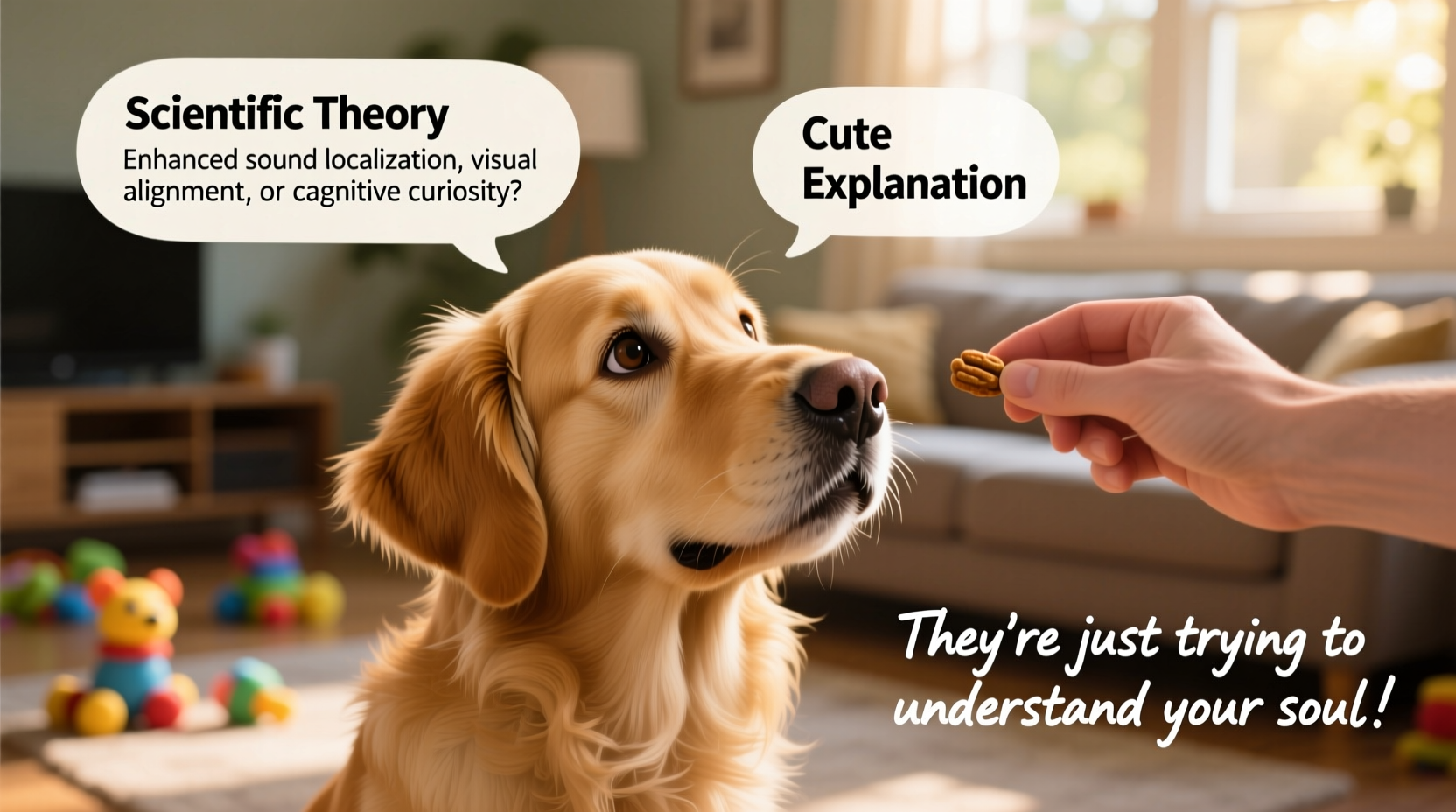
One of the most scientifically supported reasons dogs tilt their heads relates to hearing. Dogs rely heavily on auditory cues to interpret their environment, and their ear structure plays a critical role in sound localization—the ability to pinpoint where a sound is coming from. When a dog hears an unfamiliar or high-pitched noise, especially one embedded in human speech, it may tilt its head to adjust the position of its ears and improve sound reception.
In a 2019 study published in *Animal Cognition*, researchers observed that dogs with longer muzzles were more likely to tilt their heads when listening to commands than brachycephalic (short-nosed) breeds. This suggests that muzzle length could physically obstruct sound waves reaching the ear canal. By tilting their heads, long-muzzled dogs might be compensating for this obstruction, effectively “clearing the path” for better auditory input.
“Head tilting appears to be more frequent in dogs with elongated skulls, which supports the idea that they’re adjusting their ear alignment to capture sounds more efficiently.” — Dr. Stanley Coren, Professor Emeritus of Psychology, University of British Columbia
This theory gains further credibility when we consider how dogs respond to tone and pitch. High-frequency words like “squirrel” or “ball” often trigger a head tilt, possibly because these sounds are harder to process. The tilt may help the dog align its ears to better detect subtle vocal inflections, aiding comprehension.
Tip: If your dog frequently tilts its head in response to certain words, try varying your tone. You may discover which sounds elicit the strongest reactions.Social Communication and Reinforcement
Beyond physiology, head tilting serves as a powerful form of nonverbal communication between dogs and humans. From puppyhood, dogs learn which behaviors earn positive responses—praise, treats, affection. A head tilt, with its inherent charm, often triggers an enthusiastic reaction from owners. Over time, dogs may begin to associate the gesture with rewards and repeat it strategically.
This is not manipulation in a negative sense, but rather a testament to canine social intelligence. Dogs are highly attuned to human emotions and expressions. When they tilt their heads, they may be attempting to read facial cues more clearly, especially around the eyes and mouth. The angle change can reduce visual obstruction from their snout, allowing them to better interpret our expressions.
Consider this: many dogs don’t tilt their heads when alone or when interacting with other dogs. The behavior is disproportionately directed toward humans, suggesting it evolved—or was reinforced—within the context of human-dog relationships.
How Positive Reinforcement Shapes Behavior
A dog that receives attention after tilting its head is more likely to repeat the action. This creates a feedback loop:
- Dog tilts head in response to a sound.
- Owner reacts with affection or excitement (“Aww, look at him!”).
- Dog associates head tilt with positive outcome.
- Dog begins to tilt head more frequently, even in anticipation of interaction.
Over months or years, this learned behavior becomes semi-automatic, triggered not just by sounds but by the presence of attentive humans.
Anatomical and Breed Differences
Not all dogs tilt their heads equally. Some barely do it at all, while others seem to live in a perpetual state of curiosity. These differences can often be traced back to breed-specific traits.
| Breed Type | Head Tilt Frequency | Possible Reasons |
|---|---|---|
| Long-Muzzled (e.g., Collies, Shepherds) | High | Muzzle may block ear canals; greater need to adjust for sound clarity |
| Short-Muzzled (e.g., Pugs, Bulldogs) | Low to Moderate | Less physical obstruction; less need to tilt for auditory gain |
| Erect-Eared (e.g., Huskies, German Shepherds) | High | Ears are more mobile and responsive to directional cues |
| Floppy-Eared (e.g., Beagles, Spaniels) | Moderate | May rely more on movement than precise ear positioning |
The data isn’t absolute, but patterns suggest that both ear shape and muzzle length influence the frequency and angle of head tilts. Additionally, individual personality plays a role—curious, people-oriented dogs tend to tilt more than aloof or independent ones.
Cognitive Engagement and Problem Solving
Another compelling theory positions head tilting as a sign of mental processing. Just as humans might cock their heads when trying to understand a complex sentence or unfamiliar accent, dogs may use the gesture to signal cognitive engagement.
When a dog hears a novel word or command, it may tilt its head as part of an active effort to decode meaning. This isn’t just about hearing—it’s about interpreting. Researchers believe that dogs possess a limited but functional vocabulary, with some individuals understanding over 200 words. To access that mental lexicon, they may engage in subtle physical adjustments, including head tilting, to focus attention and enhance processing.
In one documented case, a Border Collie named Chaser demonstrated exceptional language comprehension during controlled experiments. While researchers didn’t specifically measure head tilting, observers noted that Chaser often tilted her head when presented with unfamiliar object names—suggesting a moment of concentration before retrieval.
Mini Case Study: Max the Rescue Dog
Max, a mixed-breed rescue adopted by a family in Colorado, rarely responded to verbal cues during his first month at home. His new owners assumed he hadn’t been trained. However, they noticed that whenever someone said “outside,” Max would tilt his head sharply to the left before running to the door.
Curious, they began using different words for the same concept—“yard,” “garden,” “bathroom”—and observed that the head tilt only occurred with familiar terms. Over time, as Max learned new commands, the tilt appeared less frequently, replaced by immediate action. This suggests that the tilt was most prominent during periods of uncertainty or active learning.
By month three, Max responded instantly to most commands without tilting. The behavior had essentially faded as his confidence and understanding grew—an indicator that head tilting may diminish with familiarity and cognitive mastery.
When to Be Concerned: Medical Considerations
While occasional head tilting is normal and often benign, a sudden, persistent, or uncontrolled tilt can signal a medical issue. Unlike the quick, responsive tilt seen during interactions, a pathological tilt often remains constant and may be accompanied by other symptoms.
Common causes include:
- Ear infections: Inflammation in the middle or inner ear can disrupt balance and cause discomfort, leading to a sustained head tilt.
- Vestibular disease: A condition affecting the inner ear or brainstem, often seen in older dogs. Symptoms include dizziness, circling, and loss of coordination.
- Neurological disorders: Tumors, inflammation, or trauma to the brain or spinal cord can manifest as abnormal posture.
- Toxin exposure: Certain medications or chemicals can damage the vestibular system.
It’s important to distinguish between voluntary, intermittent tilting and involuntary, prolonged posturing. The former is part of normal canine expression; the latter requires prompt medical evaluation.
FAQ: Common Questions About Head Tilting
Do all dogs tilt their heads?
No, not all dogs do. Frequency varies by breed, individual temperament, and life experience. Some dogs never develop the habit, while others use it regularly as a communicative tool.
Can I train my dog to tilt its head on command?
Yes—many trainers use shaping techniques to teach “tilt” as a trick. By rewarding slight head movements with treats or praise, owners can condition the behavior intentionally. However, it’s important not to overuse it, as repetitive motions could strain neck muscles if done excessively.
Is head tilting a sign of intelligence?
Not directly. While the behavior may reflect attentiveness or problem-solving, it’s not a reliable measure of cognitive ability. Some highly intelligent dogs rarely tilt, while others do so constantly without advanced comprehension skills.
Actionable Tips: Understanding and Responding to Head Tilts
To deepen your bond with your dog and better interpret this behavior, consider the following checklist:
- Observe context: Note when and why the tilt occurs—during speech, at specific words, or in response to sounds.
- Monitor frequency: Sudden increases in tilting could indicate ear discomfort or cognitive changes.
- Use consistent cues: Pair common commands with gestures to reinforce understanding and reduce confusion.
- Avoid over-rewarding: While it’s natural to coo over a cute tilt, excessive reinforcement may encourage performative behavior.
- Schedule regular vet checks: Ensure ear health and rule out underlying conditions, especially in older dogs.
Conclusion: More Than Just Cute
The dog’s head tilt is far more than a photogenic quirk. It’s a multifaceted behavior rooted in evolution, shaped by learning, and fine-tuned through companionship. Whether it’s helping a Collie hear a whispered command, prompting a toddler to laugh, or signaling a moment of canine curiosity, the tilt bridges species through shared emotion and mutual understanding.
Next time your dog cocks its head, take a moment to appreciate the layers beneath that simple motion. It’s a gesture born of biology, refined by relationship, and amplified by love. And while science continues to unravel its mechanisms, one thing remains certain: the head tilt endures because it works—not just for dogs, but for the humans who adore them.
💬 Have a story about your dog’s head tilt? Share your experiences in the comments and join the conversation about one of the most beloved behaviors in the canine world.








