If you’ve ever been startled awake by the sound of paws thundering across the floor, only to see your cat tearing through the house like a tiny, furry racecar, you’re not alone. This sudden burst of energy—commonly known as “midnight crazies” or “zoomies”—is a familiar phenomenon for cat owners worldwide. While it may seem random or even chaotic, there’s actually a deep-rooted biological explanation behind this behavior. Understanding why cats engage in nocturnal sprints isn’t just fascinating—it can also help pet owners create a more balanced environment that supports their cat’s natural instincts while minimizing disruptions.
The Evolutionary Roots of Nocturnal Activity
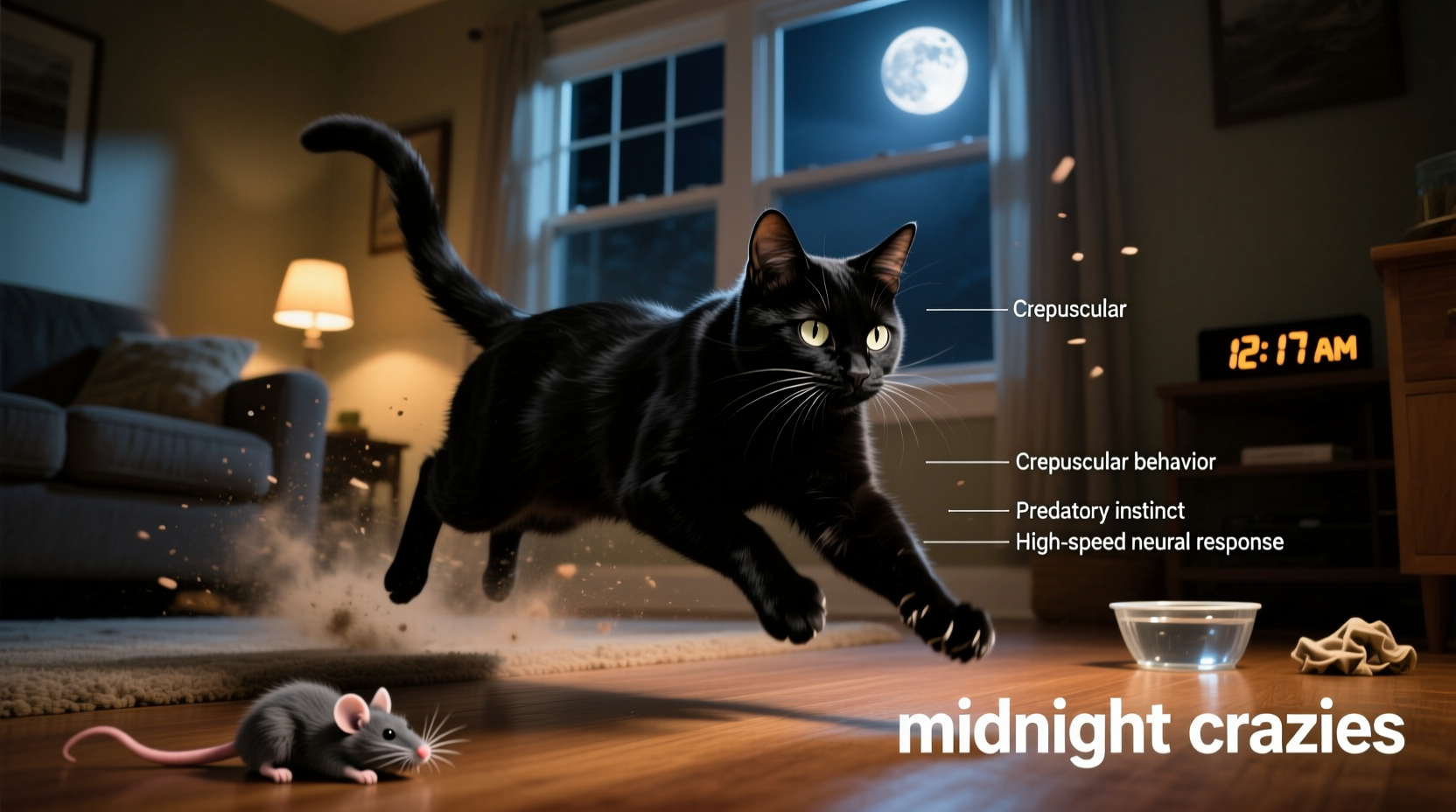
Cats are crepuscular by nature, meaning they are most active during dawn and dusk. However, many domestic cats shift their peak activity into the late evening and nighttime hours. This tendency is rooted in their evolutionary past. Wild ancestors of today’s house cats, such as the African wildcat (*Felis lybica*), hunted primarily under low-light conditions when prey was most active and predators less visible. These survival-driven rhythms have been passed down genetically, influencing the behavior of even well-fed indoor cats.
In the wild, short bursts of high-speed movement were essential for catching small rodents and birds. These explosive chases required immense physical exertion followed by long periods of rest—exactly the pattern we observe in modern cats during their nighttime sprints. Even without the need to hunt, domestic cats retain these ingrained cycles of energy conservation and release.
“Cats haven’t fully adapted to human schedules. Their internal clocks still run on predator time.” — Dr. Sarah Ellis, Feline Behavior Scientist, University of LincolnTip: Engage your cat in active play sessions before bedtime to help redirect their natural hunting impulses.
Energy Accumulation and Lack of Stimulation
Indoor cats often live highly sedentary lives compared to their outdoor counterparts. Without opportunities to stalk, chase, and explore throughout the day, excess energy builds up. Unlike dogs, who may burn calories through walks or yard play, cats rely on spontaneous bursts of activity to fulfill their predatory drive. When this energy isn’t released gradually, it tends to erupt suddenly—often right when their humans are trying to sleep.
This buildup is especially common in households where owners are away during the day. A cat left alone with limited environmental enrichment may nap for hours, then become hyperactive once the household returns and lights come on. The evening becomes a prime window for pent-up energy to explode in the form of zigzagging runs, wall-scaling leaps, and frenzied tail-chasing.
Moreover, certain stimuli can trigger an immediate response. A sudden noise, a flickering shadow, or even a dust mote floating in a beam of moonlight might be interpreted as potential prey. Once triggered, the cat’s motor patterns kick in automatically: stalk, pounce, chase, bite—all executed at full speed.
Common Triggers of Midnight Zoomies
- Sudden noises (e.g., creaking floors, appliances turning on)
- Shadows or reflections from windows or mirrors
- High-energy interactions before bed (e.g., rough play)
- Accumulated boredom due to lack of daytime stimulation
- Dietary factors, such as eating right before bedtime
The Role of Circadian Rhythms and Sleep Cycles
Cats sleep an average of 12 to 16 hours per day, but their sleep is fragmented into multiple short naps rather than one long stretch. This polyphasic sleep pattern allows them to remain alert to potential threats or opportunities. During lighter stages of sleep, cats can transition rapidly into wakefulness and action—a crucial adaptation for survival in the wild.
Their circadian rhythm, regulated by the suprachiasmatic nucleus in the brain, responds strongly to changes in light. As daylight fades and artificial lighting comes on, cats perceive this shift as a signal to increase vigilance and activity. Melatonin levels rise later in the evening, which in humans induces drowsiness—but in cats, it coincides with heightened sensory awareness and readiness to move.
Interestingly, kittens and younger cats tend to exhibit more frequent zoomies than older adults. This aligns with developmental needs: young cats use play as practice for real hunting scenarios. As they mature, the frequency usually decreases, though individual personalities and lifestyle factors continue to influence behavior.
Managing Midnight Crazies: A Practical Guide
While you can’t completely eliminate your cat’s instinctual behaviors, you can reshape their expression through structured routines and environmental adjustments. The goal isn’t to suppress natural feline energy, but to channel it constructively.
Step-by-Step Guide to Reducing Nighttime Hyperactivity
- Establish a consistent evening routine: Begin winding down household activity at the same time each night to signal that nighttime is approaching.
- Engage in interactive play 30–60 minutes before bed: Use wand toys, laser pointers, or crinkle balls to simulate a complete \"hunt-catch-kill-eat\" sequence.
- Feed a meal after play: Mimic the natural post-hunt feeding pattern. A full stomach promotes grooming and sleep.
- Provide mental stimulation during the day: Rotate puzzle feeders, hide treats, or set up perches near windows to keep your cat engaged.
- Limit overstimulation at night: Avoid reacting loudly or chasing your cat during zoomies, as this can reinforce the behavior.
Do’s and Don’ts of Handling Midnight Zoomies
| Do | Don't |
|---|---|
| Use scheduled play to redirect energy | Yell at or punish your cat mid-zoom |
| Offer safe spaces like cat trees or tunnels | Leave loose wires or fragile items within reach |
| Keep blinds open during the day for visual stimulation | Allow total inactivity during daylight hours |
| Consider automatic toys on timers | Wake your cat abruptly during deep sleep |
When Zoomies Signal Something Else
While occasional zoomies are normal, persistent or extreme nighttime activity could indicate underlying issues. Some medical conditions, such as hyperthyroidism, hypertension, or cognitive dysfunction in older cats, can manifest as restlessness, vocalization, or disoriented pacing at night. Similarly, anxiety, pain, or vision loss may disrupt sleep-wake cycles.
Behavioral red flags include:
- Constant pacing without playful elements
- Vocalizing excessively during the night
- Bumping into furniture or appearing confused
- Eliminating outside the litter box at night
If your cat’s behavior changes suddenly or seems distress-related, consult a veterinarian. Blood tests and a behavioral assessment can rule out health concerns and guide appropriate interventions.
“Not all nighttime activity is benign. In senior cats, increased nocturnal movement can be an early sign of feline cognitive decline.” — Dr. Elizabeth Colleran, Board-Certified Feline Veterinarian
Real-Life Example: Managing Midnight Zoomies in a Busy Household
Sophia, a software engineer living in Chicago, adopted a two-year-old tabby named Milo. Within weeks, she noticed he would sprint through her apartment every night between 1 a.m. and 3 a.m., knocking over plants and skidding across hardwood floors. Concerned about both Milo’s well-being and her own sleep deprivation, she consulted a veterinary behaviorist.
After evaluating Milo’s routine, the specialist recommended restructuring his evening schedule. Sophia began playing with Milo using a feather wand toy for 15 minutes starting at 8 p.m., followed by a small meal. She also installed a bird feeder outside her kitchen window to provide daytime entertainment and introduced a timed automatic ball toy that activated at 7 p.m. and 9 p.m.
Within two weeks, Milo’s nighttime sprints decreased significantly. He still had occasional bursts of energy, but they occurred earlier in the evening and were shorter in duration. By aligning Milo’s activity peaks with family hours, Sophia reduced disruption while honoring his natural instincts.
Frequently Asked Questions
Are midnight zoomies harmful to cats?
No, in most cases, zoomies are a healthy expression of natural behavior. They allow cats to stretch muscles, burn energy, and satisfy predatory drives. As long as the environment is safe and the cat isn’t injuring itself, there’s no cause for concern.
Why does my cat zoom after using the litter box?
This is a well-documented phenomenon sometimes called the “post-litter box rocket.” Possible explanations include relief from discomfort, instinctual avoidance of scent markers (to evade predators), or a sudden surge of energy from squatting. It’s typically harmless unless accompanied by signs of pain or urinary issues.
Can I train my cat to stop zooming at night?
You can’t train a cat to stop being a cat, but you can influence *when* and *how intensely* they express their energy. Consistent play, feeding schedules, and environmental enrichment are far more effective than punishment, which can damage trust and increase anxiety.
Conclusion: Embracing the Quirks of Feline Nature
The midnight zoomies aren’t a flaw in your cat’s design—they’re a feature. These bursts of energy reflect millions of years of evolution, finely tuned for survival in a world that demanded constant readiness. While modern life has changed where cats sleep and what they eat, it hasn’t rewritten their genetic programming.
Instead of resisting this behavior, the most compassionate approach is to work with it. By understanding the science behind the sprints and implementing thoughtful routines, you can reduce household disruptions while supporting your cat’s physical and psychological health. A well-played game of chase tonight might mean quieter nights tomorrow—and a happier, more fulfilled feline companion.
💬 Have a story about your cat’s wildest zoomies? Share your experience in the comments and connect with fellow cat lovers navigating the joyful chaos of feline energy.








