
Tinsel glitters, shimmers, and skitters unpredictably across the floor—especially under holiday lights. To a cat, it doesn’t look like decorative foil. It looks like something alive: a silvery insect, a wounded rodent, or a darting fish scale. This instinctive misreading isn’t whimsy—it’s hardwired neurology meeting hazardous household material. Every December, veterinary clinics report spikes in feline gastrointestinal emergencies linked directly to tinsel ingestion. Yet many owners still hang it within paw’s reach, assuming “it’s just shiny paper.” The truth is far more urgent: tinsel is one of the most common—and most dangerous—holiday hazards for cats, precisely because it triggers their predatory wiring so effectively.
The Predatory Blueprint: Why Tinsel Triggers Instinct
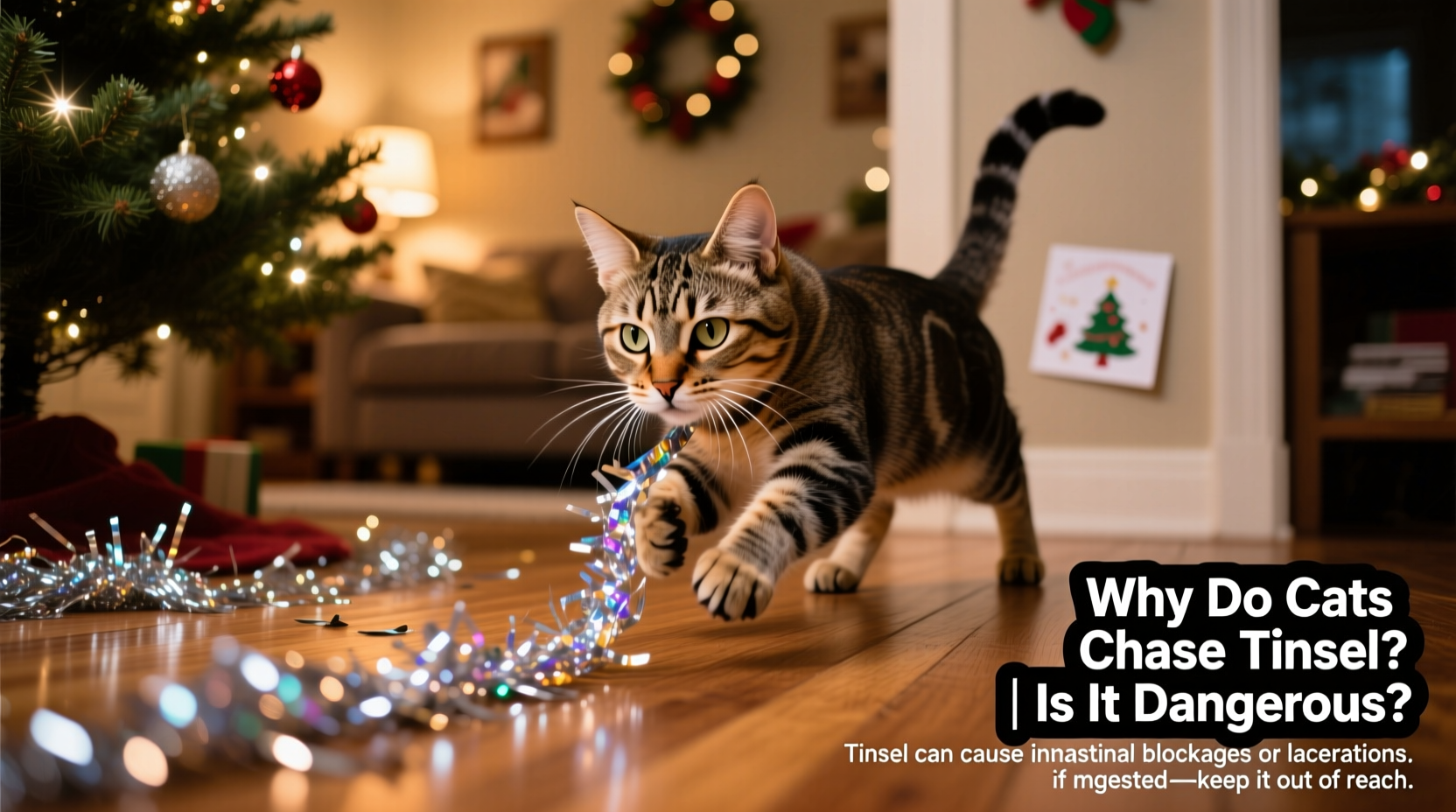
Cats are obligate predators shaped by millions of years of evolution. Their visual system prioritizes motion over static detail: they detect movement at distances up to six times farther than humans can, and their retinas contain a high density of motion-sensitive rod cells. Tinsel exploits this perfectly. When it catches light, it produces rapid, fragmented flashes—what vision scientists call “flicker fusion,” a stimulus that closely resembles the erratic flutter of moths or the shimmer of minnows in shallow water. Its thin, flexible strands also mimic the tactile feedback of prey: when batted, tinsel recoils, twitches, and slides unpredictably, triggering the same neural cascade as a live mouse tail.
Neurologically, this activates the cat’s “predatory sequence”: orient → eye-stalk → chase → grab-bite → kill-bite → consume. Tinsel rarely progresses past the grab-bite stage—but that’s where danger begins. Unlike string or yarn, which may be swallowed whole, tinsel’s metallic coating resists digestion and its jagged micro-edges catch on intestinal mucosa. Worse, it rarely passes through cleanly; instead, it anchors itself in the upper GI tract while the gut continues peristalsing, pulling loops of intestine tight around the strand—a phenomenon veterinarians call a “linear foreign body obstruction.”
Tip: Never use tinsel on lower branches of your tree—or anywhere within 3 feet of the floor. Cats don’t need to jump to engage with it; a single draft or curious nudge sends it sliding across hardwood or tile, instantly activating their chase response.The Hidden Danger: How Tinsel Injures From the Inside
Unlike plastic ornaments or pine needles—which pose choking or puncture risks—tinsel’s threat is insidious and progressive. Once swallowed, its damage unfolds in stages:
- Initial ingestion (0–6 hours): Cat may appear playful or mildly nauseous. You might notice drooling, lip licking, or repeated swallowing.
- Early obstruction (6–24 hours): Intestinal walls begin lacerating where tinsel anchors. Mild lethargy and decreased appetite emerge. Vomiting may be intermittent but non-productive.
- Full linear obstruction (24–72 hours): Bowel motility halts. Severe vomiting, abdominal pain (cat may hunch or avoid being touched), dehydration, and fever develop. Without intervention, ischemia and perforation follow.
- Critical failure (>72 hours): Full-thickness intestinal tears, septic peritonitis, and shock. Mortality rises sharply after 48 hours post-ingestion without surgical removal.
This progression explains why delayed presentation is so common—and so perilous. Owners often dismiss early signs as “just holiday stress” or “a mild tummy upset.” By the time vomiting becomes persistent, the tinsel has likely caused irreversible tissue damage.
What Veterinary Evidence Shows
A 2022 retrospective study published in the Journal of Feline Medicine and Surgery reviewed 147 cases of linear foreign body ingestion in cats over three holiday seasons. Tinsel accounted for 68% of confirmed cases—more than string, ribbon, or dental floss combined. Key findings included:
- Median time from ingestion to surgery: 31 hours
- 32% required partial intestinal resection due to necrosis
- Cats presenting >36 hours post-ingestion were 4.7× more likely to need bowel resection
- Zero cases resolved conservatively—100% required endoscopic or surgical retrieval
Dr. Lena Torres, board-certified veterinary surgeon and lead author of the study, emphasizes the physiological inevitability: “Tinsel isn’t ‘sometimes’ dangerous. Its physical properties—non-biodegradable, high tensile strength, micro-abrasive surface—guarantee mechanical injury once swallowed. There is no safe amount. One 6-inch strand is enough to initiate the obstruction cascade.”
“Tinsel is not a ‘toy’—it’s a surgical hazard disguised as decoration. I’ve removed tinsel from cats whose owners swore ‘they only played with it.’ But play becomes ingestion in seconds. Prevention isn’t caution—it’s elimination.” — Dr. Lena Torres, DVM, DACVS, Veterinary Surgeon & Director of Small Animal Surgery, Midwest Veterinary Referral Center
Practical Prevention: A Holiday Safety Checklist
Preventing tinsel exposure requires more than vigilance—it demands proactive environmental design. Use this evidence-based checklist before decorating:
Holiday Cat-Safety Checklist
- ✅ Replace all traditional tinsel with wide, matte-finish garlands made of felt, wool, or thick paper (no metallic sheen or flexibility)
- ✅ Secure tree skirts tightly to eliminate gaps where tinsel could pool or dangle
- ✅ Use double-sided tape on baseboards near the tree to deter exploration (cats dislike sticky surfaces)
- ✅ Install a baby gate or freestanding pet barrier around the tree zone—minimum 3-foot radius
- ✅ Store unused tinsel in a locked cabinet—not just a high shelf (cats leap vertically up to 5 feet)
- ✅ Check daily for stray tinsel fragments: vacuum thoroughly, wipe floors with damp cloths, inspect under furniture
What to Do If Your Cat Contacts or Swallows Tinsel
Immediate action prevents escalation. Follow this step-by-step protocol:
- Assess calmly but urgently: Look for visible tinsel in mouth, paws, or fur. Note behavior: Is cat gagging? Pawing at mouth? Licking lips excessively?
- Do NOT induce vomiting: Tinsel can cause esophageal lacerations during retching. Never administer hydrogen peroxide or salt water.
- Do NOT pull exposed tinsel: If a strand protrudes from the mouth or anus, cutting or tugging worsens internal damage. Leave it in place for veterinary assessment.
- Contact your vet or emergency clinic immediately: State “suspected tinsel ingestion” and ask for triage guidance. Most clinics will prioritize this as urgent—even if symptoms seem mild.
- Prepare for diagnostics: Expect abdominal radiographs (X-rays) and ultrasound. While tinsel isn’t always radio-opaque, its location and secondary signs (gas patterns, fluid accumulation) confirm obstruction.
- Consent to intervention: Endoscopy may retrieve tinsel if caught within 2–4 hours and still in the stomach. Beyond that, exploratory laparotomy is usually required.
Real-World Example: Luna’s Near-Miss
Luna, a 3-year-old domestic shorthair in Portland, Oregon, swiped a 10-inch strand of silver tinsel from her owner’s hand while he was trimming the tree. She batted it, chased it across the rug, then paused—mouth slightly open, tongue flicking—as if tasting the air. Her owner assumed she’d lost interest. Two hours later, Luna vomited twice, then retreated under the sofa. By morning, she refused food, had dry gums, and flinched when her abdomen was gently pressed.
At the emergency clinic, X-rays showed “string-of-pearls” gas patterns—classic linear foreign body sign. Surgery revealed tinsel anchored in her duodenum, with three inches of jejunum already necrotic. The surgeon removed 18 inches of damaged intestine and repaired the site. Luna recovered fully after two weeks of antibiotics and soft food—but her owner now uses handmade cotton pom-pom garlands and keeps the tree in a closed-off room when unattended.
Luna’s case underscores a critical reality: cats rarely show dramatic distress until damage is advanced. Early signs are subtle, easily mistaken for fatigue or seasonal stress. Her survival hinged entirely on her owner recognizing vomiting + lethargy + abdominal sensitivity as a red-flag triad—not isolated quirks.
Comparative Risk: Tinsel vs. Other Common Holiday Hazards
Not all holiday items carry equal risk. This table compares tinsel to other frequently encountered dangers based on veterinary ER data (2021–2023, AVMA Poison Control Center):
| Hazard | Ingestion Frequency (per 1000 ER visits) | Typical Intervention Required | Time to Critical Complication | Survival Rate with Prompt Care |
|---|---|---|---|---|
| Tinsel | 127 | Surgery (100%) | 24–48 hours | 92% (if surgery within 24 hrs) |
| Pine needles | 89 | Supportive care (85%), surgery (15%) | 48–72 hours | 98% |
| Chocolate | 63 | Activated charcoal + IV fluids (95%) | 6–12 hours | 99.5% |
| Electrical cords | 41 | Oral wound care + monitoring (70%) | Rarely critical unless electrocution | 99.9% |
| Gift wrap ribbons | 38 | Endoscopy (40%), surgery (60%) | 36–60 hours | 88% |
Note: Tinsel leads in both frequency and surgical necessity—yet receives the least public awareness. Its glitter creates false perceptions of harmlessness, unlike chocolate’s known toxicity or cords’ visible danger.
FAQ: Addressing Common Concerns
Can’t my cat just pass tinsel naturally?
No. Tinsel lacks elasticity and digestibility. Its rigid structure prevents peristaltic propulsion. Instead, it acts like a saw blade embedded in intestinal walls. Even “biodegradable” tinsel alternatives contain cellulose acetate or polyester blends that resist breakdown for months. Natural passage is physiologically impossible.
Is “cat-safe tinsel” really safe?
Marketing terms like “pet-safe” or “non-toxic tinsel” refer only to chemical composition—not mechanical risk. These products still possess the same thin, flexible, snag-prone form factor. Veterinary associations explicitly warn against any tinsel-like material, regardless of labeling. If it moves like prey and feels like thread, it’s unsafe.
My cat has played with tinsel for years and never gotten sick. Why change now?
Each exposure carries cumulative risk. Micro-tears in the intestinal lining may heal silently but weaken tissue integrity over time. What appears as “luck” is statistically inevitable delay—until the day a strand lodges at a vulnerable point. Prevention isn’t about past outcomes; it’s about eliminating predictable, preventable catastrophe.
Conclusion: Prioritize Instinct Over Aesthetics
Tinsel doesn’t belong in homes with cats—not as decoration, not as “controlled exposure,” not even as a brief seasonal exception. Its danger lies not in rarity, but in inevitability: a cat’s biology guarantees engagement, and its physics guarantee injury upon ingestion. You wouldn’t leave a lit candle unattended near curtains; tinsel demands the same level of non-negotiable removal. Replace it with textures cats can’t mistake for prey—burlap ribbons, wooden beads, dried orange slices. Let your holiday reflect care, not compromise. Your cat’s instincts are perfect. Your responsibility is to honor them by removing the trap disguised as treasure.
💬 Your home is safer when instinct and environment align. Share this article with fellow cat guardians—because one informed decision today prevents an emergency tomorrow.








