
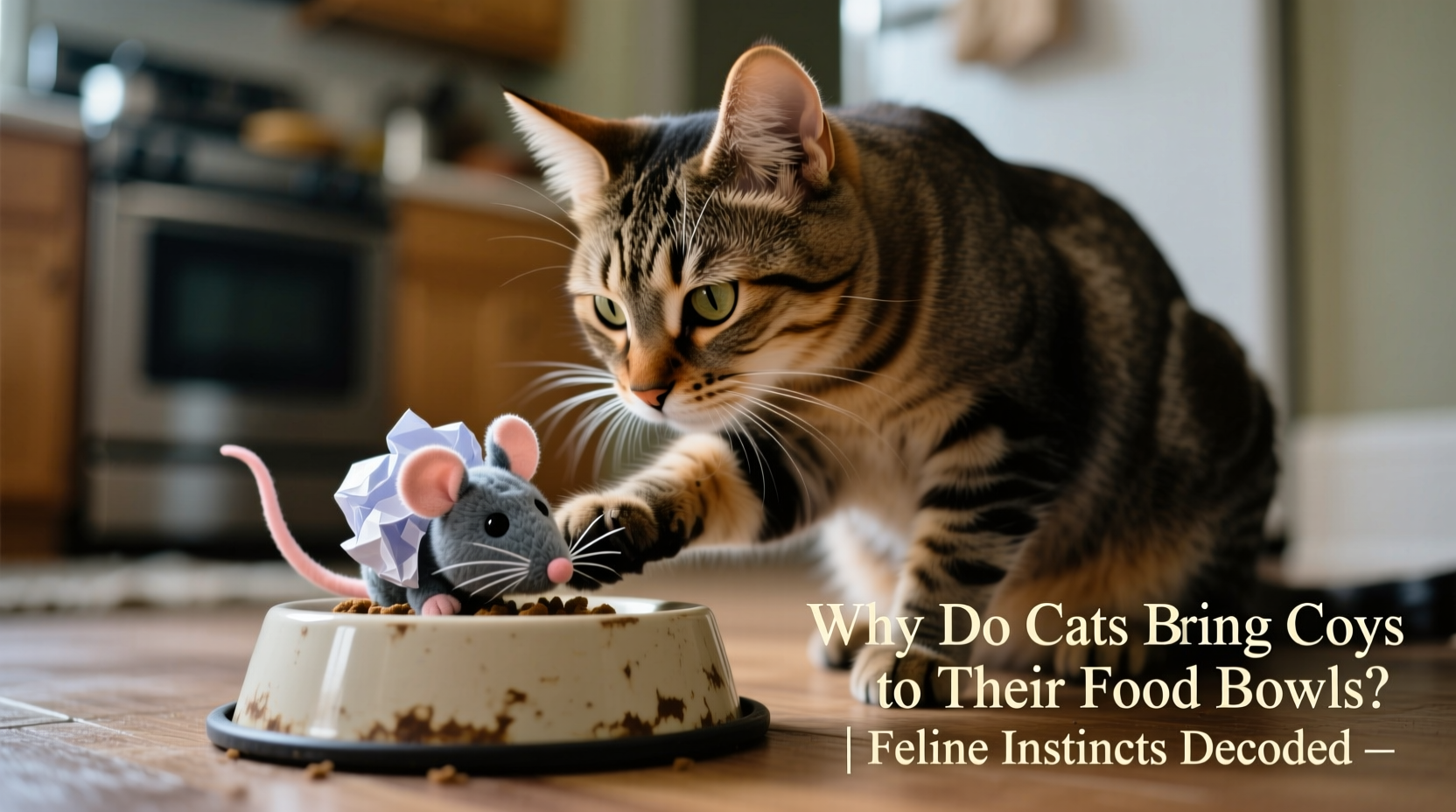
Cats are creatures of habit, mystery, and finely tuned instinct. If you’ve ever found a crumpled mouse toy nestled beside your cat’s dinner bowl—or worse, floating in their water dish—you’re not alone. This seemingly odd behavior is more common than many realize, and far from random. Behind every toy deposited near kibble lies a complex web of evolutionary drives, emotional signaling, and territorial logic. Understanding why cats bring toys to their food bowls isn’t just about solving a quirky puzzle—it’s about gaining deeper insight into your cat’s mind and needs.
This article decodes the instinctual roots of this behavior, explores its psychological underpinnings, and offers practical guidance for cat owners who want to support their pets’ natural tendencies while maintaining household harmony.
The Evolutionary Roots of Toy-Burying Behavior
To understand modern cat behavior, we must look back to their wild ancestors. Domestic cats (Felis catus) evolved from solitary hunters in arid regions like the Fertile Crescent, where survival depended on stealth, precision, and resource protection. In the wild, after making a kill, a cat would often drag prey to a safe location before consuming it. This minimized the risk of theft by scavengers or rival predators.
Bringing toys—especially those that resemble prey—to the food bowl mirrors this ancestral pattern. The food area becomes a “safe zone,” a place associated with sustenance and security. By placing their \"kill\" (the toy) near food, cats are effectively saying: This is mine. I claim this space. I trust this spot with my treasures.
Interestingly, this behavior is more pronounced in indoor cats. Without access to real hunting grounds, domestic felines redirect their predatory sequences—stalk, pounce, capture, present—onto toys. The food bowl, as a central hub of daily routine, naturally becomes a focal point for these symbolic acts.
Tip: Observe when your cat moves toys—often right after play or feeding. This timing reinforces the link between hunting simulation and mealtime safety.Scent Marking and Territorial Security
Cats are olfactory-driven animals. They perceive the world largely through scent, using glands located on their cheeks, paws, flanks, and even the base of their tails to mark territory. When a cat carries a toy in its mouth to the food bowl, it deposits saliva and facial pheromones onto the object. This act transforms the toy—and by extension, the feeding area—into part of their personal domain.
The food bowl, already imbued with the smell of meals and human interaction, becomes a sensory anchor. Adding a toy rich with their own scent creates a layered signal: “This space belongs to me, and I feel secure here.” For cats living in multi-pet households or high-traffic homes, this behavior may intensify during periods of stress or environmental change.
In some cases, cats may even attempt to “bury” toys near the food bowl by pawing at the floor or nudging them under furniture. While they can’t dig through hardwood or tile, the motion replicates the instinct to conceal prey from rivals—a vestige of survival hardwired over millennia.
How Stress Influences Toy Placement
Environmental stressors such as new pets, visitors, construction noise, or changes in routine can amplify instinctual behaviors. A study published in *Applied Animal Behaviour Science* found that cats in unstable environments were significantly more likely to engage in ritualistic object relocation, including moving toys to feeding zones.
If your cat suddenly begins hoarding multiple toys around their bowl—especially if accompanied by vocalization, overgrooming, or avoidance of other areas—it may be worth evaluating their overall stress levels. Providing vertical spaces, hiding spots, and consistent routines can help reduce anxiety-driven behaviors.
Food and Play: A Cognitive Connection
The proximity of play and eating isn’t arbitrary. In nature, successful hunts lead directly to consumption. Domestic cats, though fed on schedule, still experience the post-play “surge” of adrenaline and satisfaction akin to a real kill. Placing the toy near food completes the mental loop: hunt → capture → consume.
This cognitive sequence explains why cats often lose interest in a toy immediately after “killing” it—especially if it squeaks or crinkles. Once the simulated hunt ends, the object transitions from prey to possession, and its rightful place, in the cat’s mind, is beside the meal it “earned.”
Veterinary behaviorists refer to this as the **predatory feedback loop**. When play mimics hunting, the brain expects closure in the form of eating. Even if no actual food is involved, positioning the toy near kibble satisfies the subconscious narrative.
“Cats don’t separate play from purpose. When they ‘catch’ something, their instincts tell them to bring it to a safe place to eat. The food bowl symbolizes that safety.” — Dr. Sarah Thompson, DVM, Feline Behavior Specialist
Is It a Gift? Decoding Social Signaling
Some cat owners interpret toy delivery as a gift—an endearing gesture of affection or inclusion. While this may sound anthropomorphic, there’s biological truth behind it. Mother cats bring injured prey to their kittens to teach them how to eat. Adult cats may extend similar behavior toward humans, whom they view as clumsy, inefficient members of their social group.
If your cat drops a toy at your feet or nudges it toward your plate, they might genuinely believe they’re helping you survive. Extending this logic, placing toys near the food bowl could be a way of “stocking the pantry” for their human family. It’s a blend of caregiving instinct and territorial sharing.
This theory gains weight when observing cats who only perform the behavior around certain family members. They tend to favor individuals they bond with most closely—those who feed them, groom them, or sleep nearby.
Mini Case Study: Luna and the Midnight Mouse Parade
Luna, a 4-year-old tabby living in a two-cat household in Portland, began collecting her favorite plush mice around her food bowl every evening. Her owner, Maria, initially thought it was random until she noticed a pattern: the behavior intensified after her boyfriend moved in. With a second adult now occupying shared spaces, Luna felt her territory was under subtle threat.
After consulting a veterinary behaviorist, Maria added a second feeding station on an elevated shelf—away from foot traffic—and introduced a Feliway diffuser. Within three weeks, Luna stopped hoarding toys at ground level. Instead, she placed one toy beside her new elevated bowl each night, then settled down to eat. The ritual became calmer, more deliberate—less about defense, more about routine.
This case illustrates how toy placement functions as both instinct and communication. Once Luna felt secure, her behavior shifted from anxious guarding to symbolic claiming.
Practical Tips for Cat Owners
While bringing toys to the food bowl is normal, it can create hygiene concerns—especially if toys end up in water bowls or get chewed after meals. Here’s how to manage the behavior without suppressing your cat’s instincts.
Tip: Never punish your cat for moving toys. This behavior is instinctive, not defiant. Redirect instead of reprimand.Step-by-Step Guide: Managing Toy Hoarding Around Food
- Observe the Pattern: Note when and which toys are moved. Is it after play? Before meals? Only certain toys?
- Create a Designated “Kill Zone”: Place a small mat or basket near—but not touching—the feeding area where toys can be stored. Encourage use with treats or catnip.
- Rotate Toys Regularly: Cats fixate on specific toys. Rotating them weekly reduces obsessive attachment.
- Use Puzzle Feeders: These merge play and eating, satisfying the predatory loop without requiring toy relocation.
- Separate Play and Feeding Zones: Ideally, keep toy storage in a different room. After play, put toys away before feeding.
- Clean Frequently: Wash toys regularly, especially those exposed to food or saliva, to prevent bacterial buildup.
Checklist: Healthy Toy-to-Bowl Behavior vs. Cause for Concern
- ✅ Normal: Occasional toy placement near food; cat eats normally; no aggression.
- ✅ Normal: Toy is left untouched after placement; cat walks away calmly.
- ✅ Normal: Behavior occurs mostly at night or after play sessions.
- ⚠️ Monitor: Multiple toys moved daily; signs of anxiety (hiding, overgrooming).
- ⚠️ Monitor: Aggression when toys are removed; refusal to eat near displaced toys.
- ❌ Seek Help: Obsessive hoarding, self-injury, or complete meal avoidance.
Do’s and Don’ts: Managing Instinctive Behaviors
| Do | Don’t |
|---|---|
| Respect your cat’s need to “claim” space | Punish or scold for moving toys |
| Provide alternative zones for toy storage | Remove toys abruptly without replacement |
| Use positive reinforcement when toys stay in designated areas | Use loud noises or sprays to deter behavior |
| Engage in daily interactive play to satisfy hunting drive | Ignore signs of stress or anxiety |
| Keep feeding areas clean and predictable | Move food bowls frequently without transition |
Frequently Asked Questions
Why does my cat only bring certain toys to the food bowl?
Cats often select toys that mimic real prey—feather wands, fuzzy mice, or anything that moves unpredictably. These trigger stronger hunting responses and are more likely to be treated as “kills.” Scent, texture, and past success during play also influence preference.
Should I remove toys from the food area?
You can—but do so gently and replace them with a suitable alternative. Abrupt removal may increase anxiety. Instead, guide your cat toward a nearby basket or shelf where toys are allowed, rewarding them for using it.
Is this behavior a sign of illness?
Generally, no. However, sudden changes in behavior—such as obsessive hoarding, loss of appetite, or lethargy—should prompt a veterinary visit. Neurological issues or dental pain can sometimes alter normal routines.
Conclusion: Embracing Your Cat’s Wild Mind
The next time you find a crinkly ball tucked beside your cat’s dinner, resist the urge to simply toss it aside. That small act carries layers of meaning—a whisper from the savannah, a declaration of trust, a silent story of survival and belonging. Far from being mere whimsy, the habit of bringing toys to food bowls reveals the depth of your cat’s instincts and their desire to make sense of their world.
By understanding and accommodating these behaviors—not eliminating them—we build stronger bonds and healthier environments for our feline companions. Honor their wild hearts, even within the safety of home.
💬 Have a story about your cat’s toy rituals? Share your experience in the comments and connect with fellow cat lovers who appreciate the beautiful complexity behind every purr and paw drop.








