Birds traversing vast distances during seasonal migrations often captivate observers with their precise, synchronized flight formations—most notably the iconic V-shape seen among geese, swans, and pelicans. This remarkable behavior is not merely aesthetic; it is a highly evolved strategy rooted in physics, physiology, and social cooperation. Behind the graceful arcs across the sky lies a complex interplay of aerodynamics, energy efficiency, communication, and leadership dynamics that enable birds to complete some of the most grueling journeys in the animal kingdom.
Migratory flights can span thousands of miles, from Arctic breeding grounds to tropical wintering areas. These treks demand immense physical endurance, and any advantage that reduces energy expenditure significantly increases survival odds. Flying in formation is one such adaptation—refined over millions of years—that allows birds to travel farther, faster, and safer than they could alone.
The Aerodynamic Advantage: How Formation Flight Saves Energy
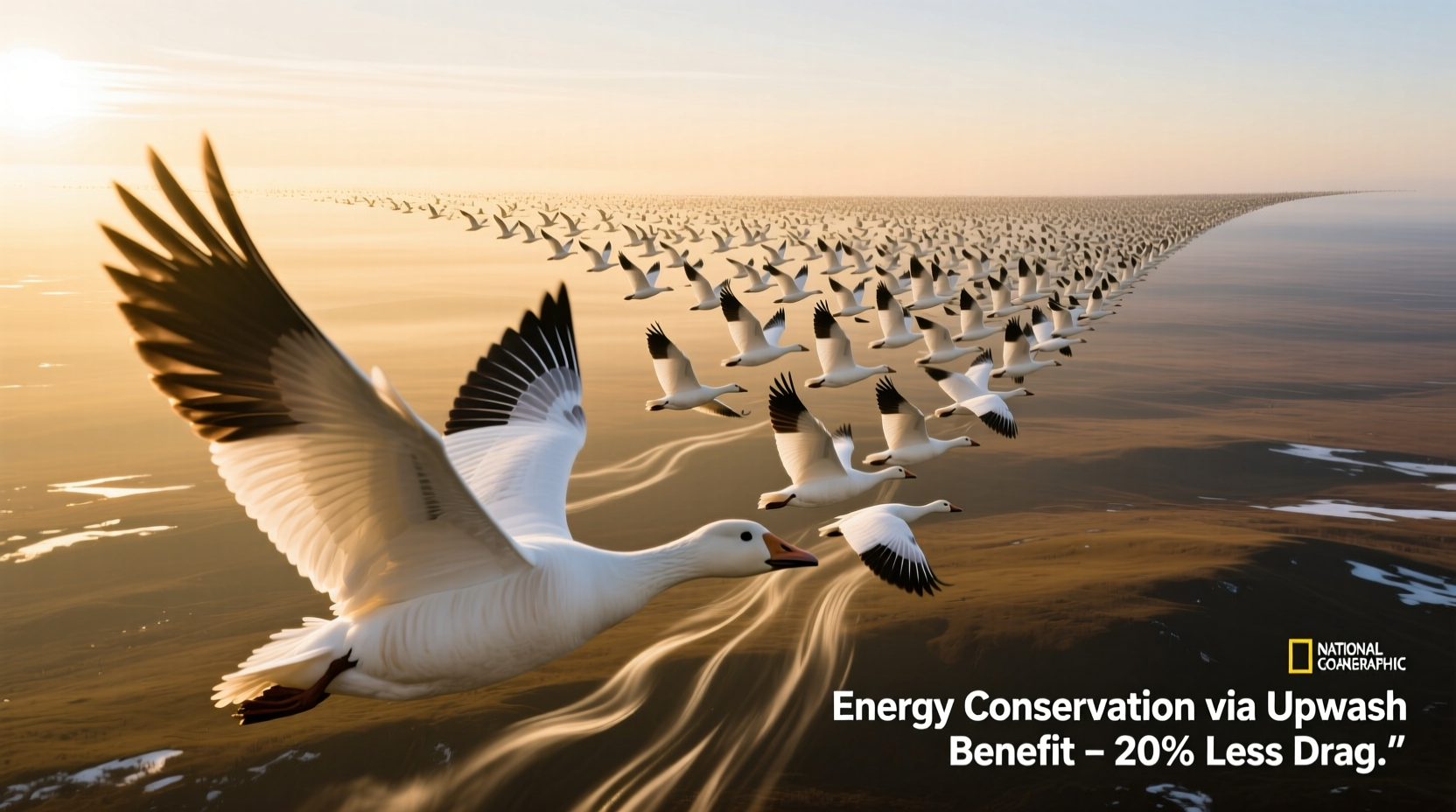
At the heart of formation flying is aerodynamics. When a bird flaps its wings, it generates lift by pushing air downward. This movement creates swirling vortices at the wingtips—regions of rotating air known as wingtip vortices. The upward-moving section of these vortices, called upwash, occurs just behind and outside the wingtips. Birds flying slightly behind and to the side of another bird can position themselves within this upwash zone, gaining free lift without flapping as hard.
This phenomenon is similar to how race cars draft behind each other on a track, reducing wind resistance. In birds, particularly large species like Canada geese or white pelicans, flying in a V-formation can reduce induced drag—the resistance created by generating lift—by up to 70% for individuals following the leader. As a result, heart rates and oxygen consumption drop measurably, allowing birds to maintain speed while expending less energy.
“By riding the upwash generated by the bird ahead, followers gain significant energetic benefits—sometimes extending their range by over 70% compared to solo flight.” — Dr. Steven Portugal, Royal Holloway, University of London
A landmark study published in *Nature* used GPS loggers attached to northern bald ibises and found that birds precisely timed their wingbeats and adjusted their positions to maximize upwash capture. Each bird maintained optimal spacing—neither too close nor too far—and synchronized its flapping with neighbors, confirming that formation flight is not random but a finely tuned cooperative system.
Tip: The energy savings from formation flight are most pronounced in large, heavy birds with long wingspans—species that benefit most from reduced aerodynamic strain.Leadership and Rotation: Shared Effort in the Sky
If the lead position offers no aerodynamic benefit (in fact, it bears the full brunt of air resistance), who takes turns leading, and how is this managed? Research shows that birds rotate leadership roles throughout a journey. The individual at the front eventually tires and drops back into the formation, allowing another bird to take the lead.
This rotation ensures that no single bird bears the metabolic cost of breaking new airflow for extended periods. Studies tracking flocks of ibises revealed that birds took turns leading for roughly equal durations—some for as little as a few minutes, others for longer stretches depending on fitness and conditions. This equitable sharing underscores the social intelligence embedded in avian flocks.
Communication plays a key role. While visual cues help birds align their positions, vocalizations also contribute. Geese honk frequently during flight—not just to signal direction changes, but possibly to coordinate effort and maintain group cohesion. These calls may serve as both navigational aids and motivational signals, reinforcing the collective rhythm of the flock.
Why the V Shape?
The V formation isn’t arbitrary. It maximizes the number of birds that can access upwash zones efficiently. Each trailing bird positions itself slightly offset from the one ahead, forming angles between 30° and 60°. This geometry ensures minimal overlap of downwash (the detrimental downward air current) while maximizing exposure to beneficial upwash.
Interestingly, some species deviate from the classic V. Ducks often fly in skewed lines or echelons, while cranes adopt looser Vs or even single-file lines. These variations reflect differences in body size, wing morphology, flock size, and flight speed—but all aim to achieve the same goal: energy conservation through coordinated movement.
Navigation and Safety: More Than Just Saving Calories
Energy conservation is a primary driver, but formation flight offers additional survival advantages. One of the most critical is improved navigation. Migrating birds rely on a suite of cues—sun position, stars, Earth’s magnetic field, and landmarks—but traveling in groups enhances accuracy. Experienced individuals, often older birds familiar with migratory routes, guide younger ones. This cultural transmission of knowledge is vital, especially for species where juveniles migrate for the first time.
In addition, flying in formation increases vigilance. With many eyes scanning the skies, the likelihood of detecting predators such as hawks or falcons rises dramatically. Even during flight, birds can react collectively to threats—suddenly changing direction or breaking formation to evade danger. This \"many-watching\" effect reduces individual stress and allows more energy to be directed toward propulsion rather than constant alertness.
Formation flying also minimizes disorientation. In poor visibility or turbulent weather, staying visually connected to companions helps prevent straggling. A lone bird risks getting lost, increasing the chance of exhaustion, predation, or death. By contrast, the group acts as a navigational safety net.
Case Study: The Northern Bald Ibis Reintroduction Project
In a real-world example highlighting the importance of formation and social learning, conservationists working with the critically endangered northern bald ibis used human-led microlight aircraft to teach captive-bred birds migration routes across Europe. Young ibises imprinted on the pilots and followed them southward, gradually learning the path.
GPS data showed that once the birds began migrating independently, they adopted tight V-formations and rotated leadership roles—despite never having experienced wild migration before. Over successive seasons, their flight efficiency improved, and route fidelity increased. This project demonstrated that formation flight is both instinctive and refined through experience, and that social structure is essential for successful migration.
Species Comparison: Who Flies in Formation and Why?
Not all migratory birds fly in organized formations. Songbirds like warblers or thrushes typically migrate alone or in loose aggregations, relying more on nocturnal flight and celestial navigation. Their smaller size and different aerodynamic profiles make drafting less effective. Instead, they conserve energy through efficient metabolism and stopover feeding.
In contrast, larger birds with high aspect ratio wings (long and narrow) benefit greatly from formation flight. Below is a comparison of species known for structured migration patterns:
| Species | Typical Formation | Migration Distance | Key Benefit |
|---|---|---|---|
| Canada Goose | V-formation | Up to 3,000 miles | Energy savings via upwash utilization |
| Whooping Crane | Diagonal line or shallow V | Over 2,500 miles | Navigation support and predator detection |
| White Pelican | Straight line or echelon | 1,500–2,000 miles | Drafting efficiency and thermal soaring synergy |
| Barnacle Goose | Tight V or J-shaped | Over 2,000 miles | Group coordination and vocal communication |
| European Starling | Fluid murmurations (non-migratory) | Shorter regional movements | Predator evasion, not energy conservation |
Note that murmurations—those mesmerizing, swirling flocks of starlings—are distinct from migratory formations. They occur primarily at dusk around roosting sites and serve anti-predator functions rather than energy-saving purposes.
Step-by-Step: How a Flock Achieves Efficient Formation Flight
While birds don’t follow a checklist, their process for achieving optimal formation involves several key stages:
- Initiation: A dominant or experienced bird takes off first, signaling the start of migration. Others follow rapidly, using visual and auditory cues.
- Alignment: Birds adjust their speed and direction to match the group, minimizing collisions and gaps.
- Positioning: Each bird finds its place in the formation, ideally within the upwash zone of the bird ahead. Wingbeat synchronization begins.
- Stabilization: The flock reaches a steady state, maintaining consistent spacing and angle. Leadership may rotate every few minutes.
- Adaptation: In response to wind shifts, terrain, or fatigue, birds subtly alter formation shape—tightening, widening, or reorganizing.
- Dissolution: Upon reaching a stopover site or destination, the formation breaks naturally as birds descend to feed or rest.
This dynamic process relies on split-second sensory processing and motor control. Birds must continuously monitor neighbors’ positions, adjust wing strokes, and respond to environmental feedback—all while navigating at speeds exceeding 40 mph.
Common Misconceptions About Bird Formations
- Misconception: The strongest bird always leads.
Reality: Leadership rotates regularly; even weaker or younger birds may lead briefly. - Misconception: All birds in the V get equal benefit.
Reality: Birds near the center of the V often enjoy the greatest aerodynamic advantage. - Misconception: Formation flight is only about saving energy.
Reality: Navigation, safety, and social bonding are equally important.
Frequently Asked Questions
Do all migratory birds fly in formation?
No. Formation flight is most common in large, long-winged birds such as waterfowl, raptors, and wading birds. Small passerines usually migrate individually or in loose groups, relying on different energy-saving strategies like flying at night or using tailwinds.
How do birds avoid colliding in tight formations?
Birds have exceptional vision and depth perception. They use rapid reflexes and continuous micro-adjustments in wing position and speed. High-speed video studies show that birds maintain safe distances—even during sudden maneuvers—thanks to advanced neural processing and spatial awareness.
Can birds fly in formation if one is injured?
Rarely. An injured bird will typically fall behind and attempt to rejoin later or find shelter. The flock rarely waits, as stopping would compromise the entire group’s energy budget and timing. However, family units (like parent-offspring pairs) may stay together even if slower.
Practical Checklist for Observing and Understanding Bird Migration Patterns
Checklist: What to look for when observing migratory bird formations:- Identify the species and typical formation shape (V, line, echelon).
- Note the size of the flock and whether birds appear evenly spaced.
- Listen for calls—frequent honking often indicates coordination.
- Watch for leadership changes—do birds rotate positions?
- Observe flight altitude and speed relative to wind conditions.
- Use binoculars or spotting scopes to see wingbeat synchronization.
Conclusion: Nature’s Masterclass in Efficiency and Cooperation
The sight of birds flying in formation is more than poetic—it’s a testament to nature’s ingenuity. Through millions of years of evolution, birds have mastered the art of collaborative flight, turning the challenges of migration into a symphony of motion, physics, and shared purpose. From the subtle choreography of wingbeats to the silent exchange of leadership, every element serves a function: to conserve energy, enhance survival, and ensure the continuation of life cycles across continents.
Understanding why birds fly in formation deepens our appreciation for avian intelligence and resilience. It also offers insights applicable beyond biology—from robotics and drone swarming algorithms to team dynamics in human organizations. But above all, it reminds us that cooperation, even in the most demanding circumstances, can elevate what any individual could achieve alone.
💬 Have you observed migratory birds in your area? Share your experiences, photos, or questions in the comments—let’s learn from each other’s encounters with nature’s aerial marvels.








