It’s 3 a.m., the world is quiet, and suddenly you’re jolted awake by a robin singing outside your window. No cars, no people—just one determined bird filling the darkness with song. It’s not a malfunction or a glitch in nature; it’s part of a well-documented avian behavior known as the dawn chorus. But why so early? Why 3 a.m.? And what drives birds to break the silence when most creatures are still asleep?
The answer lies in a complex interplay of biology, evolution, acoustics, and environmental cues. Birds don’t sing at 3 a.m. because they’re trying to annoy humans—they’re communicating, competing, and courting under conditions that maximize their chances of success. This article explores the science behind pre-dawn bird songs, unpacking the reasons, rhythms, and real-world implications of this natural phenomenon.
The Dawn Chorus: A Symphony of Survival
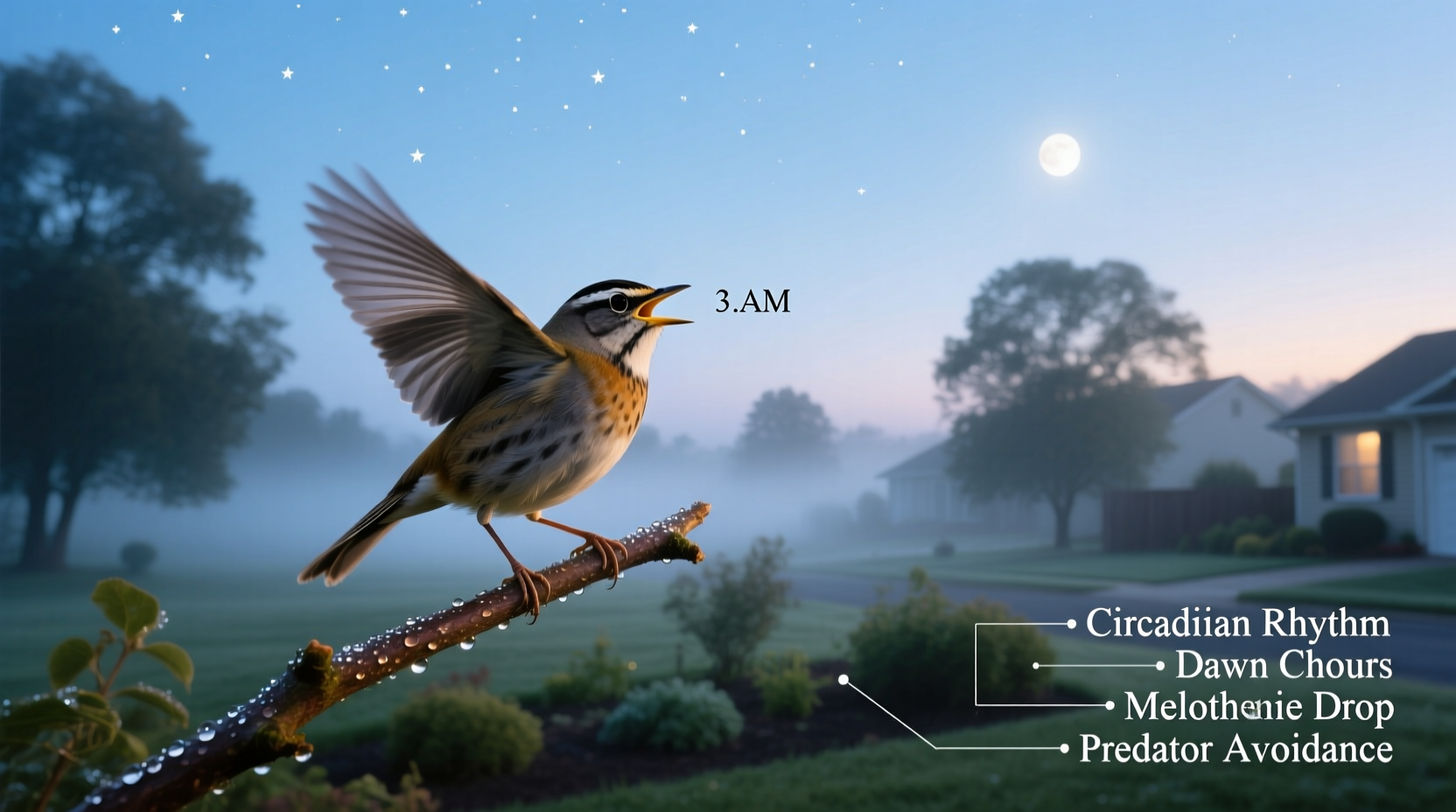
Birdsong isn't just pleasant background noise—it's a critical tool for survival. The period between 3 a.m. and sunrise, often called the \"dawn chorus,\" is when many bird species sing most intensely. This timing isn't random. Several evolutionary advantages make the early hours ideal for vocal communication.
First, sound travels more efficiently in the cool, still air before sunrise. With less wind and lower ambient noise, bird calls carry farther and with greater clarity. This allows males to broadcast their presence across larger territories, deterring rivals and attracting potential mates from a distance.
Second, light levels at dawn are too low for effective foraging but sufficient for visual signaling. Many birds pair their songs with physical displays—fluffing feathers, bobbing heads, or wing flicks—enhancing their message through multimodal communication.
“Birdsong at dawn is like placing an advertisement during prime time TV. It reaches the largest audience with minimal interference.” — Dr. Laura Finch, Behavioral Ornithologist, Cornell Lab of Ornithology
Biological Clocks and Circadian Rhythms
Birds, like humans, operate on internal biological clocks regulated by circadian rhythms. These rhythms are synchronized with the daily cycle of light and dark, primarily controlled by a region in the brain called the suprachiasmatic nucleus (SCN). In birds, this system is especially sensitive to changes in daylight, which explains why their singing patterns shift with the seasons.
During spring and summer, when days are longer and breeding activity peaks, birds begin singing earlier. Some species, such as robins, blackbirds, and thrashers, are particularly responsive to low-light conditions and may start vocalizing when light levels reach just 0.0001 lux—equivalent to deep twilight.
This sensitivity gives them a head start. By establishing territory and attracting mates before competitors wake up, early singers gain a reproductive edge. Studies show that male birds who sing earliest in the morning are often perceived as healthier, more dominant, and genetically superior—traits that directly influence mate selection.
Tip: If you're recording bird songs or studying behavior, set up equipment before 3 a.m. to capture the full range of the dawn chorus.Functions of Early Morning Singing
Birdsong serves multiple purposes, and the timing reflects strategic decision-making shaped by millions of years of evolution. Here are the primary reasons birds sing at 3 a.m.:
- Territorial Defense: Males use song to declare ownership of a space. Early singing reinforces boundaries before other males become active, reducing the likelihood of physical confrontations.
- Mate Attraction: Females often evaluate potential partners based on song complexity, duration, and consistency. Singing early demonstrates vigor and stamina.
- Individual Recognition: Many bird species have unique song signatures. Singing at dawn helps neighbors recognize each other, minimizing unnecessary conflicts.
- Acoustic Advantage: With fewer background noises and stable atmospheric conditions, songs travel farther and are easier to interpret.
In urban environments, where artificial light extends into the night, some birds begin singing even earlier—sometimes as early as 2 a.m. Light pollution disrupts natural cues, causing shifts in both timing and frequency of vocalizations.
Urban vs. Rural Singing Patterns
The environment significantly influences when and how birds sing. A comparative study conducted in London and rural Wales found stark differences in dawn chorus onset times:
| Location | Average Start Time | Primary Trigger | Common Species |
|---|---|---|---|
| Urban (London) | 2:45 a.m. | Artificial lighting | Robin, Blackbird, Sparrow |
| Rural (Wales) | 4:15 a.m. | Natural light levels | Chaffinch, Wren, Dunnock |
| Suburban (Oxfordshire) | 3:30 a.m. | Mixed lighting + traffic noise | Starling, Thrush, Goldfinch |
This data shows that artificial light is a major driver of premature singing. Streetlights, security lights, and illuminated buildings mimic dawn, tricking birds into thinking it’s time to start their daily routines. While this adaptation allows continued communication in noisy cities, it comes at a cost: disrupted sleep cycles and increased energy expenditure.
Species-Specific Timing and Behavior
Not all birds sing at the same time, even within the dawn chorus. There’s a predictable sequence, almost like a relay race, where different species take turns dominating the soundscape:
- Robins and Blackbirds: Among the first to sing, often beginning around 3 a.m. They are highly sensitive to light and dominate the earliest phase.
- Sparrows and Starlings: Join in around 4 a.m., coinciding with rising light levels and human activity.
- Finches and Warblers: Begin closer to sunrise, relying more on visual cues and foraging opportunities.
This staggered pattern reduces acoustic overlap, ensuring each species’ message is heard clearly. It also reflects ecological niches—early singers tend to be generalists that feed on insects and worms found in lawns and gardens, while later singers may rely on seeds or foliage available only after sunrise.
Mini Case Study: The Robin’s Pre-Dawn Strategy
In a 2021 field study near Bristol, researchers monitored a population of European robins over six weeks during peak breeding season. Using audio recorders and motion-activated cameras, they observed that males began singing an average of 98 minutes before sunrise. The earliest singers were consistently those holding the largest territories and highest body condition scores.
One individual, dubbed “Redcap” by the research team, started singing at 2:52 a.m. daily. Over the course of the study, Redcap successfully attracted two mates (robins are socially monogamous but genetically promiscuous) and repelled three intruders. His early and persistent singing correlated with higher nesting success compared to late-starting neighbors.
This case illustrates how precise timing can translate into real reproductive advantages. For birds, being first on the airwaves isn’t just about volume—it’s about visibility, dominance, and fitness signaling.
How Light Pollution Is Changing Bird Behavior
While natural factors explain why birds evolved to sing early, human activity is now distorting these patterns. Artificial light at night (ALAN) is one of the fastest-growing forms of environmental change, affecting over 80% of the global population’s sky.
Birds exposed to streetlights or building illumination experience altered melatonin production—the hormone regulating sleep and wake cycles. Lower melatonin levels lead to earlier onset of activity, including singing. A long-term study in Germany found that birds living under constant artificial light began singing up to 37 minutes earlier than those in dark zones—and continued singing later into the evening.
The consequences extend beyond timing. Chronic disruption of circadian rhythms can weaken immune function, reduce reproductive success, and increase stress hormone levels. In extreme cases, birds may sing so frequently that they neglect feeding or nest maintenance.
Tip: Reduce outdoor lighting or use motion-sensor fixtures to minimize impact on local bird populations.Step-by-Step: Understanding What You’re Hearing at 3 a.m.
If you’re curious about the birds waking you up, follow this simple process to identify and interpret the sounds:
- Listen for Pattern and Pitch: Robins have a clear, melodious warble; blackbirds produce rich, flute-like notes; sparrows offer rapid, chattering trills.
- Note the Time: Use a clock or phone to log when singing begins and ends. Compare across days to detect trends.
- Check Local Lighting: Observe if nearby streetlights, porch lights, or signs coincide with the bird’s location.
- Use a Bird ID App: Tools like Merlin Bird ID or Song Sleuth can analyze recordings and suggest species matches.
- Map Territory Boundaries: Over time, you may notice consistent locations where songs originate—likely perching spots within defended areas.
This observational approach turns frustration into fascination, helping you appreciate the complexity behind the chirping.
Frequently Asked Questions
Is it normal for birds to sing at 3 a.m.?
Yes, especially during breeding season. Species like robins, blackbirds, and mockingbirds are naturally inclined to sing in low-light conditions. It’s a sign of healthy bird activity, not abnormal behavior.
Can bird chirping at night indicate danger?
Generally, no. Most pre-dawn singing is routine communication. However, sudden sharp alarm calls (short, high-pitched notes) may signal predators like cats or owls nearby.
How can I reduce early morning bird noise?
You can’t stop birds from singing, but you can minimize disturbance. Use blackout curtains to reduce indoor light spill (which attracts birds), install white noise machines, or consider double-glazed windows for better sound insulation.
Action Checklist: Supporting Healthy Bird Behavior
If you enjoy birds but want to balance coexistence with restful sleep, here’s what you can do:
- ✅ Install motion-sensor outdoor lights instead of always-on fixtures
- ✅ Keep blinds closed at night to prevent indoor light from spilling outside
- ✅ Plant native trees and shrubs to provide natural shelter away from bedrooms
- ✅ Avoid using reflective surfaces or glass walls that amplify sound
- ✅ Support local dark-sky initiatives to reduce light pollution
“The dawn chorus is one of nature’s most sophisticated communication networks. When we alter its timing with artificial light, we’re not just changing when birds sing—we’re reshaping ecosystems.” — Dr. Aris Thorne, Environmental Acoustics Researcher, University of Exeter
Conclusion: Embracing the Chorus
Birds chirp at 3 a.m. not out of mischief, but as part of a finely tuned survival strategy refined over millennia. Their songs mark territory, attract mates, and assert dominance—all optimized by the quiet clarity of the pre-dawn hours. While modern life has pushed some species to sing earlier due to light pollution, the core behavior remains rooted in natural advantage.
Instead of viewing early bird songs as a nuisance, consider them a rare auditory connection to the wild rhythms of the planet. With mindful choices—like reducing unnecessary lighting and learning to identify species—you can transform annoyance into appreciation.
🚀 Take action today: Record the next dawn chorus from your window, identify one new bird species, and share your findings with a friend. You might just start seeing (and hearing) the world differently.








