Birds perch on high-voltage power lines every day without harm—a sight so common it often goes unquestioned. Yet, for anyone curious about electricity or basic physics, the phenomenon raises an obvious question: how do they survive when a single touch from a human could be fatal? The answer lies not in biology, but in the principles of electrical circuits, voltage gradients, and the path electricity takes. Understanding this reveals a fascinating intersection of nature and physics.
The Basics of Electrical Flow
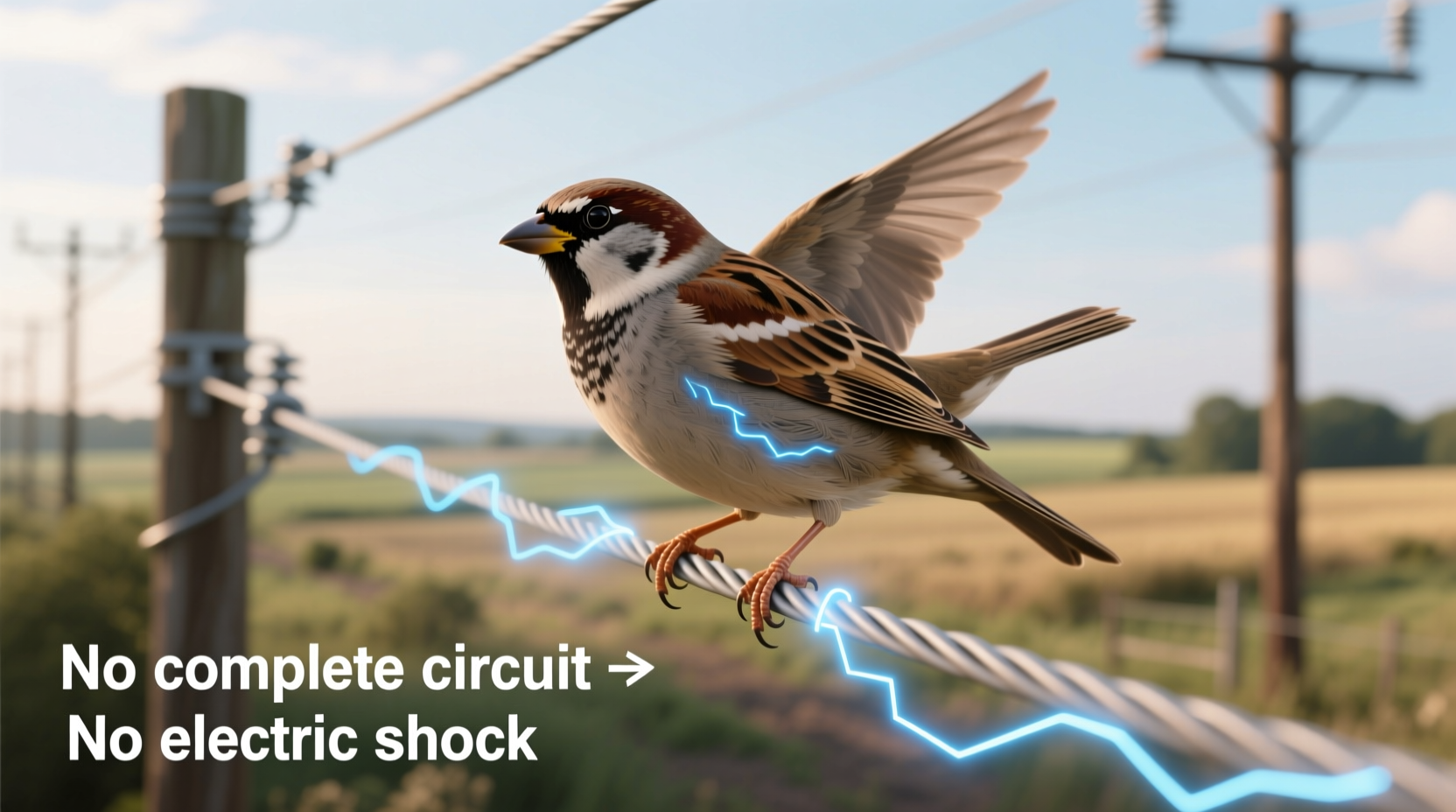
Electricity always seeks the path of least resistance to the ground. In a typical power system, current flows from the power plant through conductive wires (usually aluminum or copper), delivering energy to homes and businesses. For a circuit to be complete—and for current to flow—there must be a difference in electrical potential (voltage) between two points and a continuous conductive path connecting them.
When a bird lands on a single power line, it touches only one point in the circuit. Because both of its feet are on the same wire, there’s no significant voltage difference across its body. Without a voltage differential, electric current has no reason to flow through the bird. It continues along the wire, which offers far less resistance than the bird’s body.
“Electricity isn’t attracted to living things—it follows physics. If there’s no path to a lower voltage or ground, current won’t flow, regardless of what’s touching the wire.” — Dr. Alan Reyes, Electrical Engineer and Physics Educator
Why Voltage Difference Matters
Voltage is a measure of potential energy difference between two points. Think of it like water pressure in a pipe: water flows from high pressure to low pressure. Similarly, electricity flows from high voltage to low voltage. A bird on a wire is like a person standing on a step halfway up a staircase—there’s no fall unless they reach down to a lower level.
If a bird were to touch another wire with a different voltage—or simultaneously touch a grounded pole or transformer—it would create a path for current to flow through its body. This would result in electrocution. But under normal perching conditions, the bird remains at the same electrical potential as the wire, avoiding any dangerous current flow.
Tip: Always assume power lines are live and dangerous—even if birds sit on them. Their safety doesn’t imply human safety.What Happens When Conditions Change?
While birds are generally safe on a single line, certain behaviors or environmental factors increase risk. Large birds like eagles, hawks, or owls are more vulnerable because of their wide wingspans. If a bird stretches one wing and touches a second wire or a grounded structure while still contacting the first, it creates a short circuit. Current then flows through the bird, causing injury or death.
This is also why utility companies install bird guards, insulated covers, and perch deterrents on poles and transformers. These measures reduce accidental electrocutions, especially among raptors and other large species that play crucial roles in ecosystems.
Real Example: The Case of the Red-Tailed Hawk
In 2021, wildlife biologists in Colorado responded to a call about a red-tailed hawk found dead beneath a utility pole. Upon inspection, burn marks on its wings indicated electrocution. Investigation revealed that the bird had landed on a crossbar while attempting to take off, simultaneously touching a live wire and a grounded transformer. This tragic incident underscores how quickly safety can turn to danger when the electrical path changes.
Following such events, local utilities upgraded insulation on several poles and began monitoring high-risk areas during nesting season. The case became a model for avian protection programs across the western U.S.
Comparing Conductivity: Bird vs. Wire
Even if a small voltage difference exists between a bird’s feet, the amount of current that might theoretically pass through its body is negligible. Copper and aluminum wires are excellent conductors; bird tissue, by comparison, has much higher resistance. Electricity prefers the easier route—the wire—bypassing the bird entirely.
To illustrate, consider the following table comparing conductivity and resistance:
| Material | Electrical Conductivity (S/m) | Resistance (Relative) | Suitable Path for Current? |
|---|---|---|---|
| Copper Wire | 59,600,000 | Very Low | Yes – primary path |
| Aluminum Wire | 37,700,000 | Low | Yes – commonly used |
| Bird Tissue (average) | ~0.1 – 1.0 | High | No – avoided by current |
| Air (surrounding space) | Nearly 0 | Extremely High | No – insulator |
The vast difference in conductivity ensures that even minor imperfections in the wire don’t tempt current into a bird’s body. As long as the bird doesn’t bridge a gap to another conductor, it remains unharmed.
Myths and Misconceptions About Birds and Power Lines
Several myths persist about why birds aren’t shocked. One common belief is that birds have “insulated feet” or special biological protection. This is false. Birds do not possess natural insulation capable of withstanding thousands of volts. Rubber-soled shoes protect humans not because of the rubber alone, but because they break contact with the ground—a key difference.
Another myth suggests that small size protects birds. While size affects surface area and resistance slightly, the real factor is the lack of a voltage gradient. A mouse on a wire would be just as safe as a sparrow—if it didn’t touch anything else.
Checklist: What Keeps Birds Safe on Power Lines?
- ✅ Both feet remain on the same wire
- ✅ No contact with a second wire or grounded object
- ✅ Minimal voltage difference across the body
- ✅ Wire provides a much better conductive path than the bird
- ✅ Air acts as an insulator around the bird
Could Humans Do the Same?
In theory, yes—but only under highly controlled conditions. Linemen working on live high-voltage lines use helicopters and conductive suits to equalize their body potential with the wire. Once they’re at the same voltage, they can work safely without being grounded. This technique, known as “hot sticking” or “barehand maintenance,” requires extensive training and specialized equipment.
Never attempt to replicate this. For the average person, touching a power line while grounded—even through a ladder, tree, or wet surface—creates a lethal path for current. Unlike birds, humans are almost always connected to the ground, making electrocution nearly certain.
Frequently Asked Questions
Can birds get shocked if the wire is damaged?
Only if the damage creates a new conductive path—for example, if frayed wires touch a pole or another line. The bird itself isn’t at greater risk unless it bridges a gap between voltages.
Do all birds avoid electrocution equally?
No. Small perching birds like sparrows and pigeons are safest due to their size and behavior. Larger birds, especially raptors, face higher risks because of their wingspan and tendency to land on poles near multiple wires.
Why don’t squirrels get shocked on power lines?
For the same reason as birds—they typically touch only one wire at a time. However, squirrels are frequent causes of power outages because they sometimes bridge connections between wires or chew through insulation, creating shorts.
Protecting Wildlife and Infrastructure
Utility companies increasingly recognize the importance of bird-safe infrastructure. Installing wider spacing between lines, using insulated connectors, and placing perch discouragers on dangerous poles help prevent accidents. Some regions require avian protection plans before new power lines are approved.
Conservationists and engineers now collaborate on “avian-friendly” designs, reducing both wildlife fatalities and service disruptions caused by animal contact.
Conclusion: Nature Meets Physics
Birds land on power lines safely not because they’re immune to electricity, but because they don’t complete an electrical circuit. Their presence reminds us that electricity behaves predictably according to physical laws—not intuition. This principle applies far beyond birds: understanding voltage, grounding, and conductivity is essential for everything from home wiring to industrial safety.
Next time you see a row of birds on a wire, appreciate it as a quiet lesson in physics. And if you work near electrical systems, remember: respect the circuit. Unlike birds, we’re rarely isolated from the ground—and that makes all the difference.
🚀 Stay curious and stay safe. Share this explanation with someone who’s wondered why birds don’t get zapped—or leave a comment with your own observations from nature and science!








