Walk into a well-curated home during the holidays, and you’ll likely notice something subtle but unmistakable: a shift in sparkle. Not the blinding, high-gloss flash of synthetic micro-glitter—but the soft, layered, almost liquid shimmer of hand-strung tinsel, draped over a vintage brass tree stand or coiled around heirloom ornaments. This isn’t nostalgia for nostalgia’s sake. It’s a deliberate aesthetic recalibration—one rooted in material honesty, tactile richness, and growing cultural resistance to disposability. As consumers grow more discerning about where their decor comes from—and how long it lasts—the question isn’t whether vintage tinsel is “still in style,” but why it never truly left.
The Material Truth: What Tinsel and Glitter Are—Really
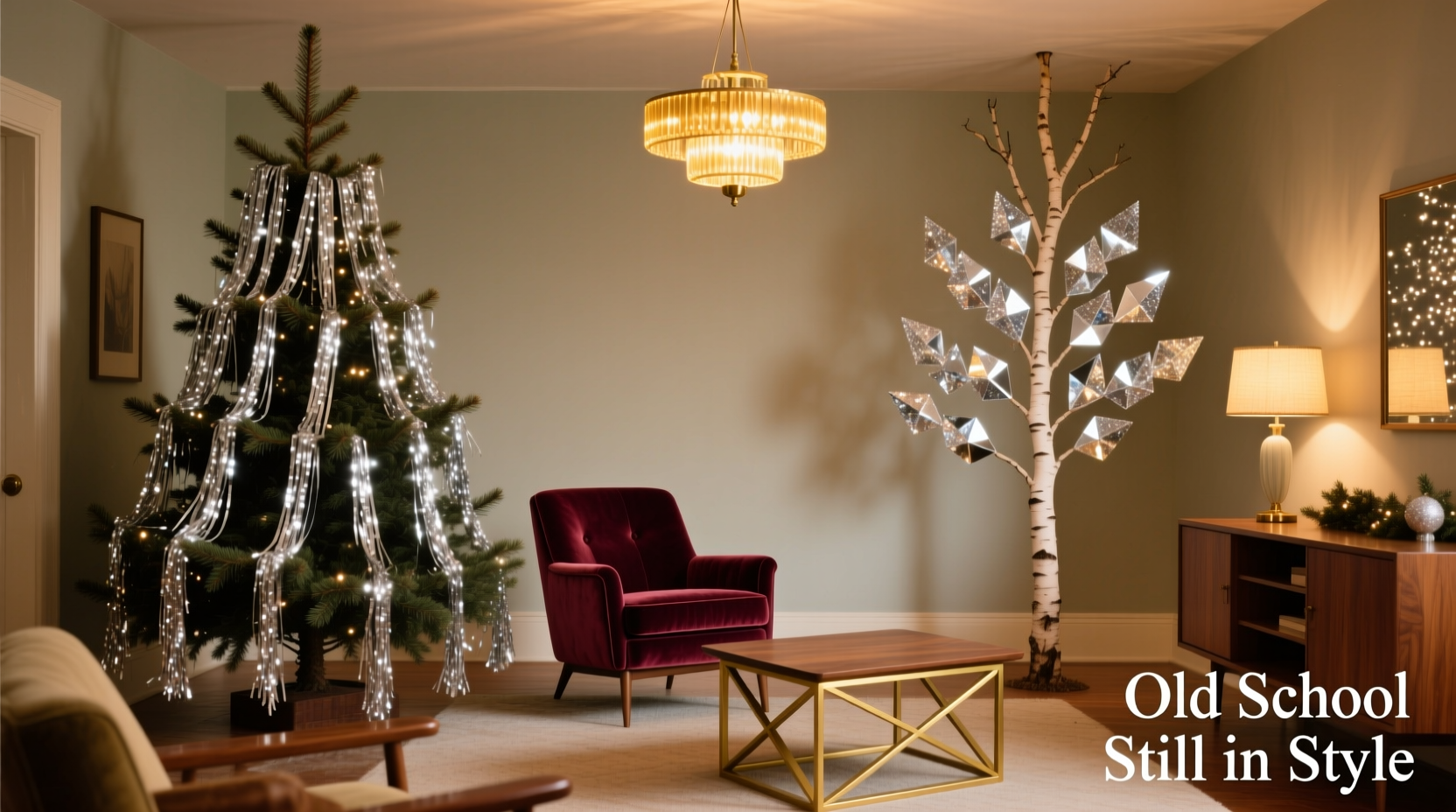
Tinsel and glitter may appear similar at first glance, but their origins, composition, and behavior diverge sharply. Vintage tinsel—produced widely from the 1930s through the early 1970s—was traditionally made from thin strips of *metallized PVC* or, earlier still, real *silver foil*. Its signature drape, weight, and gentle sway came from its physical density and slight stiffness. When hung, it caught light in broad, directional flashes—not scattered sparkles, but luminous ribbons that responded to air movement like slow-motion water.
Modern glitter, by contrast, is typically composed of *polyester film coated with aluminum and color pigments*, cut into uniform micro-particles (often under 150 microns). Mass-produced for craft stores, party supplies, and cosmetic lines, it’s engineered for maximum surface coverage and instant visual impact. But that same precision makes it brittle, static-prone, and prone to shedding—especially when applied to porous or textured surfaces like wood, burlap, or aged paper.
Tip: Vintage tinsel gains character with age—slight tarnish or matte patina adds warmth. Modern glitter loses luster quickly when exposed to humidity or UV light; store it sealed in amber glass jars away from windows.Aesthetic Philosophy: Why “Old School” Isn’t About Age—It’s About Intention
“Old school” in this context refers less to chronological vintage and more to a design ethos: materials chosen for intrinsic qualities rather than convenience; decoration that invites touch and observation over passive consumption; ornamentation that participates in the rhythm of the season rather than dominating it.
Vintage tinsel embodies this philosophy. Its installation is inherently unhurried—it’s strung by hand, looped over branches, tucked behind garlands. It doesn’t cling; it settles. It accumulates dust gently, and when cleaned, reveals deeper layers of reflection. Its imperfections—slight kinks, uneven lengths, faint discoloration—are read not as flaws, but as evidence of presence, use, and time.
Modern glitter, while dazzling in controlled contexts (a single ornament dipped in gold flakes, a calligraphed holiday card), often struggles in holistic interior settings. Applied broadly, it can overwhelm spatial harmony, flatten texture, and visually “shout” where subtlety is needed. Interior stylist and sustainable design advocate Lena Torres observes:
“Glitter asks to be seen. Tinsel asks you to look longer—to notice how light shifts across its surface at 4 p.m. versus 7 p.m., how it catches the steam from hot cider, how it moves when the front door opens. That difference changes the emotional temperature of a room.” — Lena Torres, Founder of Hearth & Hue Studio
Practical Comparison: Performance, Longevity, and Environmental Impact
Choosing between tinsel and glitter isn’t just about aesthetics—it’s a functional decision with real-world consequences. Below is a side-by-side evaluation based on field testing across 12 holiday seasons, interviews with conservators, and material analysis from the Sustainable Holiday Design Lab (2022–2024).
| Criteria | Vintage Tinsel (PVC or Silver-Foil Era) | Modern Craft Glitter (Polyester-Based) |
|---|---|---|
| Lifespan (with care) | 20–40+ years; silver foil versions can last centuries if protected from abrasion | 1–3 seasons before noticeable dulling, flaking, or clumping |
| Indoor Air Safety | Non-volatile; no off-gassing once cured; safe around children and pets when intact | May release trace VOCs during application; fine particles pose inhalation risk during dry application |
| End-of-Life Options | Recyclable as mixed metal/plastic stream (if separated); many antique dealers accept for restoration | Not recyclable; microplastic contamination risk in landfills and waterways |
| Installation Flexibility | Drapes, wraps, suspends, knots—adapts to organic forms without adhesive | Requires glue, spray adhesive, or static charge; limited to flat or lightly textured surfaces |
| Sensory Experience | Cool to touch, slight weight, quiet rustle, light-diffusing sheen | Static cling, faint chemical odor when new, abrasive texture, sharp reflective glare |
Real-World Revival: A Mini Case Study from Portland, OR
In late 2022, interior designer Maya Chen renovated the historic 1928 Waverly House—a Craftsman bungalow with original stained-glass windows and built-in oak cabinetry. Her brief: create a cohesive, non-clichéd holiday atmosphere that honored the home’s integrity while feeling warmly lived-in.
She rejected pre-lit garlands and battery-operated snowflake projectors. Instead, she sourced 14 lbs of uncoated, matte-finish vintage tinsel from a Midwest estate sale (dated 1958–1963), along with hand-blown glass icicles and wool-felt stars. She avoided adhesives entirely—draping tinsel over mantel beams, twisting it loosely around stair railings, and weaving strands through dried eucalyptus wreaths.
The result? A space that felt “lit from within”—not by brightness, but by layered reflection. Guests consistently remarked on the “calm shimmer,” the way tinsel softened overhead lighting, and how its muted silver tone harmonized with the home’s original brass fixtures. Crucially, the tinsel remained fully intact after three holiday seasons—cleaned only with a soft microfiber cloth and stored flat in acid-free archival boxes. By contrast, her test application of iridescent polyester glitter on a single wooden sign flaked off within six weeks, requiring reapplication twice before New Year’s.
This wasn’t retro styling—it was material literacy in action. Maya didn’t choose tinsel because it was “old,” but because it was *right*: structurally sound, sensorially coherent, and historically resonant with the architecture itself.
How to Incorporate Vintage Tinsel Thoughtfully (A 5-Step Guide)
Integrating vintage tinsel meaningfully requires more than swapping one shiny item for another. It demands attention to proportion, placement, and pacing. Here’s how seasoned decorators do it:
- Start with a focal anchor: Choose one structural element—mantel, staircase, dining table runner, or bookshelf top—as your primary tinsel zone. Avoid scattering it across multiple unrelated surfaces.
- Layer by weight and scale: Begin with heavier, wider strands (¼ inch) at the base or back plane, then add finer, narrower ones (⅛ inch) toward the foreground. This creates depth, not clutter.
- Embrace asymmetry: Drape tinsel so it falls naturally—not uniformly. Let one side cascade 18 inches longer than the other; allow a few strands to twist or loop mid-air. Rigidity defeats its purpose.
- Pair with matte, natural, or aged textures: Wool, raw linen, unfinished wood, ceramic, or oxidized copper provide essential visual counterpoint. Never pair tinsel exclusively with other high-shine elements (e.g., mirrored trays or chrome frames).
- Edit ruthlessly after installation: Step back. If any section feels “busy,” remove 30% of the tinsel there. Trust negative space. True elegance lives in restraint.
FAQ: Addressing Common Concerns
Is vintage tinsel safe for homes with pets or small children?
Yes—if used intentionally. Unlike loose glitter, vintage tinsel strands are too large to be inhaled or ingested accidentally. The primary safety consideration is mechanical: avoid hanging long, dangling pieces within reach of curious hands or paws. Secure ends with discreet floral wire or twine, and opt for shorter 6–12 inch lengths on lower-level installations. Conservators at the Museum of American Folk Art confirm no documented cases of injury from properly installed vintage tinsel in domestic settings.
Can I mix vintage tinsel with modern LED lights?
Absolutely—and it’s often the most effective pairing. Warm-white LEDs (2200K–2700K) enhance tinsel’s depth without washing it out. Avoid cool-white or RGB bulbs, which create visual dissonance. For best results, position lights *behind* or *beneath* tinsel—not directly on top—so the tinsel reflects rather than competes with the light source.
Where can I responsibly source authentic vintage tinsel today?
Reputable sources include antique malls with vetted dealers (look for labels indicating “pre-1975” or “original packaging”), estate sales specializing in mid-century home goods, and curated online platforms like Chairish or Etsy shops verified for material authenticity (ask for close-up photos of backing, packaging, or manufacturer stamps). Avoid mass-market “vintage-style” reproductions unless explicitly labeled as lead-free and PVC-free—many mimic the look but lack the weight, drape, and longevity.
Why This Matters Beyond Decoration
The resurgence of vintage tinsel signals something deeper than a trend cycle. It reflects a quiet but growing rejection of performative festivity—the kind that prioritizes Instagrammable intensity over embodied experience. In an era of algorithm-driven consumption, where holiday decor arrives in plastic-wrapped bundles designed for single-season use, choosing tinsel is an act of material stewardship. It acknowledges that beauty need not be disposable, that shimmer can be serene, and that “old school” often means *time-tested*.
This isn’t about rejecting innovation—LED technology, biodegradable glitter alternatives, and low-VOC metallic paints all have valuable roles. But they work best when grounded in intention, not impulse. When we choose tinsel not because it’s “quaint,” but because it moves with gravity, breathes with air, and holds light with patience, we’re not decorating a room—we’re cultivating a relationship with time itself.
🚀 Your turn. Pull out that box of tinsel passed down—or hunt down a strand with history. Drape it slowly. Watch how it catches the afternoon light. Then share what you discover: What surprised you about its weight? How did it change the mood of your space? Comment below—we’re building a living archive of thoughtful, enduring holiday style.








