Parrots are extraordinary communicators—not just mimics, but context-sensitive learners who absorb language, tone, and social cues with startling precision. When a bird repeatedly shouts “Shot time!” during dinner parties, cocktail hours, or family game nights, it’s rarely about seeking attention for its own sake. It’s responding to patterns: the clink of glasses, the rise in human laughter, the shift from quiet conversation to animated energy. This behavior isn’t defiance—it’s learned association, reinforced over weeks or months. The challenge isn’t silencing the bird; it’s reshaping the link between social excitement and that specific phrase. Done thoughtfully, this process strengthens the human–parrot bond, builds trust through predictability, and honors the bird’s intelligence without compromising household harmony.
Why “Shot Time” Sticks—and Why Punishment Backfires
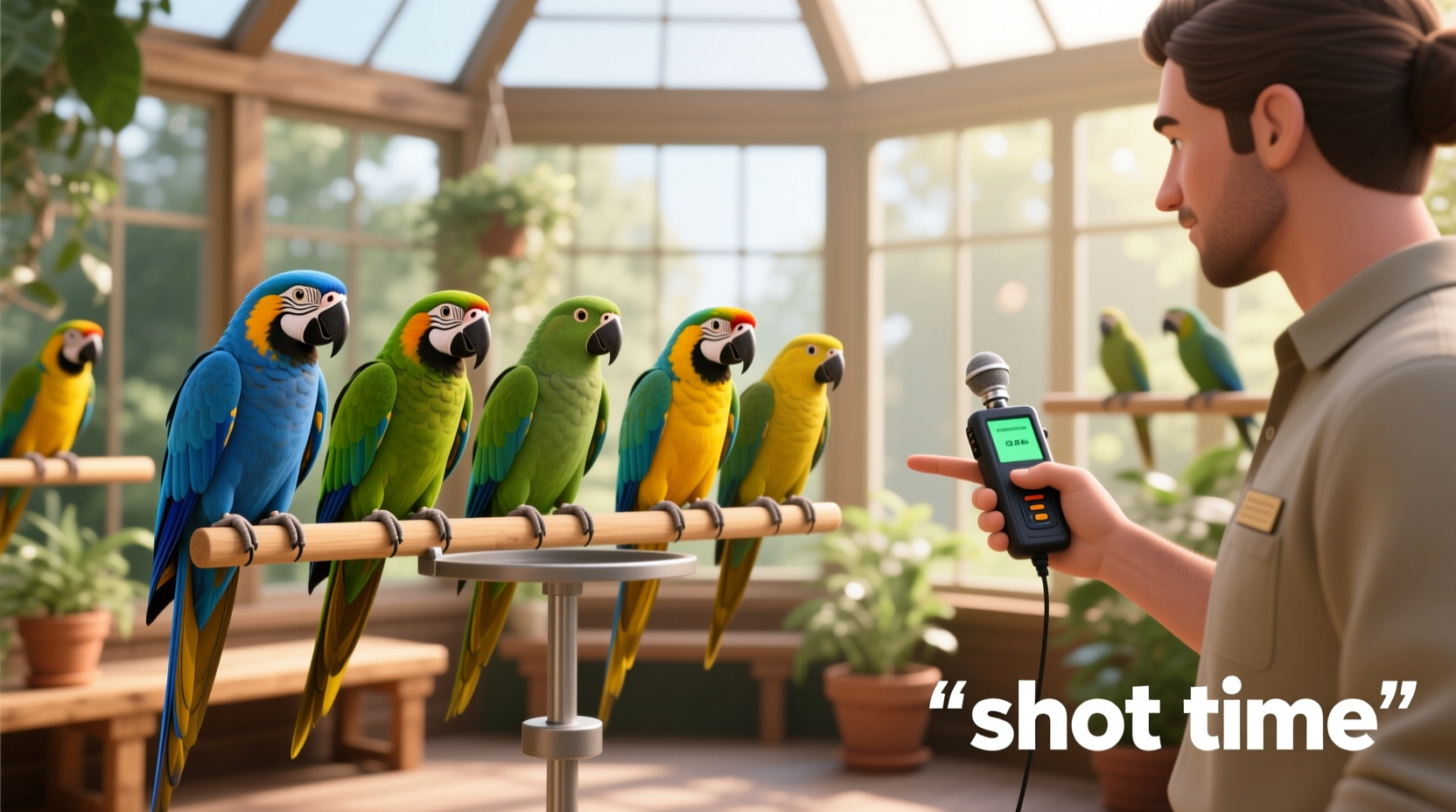
Parrots don’t mimic randomly. They select phrases that reliably produce high-value outcomes: laughter, eye contact, movement toward their cage, or even the brief pause in human activity that follows a loud, unexpected utterance. “Shot time” is especially potent because it often coincides with peak social energy—people standing, glasses raised, voices lifting in anticipation. That moment delivers a rich sensory package: visual motion, auditory spikes (ice clinking, cheers), and sudden shifts in human posture. For a socially attuned species like the grey or Amazon, this becomes a powerful operant trigger.
Punitive responses—shouting “No!”, covering the cage, or walking away abruptly—don’t erase the association. They often intensify it. A startled or frustrated reaction still delivers attention (even negative attention), confirms the phrase’s power to disrupt the environment, and may erode the bird’s sense of safety. Neurobiological research on avian learning shows that stress hormones like corticosterone impair new memory formation while strengthening emotionally charged associations—meaning scolding can actually cement “shot time” as a go-to tool for regaining control in unpredictable settings.
“Parrots don’t misbehave—they communicate unmet needs or rehearse what works. Our job isn’t to suppress speech, but to expand their vocabulary of appropriate, rewarding alternatives.” — Dr. Irene Pepperberg, Comparative Cognition Researcher & Author of The Alex Studies
A 5-Step Redirection Protocol (Weeks 1–4)
This protocol prioritizes consistency, timing, and environmental design over speed. It assumes baseline trust and no underlying anxiety or medical issues (always rule out pain or hormonal triggers with an avian vet first). Each step builds on the last—skip none, and allow at least three full days per phase before progressing.
- Phase 1: Environmental Audit & Neutralization (Days 1–3)
Remove all visual and auditory cues tied to “shot time” during gatherings. Serve drinks *before* guests arrive. Keep bottles and shakers out of sight. Play soft background music to dampen sharp glass sounds. Note when and where the phrase occurs most (e.g., “every time someone stands near the bar cart”). - Phase 2: Phrase Substitution Training (Days 4–9)
Teach a short, positive alternative phrase (“Cheers!”, “Happy hour!”, or even a cheerful whistle) using clicker training or verbal marker (“Yes!”) paired with immediate high-value treats (e.g., crushed almond slivers). Practice 3x/day for 90 seconds—never during actual gatherings yet. - Phase 3: Controlled Exposure + Redirect (Days 10–15)
Host one low-stakes “mock gathering” with 1–2 calm friends. As soon as the first cue appears (e.g., ice poured into a glass), immediately say your chosen alternative phrase *in a bright, upbeat tone*, then reward your parrot *the instant* they vocalize it—even if faint or partial. Do not wait for perfection. - Phase 4: Contextual Fading (Days 16–21)
Gradually increase complexity: add more people, extend duration, introduce mild distractions (e.g., turning on a lamp, shifting chairs). Continue rewarding only the substitute phrase. If “shot time” occurs, pause, calmly say “Oops,” and restart the cue—no punishment, no frustration, just reset. - Phase 5: Generalization & Maintenance (Day 22+)
Apply the protocol across varied settings (different rooms, times of day, guest combinations). Introduce “maintenance sessions”: once weekly, run a 2-minute practice with the substitute phrase—even when no gathering is planned—to keep the association fresh.
Do’s and Don’ts During Social Gatherings
| Action | Do | Don’t |
|---|---|---|
| Before Guests Arrive | Offer a foraging toy filled with favorite treats; place it in a quiet corner of the room where your parrot feels secure but included. | Move your parrot to a separate, darkened room—this signals exclusion and increases frustration-driven vocalizations later. |
| When “Shot Time” Occurs | Calmly say your substitute phrase once, then immediately reward any attempt—even a soft chirp or head bob—as if it were the full phrase. | Repeat “No!” or “Stop!” multiple times. Parrots hear repetition as engagement, not correction. |
| Guest Interaction | Ask 1–2 trusted guests to quietly offer a treat *only* when your parrot uses the substitute phrase. Keep interactions brief and low-energy. | Encourage guests to “say hello” directly to the bird or crowd around the cage—this overstimulates and raises arousal levels. |
| After the Gathering | Spend 5 minutes of calm, focused interaction: gentle preening, shared quiet time, or teaching a simple trick (e.g., “step up” on cue). | Immediately put the bird to bed or ignore them—this misses a critical window to reinforce calm post-event behavior. |
Real-World Case Study: Luna, a 7-Year-Old Congo African Grey
Luna lived with a couple who hosted weekly wine tastings. She began shouting “Shot time!” precisely when the first bottle was uncorked—initially met with laughter, then growing embarrassment as guests arrived early. Her owners tried ignoring her, then covering her cage, then reprimanding her—each making the behavior louder and more frequent. After consulting an avian behaviorist, they implemented the 5-step protocol. Key adjustments made the difference: they switched from wine to non-alcoholic sparkling cider (removing the cork-popping sound), taught Luna “Cheers!” using almond butter smeared on a spoon as reinforcement, and positioned her play stand near—but not in—the dining area so she felt part of the event without being center-stage. By Week 3, Luna offered “Cheers!” spontaneously 70% of the time during mock tastings. At Week 6, during a real gathering with eight guests, she used “Cheers!” four times and “Shot time!” only once—promptly redirected with zero escalation. Her owners noted a broader shift: Luna began initiating other cheerful phrases (“Yum!”, “Hi friends!”) during relaxed moments, signaling increased confidence in her ability to influence social outcomes positively.
Common Pitfalls & How to Avoid Them
- Over-relying on treats alone: While food rewards jumpstart learning, pairing them with tactile praise (gentle head scratches for birds who enjoy touch) or social rewards (a shared laugh, eye contact) creates deeper, more sustainable motivation.
- Inconsistent timing: Rewarding 2 seconds after the desired sound instead of within 0.5 seconds weakens the connection. Use a clicker or sharp “Yes!” to mark the exact moment of vocalization—then deliver the treat.
- Misreading body language: Fluffed feathers, pinned eyes, or rapid tail wagging signal rising arousal—not readiness to learn. If these appear during practice, pause, lower lights, and resume later.
- Ignoring environmental triggers: “Shot time” may be tied to a specific person (e.g., Uncle Dave always says it first), a scent (cinnamon from spiced rum), or lighting (dimmed lamps). Track patterns for three gatherings before starting training.
- Expecting overnight change: Neural pathways take repetition to rewire. Most parrots show measurable improvement in 3–5 weeks—not days. Celebrate small wins: a quieter utterance, a delayed response, or a single successful substitution.
FAQ
Can I just teach my parrot a completely different phrase instead of redirecting “shot time”?
Yes—but only if you simultaneously remove all reinforcement for the original phrase. Teaching “Good morning!” won’t stop “shot time” unless you also ensure it never produces attention, laughter, or movement. Redirecting leverages existing motivation; replacing requires building motivation from scratch. Redirection is faster and more reliable for high-value, context-linked phrases.
My parrot screams “shot time” only when certain guests arrive. Is this territorial behavior?
It may be—but more likely, those guests unintentionally reinforce it. Do they laugh loudly? Stand close to the cage? Offer treats without prompting? Record interactions for 20 minutes. You’ll likely spot subtle cues you’re missing. Once identified, ask those guests to follow your redirection protocol exactly—consistency across humans is critical.
What if my parrot stops talking altogether during training?
This signals stress or confusion—not stubbornness. Pause training for 48 hours. Return to basic trust-building: hand-feeding favorite foods, offering foot toys, sitting quietly nearby while reading aloud (not addressing the bird). Resume only when your parrot initiates contact (e.g., steps toward you, makes eye contact, offers a soft whistle). Silence is a request for safety—not a failure.
Conclusion
Training a parrot not to mimic “shot time” during gatherings isn’t about controlling their voice. It’s about honoring their intelligence by giving them better tools to participate in your world. It’s about replacing a learned disruption with a joyful contribution—turning a source of social tension into a moment of shared delight. Every time you calmly redirect, every time you reward a whispered “Cheers!”, every time you adjust the environment to reduce overwhelm, you’re doing more than modifying behavior. You’re deepening mutual understanding. You’re saying, “I see you. I hear you. And I’ll help you find ways to belong here that feel good for both of us.” That kind of partnership doesn’t happen overnight—but it grows, steadily and surely, in the quiet consistency of daily practice. Start small. Be patient. Trust the process. Your parrot isn’t the problem. They’re your partner in learning something new—together.
💬 Have you successfully redirected a tricky phrase with your parrot? Share your strategy, timeline, or biggest insight in the comments—your experience could be the exact encouragement another caregiver needs right now.








