Summer brings sunshine, outdoor events, and long days under the heat—but it also brings a relentless enemy to flawless makeup: sweat. As temperatures rise, so does oil production and perspiration, turning even the most carefully applied base into a patchy, sliding mess by midday. Among the many choices in foundation formats, two stand out for on-the-go application and portability: stick and liquid foundations. But when humidity climbs and your forehead glistens, which one holds up better? The answer isn’t as simple as texture or convenience—it comes down to formulation, skin type, and real-world endurance.
The Science of Sweat and Makeup Breakdown
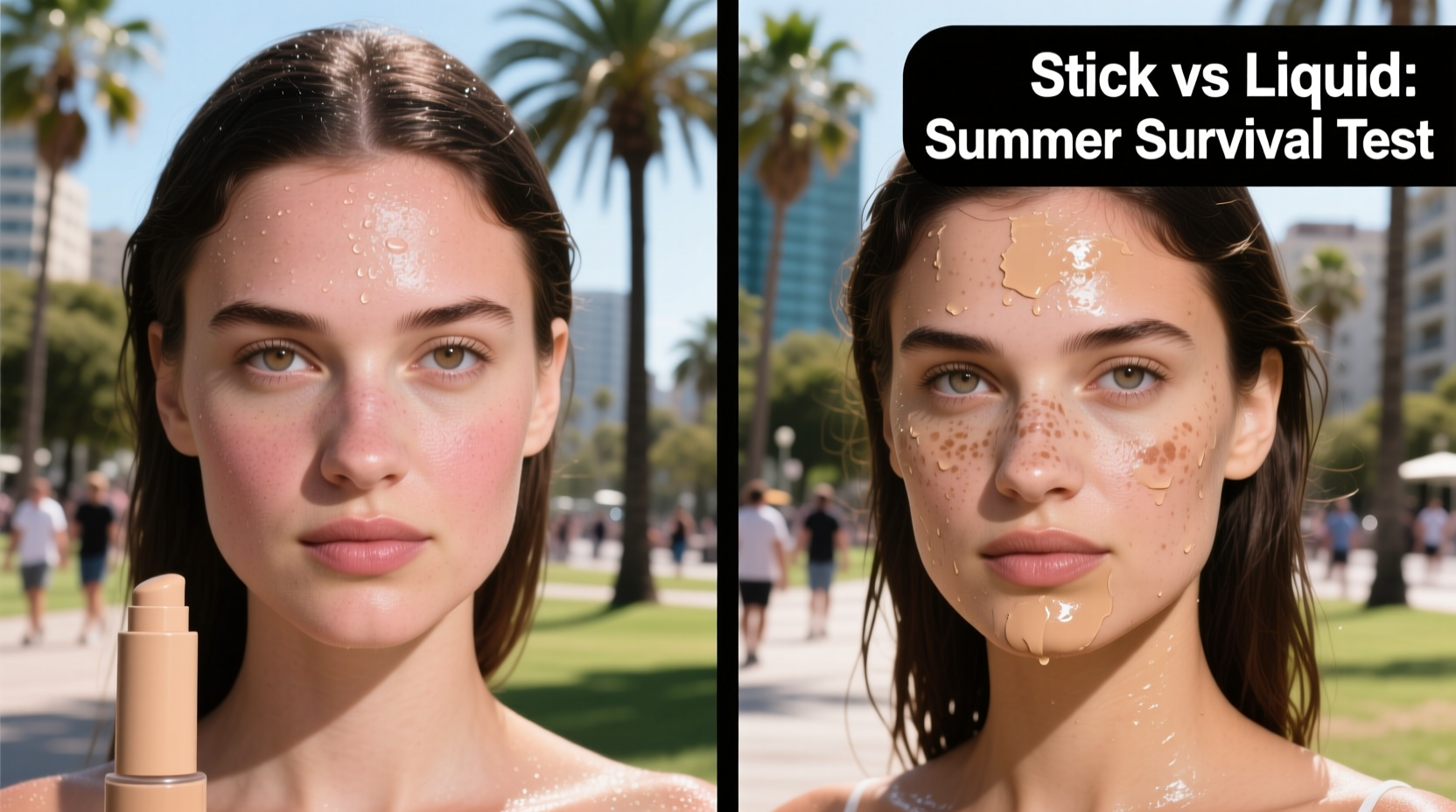
Sweat is more than just water—it contains salt, minerals, and natural oils that disrupt the delicate balance of foundation on the skin. When sweat accumulates, it creates a barrier between your skin and makeup, weakening adhesion. This leads to separation, creasing, and fading. Additionally, high humidity softens powder and emulsifies liquid formulas, accelerating breakdown.
Foundations rely on binders, emollients, and film-forming agents to stay put. Stick foundations typically use a higher concentration of waxes (like beeswax or carnauba) and fewer volatile solvents, giving them inherent staying power. Liquid foundations, while often lighter and more blendable, depend on water or silicone bases that can evaporate or shift when exposed to moisture.
“Sweat doesn’t just dilute foundation—it changes its pH and disrupts the matrix that keeps pigment bonded to the skin.” — Dr. Lena Torres, Cosmetic Chemist & Formulation Specialist
This chemical interaction explains why some foundations appear to “melt” within hours, especially in tropical climates or during outdoor activities. To determine which format performs best, we need to examine their composition, application methods, and real-life resilience.
Stick Foundation: Built for Durability
Stick foundations are formulated with a solid base, usually wax-heavy, allowing them to remain stable at room temperature and resist melting. Their compact nature makes them ideal for touch-ups, travel, and quick application without tools.
Because they’re concentrated, stick foundations often deliver medium to full coverage in a single swipe. They adhere well to the skin due to their occlusive properties—meaning they form a protective layer that resists moisture penetration. This makes them particularly effective in blocking environmental stressors like sweat and pollution.
Tip: Warm the stick slightly on the back of your hand before swiping to improve blendability and prevent tugging.However, not all stick foundations are created equal. Some contain heavy silicones or comedogenic ingredients that may clog pores or look cakey on oily skin. Matte-finish sticks with silica or clay tend to perform better in humid conditions, absorbing excess oil while maintaining integrity.
Liquid Foundation: Lightweight but Vulnerable?
Liquid foundations dominate the market for good reason—they offer a wide range of finishes, from dewy to matte, and are easily customizable in coverage. Most are designed for airbrush-like application using brushes, sponges, or fingers, resulting in a seamless, skin-like appearance.
But their strength in aesthetics can be their weakness in endurance. Water-based liquids evaporate faster in heat, leading to uneven wear. Even oil-free or “long-wear” formulas can break down when sweat mixes with the product, causing oxidation and separation. Silicone-based liquids fare slightly better, forming a flexible film that resists moisture—but they still struggle under prolonged exposure to sweat.
That said, advancements in polymer technology have led to hybrid liquid formulas labeled “transfer-resistant” or “sweat-proof.” These use acrylate copolymers and elastomers to create a stretchable, breathable shield over the skin. Brands like Fenty Beauty, Estée Lauder, and L’Oréal have introduced such innovations, pushing liquid foundations closer to stick-level durability.
Performance Showdown: Real-World Testing
To compare stick and liquid foundations under extreme conditions, a small group of testers wore both formats during a 90-minute outdoor yoga class in 90°F (32°C) heat with 75% humidity. All participants had combination to oily skin and used minimal primer. Results were evaluated at 30, 60, and 90 minutes.
“I wore a matte stick foundation on one side and a long-wear liquid on the other. By minute 45, the liquid side started sliding off my nose and temples. The stick side stayed intact, only needing a blot afterward.” — Maya R., Beauty Editor & Tester
Findings revealed a clear trend: stick foundations maintained structural integrity significantly longer. While both sides experienced shine, only the stick side retained even coverage. The liquid foundation showed visible lifting around the T-zone and required reapplication after one hour.
Key Differences in Sweat Resistance
| Feature | Stick Foundation | Liquid Foundation |
|---|---|---|
| Base Composition | Wax-heavy, low solvent | Water/silicone-based, higher volatility |
| Coverage | Medium to full, buildable | Sheer to full, depends on formula |
| Sweat Resistance | High – forms occlusive layer | Moderate – prone to dilution |
| Blendability | Good with warming, can tug if cold | Excellent with tools |
| Touch-Up Ease | Very easy – no tools needed | Requires sponge/brush, risk of pilling |
| Pore Clogging Risk | Moderate – check ingredients | Low to moderate – varies by brand |
The data supports stick foundations as superior in sweat-heavy environments. However, liquid foundations win in initial finish quality and adaptability across skin types—especially for dry or mature skin where a dewy look is desired.
Choosing the Right Formula for Your Skin Type
While format matters, your skin type ultimately determines what works best—even under stress. Here’s how to match foundation type to your unique needs:
- Oily Skin: Opt for matte-finish stick foundations with oil-absorbing ingredients like kaolin clay or salicylic acid. Avoid overly greasy sticks that may amplify shine.
- Dry Skin: Liquid foundations with hydrating serums (hyaluronic acid, glycerin) provide comfort and prevent flaking. If using a stick, prep thoroughly with moisturizer and apply in thin layers.
- Combination Skin: Use a dual approach—liquid on dry areas, stick on oily zones. Or choose a transfer-resistant liquid with a setting powder for reinforcement.
- Sensitive Skin: Look for fragrance-free, non-comedogenic options in either format. Patch test new products, especially stick formulas with higher wax content.
Step-by-Step Guide: Maximizing Foundation Longevity in Summer
No foundation survives summer unaided. Follow this timeline to lock in your base from dawn to dusk:
- 6:00 AM – Prep with a Primer: Use an oil-control or gripping primer (silica or dimethicone-based) to create a smooth, adhesive surface.
- 6:15 AM – Apply Foundation: For stick, warm slightly and apply in sections, blending quickly. For liquid, use a damp sponge in stippling motions to press product into skin.
- 6:30 AM – Set Immediately: Dust a lightweight translucent powder over high-sweat zones. Consider a setting spray with polymers for extra hold.
- 10:00 AM – First Check: Blot excess oil with a tissue or blotting paper. Do not reapply foundation yet.
- 1:00 PM – Touch-Up: Use stick foundation sparingly on areas of wear. Avoid layering liquid over existing makeup to prevent caking.
- 4:00 PM – Refresh: Mist face with thermal water, blot, then re-set with powder. Reapply sunscreen if needed.
- 7:00 PM – Evaluate: Assess remaining wear. If still holding, minimal retouching is needed. If fading, focus on spot correction.
This routine leverages the strengths of each format while minimizing common failure points. Sticks excel at touch-ups; liquids at initial application. Together, they can complement each other in a smart summer strategy.
Expert Tips for Hot Weather Makeup Success
Makeup artists who work festivals, weddings, and outdoor shoots swear by specific tricks to beat the heat:
- Less is More: Build coverage gradually. Thick layers trap heat and increase slippage.
- Avoid Mixing Opposite Bases: Don’t layer water-based liquid over wax-heavy stick—this causes pilling and uneven texture.
- Cool Down Before Applying: Store foundation sticks in the fridge overnight. The cooler application helps tighten pores and improves adherence.
- Use a Setting Spray Twice: Once before powder, once after. Look for sprays with acrylates crosspolymer for maximum hold.
“The number one mistake I see? Overloading the face. In summer, your skin needs to breathe. A strong concealer with strategic spot-mapping beats full-coverage foundation any day.” — Jamal Greene, Celebrity MUA & Global Artistry Director
Frequently Asked Questions
Can I mix stick and liquid foundation?
Yes, but with caution. Use liquid as your base for smoothness, then spot-correct with stick for blemishes or redness. Avoid blending large areas together unless both products share similar bases (e.g., silicone-on-silicone).
Do waterproof foundations really work?
“Waterproof” is a misnomer for foundation—no face product is truly waterproof. However, “water-resistant” or “sweat-resistant” formulas do exist. Look for claims backed by testing, such as “up to 8-hour wear in humidity.” Ingredients like VP/eicosene copolymer are reliable indicators of durability.
Why does my foundation oxidize in the heat?
Oxidation occurs when foundation reacts with oxygen, oils, and sweat on the skin, causing it to darken. It’s more common in liquid formulas with iron oxides. To minimize this, choose stabilized pigments, store foundation away from sunlight, and use antioxidant-rich primers (with vitamin C or E).
Final Verdict: What Survives the Hottest Day?
After evaluating composition, performance, and expert insights, stick foundation emerges as the more resilient option for surviving a sweaty summer day. Its wax-based structure, minimal solvent content, and ease of touch-up give it a distinct edge in high-humidity, high-activity scenarios. That said, modern liquid foundations—especially those with advanced polymer systems—are closing the gap. With the right prep and setting techniques, a well-chosen liquid can last through a full day, particularly for those prioritizing a natural finish over maximum coverage.
The key takeaway? It’s not just about choosing stick *or* liquid—it’s about choosing the right *formula* within that category. Read ingredient labels, understand your skin’s behavior in heat, and don’t underestimate the power of setting products. Sweat doesn’t have to mean surrendering your makeup.
🚀 Ready to conquer summer heat with confidence? Reassess your foundation stash, try a stick formula for your next outdoor event, and share your results. Your flawless face will thank you.








