For cat owners with outdoor pets, flea prevention isn’t just about comfort—it’s a critical part of health management. Outdoor cats face constant exposure to fleas, ticks, and other parasites that can transmit diseases like hemobartonellosis and tapeworms. Two leading solutions dominate the market: the Seresto flea collar and oral flea medications. Each has distinct advantages and drawbacks, but determining which offers better protection requires understanding how they work, how consistently they perform, and how well they suit real-world feline behavior.
This article breaks down both options with practical insights, scientific backing, and real-life considerations to help you make an informed decision tailored to your cat’s lifestyle.
How Flea Prevention Works: The Basics
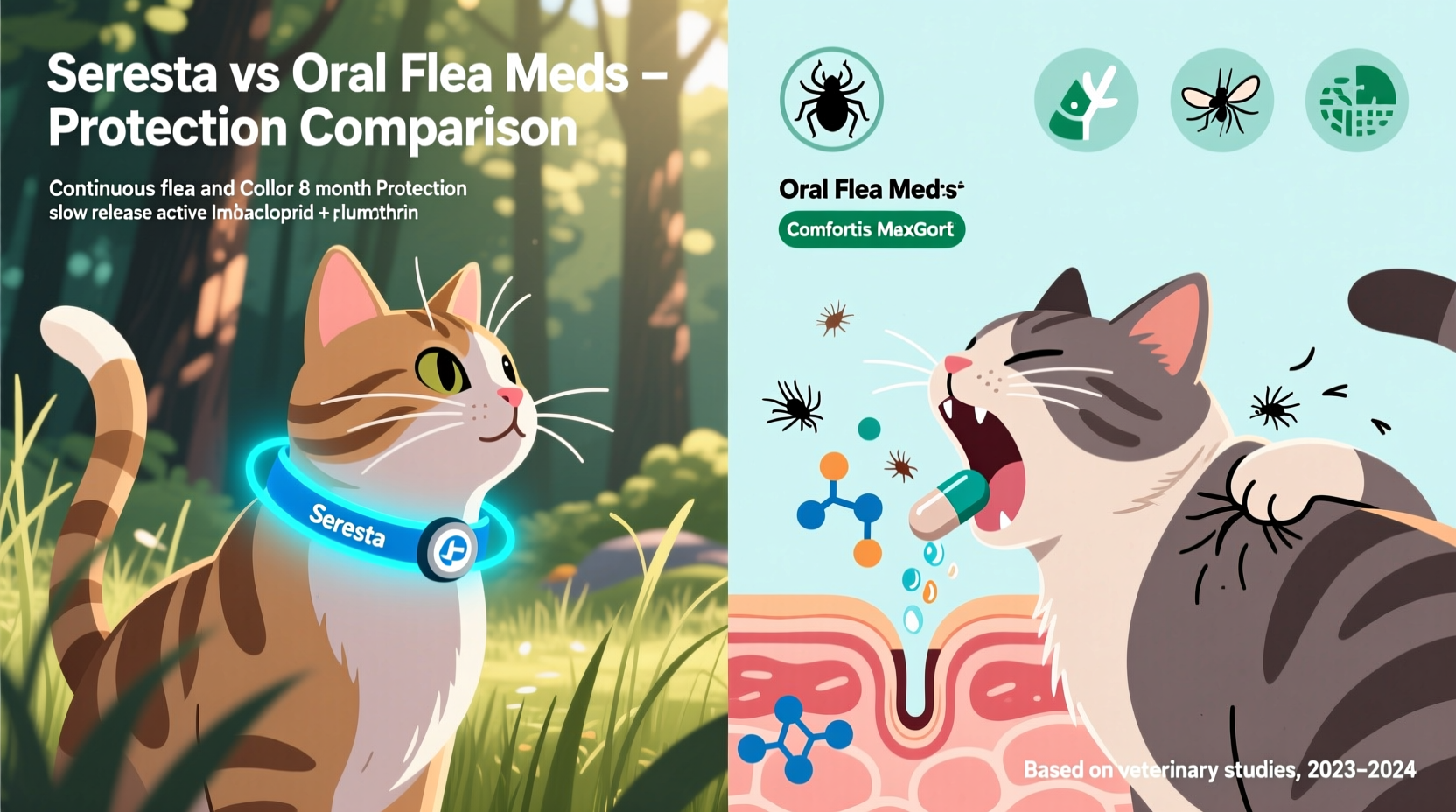
Fleas are more than a nuisance—they reproduce rapidly and can cause severe skin irritation, anemia in kittens, and secondary infections. Effective flea control must not only kill adult fleas but also interrupt their life cycle by targeting eggs and larvae. For outdoor cats, consistent, continuous protection is essential because reinfestation from the environment happens quickly.
Both Seresto and oral flea medications operate on different mechanisms:
- Seresto Collar: A sustained-release polymer matrix infused with two active ingredients—imidacloprid and flumethrin—that spread across the cat’s skin and coat through natural oil distribution.
- Oral Medications: Fast-acting systemic drugs such as spinosad, nitenpyram, or afoxolaner that enter the bloodstream and kill fleas when they bite.
The difference in delivery method leads to variations in onset time, duration, reliability, and suitability depending on the cat’s habits and environment.
Effectiveness Over Time: Duration and Consistency
One of the most significant factors in choosing a flea treatment is how reliably it performs over time. Missed doses or inconsistent application reduce efficacy dramatically—especially for outdoor cats who can’t be easily restrained every month.
Tip: For cats that roam frequently, treatments requiring monthly action (like pills) are more likely to suffer from lapses in coverage.Seresto: Eight Months of Continuous Protection
The Seresto collar is designed to provide up to eight months of continuous flea and tick control. Its slow-release technology ensures steady delivery of active ingredients without spikes or drops in concentration. Independent studies have shown that Seresto maintains >90% flea kill rate throughout its lifespan under normal conditions.
Because it works topically via lipid diffusion, it doesn’t rely on the cat ingesting anything or having a full meal. This makes it ideal for cats with irregular feeding patterns or those wary of taking medication.
Oral Medications: Immediate Action, Shorter Window
Oral treatments like Comfortis (spinosad) or Capstar (nitenpyram) act fast—Capstar kills fleas within 30 minutes—but their protection window is narrow. Most require monthly dosing, and some last only a few days. Even longer-acting options like Bravecto (fluralaner) offer three months of protection at best—still half the duration of Seresto.
While highly effective when administered correctly, oral meds depend entirely on owner compliance. A single missed dose leaves the cat vulnerable, especially during peak flea season.
“Long-acting topical formulations like Seresto reduce human error, which is the biggest variable in parasite control success.” — Dr. Laura Bree, Veterinary Parasitologist
Comparative Analysis: Key Factors Side-by-Side
| Feature | Seresto Collar | Oral Flea Meds |
|---|---|---|
| Duration of Protection | Up to 8 months | 1 day (Capstar) to 3 months (Bravecto) |
| Application Frequency | Once every 6–8 months | Monthly (most), daily (emergency) |
| Speed of Kill | Starts within 24 hours, peaks in 48 hrs | Within 30 min – 6 hours |
| Tick Protection | Yes (flumethrin repels & kills) | Varies (some do, many don’t) |
| Water Resistance | Yes (swimming, rain OK) | N/A (systemic) |
| Risk of Missed Doses | Very low | Moderate to high |
| Suitability for Difficult-to-Handle Cats | High (once applied) | Low (requires restraint) |
| Potential for Gastrointestinal Side Effects | None (topical) | Possible (vomiting, diarrhea) |
The table highlights a central trade-off: speed versus sustainability. Oral medications win in rapid elimination, but Seresto excels in long-term, hands-off protection—critical for outdoor cats that may disappear for days.
Safety and Tolerance: What Owners Need to Know
No flea treatment is entirely risk-free. Understanding potential side effects helps balance benefits against risks.
Seresto Safety Profile
The most common issues with the Seresto collar are mild and localized: temporary itching, redness, or hair loss at the contact site. These usually resolve within a few days. Rarely, cats may chew or scratch at the collar, possibly ingesting small amounts of the active ingredients. However, toxicity reports are minimal when used as directed.
Importantly, Seresto uses low-dose, controlled release—meaning less chemical burden over time compared to repeated high-dose oral treatments.
Oral Medication Risks
Systemic drugs pass through the liver and kidneys. While generally safe, they carry higher risks for cats with pre-existing organ conditions. Spinosad, for example, has been associated with vomiting and, in rare cases, neurological symptoms like tremors. Nitenpyram is extremely safe but short-lived, often necessitating frequent use.
Additionally, forcing pills into a resistant cat can create stress, weaken trust, and even lead to avoidance behaviors or aggression around feeding time.
Tip: If your cat has kidney or liver disease, consult your vet before starting any systemic flea treatment.Real-World Scenario: A Case Study in Rural Vermont
In rural northern Vermont, Sarah adopted a semi-feral male tabby named Jasper who spends 80% of his time outdoors hunting rodents and exploring wooded areas. During summer, flea infestations were rampant despite biweekly combing and occasional Capstar use.
She switched to monthly Comfortis tablets. Initially effective, she soon missed a dose when Jasper vanished for five days. Upon return, he was covered in fleas and had developed miliary dermatitis.
Her veterinarian recommended the Seresto collar. After fitting it properly (with slight loosening to allow two fingers beneath), Sarah noticed no irritation. Over the next six months, Jasper remained flea-free—even after swimming in a pond and getting caught in heavy rainstorms.
“It’s the first solution that actually kept up with his lifestyle,” Sarah said. “I don’t have to chase him down every month. That peace of mind is worth everything.”
This case illustrates a key reality: for truly outdoor-oriented cats, convenience isn’t a luxury—it’s a necessity for consistent protection.
Step-by-Step Guide to Choosing the Right Option
Follow this logical process to determine whether Seresto or oral medication suits your cat best:
- Evaluate Your Cat’s Lifestyle: Does your cat go outside daily? Roam far from home? Stay out overnight?
- Assess Handling Ease: Can you reliably administer a pill every month? Does your cat resist handling?
- Check Medical History: Any past digestive issues, seizures, or liver/kidney concerns? Systemic meds may pose greater risk.
- Consider Environmental Exposure: Are ticks present in your area? Seresto offers broader protection.
- Review Past Treatment Failures: Did missed doses lead to reinfestation? Long-acting collars reduce human error.
- Consult Your Veterinarian: Discuss specific product recommendations based on local parasite prevalence.
- Test Tolerance: Introduce the collar gradually; monitor for scratching or skin reactions in the first week.
This structured approach minimizes guesswork and aligns the treatment with your cat’s actual needs—not just marketing claims.
Common Misconceptions About Flea Control
Several myths persist that can mislead pet owners into making suboptimal choices:
- Myth: “Natural remedies are safer and just as effective.” Reality: Essential oils, garlic, or herbal sprays lack proven efficacy and some (e.g., tea tree oil) are toxic to cats.
- Myth: “If I don’t see fleas, my cat doesn’t need prevention.” Reality: Fleas can jump onto your cat anytime. By the time you spot one, dozens may already be in your environment.
- Myth: “All flea collars are old-fashioned and ineffective.” Reality: Modern collars like Seresto use advanced polymer technology far removed from older, pesticide-heavy models.
Effective flea control is proactive, not reactive. Waiting until infestation occurs means dealing with eggs in carpets, baseboards, and yards—making eradication much harder.
FAQ: Common Questions Answered
Can I use Seresto if my cat swims often?
Yes. The Seresto collar is water-resistant and remains effective after swimming, bathing, or exposure to rain. However, prolonged submersion (e.g., frequent deep diving) may slightly reduce its lifespan. Wipe dry after wet exposure to maintain integrity.
Are oral flea meds safer than collars?
Not necessarily. “Safer” depends on context. Oral meds avoid skin contact but introduce chemicals systemically. For healthy cats, both are considered safe. For cats with sensitive skin or difficulty swallowing, one may be preferable over the other.
What if my cat loses the Seresto collar?
Replace it immediately. Some manufacturers offer partial refunds or replacements if registered. Consider adding an ID tag alongside the collar to increase chances of recovery if lost.
Final Recommendation: Matching Solution to Lifestyle
For strictly indoor cats, oral medications may suffice—especially if dosing is easy and the environment is controlled. But for outdoor cats, the Seresto collar typically provides superior overall protection due to its extended duration, resistance to environmental factors, and minimal reliance on owner intervention.
Its ability to repel as well as kill fleas and ticks gives an added layer of defense. When combined with regular grooming and environmental hygiene (e.g., treating yards or bedding), Seresto forms a robust foundation for year-round parasite control.
That said, no single product fits all situations. In regions with extreme tick pressure, combining Seresto with a targeted dewormer might be advised. Always tailor your strategy to your cat’s individual health, behavior, and habitat.
💬 Your cat’s protection starts today. Evaluate your current flea protocol, consider switching to a longer-lasting option like Seresto if you’re struggling with consistency, and share your experience below to help fellow outdoor cat owners make smarter choices.








