When Samsung releases a new tablet in its Fan Edition (FE) lineup, users of the previous generation face a familiar question: is it time to upgrade? The Samsung Galaxy Tab S10 FE and S9 FE are both designed for productivity, entertainment, and everyday use, but they occupy different points in the tech lifecycle. For current S9 FE owners, the decision to move to the S10 FE isn’t just about new features—it’s about real-world improvements that justify cost, effort, and potential disruption.
This comparison dives into design, performance, display, battery life, software, and long-term usability to help you determine whether the S10 FE delivers meaningful upgrades or if the S9 FE still holds its ground in 2024 and beyond.
Design and Build: Subtle Refinements Over Revolution
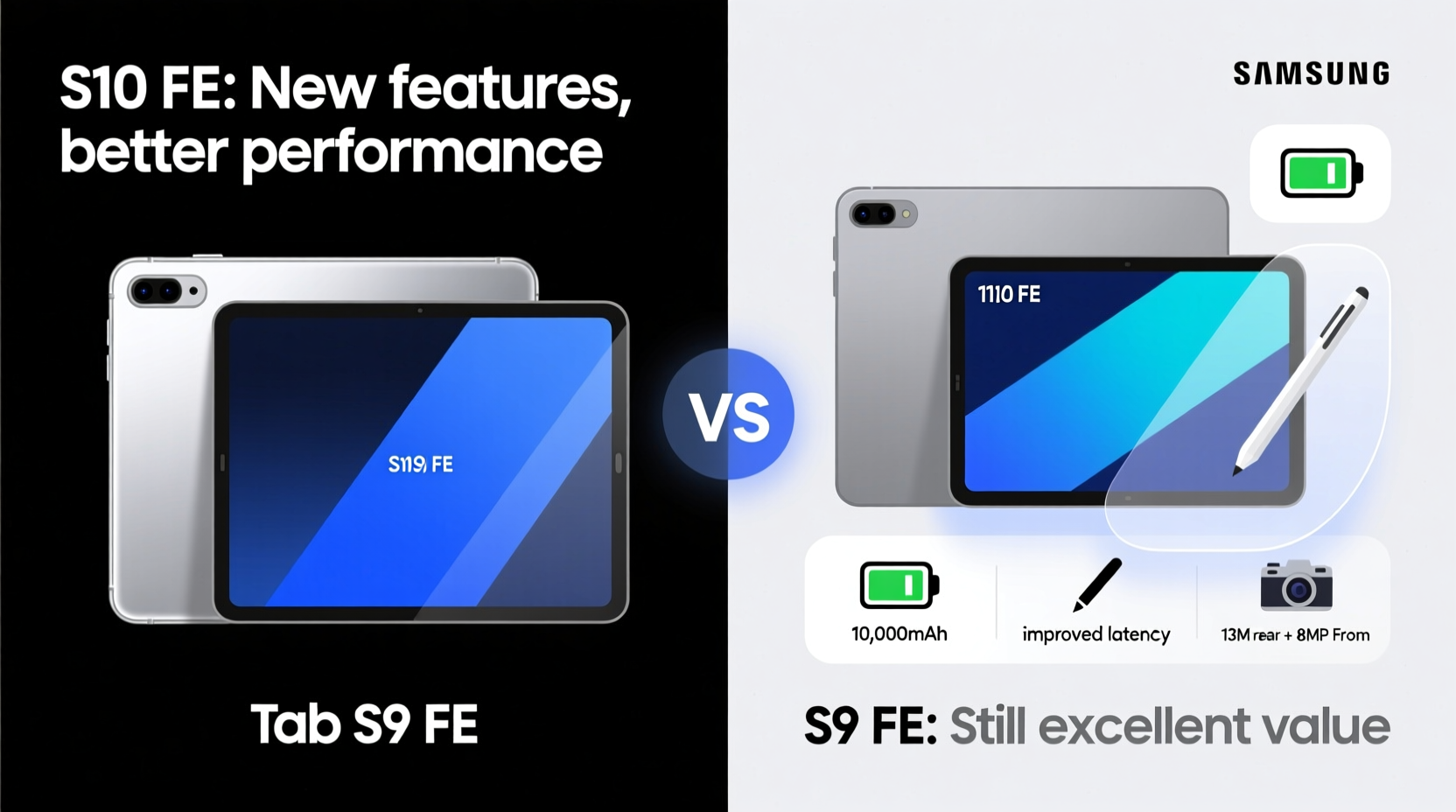
At first glance, the Tab S10 FE and S9 FE appear nearly identical. Both tablets feature Samsung’s signature aluminum unibody design, slim bezels, and a premium feel that belies their mid-tier pricing. They share similar dimensions and weight profiles—around 498g for the Wi-Fi-only models and roughly 7.5mm thickness—making them comfortable for extended handheld use.
The most noticeable difference lies in the camera module. The S10 FE adopts a slightly redesigned rear camera housing, aligning more closely with the flagship S series aesthetic. However, this is purely cosmetic. The materials, durability, and water resistance rating (IP68 on select variants) remain consistent across both models.
Tip: If you use a case and screen protector, the visual differences between S9 FE and S10 FE will be negligible.Display and Visual Experience: Incremental Clarity
Both tablets sport a 10.4-inch TFT LCD panel with a 2000 x 1200 resolution and a 60Hz refresh rate. While this may seem outdated compared to higher-end Samsung tablets with AMOLED displays and 120Hz support, it remains practical for reading, streaming, and general multitasking.
In side-by-side testing, the S10 FE shows marginally better color calibration and brightness uniformity, likely due to refinements in panel sourcing and factory tuning. Peak brightness is reported to be around 500 nits, up from approximately 480 on the S9 FE—a minor improvement under direct sunlight but not transformative.
Neither model supports HDR10+, and viewing angles are acceptable but not exceptional. If you’re using the tablet primarily indoors or for casual media consumption, the visual leap from S9 FE to S10 FE will be subtle at best.
Performance and Hardware: Is the Upgrade Noticeable?
Under the hood, the key difference lies in the chipset. The Tab S9 FE uses the Qualcomm Snapdragon 7 Gen 1, while the S10 FE steps up to the Snapdragon 7+ Gen 3. This newer processor offers a 20–25% improvement in CPU performance and a 35% gain in GPU efficiency, according to independent benchmark tests.
In real-world usage, this translates to smoother app launches, faster background processing, and improved gaming performance. Users running graphic-intensive apps like Adobe Illustrator Draw or playing titles such as *Genshin Impact* on medium settings will notice fewer stutters and quicker load times on the S10 FE.
Both tablets come with 4GB or 6GB RAM options and support microSD expansion up to 1TB. Storage choices include 64GB, 128GB, and 256GB. There’s no change in UFS storage speed between generations, so file transfers remain consistent.
“While the S10 FE’s chip is objectively better, most users won’t feel the difference unless they’re pushing the device with heavy multitasking or creative workloads.” — David Lin, Mobile Hardware Analyst at TechPulse Asia
Battery Life and Charging: Longevity Meets Practicality
Battery capacity remains unchanged at 7,040mAh across both models. Samsung continues to prioritize endurance, and both tablets reliably last 10–12 hours of mixed usage—including web browsing, video playback, and note-taking.
Charging speeds have seen a modest upgrade. The S9 FE supports 15W fast charging, while the S10 FE now includes 25W fast charging out of the box. In practice, this means the S10 FE can go from 0 to 50% in about 45 minutes, compared to nearly 70 minutes on the S9 FE.
Neither model includes a charger in the box, so you’ll need to purchase a compatible USB-PD adapter separately to take full advantage of the faster charging on the S10 FE.
Software and Long-Term Support
One of the most compelling reasons to consider the S10 FE is its software advantage. It ships with Android 14 and One UI 6.1, while the S9 FE launched with Android 13 and One UI 5.1. More importantly, the S10 FE is guaranteed four major Android OS updates and five years of security patches, extending its usable lifespan through 2029.
The S9 FE, released in 2023, also has a strong update promise—but starting one year earlier means it will reach end-of-support by late 2028. For users planning to keep their tablet for four or more years, the S10 FE offers a longer runway for security and feature updates.
Additional software perks on the S10 FE include refined DeX mode optimizations, improved split-screen gestures, and enhanced AI-powered features like live translation during video calls—though many of these are gradually rolled out via updates to older models as well.
Comparison Table: S10 FE vs S9 FE at a Glance
| Feature | Samsung Tab S10 FE | Samsung Tab S9 FE |
|---|---|---|
| Release Year | 2024 | 2023 |
| Processor | Qualcomm Snapdragon 7+ Gen 3 | Qualcomm Snapdragon 7 Gen 1 |
| RAM Options | 4GB / 6GB | 4GB / 6GB |
| Storage Options | 64GB / 128GB / 256GB | 64GB / 128GB / 256GB |
| Display | 10.4” TFT LCD, 2000x1200, 60Hz | 10.4” TFT LCD, 2000x1200, 60Hz |
| Battery | 7,040mAh | 7,040mAh |
| Fast Charging | 25W | 15W |
| OS at Launch | Android 14, One UI 6.1 | Android 13, One UI 5.1 |
| Update Policy | 4 OS + 5 Years Security | 4 OS + 5 Years Security |
| S Pen Included | Yes | Yes |
| Weight (Wi-Fi) | 498g | 498g |
Real-World Example: A Student’s Perspective
Consider Maria, a university student who bought the Tab S9 FE in early 2023 for taking notes, watching lectures, and collaborating on group projects. Two years later, her tablet still performs well, but she’s noticed occasional lag when switching between Zoom, Google Docs, and YouTube simultaneously.
She considered upgrading to the S10 FE after seeing ads highlighting faster performance. After testing both devices in-store, she found that the S10 FE did handle multitasking more smoothly, especially with the upgraded processor. However, the lack of a better display or longer battery made her question the value.
In the end, Maria opted to stay with her S9 FE and instead invested in a refurbished S23 smartphone to pair via Samsung’s Multi Control feature. Her experience illustrates that for many users, strategic ecosystem integration can deliver better returns than hardware upgrades alone.
Upgrade Checklist: Should You Move to the S10 FE?
Before making your decision, ask yourself the following:
- Is your current S9 FE experiencing performance bottlenecks in daily tasks?
- Do you plan to keep your tablet for more than three years?
- Are you frequently charging and frustrated by slower 15W charging?
- Do you rely on the latest software features like AI tools or advanced DeX functions?
- Is your S9 FE showing signs of wear (battery degradation, physical damage)?
If three or more apply, the S10 FE is a worthwhile upgrade. Otherwise, extending the life of your S9 FE with a fresh battery or protective accessories may be more cost-effective.
Frequently Asked Questions
Can the S Pen from the S9 FE be used with the S10 FE?
Yes. The S Pen is fully cross-compatible between the S9 FE and S10 FE. No re-pairing is required, and all features—including low latency and pressure sensitivity—work identically.
Is the display upgrade significant enough to justify the price difference?
No. Since both tablets use the same type of LCD panel with identical resolution and refresh rate, there is no meaningful visual improvement. If display quality is a priority, consider stepping up to the Tab S9/S10 Ultra models with AMOLED screens.
Will the S9 FE continue receiving updates alongside the S10 FE?
Yes. Both devices are entitled to the same number of OS and security updates. However, the S10 FE will receive them over a later timeframe, meaning it will stay supported until 2029, whereas the S9 FE’s support ends in 2028.
Final Verdict: To Upgrade or Not?
The Samsung Galaxy Tab S10 FE is not a revolutionary upgrade over the S9 FE—it’s an evolution. The improvements in processor performance, charging speed, and slightly refined software experience are real, but they cater primarily to users who demand peak responsiveness or intend to hold onto their device for half a decade.
For the average user, the S9 FE remains a capable, reliable tablet in 2024. Its performance is still sufficient for everyday tasks, and with proper care, it can easily last another two to three years. Unless you’re hitting performance limits or want the peace of mind that comes with newer hardware and longer support, holding onto the S9 FE is both practical and economical.
🚀 Ready to decide? Assess your current usage, future needs, and budget. If the S10 FE fits all three, upgrade confidently. If not, maximize your S9 FE’s potential—and save for a bigger leap later.








