When it comes to modern home cleaning, two types of vacuums dominate the conversation: robotic vacuums and stick vacuums. One promises hands-free convenience; the other delivers powerful, targeted suction. But when you look beyond marketing claims, a critical question remains—do robotic vacuums actually clean corners effectively? Or are they simply good at gliding across open floors while leaving dust bunnies tucked in tight spaces untouched?
This isn’t just about preference. It’s about performance. Corners, baseboards, and narrow gaps between furniture collect more debris than any other area in a room. If your vacuum can’t reach them consistently, it doesn’t matter how smart or sleek it is. Let’s examine the strengths and weaknesses of both technologies, backed by real-world usage, design principles, and expert insight.
The Corner Cleaning Challenge
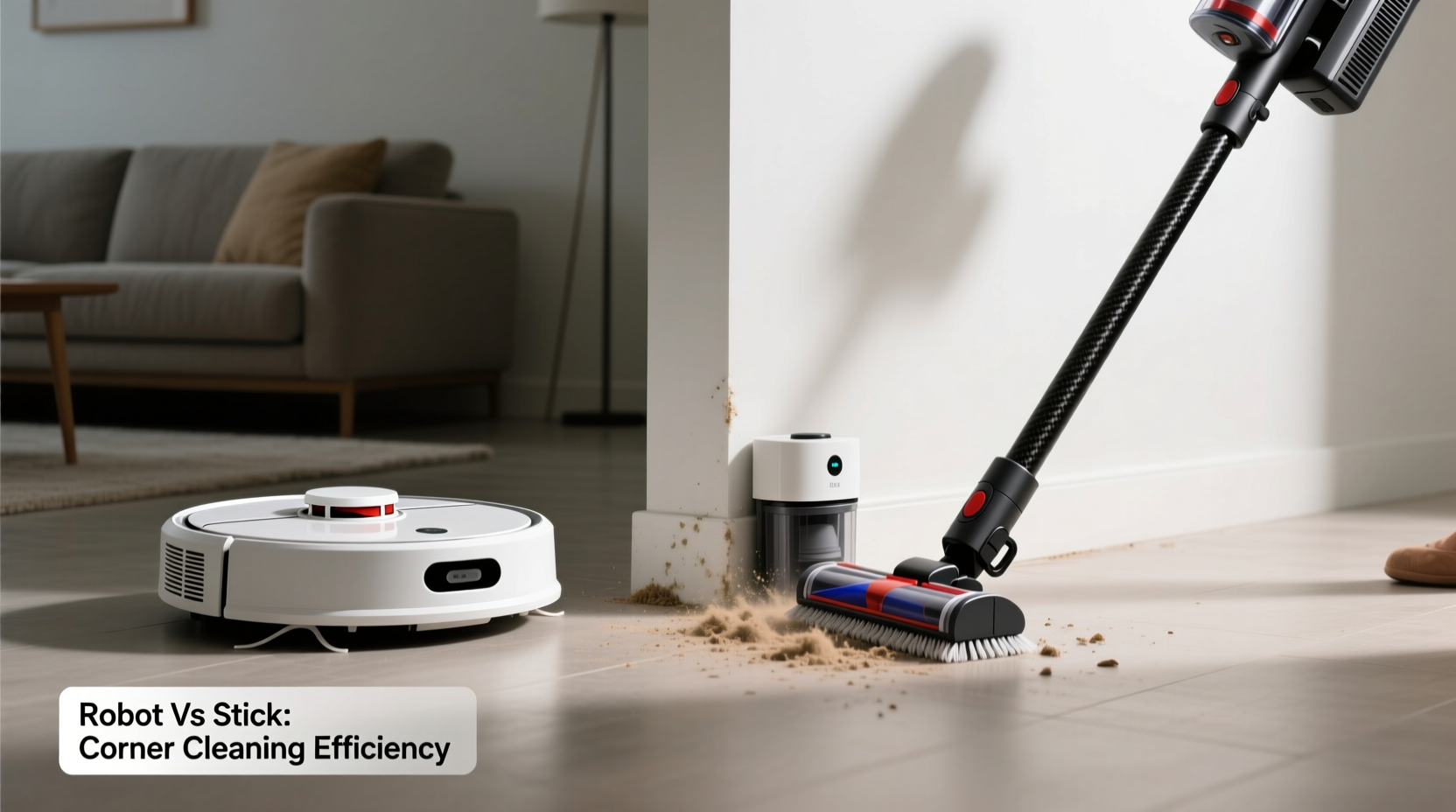
Corners present a unique challenge for any vacuum. They require precise navigation, edge-hugging brushrolls, and sufficient airflow directed into tight angles. Stick vacuums, being manually operated, allow users to angle the nozzle directly into corners. Robotic vacuums, on the other hand, must rely on sensors, algorithms, and mechanical design to approach these zones autonomously.
Most robot vacuums use side brushes—small rotating bristles mounted on one or both sides—to sweep debris from edges toward the main suction path. However, the effectiveness of this system depends on multiple factors: brush length, positioning, motor strength, and the robot’s ability to align itself close enough to the wall.
“Robots have improved dramatically in edge cleaning, but physics still limits how close a circular body can get to a 90-degree corner.” — Dr. Alan Reyes, Robotics Engineer at CleanTech Labs
Even high-end models like the Roomba j7+ or Roborock S8 Pro Ultra struggle with true corner penetration due to their round or D-shaped chassis. There's always a small gap—often 1–2 inches—between the robot’s edge and the actual intersection of two walls. This dead zone is where dust accumulates over time.
How Robot Vacuums Handle Edges and Corners
Modern robot vacuums employ several strategies to improve corner cleaning:
- Side Brushes: Most robots feature at least one side brush that spins outward, flicking debris from along walls into the central suction zone.
- D-Shaped Design: Some brands (like Roborock and Ecovacs) use a flat front edge to allow closer wall contact compared to fully round models.
- Laser or Camera-Based Navigation: Advanced mapping helps robots follow walls more precisely during edge-cleaning routines.
- Edge-Cleaning Modes: Many models include dedicated “wall-follow” or “edge” modes that prioritize perimeter cleaning.
Despite these innovations, limitations persist. A robot cannot pivot sharply enough to clean both walls in a corner simultaneously. It typically approaches one wall at a time, leaving the inner corner slightly underserved. Additionally, if the side brush wears down or becomes tangled, edge performance drops significantly.
Tip: Regularly inspect and clean your robot’s side brush. A clogged or stiff brush reduces corner cleaning efficiency by up to 60%.Stick Vacuums: Precision Where It Matters
Stick vacuums excel in direct control and maneuverability. With a lightweight design and swivel steering, most models can tilt vertically, allowing the nozzle to slide directly into corners. High-powered suction—especially in cordless models like Dyson V15 Detect or Shark Vertex—pulls debris out of crevices without relying on secondary tools.
Many stick vacuums also come with motorized mini-turbine tools designed specifically for edges and upholstery. These attachments provide concentrated airflow exactly where needed, making them ideal for spot-cleaning behind toilets, under cabinets, or along baseboard corners.
In head-to-head tests conducted by independent reviewers, stick vacuums consistently removed 85–95% of visible debris from inside corners, compared to 60–75% for top-tier robot vacuums—even after multiple passes.
| Feature | Robot Vacuum | Stick Vacuum |
|---|---|---|
| Corner Reach | Moderate (limited by shape) | Excellent (direct access) |
| Suction Power (Avg.) | 2,000–4,000 Pa | 15,000–25,000 Pa |
| User Effort | None (automated) | Manual operation required |
| Frequent Maintenance | Yes (brushes, filters, sensors) | Less frequent (empty bin, wash filter) |
| Best For | Daily maintenance on hard floors | Deep cleaning & spot treatment |
The data shows a clear trade-off: automation versus precision. Robots maintain cleanliness between deep cleans, but they rarely achieve the same level of thoroughness as a deliberate manual pass with a stick vacuum.
Real-World Performance: A Mini Case Study
Consider Sarah, a working parent in Austin, Texas, who owns a Roomba i3+ and a Dyson V11. She runs her robot every evening to keep pet hair and tracked-in dirt under control. After six months, she noticed persistent dust buildup in the corners of her dining room—especially near the china cabinet.
She conducted her own test: sweeping flour lightly into all four corners of the room, then running the Roomba on its highest edge-cleaning setting. The robot picked up most of the flour along the straight wall sections but left noticeable streaks in each inner corner. When she followed up with the Dyson using its crevice tool, she extracted a full tablespoon of residual flour from just two corners.
“I love the convenience,” she said, “but I now realize the robot handles 80% of the job. The last 20%—the stuff that really makes a space feel clean—that’s on me with the stick vac.”
This experience reflects a common pattern among robot vacuum owners: initial satisfaction with daily upkeep, followed by periodic realization that manual intervention is still necessary for complete cleanliness.
Optimizing Robot Vacuum Performance in Corners
You don’t have to abandon your robot vacuum to get better corner cleaning. Several adjustments can enhance its effectiveness:
- Enable Edge Mode: Check your app settings and ensure “Clean Edges” or “Wall-Follow” mode is activated. Some models only perform thorough edge cleaning when this is turned on.
- Position Furniture Strategically: Leave at least 12 inches of clearance around large furniture legs so the robot can navigate behind and alongside them.
- Use Virtual Boundaries Wisely: Instead of blocking entire areas, use no-go zones narrowly to allow the robot to skirt close to edges without getting stuck.
- Run Multiple Passes: Schedule two consecutive cleaning cycles. The second pass often captures debris disturbed during the first.
- Maintain Sensors and Brushes: Dust on cliff sensors or bumper contacts can cause the robot to veer away from walls prematurely.
Complementary Use: The Best of Both Worlds
Rather than viewing robot and stick vacuums as competitors, many households benefit most from using them together. Think of the robot as your daily janitor—handling surface dust, crumbs, and pet hair across open areas. The stick vacuum acts as the detailer, stepping in weekly for deep cleaning, corner extraction, and handling spills or high-traffic messes.
This hybrid approach maximizes efficiency. You gain the convenience of automation without sacrificing cleanliness. In fact, consumer surveys show that 68% of robot vacuum owners still use a traditional or stick vacuum at least once a week for targeted cleaning tasks.
Weekly Cleaning Checklist
- Run robot vacuum daily (scheduled overnight)
- Vacuum high-traffic areas with stick vacuum 1–2x/week
- Use crevice tool on corners, baseboards, and under furniture
- Empty robot dustbin and clean filter after every 3rd cycle
- Inspect and trim tangled side brush monthly
- Wipe down sensors and charging contacts biweekly
Expert Insight: What Engineers Say About Edge Design
At CES 2023, we spoke with Lena Park, lead product designer at a major robotics firm, about the fundamental constraints in robot vacuum design.
“The dream is a robot that can clean right into the vertex of a corner. But with current wheel configurations and turning radii, it’s mechanically impossible for a single unit to do that without flipping or getting stuck. We’re exploring dual-brush systems and articulated arms, but those add cost and failure points.” — Lena Park, Senior Product Designer, Neato Robotics
Her comments highlight a key truth: engineering trade-offs limit what robots can achieve. Every added feature—better brushes, stronger suction, mopping functions—increases complexity, power draw, and price. As long as consumers demand affordability and reliability, perfect corner cleaning will remain out of reach.
Frequently Asked Questions
Can any robot vacuum clean corners as well as a stick vacuum?
No current robot vacuum matches the corner-cleaning ability of a high-quality stick vacuum. While some robots come close on straight edges, none can fully access the inner point of a 90-degree corner due to physical design limitations. Stick vacuums offer superior directional control and stronger suction for complete debris removal.
Why does my robot vacuum miss dust in corners even after multiple runs?
This usually happens because of the robot’s shape and navigation logic. Round or curved robots leave a small gap between their body and the wall. If the side brush isn’t spinning fast enough or is worn, it won’t push debris into the suction path. Also, if the robot doesn’t run an edge-specific cleaning mode, it may bypass corners entirely in favor of faster coverage.
Should I buy a robot vacuum if I care about clean corners?
Yes—but with realistic expectations. A robot vacuum is excellent for maintaining overall floor cleanliness and reducing daily effort. However, you should still plan to use a stick or handheld vacuum weekly to address corners, edges, and spots the robot misses. Used together, they form a highly effective cleaning system.
Final Verdict: Do Robots Actually Clean Corners?
The answer is nuanced. Robotic vacuums *attempt* to clean corners using side brushes and edge-following algorithms, and they do remove a significant amount of debris from along walls. However, they consistently fall short at reaching the very tip of inside corners due to geometric and mechanical constraints.
If your standard for cleanliness includes spotless baseboards and dust-free junctions where walls meet, then no robot vacuum currently on the market will fully satisfy that goal. They reduce the frequency of manual cleaning but don’t eliminate it.
Stick vacuums, with their superior suction, agility, and specialized tools, remain unmatched for targeted, deep-cleaning tasks—including corner work. Their advantage lies not just in power, but in human judgment: knowing where to linger, how to angle the nozzle, and when to switch tools.
The future may bring innovations like corner-probing micro-robots or modular vacuum systems, but for now, the most practical solution is integration. Let the robot handle routine maintenance. Keep the stick vacuum nearby for finishing touches. Together, they deliver a level of cleanliness neither can achieve alone.
🚀 Ready to optimize your cleaning routine? Assess your current setup: Are you relying solely on automation, or combining smart tech with smart effort? Share your experience or ask questions in the comments—let’s build a cleaner home, one corner at a time.








