
In today’s fast-paced world, time-saving appliances are more appealing than ever. Among them, robot vacuums promise effortless cleaning with minimal user input. Meanwhile, stick vacuums offer lightweight power and immediate control. But when comparing robot vacuum vs stick vacuum, the real question isn’t just about suction strength or battery life—it’s whether the automated convenience of a robot vacuum outweighs its occasional navigation errors and missed spots. For many homeowners, this decision hinges on lifestyle, home layout, and personal tolerance for imperfection in exchange for freedom from daily chores.
This article dives deep into both options, examining their strengths, limitations, and real-world performance to determine if letting a robot handle your floors is truly worth the trade-offs.
How Robot Vacuums Work: Automation with Trade-Offs
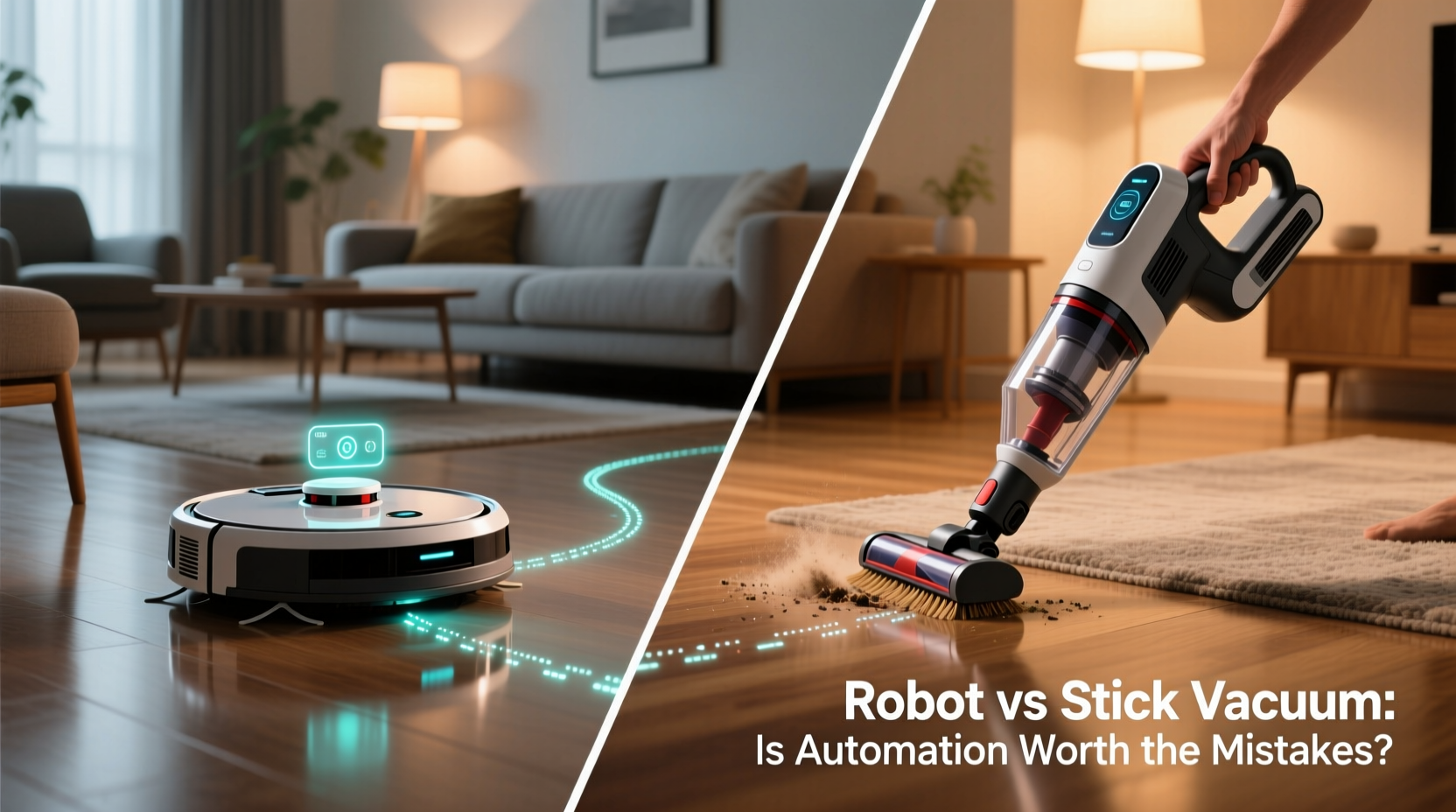
Robot vacuums operate autonomously using sensors, mapping technology, and pre-programmed cleaning patterns. Most modern models use LiDAR or camera-based navigation to create floor plans, remember room layouts, and avoid obstacles. They can be scheduled through smartphone apps, voice assistants, or built-in controls, allowing users to maintain clean floors without lifting a finger.
However, automation comes with compromises. Despite advances in AI-driven navigation, robot vacuums still struggle with certain environments. Cords, pet toys, low-light corners, and dark rugs often confuse sensors, leading to missed areas, erratic movements, or even getting stuck. Some models bump into furniture repeatedly, while others fail to detect high-traffic zones that need extra attention.
As one robotics engineer at iRobot explained:
“Even with advanced algorithms, real homes are unpredictable. A robot vacuum learns over time, but it will never have human spatial awareness.” — Dr. Lena Torres, Robotics Systems Developer
The convenience of “set it and forget it” cleaning is undeniable, but only if you’re willing to accept that some spots may remain untouched until manually addressed.
Stick Vacuums: Precision, Power, and Human Control
Stick vacuums represent the opposite end of the spectrum—manual operation with maximum control. These cordless devices are designed for quick cleanups, spot treatment, and thorough sweeps across various surfaces. With strong motors, direct suction paths, and swivel heads, they outperform most robot vacuums in raw cleaning ability, especially on carpets and embedded debris.
Unlike robots, stick vacuums allow users to target specific areas, adjust suction on demand, and immediately respond to spills or tracked-in dirt. Their slim profiles make them ideal for reaching under furniture, stairs, and tight spaces where robots simply can’t go. Additionally, stick vacuums typically have larger dustbins and HEPA filtration systems, making them better suited for allergy sufferers or homes with pets.
But all this power requires effort. You must carry, maneuver, and store the device after each use. For busy professionals, parents, or those with mobility issues, this physical involvement can be a deterrent—even if the cleaning results are superior.
Tip: Use a stick vacuum for deep weekly cleans and a robot for daily maintenance to get the best of both worlds.Head-to-Head Comparison: Key Differences at a Glance
| Feature | Robot Vacuum | Stick Vacuum |
|---|---|---|
| User Effort | Minimal (fully automatic) | High (manual operation) |
| Cleaning Frequency | Daily or scheduled | On-demand |
| Suction Power | Moderate (1500–3000 Pa) | High (up to 200+ AW) |
| Floor Type Performance | Good on hard floors, variable on carpets | Excellent on all surfaces |
| Navigational Accuracy | Good with maps; struggles with clutter | Perfect (user-controlled) |
| Battery Life | 60–120 minutes (auto-recharge) | 20–60 minutes (no auto-recharge) |
| Price Range | $250–$1,200+ | $150–$700 |
| Maintenance Needs | Regular filter/dustbin emptying, sensor cleaning | Filter cleaning, brush roll maintenance |
The table highlights a fundamental divide: robot vacuums win in convenience and consistency, while stick vacuums dominate in cleaning effectiveness and adaptability.
Real-World Scenario: The Busy Family’s Dilemma
Consider the Martinez family: two working parents, two young kids, and a golden retriever named Max. Their home sees constant foot traffic, spilled snacks, and muddy paw prints. Before investing in any vacuum, they tested both types over a six-week period.
They started with a premium stick vacuum. While it cleaned deeply and handled pet hair well, neither parent had time for daily use. Floors looked fine on weekends but became visibly dusty by midweek. Then they tried a mid-tier robot vacuum with app scheduling. It ran every morning before school, collecting crumbs and debris automatically. However, it occasionally missed the area behind the couch where Max sheds the most, and once got tangled in a charging cable.
Their solution? A hybrid approach. They now run the robot vacuum daily for maintenance and use the stick vacuum every Friday evening for a thorough clean. This combination reduced visible mess by 80% and cut total cleaning time in half.
“We realized we didn’t have to choose one or the other. Using both changed how we think about cleaning.” — Sarah Martinez, homeowner
When a Robot Vacuum Makes Sense (And When It Doesn’t)
The value of a robot vacuum depends heavily on individual circumstances. Here’s a checklist to help determine if it’s right for your household:
- You have a relatively open floor plan with few obstacles
- Your schedule leaves little time for regular sweeping
- You own pets or shedders and want consistent hair pickup
- You’re tech-savvy and comfortable using smartphone apps
- You prioritize convenience over absolute cleaning perfection
Conversely, a robot vacuum may disappoint if:
- Your home is cluttered or has many cords and small objects on the floor
- You have thick carpets or high-pile rugs that challenge suction
- You expect spotless results every single time without manual follow-up
- You live in a multi-level home without multiple docking stations
Step-by-Step: Building an Effective Hybrid Cleaning Routine
For those seeking optimal results without burnout, combining both vacuums strategically offers the best outcome. Follow this five-step process to implement a balanced system:
- Assess Your Home Layout: Map high-traffic zones (entryways, kitchens) and problem areas (pet beds, under tables). Note obstacles that could hinder robot movement.
- Select Complementary Models: Choose a robot vacuum with strong navigation (LiDAR or vSLAM) and a stick vacuum with powerful suction and crevice tools.
- Schedule Daily Robot Runs: Set the robot to clean during daytime hours when floors are clear. Use zone cleaning features to focus on key areas.
- Establish Weekly Deep-Clean Days: Pick one evening per week to manually vacuum with the stick model, focusing on edges, stairs, and missed spots.
- Maintain Both Devices: Empty dustbins after each robot cycle, clean brushes weekly, and check filters monthly to ensure peak performance.
This routine leverages automation for consistency while preserving human oversight for quality control. Over time, many users find they rely less on full manual sessions, reserving the stick vacuum for targeted interventions.
Expert Insight: What Industry Leaders Say About the Future
Vacuum technology continues to evolve rapidly. According to market analysts at GfK, global sales of robot vacuums grew by 14% annually between 2020 and 2023, driven by improvements in AI and affordability. Yet experts caution against viewing them as complete replacements.
“Robot vacuums are excellent maintenance tools, not deep-cleaning solutions. Think of them like automatic car washes—they keep things presentable between professional detailing.” — Mark Chen, Home Appliance Analyst at TechTrend Insights
Future models are expected to integrate better obstacle recognition, self-emptying bins, and even mopping functions with adaptive pressure. However, until robots can match human judgment in dynamic environments, stick vacuums will remain essential for comprehensive cleaning.
Frequently Asked Questions
Can a robot vacuum replace a stick vacuum entirely?
For most households, no. While robot vacuums excel at daily upkeep, they lack the suction power, reach, and precision needed for deep cleaning. Homes with carpets, pets, or high standards of cleanliness will still benefit from a stick vacuum for weekly use.
Do robot vacuums work well on dark floors or rugs?
Some older models struggle because optical sensors misinterpret dark surfaces as drop-offs (like stairs). Newer units with LiDAR or upgraded cameras handle dark flooring much better. If you have black tile or charcoal rugs, look for models specifically rated for dark surface compatibility.
Which is more cost-effective in the long run?
Stick vacuums generally have lower upfront costs and longer lifespans (5–7 years with care). Robot vacuums cost more initially and may require replacement parts (batteries, brushes) sooner. However, their energy efficiency and time savings can justify the investment for time-constrained users.
Conclusion: Balancing Automation and Expectations
The debate between robot vacuum and stick vacuum ultimately boils down to values: Do you prioritize time savings or cleaning perfection? The automated convenience of a robot vacuum is genuinely transformative for many, offering peace of mind and consistent baseline cleanliness. But navigation errors, missed spots, and limited suction mean it cannot fully replicate the thoroughness of a manual pass with a stick vacuum.
Rather than choosing one over the other, the smartest path forward is integration. By using a robot for daily maintenance and a stick vacuum for periodic deep cleans, you gain the benefits of both—reduced effort without sacrificing results. As technology improves, the gap will narrow, but for now, the most effective cleaning strategy remains a collaborative one: human insight guiding machine persistence.
🚀 Ready to optimize your cleaning routine? Evaluate your needs, try a hybrid setup, and see how much time—and stress—you can save. Share your experience in the comments below!








