
For pet owners, cleanliness is not just about aesthetics—it’s a daily battle against fur, dander, tracked-in dirt, and the occasional accident. With pets shedding year-round and tracking debris across carpets and hardwood, maintaining a clean home can feel like an endless chore. Two popular tools have emerged to help: the robot vacuum and the handheld stick vacuum. Both promise convenience, but when it comes to saving time—the most valuable resource for busy households—which one truly delivers? The answer isn’t always obvious, and depends heavily on lifestyle, home layout, and pet behavior.
The Daily Reality of Pet Ownership and Cleaning
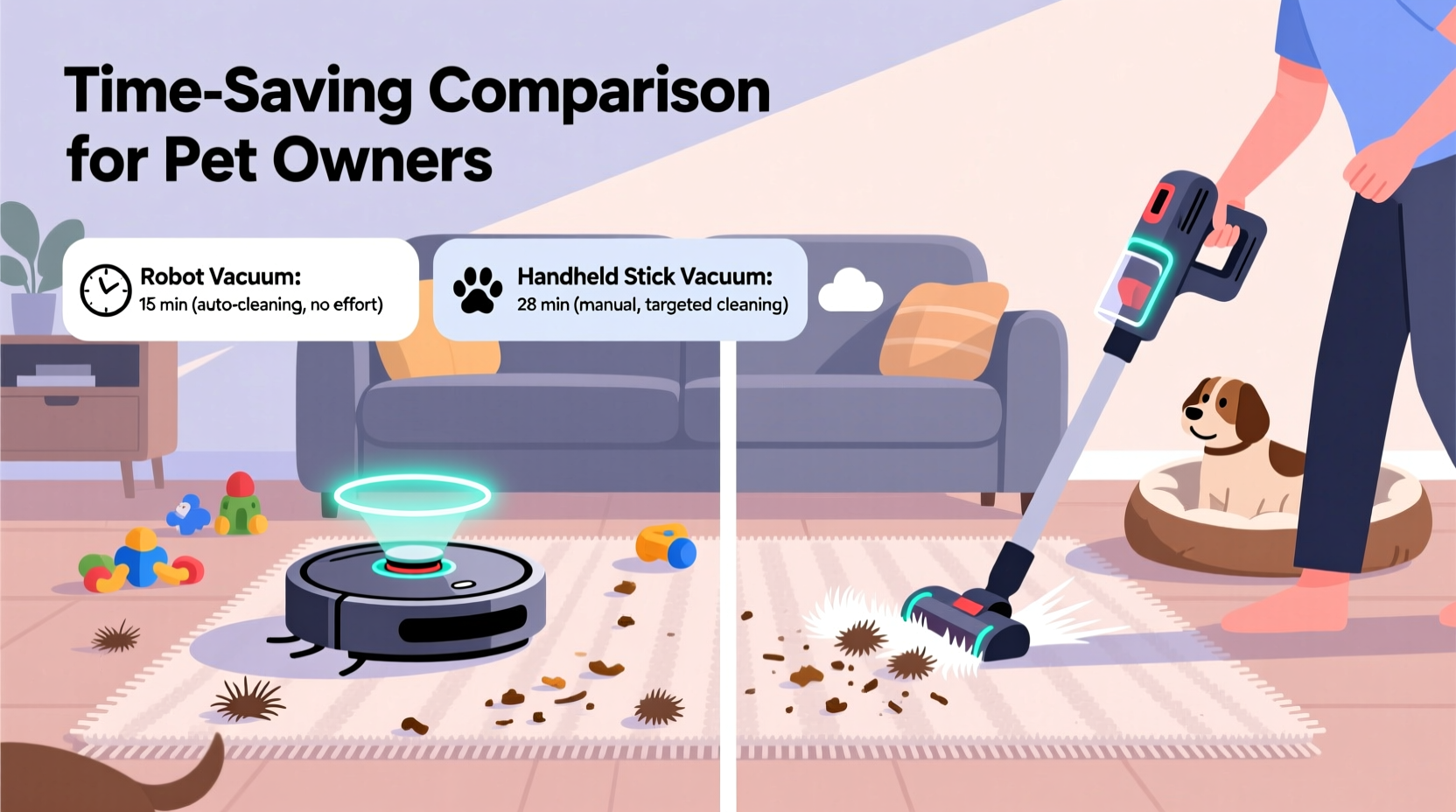
Pets enrich our lives, but they also generate consistent messes. Dogs kick up mud after walks, cats shed fur during seasonal changes, and small animals scatter bedding. Even well-trained pets contribute to dust accumulation and allergen buildup. For owners with allergies or young children, this demands frequent cleaning. Traditional upright vacuums are effective but time-consuming. That’s where automated and portable alternatives come in.
The key metric for many pet owners isn’t suction power or noise level—it’s time saved. A device that reduces hands-on cleaning effort by even 10 minutes per day adds up to over 60 hours annually. But does a robot vacuum eliminate labor through automation, or does a handheld stick vacuum offer faster spot-cleaning precision when accidents happen?
How Robot Vacuums Save Time Through Automation
Robot vacuums operate on a “set it and forget it” model. Once scheduled, they navigate floors autonomously, returning to their dock when finished. For pet owners, this means floors can be cleaned daily without lifting a finger.
Modern models like the Roomba j7+, Roborock S8, and Ecovacs Deebot X2 Omni include features tailored to pet households:
- Self-emptying bins – Hold weeks’ worth of pet hair before needing disposal.
- Anti-tangle brushes – Reduce clogs from long pet fur.
- Smart mapping and room targeting – Clean high-traffic zones like pet feeding areas or favorite napping spots.
- Obstacle avoidance – Advanced sensors detect toys, leashes, and litter boxes, avoiding collisions.
A robot vacuum running nightly ensures that fur and dander don’t accumulate. This prevents deep-set stains and odors, reducing the need for intensive weekend cleaning sessions. Over time, this consistent maintenance cuts total cleaning hours dramatically.
Tip: Schedule your robot vacuum to run right after your dog comes inside from a walk—this captures tracked-in dirt before it spreads.When Robot Vacuums Fall Short for Pet Owners
Despite their strengths, robot vacuums aren’t flawless. They struggle with:
- Immediate messes – If your cat knocks over food or your puppy has an accident, waiting for the next scheduled cycle isn’t practical.
- Carpet edges and corners – Many models miss baseboards where fur accumulates.
- Liquids and sticky spills – Most robot vacuums cannot handle wet messes and may be damaged if used improperly.
- Furniture clearance – Low-clearance sofas or dining chairs can block access.
In multi-pet homes or those with energetic animals, unpredictable messes make full reliance on automation risky. A robot might clean the living room floor at 9 PM, only for a dog to shed a clump of fur at 9:05 PM—rendering the effort partially wasted.
The Speed Advantage of Handheld Stick Vacuums
Handheld stick vacuums shine in immediacy. When a mess occurs, you grab the vacuum, switch it on, and clear it within seconds. Models like the Dyson V15 Detect, Shark WandVac, and Tineco PURE ONE S12 offer strong suction, lightweight design, and quick-release attachments ideal for pet hair.
Key time-saving benefits include:
- Instant response – No waiting for a schedule or recharging; use it the moment a spill happens.
- Portability – Store it under a cabinet or in a closet near pet zones for rapid access.
- Versatility – Clean stairs, furniture, car interiors, and curtains—areas robots can’t reach.
- Spot cleaning efficiency – Takes less than a minute to clean up kibble, litter scatter, or muddy paw prints.
For homes with multiple pets or frequent indoor-outdoor activity, this responsiveness is invaluable. It prevents small messes from becoming larger ones through foot traffic.
“Time savings in pet homes come not from how often you clean, but how quickly you respond. A handheld vacuum can stop a mess from spreading in under 30 seconds.” — Dr. Lena Patel, Home Hygiene Researcher, University of Michigan
Limitations of Handheld Stick Vacuums
Their convenience comes with trade-offs:
- Battery life – Most last 20–60 minutes on a charge, limiting whole-home use.
- Daily discipline required – You must remember to use it consistently; there’s no automation.
- Physical effort – Requires bending, reaching, and carrying—challenging for some users.
- Smaller dustbins – Need emptying after every few uses, especially with heavy shedding.
Without routine use, the stick vacuum gathers dust on the shelf while fur builds up across floors. Its time-saving potential is only realized with active engagement.
Direct Comparison: Time-Saving Features Side by Side
| Feature | Robot Vacuum | Handheld Stick Vacuum |
|---|---|---|
| Hands-free operation | Yes – runs automatically on schedule | No – requires manual use |
| Response time to mess | Delayed (depends on schedule) | Immediate (instant activation) |
| Cleaning frequency | Daily (if scheduled) | As needed (user-dependent) |
| Whole-home coverage | Excellent (with mapping) | Moderate (limited by battery) |
| Spot cleaning speed | Poor (not designed for instant use) | Excellent (under 1 minute) |
| Maintenance effort | Low (self-emptying models) | Moderate (empty bin, charge battery) |
| Best for | Consistent, preventative cleaning | Fast response to accidents and spills |
Real-Life Example: A Multi-Pet Household Test
Sarah Thompson, a dog trainer in Portland, owns two golden retrievers and a cat. Her 1,200 sq ft home sees heavy shedding, muddy paws in winter, and frequent kibble spills. She tested both vacuums over six months.
Initially, she relied solely on a robot vacuum (Roborock Q5). It ran nightly and kept general floor dust low. However, she found herself still sweeping daily because meals spilled outside the feeding zone weren’t cleaned until the next evening. Fur clumps behind the sofa persisted.
She then added a Dyson V8 to her routine. Within a week, she was using it multiple times a day—after meals, post-walk wipe-downs, and bedtime tidying. Though she spent 5–7 minutes daily using it manually, she noticed fewer deep cleans were needed on weekends.
Her conclusion: “The robot handles background cleaning, but the stick vacuum saves me actual time when messes happen. I’d rather spend 30 seconds now than 20 minutes scrubbing later.”
She now uses both: the robot runs every night, and the stick vacuum stays charged in the kitchen. Total weekly cleaning time dropped from 3 hours to under 1 hour.
Optimal Strategy: Combine Both for Maximum Time Savings
The most effective approach for pet owners isn’t choosing between a robot and a stick vacuum—it’s using them together. Each compensates for the other’s weaknesses.
Here’s a step-by-step integration plan:
- Deploy a robot vacuum with scheduling – Set it to run daily in high-traffic zones (kitchen, entryway, living room).
- Use self-emptying models – Minimize maintenance; empty the base only once every 2–3 weeks.
- Keep a handheld stick vacuum charged and accessible – Place it near pet feeding areas or mudrooms.
- Respond immediately to spills – Use the stick vacuum within minutes of any accident.
- Weekly maintenance check – Inspect robot brushes for tangled fur and recharge both devices.
Checklist: Maximizing Time Savings for Pet Owners
- ✅ Choose a robot vacuum with pet-specific features (tangle-free brushroll, smart mapping)
- ✅ Invest in a self-emptying model to reduce maintenance
- ✅ Schedule cleanings during or after peak pet activity (e.g., post-walk, post-meal)
- ✅ Keep a handheld stick vacuum fully charged and within 10 feet of common mess zones
- ✅ Train family members to use the stick vacuum immediately after accidents
- ✅ Run robot vacuum at least 5x per week for consistent upkeep
- ✅ Clean filters monthly to maintain suction efficiency
Frequently Asked Questions
Can a robot vacuum replace a stick vacuum completely?
Not reliably. While robot vacuums excel at routine cleaning, they lack the immediacy and precision needed for sudden pet messes. A stick vacuum remains essential for spot cleaning.
Which vacuum type is better for homes with cats?
Cats tend to create smaller, scattered messes (litter, food pellets, fur). A handheld stick vacuum is ideal for quick cleanup, but a robot helps manage daily shedding on floors. For homes with litter boxes, a robot that avoids obstacles is crucial.
Do robot vacuums work well on thick carpet with pet hair?
High-end models with dual rubber brushes (like Dyson 360 Vis Nav) perform well on carpets. However, low-power bots may struggle. Check suction power (measured in Pa or AW); aim for 2,000+ Pa for pet-heavy homes.
Final Verdict: Which Saves More Time?
If forced to choose one, the robot vacuum saves more cumulative time over weeks and months due to automation. It operates without prompting, maintains baseline cleanliness, and prevents dirt buildup. For owners seeking passive maintenance, it’s the superior option.
However, the handheld stick vacuum saves more *immediate* time when dealing with urgent messes. It prevents small issues from escalating into larger cleaning projects. In terms of crisis response, it’s unmatched.
The truth is, neither alone achieves maximum time savings. The winning strategy combines both: the robot as the silent, daily janitor, and the stick vacuum as the emergency responder. Together, they reduce total cleaning time by up to 70% compared to traditional methods.
“The future of pet-friendly cleaning isn’t about choosing one tool—it’s about creating a system where automation and agility work together.” — Mark Reynolds, Smart Home Integration Specialist, IEEE
Take Action Today
Don’t let pet messes dictate your schedule. Evaluate your home’s layout, your pets’ habits, and your tolerance for daily maintenance. Start with a robot vacuum if you want consistency, or a stick vacuum if you need instant response. But for lasting time savings, invest in both. Your future self—walking into a clean home without lifting a cord or pressing a button—will thank you.
🚀 Ready to reclaim your time? Audit your current cleaning routine, identify your top three mess zones, and choose the vacuum—or combination—that fits your life. Share your experience and help fellow pet owners clean smarter.








