For pet owners, managing loose fur is a daily chore. Whether it’s clumps of cat hair on the sofa or dog hair embedded in carpets, pet dander and shedding can quickly turn a clean home into a grooming session battleground. Two popular solutions dominate the market: robot vacuums and cordless stick vacuums. Both promise convenience, but when it comes to saving time—especially in homes with pets—the differences matter. This article breaks down how each type handles pet hair, evaluates their time-saving potential, and helps you decide which fits your lifestyle best.
How Pet Hair Challenges Cleaning Efficiency
Pet hair isn’t like ordinary dust. It’s clingy, static-prone, and often mixed with dander, dirt, and food crumbs. Long-haired breeds like Golden Retrievers or Persian cats shed heavily, creating layers that embed into fibers of rugs, upholstery, and baseboards. Traditional vacuums struggle with consistent pickup, let alone saving time. That’s where modern cordless and robotic models come in.
The key challenge isn’t just removing visible hair—it’s preventing buildup between deep cleans. A machine that reduces daily effort while maintaining cleanliness offers true time savings. Time saved isn’t only about active cleaning minutes; it includes frequency of use, maintenance, and consistency of results.
Tip: Vacuum high-traffic areas at least every other day if you have shedding pets to prevent matting and allergen accumulation.Robot Vacuums: The Set-and-Forget Advantage
Robot vacuums are designed for autonomy. Models from brands like iRobot Roomba, Roborock, and Ecovacs Deebot navigate rooms using sensors and mapping technology. Once scheduled, they clean daily without user intervention. For pet owners, this means floors are consistently maintained—even when you’re at work or asleep.
Modern robot vacuums feature tangle-free brush rolls, strong suction (up to 3000 Pa), and HEPA filtration to capture allergens. Some include self-emptying bases that store months’ worth of debris, reducing maintenance to emptying the bin every few weeks.
Their biggest time-saving benefit? Automation. You set a cleaning schedule—say, 15 minutes every morning and evening—and the robot handles the rest. No need to remember to vacuum; no dragging equipment out. Over weeks, this prevents hair buildup, reducing the need for intensive cleanups later.
However, limitations exist. Robots may miss edges, require manual spot-cleaning after accidents, and struggle with thick carpets or tangled cords. They also need clear pathways and regular upkeep—cleaning brushes, emptying bins, and recharging.
“Automated cleaning tools reduce household labor by up to 30% in pet-owning homes.” — Dr. Laura Simmons, Home Efficiency Researcher at MIT Living Systems Lab
Cordless Stick Vacuums: Power and Precision on Demand
Cordless stick vacuums like the Dyson V15 Detect, Shark Vertex, or Tineco Pure One offer powerful, handheld flexibility. With suction power exceeding 200 AW and motorized pet tools, they excel at targeted cleaning—think under furniture, stairs, car interiors, or freshly shed spots on the couch.
These vacuums provide immediate response. When your dog shakes off after a walk, you grab the stick vacuum and clear the area in two minutes. Their lightweight design and swivel steering make them ideal for quick pickups, and many convert into handheld units for upholstery or crevices.
Time savings here are situational. You save effort per session due to strong suction and maneuverability, but you still need to initiate each clean. There’s no automation. If you forget or delay, hair accumulates. Frequent charging and bin emptying add micro-tasks throughout the week.
Still, for homes needing deep, reliable cleanups multiple times a week, cordless sticks deliver unmatched performance. Their cyclonic filtration and sealed HEPA systems trap 99.97% of particles as small as 0.3 microns—critical for allergy sufferers.
Detailed Comparison: Time Investment and Real-World Performance
To determine which vacuum saves more time, we must assess not just cleaning speed but total time cost: setup, operation, maintenance, and long-term effectiveness.
| Factor | Robot Vacuum | Cordless Stick Vacuum |
|---|---|---|
| Active User Time per Week | 5–10 minutes (setup, occasional intervention) | 30–60 minutes (multiple sessions) |
| Maintenance Frequency | Weekly brush cleaning, monthly filter wash | After every 2–3 uses (empty bin, clean filter) |
| Pet Hair Pickup Efficiency | Good on hard floors, moderate on low-pile carpets | Excellent across all surfaces |
| Scheduling & Automation | Yes (daily runs, app control) | No |
| Spot Cleaning Response | Slow (must reposition, reschedule) | Immediate (grab and go) |
| Lifetime Cost (approx.) | $500–$900 (including self-empty base) | $300–$700 |
| Best For | Daily maintenance, prevention-focused users | Deep cleaning, fast response, hands-on owners |
This comparison shows a trade-off: robot vacuums minimize daily effort through automation, while cordless sticks maximize cleaning power and responsiveness at the cost of user involvement.
Real-Life Scenario: The Smith Family’s Experience
The Smiths, a family of four with two Labrador retrievers, tested both systems over six months. Initially, they used a Dyson V11 weekly. Despite its power, pet hair built up between cleanings, requiring 45-minute weekend sessions. After switching to a Roborock S8 Pro Ultra with auto-empty and dual rubber brushes, they scheduled cleanings twice daily.
Within three weeks, visible hair decreased significantly. Daily maintenance prevented deep embedding. They still used the stick vacuum monthly for stairs and furniture, but floor cleaning time dropped from 4 hours/month to less than 30 minutes. “It’s not that the robot picks up *more*,” said Mark Smith, “it’s that it never lets things get bad.”
Their conclusion? The robot saved time overall despite higher upfront cost and occasional troubleshooting. The reduction in reactive cleaning was the real win.
Tip: Pair a robot vacuum with a cordless stick for hybrid efficiency—automation for floors, power for spot jobs.Step-by-Step: Optimizing Your Vacuum Routine for Maximum Time Savings
Regardless of your choice, strategy matters. Follow this timeline to minimize effort and maximize results:
- Day 1: Assess Your Space – Map high-shedding zones (pet beds, entryways, sofas). Note flooring types and obstacles.
- Day 2: Choose Based on Lifestyle – If you value hands-off maintenance, prioritize robot vacuums with strong pet features. If you prefer control and power, opt for a cordless stick with tangle-free brushrolls.
- Week 1: Setup & Calibration – For robots: run mapping cycles, set virtual boundaries, schedule cleanings during low-occupancy times. For stick vacuums: charge fully, attach pet tool, test on carpet and hardwood.
- Ongoing: Maintain Consistency – Robot: clean brushes weekly, check sensors monthly. Stick: empty after use, wash filters every 2–4 weeks.
- Monthly: Deep Check – Inspect brushrolls for缠绕 (tangling), test suction, wipe down bins and sensors. Replace filters as needed.
- Every 3 Months: Re-evaluate – Are you still spending too much time cleaning? Adjust schedule, upgrade accessories, or consider combining both systems.
This structured approach ensures your vacuum works efficiently over time, avoiding degradation in performance that leads to longer cleaning sessions.
Expert Tips for Maximizing Time Savings with Either Device
- Use scheduling wisely: Run robot vacuums during work hours or after walks when pets are outside.
- Keep charging docks accessible: Avoid clutter near the base so robots return reliably.
- Invest in pet-specific attachments: Motorized mini tools for couches and stairs make stick vacuums far more effective.
- Pre-vacuum prep: Pick up toys, close doors to off-limit rooms, and secure cords to reduce robot interruptions.
- Empty bins promptly: A full bin reduces suction and forces repeat passes, wasting time.
Frequently Asked Questions
Can robot vacuums handle heavy pet shedding?
Yes, but with conditions. High-end models with rubber extractors (not bristle brushes) resist tangling and perform better on long hair. However, they may need more frequent brush cleaning. For extreme shedding, pairing with a weekly stick vacuum session is recommended.
Do cordless vacuums last long enough to clean an entire home?
Most last 20–60 minutes on a charge, depending on suction mode. For larger homes, choose models with swappable batteries or lower-power eco modes for routine sweeps. Smaller spaces (under 1,500 sq ft) are easily covered in one charge.
Which is better for allergies?
Both can be effective if equipped with HEPA filtration. Robot vacuums reduce airborne allergens through daily cleaning, while cordless sticks offer stronger immediate capture. For allergy sufferers, consistency (robot) combined with power (stick) delivers optimal air quality.
Checklist: Choosing the Right Vacuum for Your Pet-Friendly Home
- ☐ Identify primary flooring type (carpet, hardwood, tile)
- ☐ Determine pet shedding level (light, moderate, heavy)
- ☐ Decide on budget range ($200–$400 vs $500+)
- ☐ Prioritize automation or power
- ☐ Look for tangle-free brushrolls and HEPA filters
- ☐ Check noise level (important for sound-sensitive pets)
- ☐ Consider self-emptying capability (for maximum convenience)
- ☐ Read verified reviews focused on pet hair performance
Final Verdict: Which Saves More Time?
The answer depends on how you define “time saved.”
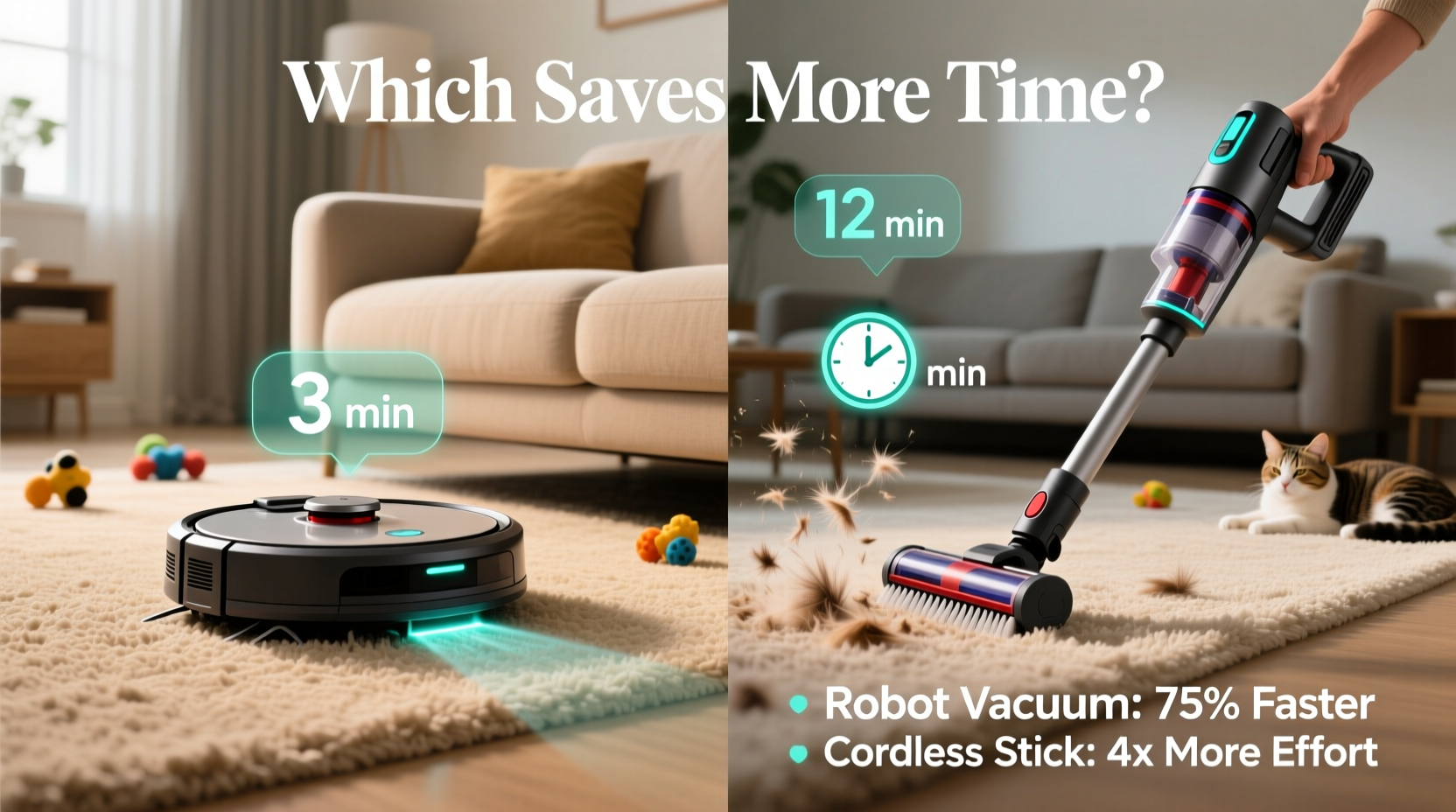
If you measure by active user effort, the robot vacuum wins decisively. Automated daily runs, minimal oversight, and self-emptying options reduce hands-on time to near zero. Over months, this consistency prevents the snowball effect of neglected fur buildup, eliminating the need for marathon cleaning sessions.
If you value immediate, powerful cleanup, the cordless stick vacuum provides faster results per session. But because it relies on human initiation, it demands discipline. Without a strict routine, lapses occur, and time savings vanish.
In most households with pets, especially those with busy schedules, the robot vacuum offers superior long-term time efficiency. It shifts the focus from reactive cleaning to proactive maintenance. That said, the ideal solution for many is a hybrid: a robot for daily floor upkeep and a cordless stick for furniture, stairs, and emergencies.
“The future of pet-friendly homes isn’t about choosing one tool—it’s about layering smart automation with targeted power.” — Karen Liu, Senior Product Designer at iRobot
Take Action Today to Reclaim Your Time
Your relationship with pet hair doesn’t have to be a constant battle. By understanding how robot and cordless vacuums differ in time investment and performance, you can make a choice that aligns with your lifestyle—not just your budget. Evaluate your daily routine, assess your pet’s shedding patterns, and consider whether automation or power matters more to you.
If you already own one type, think about complementing it. A robot vacuum can handle the floors while you reserve the stick for upholstery. Small changes in strategy lead to big gains in free time.
💬 Have experience with robot or cordless vacuums for pet hair? Share your story, tips, or questions in the comments—your insight could help another pet owner save hours every month.








