Most people fail not because they lack ambition, but because their approach to change is misaligned with how the human brain actually works. Setting big goals—like losing weight, writing a book, or learning a language—is easy. Sticking to them is hard. The secret isn’t willpower or motivation; it’s structure. And one of the most effective structural tools for lasting behavior change is habit stacking.
Habit stacking, a concept popularized by productivity expert James Clear in *Atomic Habits*, involves attaching a new behavior to an existing one. Instead of trying to build habits from scratch, you “stack” them onto routines already embedded in your daily life. This method leverages the brain’s natural tendency to operate on autopilot, making consistency far more achievable. But what makes this technique so powerful? The answer lies in neuroscience, behavioral psychology, and decades of research on automaticity.
The Science Behind Habit Formation
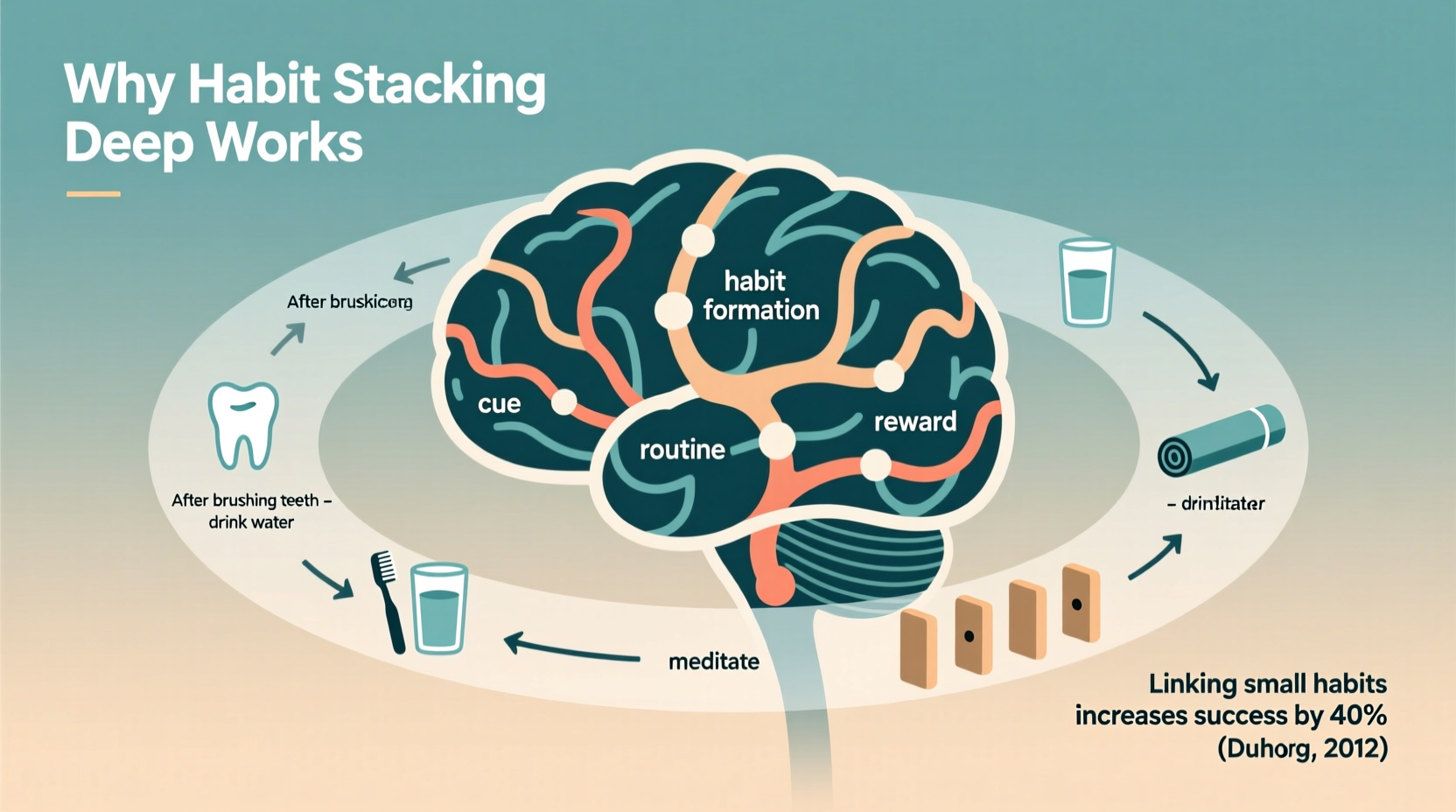
Habits are mental shortcuts. The brain constantly seeks efficiency, reducing effort by turning repeated behaviors into automatic routines. This process occurs in the basal ganglia, a region responsible for pattern recognition and routine execution. When a behavior is repeated consistently in a specific context, the brain begins to associate cues (time, location, emotional state) with actions and rewards, forming what researchers call the “habit loop.”
The habit loop consists of three parts:
- Cue: A trigger that signals the brain to initiate a behavior.
- Routine: The behavior itself, which can be physical, emotional, or cognitive.
- Reward: A positive outcome that reinforces the loop and increases the likelihood of repetition.
Over time, the cue and reward become neurologically intertwined, so the craving for the reward drives the behavior—even without conscious thought. Brushing your teeth after waking up, checking your phone before bed, or grabbing coffee at the same café each morning—these aren’t random acts. They’re deeply ingrained habits shaped by repetition and reinforcement.
When we try to form new habits in isolation, we often fail because we neglect the cue. Without a clear trigger, motivation wanes and forgetfulness takes over. This is where habit stacking shines: it uses an existing habit as the cue for a new one, creating a seamless transition from old behavior to new.
Tip: Choose a current habit that happens at a consistent time and place—like drinking morning coffee or brushing your teeth—as the anchor for your new routine.Why Linking Routines Increases Success Rates
Attempting to adopt a new habit requires mental energy. Each decision—when, where, and how to act—drains willpower, a limited resource. This phenomenon, known as “decision fatigue,” explains why even disciplined people struggle with consistency later in the day. Habit stacking conserves mental energy by eliminating the need for deliberation. If you always meditate after brewing tea, the tea becomes the automatic signal to meditate—no planning required.
Research supports this. A 2010 study published in the European Journal of Social Psychology found that it takes an average of 66 days for a behavior to become automatic—but only if it’s performed consistently in the same context. The more predictable the cue, the faster the habit forms. By anchoring a new habit to an established one, you create a reliable context, accelerating the automation process.
Moreover, linked routines reduce friction. Starting a new behavior feels daunting when it exists in a vacuum. But when it follows something you already do, the barrier to entry disappears. You’re not asking yourself, “Should I journal today?” You’re simply following a sequence: finish breakfast → write in journal. The decision has already been made.
“Habits are the compound interest of self-improvement. Small changes, linked to existing routines, yield remarkable results over time.” — James Clear, author of *Atomic Habits*
How to Build Effective Habit Stacks: A Step-by-Step Guide
Creating a successful habit stack isn’t just about pairing any two activities. It requires intentionality and alignment with your lifestyle. Follow this five-step process to design stacks that last.
- Identify keystone habits. These are foundational behaviors that naturally influence other areas of your life. Examples include morning movement, daily planning, or evening reflection. Focus on stacking around these first.
- List your existing routines. Track your day for 48 hours. Note automatic behaviors like making coffee, commuting, eating lunch, or locking the front door. These are potential anchors.
- Define the new habit. Be specific. Instead of “exercise more,” choose “do 10 push-ups.” Vague goals don’t stack well.
- Link them with a formula. Use the phrase: “After [current habit], I will [new habit].” For example: “After I pour my morning coffee, I will write three things I’m grateful for.”
- Test and refine. Try the stack for a week. If it feels forced or inconsistent, adjust the timing, location, or habit pairings.
The key is proximity and sequence. The anchor habit must immediately precede the new one. Delay introduces uncertainty. If you plan to stretch after work, do it the moment you walk through the door—not after checking email or changing clothes.
Example Habit Stacks That Work
| Anchor Habit | New Habit | Benefit |
|---|---|---|
| Brushing teeth at night | Floss one tooth | Builds flossing habit with minimal effort |
| Sitting down for lunch | Drink a full glass of water | Improves hydration without extra decisions |
| Opening laptop in the morning | Review top 3 priorities | Enhances focus and reduces distraction |
| Returning home from work | Change into workout clothes | Lowers activation energy for exercise |
| Finishing dinner | Write tomorrow’s to-do list | Reduces morning decision fatigue |
Real-World Example: From Procrastination to Productivity
Consider Mark, a graphic designer who struggled to maintain a fitness routine. He joined gyms, bought equipment, and set ambitious goals—but never followed through. After reading about habit stacking, he analyzed his daily patterns. He realized he always checked social media right after breakfast.
Instead of fighting the urge, he used it as a cue. He created a stack: “After I finish breakfast, I will do five squats before opening Instagram.” The next week, he increased it to ten. Within a month, the squatting became automatic. Eventually, he replaced the social media scroll with a 20-minute home workout.
What changed? Not motivation. Not discipline. The environment and sequence did the work. The breakfast plate became a trigger. The reward wasn’t just physical—it was the satisfaction of completing a tiny win before starting the day. Over time, the stack evolved naturally, proving that small links can lead to large transformations.
Avoiding Common Pitfalls
Habit stacking sounds simple, but mistakes can derail progress. Here are frequent errors and how to avoid them:
- Stacking too many habits at once. Trying to add five new behaviors in a week overwhelms the system. Stick to one or two stacks until they feel automatic.
- Poorly timed anchors. If your anchor habit is inconsistent—like going to the gym, which may vary by day—the stack fails. Choose stable, daily routines like waking up, eating meals, or bedtime.
- Unrealistic new habits. Don’t stack “run 5 miles” after “wake up.” Begin with “put on running shoes” or “step outside.” Gradually increase difficulty.
- Neglecting the reward. Even subtle rewards reinforce the loop. Celebrate completion with a mental note, a checkmark, or a deep breath.
“People underestimate the power of tiny behaviors because they seem insignificant. But linked together, they reshape identity.” — Dr. BJ Fogg, founder of the Tiny Habits method
Checklist: Building Your First Habit Stack
Use this checklist to implement a high-success habit stack today:
- ☐ Identify a daily routine that happens at the same time and place.
- ☐ Define a tiny, specific new habit (under 2 minutes).
- ☐ Phrase it using: “After [current habit], I will [new habit].”
- ☐ Perform the stack at the same time every day for 7 days.
- ☐ Track completion with a calendar or app.
- ☐ After consistency is achieved, consider adding a second stack.
FAQ
Can habit stacking work for complex goals like learning a language?
Yes, but break the goal into micro-habits. For example: “After I brush my teeth at night, I will review five flashcards.” Consistency with small actions leads to fluency over time.
What if my schedule changes frequently?
Focus on portable cues. Instead of time-based triggers, use event-based ones like “after I sit down to eat” or “before I open my email.” These adapt to shifting routines.
How long does it take for a habit stack to become automatic?
Studies suggest 18 to 254 days, depending on complexity and individual differences. Most simple stacks become automatic within 30–60 days with consistent practice.
Conclusion: Small Links, Lasting Change
The psychology of habit stacking reveals a fundamental truth: sustainable change doesn’t come from grand gestures, but from intelligent design. By aligning new behaviors with existing neural pathways, you bypass resistance and tap into the brain’s preference for efficiency. What starts as a deliberate choice becomes an unconscious routine—one that quietly transforms your days, your months, and ultimately, your life.
You don’t need more motivation. You need better systems. Start with one stack. Anchor it to a habit you already own. Make it so easy it feels effortless. Repeat. Over time, those linked routines will compound, turning aspirations into automatic achievements.
🚀 Ready to build your first habit stack? Pick one tiny habit today and link it to something you already do. In 30 days, you’ll wonder why you didn’t start sooner.








