Home bars have evolved from novelty decor to functional centerpieces—especially as more people entertain at home and invest in craft spirits, cocktail tools, and elegant shelving. But for dog owners, that beautiful open shelving unit holding bourbon, vodka, wine, and liqueurs poses a quiet but serious hazard: ethanol toxicity. Dogs metabolize alcohol far less efficiently than humans, and even small amounts of spilled or accessible ethanol—whether in a tipped tumbler, a cracked bottle, or a puddle on the bar top—can trigger vomiting, disorientation, respiratory depression, and in severe cases, coma or death. This isn’t about overcaution; it’s about designing intentionality into your space. A truly safe home bar doesn’t sacrifice style or functionality—it integrates canine behavior science, household ergonomics, and veterinary toxicology into its layout and daily operation.
Why Ethanol Is Especially Dangerous for Dogs
Dogs lack sufficient levels of gastric alcohol dehydrogenase—the enzyme that begins breaking down ethanol in the stomach. As a result, nearly 100% of ingested alcohol passes directly into the bloodstream. Their smaller body mass amplifies concentration effects: just one standard shot (14 g ethanol) in a 10 kg (22 lb) dog equals a blood alcohol concentration (BAC) of ~0.15%, well above the human legal driving limit—and enough to cause neurological impairment. According to the ASPCA Animal Poison Control Center, ethanol ingestion accounts for over 12% of all reported toxin exposures in dogs annually, with home bars and unattended cocktails cited in 68% of those cases involving adult dogs. Most incidents occur not from intentional feeding, but from opportunistic access: a dog nudging a low-hanging decanter, licking a spill while the owner steps away, or chewing through a corked bottle left within reach.
Tip: Never assume “a little sip won’t hurt.” A single tablespoon of 40% spirit contains ~3.7 g of pure ethanol—enough to induce clinical signs in a 5 kg (11 lb) terrier.Designing the Physical Barrier: Layout, Height, and Containment
Creating a pet-safe bar starts with architecture—not just aesthetics. The goal is layered containment: preventing access at the source, intercepting spills before they pool, and eliminating temptation through visual and spatial separation.
Begin with vertical zoning. The American Kennel Club’s Canine Behavior Task Force recommends establishing three distinct height-based zones:
- Zone 1 (0–18 inches): Reserved exclusively for non-toxic, non-liquid items—coasters, napkin rings, decorative wood blocks. No bottles, glasses, or open containers permitted.
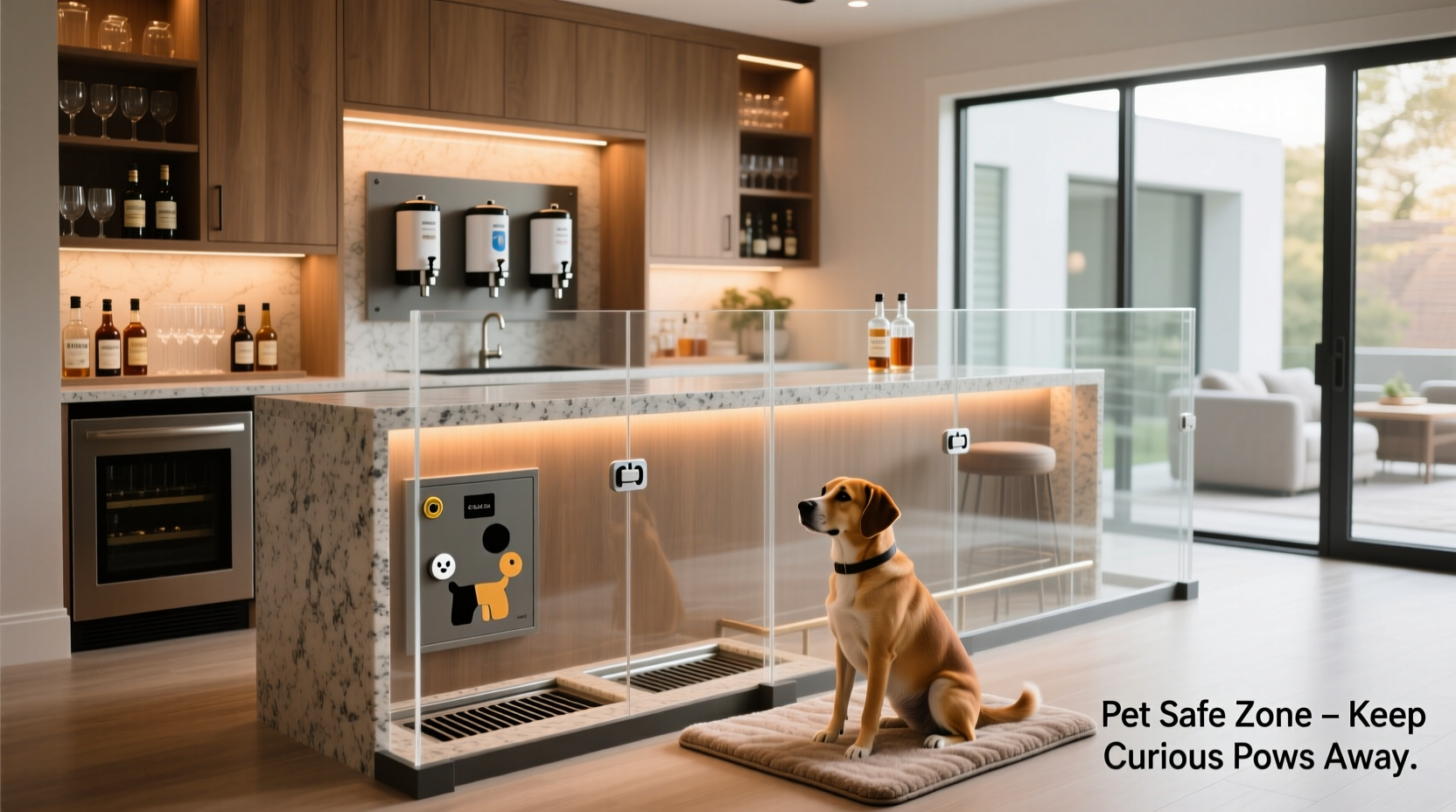
- Zone 2 (18–42 inches): The “transition zone.” Use only fully enclosed cabinets with childproof latches or magnetic locks rated for >15 lbs pull force. If open shelving is preferred, install rigid acrylic or tempered glass barriers (minimum ½ inch thick) with no gaps wider than ¼ inch.
- Zone 3 (42+ inches): The “safe display zone.” This is where bottles, decanters, and glassware may be displayed—but only if secured with museum-grade wall anchors and non-slip silicone pads underneath each item. Any shelf deeper than 8 inches must feature a 1-inch raised front lip to prevent sliding during vibration or accidental bumps.
Crucially, avoid “bar rail” designs that double as ledges for dogs to rest their paws—or worse, vault onto. Instead, opt for continuous, sloped countertops (minimum 5° downward pitch toward the user side) paired with recessed storage trays beneath the surface. These trays hold shakers, jiggers, and citrus tools—keeping them out of paw range while remaining instantly accessible to humans.
Spill Mitigation: Materials, Surfaces, and Real-Time Response Protocols
A spill isn’t an “if”—it’s a “when.” What matters is how quickly it’s contained and neutralized. Traditional bar surfaces like marble, granite, or unfinished wood absorb ethanol rapidly, making cleanup incomplete and odor lingering—a powerful attractant for dogs’ olfactory senses (which are 10,000–100,000x more sensitive than ours).
| Surface Material | Ethanol Resistance | Cleanup Efficiency | Dog-Safety Risk Level |
|---|---|---|---|
| Polished quartz composite (e.g., Caesarstone) | Excellent — non-porous, chemically inert | Wipe clean in <15 sec; no residue | Low — minimal odor retention |
| Stainless steel (brushed finish) | Excellent — impermeable, corrosion-resistant | Rinse + dry in <20 sec; no etching | Low — cool to touch, deters prolonged contact |
| Sealed concrete | Fair — micro-cracks trap ethanol vapor | Requires enzymatic cleaner; 3+ min dwell time | Medium-High — persistent scent draws investigation |
| Butcher block (oiled walnut) | Poor — absorbs ethanol deeply; accelerates rancidity of oil finish | Cannot fully remove; requires sanding & resealing | High — strong residual aroma, invites licking |
Pair your surface choice with a proactive spill protocol. Keep a dedicated “ethanol response kit” under the bar: microfiber cloths pre-cut to 12×12 inches, food-grade sodium bicarbonate powder (to neutralize acidity and reduce volatility), and a small squeegee with rubber blade. When a spill occurs, act in this sequence:
- Isolate: Gently but firmly guide your dog away using a verbal cue (“Leave it”) and redirect with a high-value treat *away* from the area.
- Neutralize: Sprinkle baking soda liberally over the wet area—this raises pH and reduces ethanol vapor pressure, cutting airborne attraction by up to 70%.
- Remove: Wipe with a dry microfiber cloth using firm, overlapping strokes—no circular motions (which spread ethanol laterally).
- Verify: Hold your nose 2 inches above the surface for 10 seconds. If you detect any alcohol scent, repeat steps 2–3.
Behavioral Management: Training, Timing, and Environmental Cues
Physical barriers alone aren’t enough. Curiosity, boredom, anxiety, and learned association (“bar = treats dropped during parties”) drive most bar-related incidents. Integrate behavioral strategy alongside structural design.
Start with scent discrimination training. Using a sterile cotton swab lightly dampened with 0.5% ethanol solution (diluted from pharmacy-grade ethanol), present it at a distance while saying “No sniff” and immediately rewarding focus on a toy. Gradually decrease distance over 10 sessions—never forcing proximity. This teaches dogs to associate ethanol scent with cessation of reward, not exploration.
Timing matters too. Reserve bar use for periods when your dog is either crated (with enrichment), in another room behind a baby gate, or engaged in a long-lasting food puzzle. Avoid “quick pours” while your dog is nearby—even 90 seconds is enough for a curious nose to investigate a newly opened bottle.
Environmental cues reinforce safety. Install a subtle but consistent auditory signal—such as a soft chime triggered by opening cabinet doors—that precedes every bar interaction. Over time, dogs learn the chime predicts human activity *and* restricted access, reducing anticipatory pacing or nudging.
“Ethanol toxicity in dogs is 100% preventable—not through restriction alone, but through thoughtful environmental design paired with positive reinforcement. The safest bar isn’t the one behind a locked door; it’s the one your dog walks past without glancing twice.” — Dr. Lena Torres, DVM, DACVECC, Director of Toxicology at UC Davis Veterinary Medical Teaching Hospital
Real-World Case Study: The Portland Bungalow Incident
In early 2023, a 3-year-old Australian Shepherd named Jasper ingested approximately 2 oz of spilled rum after his owner refilled a decanter on a low, open oak shelf. Jasper had previously shown no interest in the bar—but that day, a delivery person knocked, startling the owner mid-pour. The decanter slipped, spilling across the shelf and dripping onto a rug below. While the owner attended the door, Jasper licked the rug for 47 seconds before exhibiting wobbliness and excessive salivation. He was rushed to an emergency clinic and treated with IV fluids and activated charcoal. Blood tests confirmed BAC of 0.21%. Recovery took 36 hours.
Post-incident, the owner retrofitted the bar using evidence-based interventions: replacing the oak shelf with a 48-inch-high stainless steel counter, installing magnetic cabinet locks on all lower storage, adding a downward-sloping quartz surface with integrated drip tray, and beginning scent-discrimination training. Six months later, during a house party with spilled champagne on the floor, Jasper walked past the bar—then paused, looked at his owner, and lay down beside his bed. No redirection was needed.
Essential Safety Checklist
Use this actionable checklist before hosting, after renovations, or during seasonal bar updates:
- ✅ All bottles stored upright with caps tightened and sealed with tamper-evident shrink bands
- ✅ No open containers left unattended—even for “just 60 seconds”
- ✅ Bar surface cleaned with vinegar-water (1:3) weekly to eliminate residual ethanol traces
- ✅ Cabinet latches tested monthly with 10-lb weight simulation (e.g., filled water bottle)
- ✅ Emergency vet number and ASPCA Poison Control (888-426-4435) visibly posted near the bar
- ✅ Non-slip matting placed *under* bar stools to prevent sliding during sudden dog approaches
- ✅ All citrus peels, cherry garnishes, and sugary syrups removed immediately after use (xylitol and moldy fruit pose secondary risks)
FAQ
What should I do if my dog licks a small ethanol spill?
Immediately rinse their mouth with lukewarm water for 30 seconds using a syringe (no needle) or turkey baster—do not induce vomiting. Monitor closely for lethargy, vomiting, or loss of coordination for the next 2 hours. Call your veterinarian or ASPCA Poison Control even for seemingly minor exposure; early intervention prevents progression to life-threatening stages.
Are “non-alcoholic” spirits safe for dogs?
Not necessarily. Many contain glycerol, artificial sweeteners (including xylitol, which is acutely toxic), or botanical extracts like hops (linked to malignant hyperthermia in dogs). Always check full ingredient labels—and assume “alcohol-free” does not equal “dog-safe.”
Can I use ethanol-based cleaning products near my bar if my dog is present?
No. Isopropyl alcohol, ethanol wipes, and glass cleaners with >5% alcohol content emit volatile organic compounds (VOCs) that irritate airways and can be absorbed through paw pads. Use vinegar-water, diluted Castile soap, or pet-safe enzymatic cleaners instead. Ventilate thoroughly after any cleaning.
Conclusion
Your home bar reflects your taste, hospitality, and personal rhythm—but it shouldn’t compromise the health or safety of the family member who greets you at the door with unwavering loyalty. Creating pet-safe areas in home bars isn’t about diminishing joy or convenience; it’s about elevating responsibility into elegance. It means choosing quartz over walnut not just for durability, but because it denies ethanol a foothold. It means installing magnetic locks not as a barrier, but as a quiet promise—to yourself and your dog—that curiosity will always meet kindness, not consequence. Every polished surface, every anchored shelf, every practiced “Leave it” is a stitch in the fabric of coexistence. You don’t need to abandon your love of craft cocktails to honor your dog’s vulnerability. You simply design with both in mind—simultaneously, intentionally, and without compromise.
💬 Your turn: Share one change you’ll make to your bar this week—whether it’s swapping a surface, adding a latch, or starting scent training. Your experience could help another dog owner prevent a crisis. Comment below.








