Hosting summer gatherings on your patio shouldn’t mean choosing between human comfort and canine well-being. “Dog days” — those long, sun-drenched afternoons when friends gather with chilled glasses and dogs sprawl in dappled shade — thrive only when both species feel safe, cool, and genuinely welcome. Yet many patios unintentionally pose hazards: scorching pavers, toxic plants, unsecured trash, or poorly placed furniture that traps heat and limits airflow. This isn’t about adding a token water bowl beside the bar cart. It’s about intentional design — integrating veterinary guidance, behavioral science, and practical horticulture to create a space where wagging tails and clinking glasses coexist without compromise.
1. Surface Safety: What Your Dog’s Paws Can (and Can’t) Handle
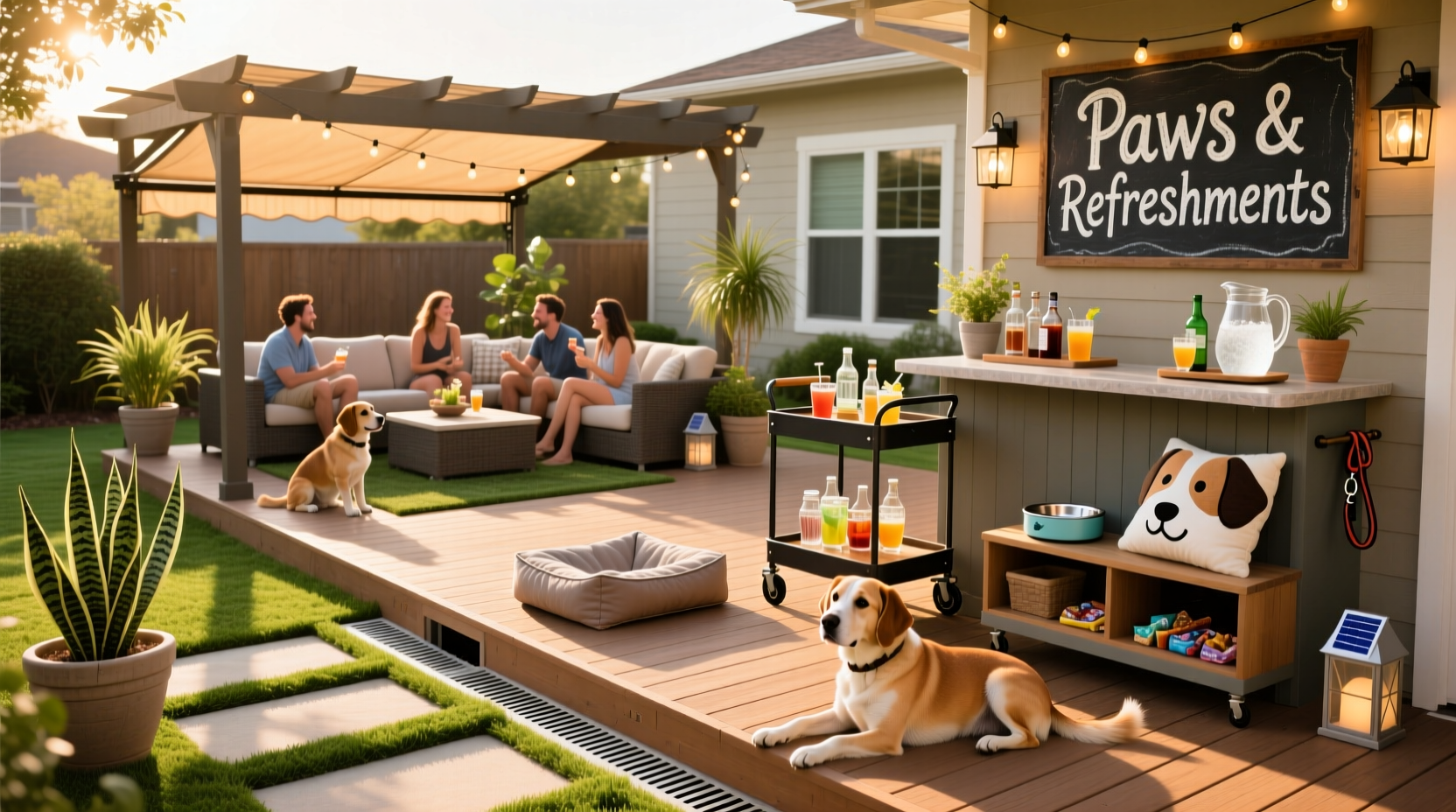
Dogs don’t sweat through their skin — they rely on panting and paw pad evaporation to cool down. That makes surface temperature critical. Asphalt can reach 140°F (60°C) on an 85°F (29°C) day; concrete follows closely. At 125°F, paw pads sustain third-degree burns in under 60 seconds. Grass stays coolest but often lacks durability for frequent foot traffic and muddy paws. The solution lies in layered, low-risk materials — not just aesthetics.
Tip: Test surface safety with the “7-second rule”: place the back of your hand on the patio surface for seven seconds. If it’s too hot for you, it’s dangerous for your dog.Opt for permeable, shaded, or thermally reflective options. Crushed granite or decomposed granite stays 15–20°F cooler than concrete and allows drainage. Poured rubber surfacing — commonly used in playgrounds — offers shock absorption and consistent temperature control. If you love tile or stone, choose light-colored, textured varieties (like honed limestone or sandstone) and install them over a gravel base rather than concrete slabs to reduce heat retention. Avoid dark-stained wood decks — they absorb and radiate heat, especially in direct sun.
2. Hydration & Cooling Stations: Beyond the Basic Bowl
A single ceramic bowl refilled twice an hour doesn’t meet canine physiological needs during active social time. Dogs dehydrate faster than humans — especially brachycephalic breeds, seniors, or those with underlying conditions. Effective hydration requires redundancy, accessibility, and temperature control.
- Three-tiered water access: Place one elevated stainless steel bowl near the seating zone (for easy sipping), one shaded ground-level station near play areas (for enthusiastic lapping), and one insulated, solar-powered circulating fountain at the perimeter (to deter mosquitoes and keep water oxygenated and cool).
- Cooling mats and zones: Use non-toxic, gel-filled cooling mats (tested for chew resistance) under shaded pergola corners. Pair them with breathable cotton dog beds — never memory foam, which traps heat.
- Strategic misting: Install a low-pressure misting system along the north-facing edge of your patio, activated manually or via timer. Avoid overhead spray directly above food or drink stations — mist should land on shaded surfaces and air, not glassware or appetizers.
Remember: water bowls must be cleaned daily with vinegar-water solution (1:3 ratio) to prevent biofilm buildup — a breeding ground for bacteria like Leptospira, which thrives in stagnant outdoor water.
3. Plant Intelligence: Creating a Non-Toxic, Sensory-Rich Landscape
Plants do more than beautify — they provide shade, mask urban noise, and offer natural scent stimulation. But nearly 700 common ornamental plants are toxic to dogs, according to the ASPCA Poison Control Center. Lilies, oleander, sago palm, and even popular lavender cultivars (high in linalool) can cause vomiting, tremors, or organ failure. Choose wisely — and prioritize function alongside form.
| Plant | Safety for Dogs | Functional Benefit | Notes |
|---|---|---|---|
| Lemon balm (Melissa officinalis) | ✅ Non-toxic | Natural insect repellent; calming scent | Pinch regularly to encourage bushiness — avoids leggy growth near walkways |
| Blue fescue grass (Festuca glauca) | ✅ Non-toxic | Low-maintenance ground cover; soft texture | Drought-tolerant; no sharp blades; ideal for paw-safe edging |
| Japanese maple (Acer palmatum) | ✅ Non-toxic | High shade density; slow-growing canopy | Choose dwarf varieties for compact patios; avoid root-pruning near pavers |
| Marigolds (Tagetes spp.) | ✅ Non-toxic | Natural nematode deterrent; pollinator-friendly | Plant in raised beds — prevents accidental trampling by guests or dogs |
| Hydrangea (Hydrangea macrophylla) | ❌ Toxic (cyanogenic glycosides) | Floral impact; shade-loving | Remove if present — symptoms include depression, vomiting, and diarrhea within hours |
Pair plantings with hardscaping: use smooth river rocks (not jagged lava rock) as mulch to deter digging while staying cool. Avoid cocoa bean mulch entirely — its theobromine content is lethal to dogs, even in small amounts.
4. Social Flow Design: Preventing Stress, Not Just Spills
Dogs experience parties differently than humans. Crowds, sudden movements, overlapping voices, and unfamiliar scents trigger acute stress — which manifests not always as barking or jumping, but as lip-licking, yawning, whale-eye (showing the whites of eyes), or withdrawal. A well-designed patio anticipates canine body language and builds in behavioral “pressure valves.”
“Dogs aren’t misbehaving at gatherings — they’re communicating overload. The best pet-friendly spaces give them agency: clear paths to retreat, predictable zones for rest, and zero expectation to perform sociability.” — Dr. Lena Torres, DVM, Certified Canine Behavior Consultant
Implement these spatial principles:
- The 3-Zone Layout: Define distinct areas — a social hub (seating + bar), a play perimeter (open turf or rubber matting with toys), and a quiet sanctuary (covered, partially enclosed nook with bed, white-noise speaker playing rain sounds, and visual barrier from high-traffic flow).
- Vertical separation: Use waist-height lattice panels draped with non-toxic vines (e.g., clematis or star jasmine) to segment space without blocking airflow or sightlines — giving dogs visual breaks while keeping hosts aware.
- Leash-free navigation: Ensure minimum 36-inch-wide pathways between furniture — wide enough for two dogs passing comfortably. Anchor all rugs with non-slip pads to prevent slips and panic.
Avoid placing food tables at dog nose level. Elevate appetizer platters on stands at least 24 inches tall — discourages counter-surfing and reduces temptation-induced anxiety.
5. Real-World Execution: A Case Study from Portland, OR
In 2023, Maya R., a physical therapist and owner of two rescue terriers, transformed her narrow 12’x20’ urban patio into a certified “Paw-Safe Social Space” — verified by her veterinarian and local dog trainer. Her starting point? A cracked concrete slab, a single toxic boxwood hedge, and guests constantly stepping over tangled leashes.
Her phased implementation took six weeks:
- Week 1–2: Removed boxwood and sealed concrete cracks. Installed 2-inch-thick poured rubber surfacing in charcoal-gray (heat-reflective pigment) over compacted gravel base.
- Week 3: Built a cedar-framed pergola with retractable UV-blocking canopy. Added three-tiered watering: elevated stainless bowl (with flow sensor alerting to low levels), ground-level fountain with floating mint plants (non-toxic, mosquito-repellent), and shaded “sip station” with chilled herbal ice cubes (rosemary + chamomile).
- Week 4: Planted blue fescue borders, lemon balm in terracotta pots (hung on pergola posts), and dwarf Japanese maple in a raised planter with built-in bench seating — doubling as quiet zone and guest seating.
- Week 5–6: Installed motion-activated pathway lights (warm-white, 2700K) to guide late-evening movement without glare; added a “dog check-in kit” on the wall: biodegradable waste bags, paw wipe towels soaked in aloe-vinegar solution, and a laminated card listing each dog’s emergency contact and medical notes.
Result? Her first “Dog Days Soirée” hosted 14 humans and 7 dogs — zero incidents, zero vet calls, and multiple guests asking how to replicate her setup. Most notably: her anxious terrier, Pip, spent 40 minutes napping unattended in the quiet zone — a behavior previously unseen in group settings.
6. Essential Pre-Event Checklist
Run this checklist 24 hours before every gathering — it takes under 10 minutes and prevents 90% of common issues:
- ✅ Wipe down all surfaces with pet-safe cleaner (avoid essential oil blends — many are neurotoxic to dogs)
- ✅ Test shade coverage: ensure at least 60% of the patio has shade between 11 a.m. and 4 p.m.
- ✅ Secure trash bins with latched lids — dogs detect food scent from 20+ feet away
- ✅ Remove or anchor loose cushions, tablecloths, and decorative string lights (choking/tangling hazard)
- ✅ Verify all guests know the location of the quiet zone and that “no-petting without permission” is enforced for nervous dogs
- ✅ Charge portable battery pack for misting system and test fountain pump flow
- ✅ Stock first-aid kit: gauze pads, adhesive tape, styptic powder (for nail trims), and contact info for nearest 24-hour vet
7. FAQ: Addressing Common Concerns
Can I serve my dog “pup cups” or frozen treats during the party?
Yes — but only if formulated for safety. Avoid xylitol (found in many sugar-free products), grapes, raisins, onions, garlic, macadamia nuts, and chocolate. Safe options include plain Greek yogurt frozen with blueberries, bone broth ice cubes, or commercially tested frozen treats like Frosty Paws (vet-reviewed). Never serve alcohol-infused “dog beer” — ethanol toxicity occurs at just 0.5g/kg; even small sips can cause lethargy, vomiting, or seizures.
What’s the safest way to manage multiple dogs with different energy levels?
Use visual cue systems, not verbal commands alone. Hang color-coded bandanas on hooks near the quiet zone: green = “happy to greet,” yellow = “needs space, ask before approaching,” red = “in quiet zone — do not disturb.” Train guests to respect these signals — it reduces pressure on dogs and eliminates guesswork. Rotate playtime in 15-minute intervals to prevent over-arousal, especially for adolescent dogs.
How do I clean up after the party without harming my lawn or soil?
Never use chlorine bleach or ammonia-based cleaners outdoors — they kill beneficial soil microbes and contaminate groundwater. Instead, use diluted white vinegar (1:10 with water) for hard surfaces and a pet-safe enzymatic cleaner (e.g., Nature’s Miracle) for organic stains. For urine spots on grass, immediately flood with water (1 gallon per square foot) to dilute nitrogen concentration — then sprinkle gypsum to neutralize salt buildup. Re-seed bare patches with fescue or clover — both dog-tolerant and drought-resilient.
Conclusion
A truly pet-friendly patio isn’t defined by novelty accessories or Instagrammable props. It’s measured in lowered heart rates, relaxed postures, and the quiet confidence of a dog choosing to nap inches from laughing guests — not retreating behind a chair. It’s the result of observing how dogs move, breathe, cool, and communicate — then designing with that biology in mind. You don’t need a sprawling backyard or a contractor’s budget. Start with one change: replace that blistering black paver with a light-toned alternative. Add one non-toxic plant. Designate one corner as a no-disturbance zone. These aren’t compromises — they’re commitments to shared joy, grounded in care and competence.
💬 Your patio tells a story — what will it say about how you welcome life, in all its furry, four-legged forms? Share your own dog-day success, a lesson learned the hard way, or a question we haven’t covered. Real experiences build the most trusted resource — and your insight might be the exact idea someone else needs to host their first truly joyful, stress-free gathering.








