At first glance, a stainless steel non-spill dog bowl with a weighted base and gently flared rim might look uncannily like a vintage cocktail coupe resting on a bar counter. Both are shallow, wide-rimmed, curved vessels—often polished to a mirror finish, frequently seen in minimalist kitchens or Instagram-worthy pet setups. But that visual overlap isn’t just coincidental; it’s become a quiet point of confusion among new pet owners, interior design enthusiasts, and even small-batch kitchenware sellers. More importantly, it’s a potential safety concern: using a dog bowl for cocktails—or worse, serving human food from a pet product not certified for food contact—carries real health and regulatory risks. This article dissects the convergence and divergence between these two objects—not as a curiosity, but as a practical guide grounded in material science, FDA compliance, behavioral design, and everyday usability.
Why the Confusion Exists: Form Over Function
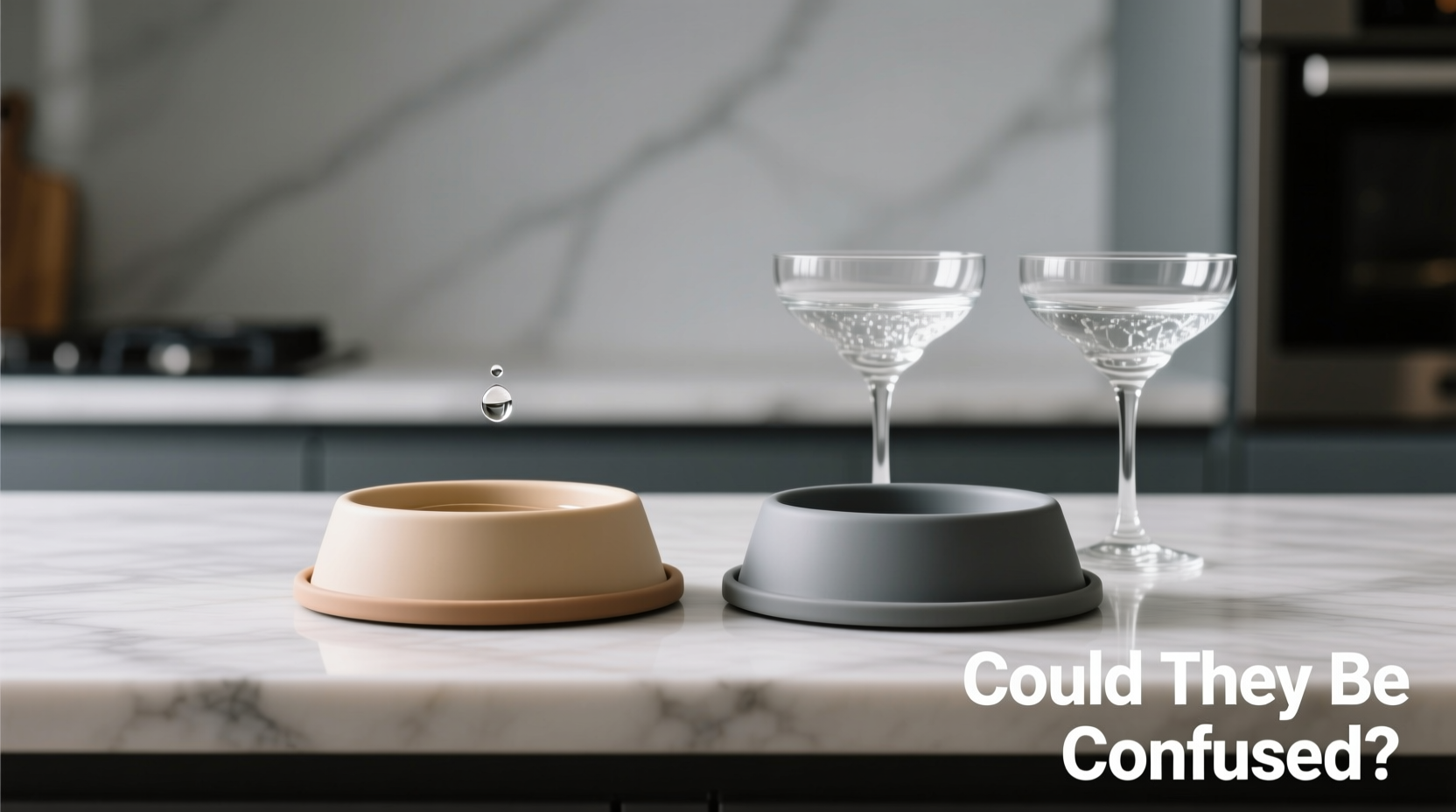
The resemblance isn’t accidental—it’s rooted in shared design logic. Non-spill dog bowls prioritize stability and spill resistance through three key features: a low center of gravity (achieved via a weighted base), a wide, slightly flared rim (to prevent tipping), and a smooth, shallow curvature (to allow easy tongue access while discouraging aggressive scooping). Cocktail coupes, designed in the 1930s for sparkling wine and later adopted for martinis and champagne cocktails, rely on nearly identical geometry: a broad, shallow bowl (typically 3–4 inches in diameter), a gentle parabolic curve, and a stem that lowers the center of gravity for balance on a bar top.
Where modern manufacturing amplifies the similarity is in finish and material. Many premium non-spill dog bowls now use food-grade 304 stainless steel—polished to a bright, reflective sheen indistinguishable from barware-grade stainless. Likewise, cocktail coupes made from stainless steel (increasingly common for durability and dishwasher safety) mirror the weight, heft, and tactile coolness of high-end pet bowls. Even color options overlap: brushed nickel, matte black, rose gold PVD coatings—available across both categories.
Tip: If you’re shopping online and see a “modern minimalist pet bowl” listed alongside barware keywords like “martini,” “champagne,” or “stemless,” pause and check the product specifications—not just the photos. Visual similarity rarely equals functional interchangeability.Material & Safety Standards: A Critical Divide
While appearance may align, regulatory expectations do not. The U.S. Food and Drug Administration (FDA) classifies items based on intended use—and that classification dictates mandatory testing, labeling, and manufacturing controls.
Cocktail coupes intended for human beverage service must comply with FDA 21 CFR §177.1350 (for stainless steel food-contact surfaces), requiring verification that leachable metals (nickel, chromium, manganese) remain below strict migration limits after repeated exposure to acidic liquids (e.g., citrus juice, vermouth, vinegar-based shrubs). They also require explicit food-grade certification—often documented via third-party lab reports referenced in product listings.
Non-spill dog bowls, by contrast, fall under the FDA’s “animal feed contact surface” category—a significantly less prescriptive regulatory space. While reputable manufacturers voluntarily meet NSF/ANSI 51 (food equipment standards), there is no federal requirement for leach testing specific to canine saliva pH (~6.0–7.5) or long-term exposure to wet kibble residue. Some bowls carry FDA-compliant food-grade stainless labels; others list only “BPA-free plastic” or “lead-free ceramic” without specifying migration thresholds for acidic or fatty substances.
“Stainless steel is inert—but only when properly alloyed and finished. A dog bowl stamped ‘304 stainless’ may meet basic corrosion resistance, but unless it’s been tested for nickel release in citric acid solution at 70°C for 2 hours, it shouldn’t be assumed safe for repeated martini service.” — Dr. Lena Torres, Materials Toxicologist, FDA Center for Food Safety and Applied Nutrition (ret.)
Functional Differences That Change Behavior
Design intent shapes subtle but consequential details. Below is a side-by-side comparison of operational characteristics:
| Feature | Non-Spill Dog Bowl | Cocktail Coupe |
|---|---|---|
| Depth-to-diameter ratio | Shallow (0.8–1.2 cm depth / 10–12 cm diameter) | Shallow (1.0–1.5 cm depth / 10–11 cm diameter) |
| Base weight distribution | Heavy rubberized or filled polymer base (often 60–70% of total mass) | Stem + foot assembly (balanced but not weighted; relies on low center of gravity) |
| Rim thickness & edge finish | Reinforced, rounded, sometimes silicone-coated to reduce jaw pressure | Thin, precision-polished, sharp or softly beveled—optimized for lip seal and aroma retention |
| Interior surface texture | Often micro-etched or lightly brushed to reduce slipperiness for wet kibble | Mirror-polished to minimize surface adhesion and maximize visual clarity of liquid |
| Cleaning tolerance | Rated for dishwasher use (top rack), but many have non-removable rubber bases prone to mold if not air-dried | Typically fully dishwasher-safe—including stems—due to seamless welds and uniform alloy |
These differences impact real-world use. A dog bowl’s thick, soft rim reduces dental wear during enthusiastic eating—but creates an uneven lip seal that causes champagne bubbles to dissipate faster. Conversely, the coupe’s razor-thin rim enhances effervescence but would irritate a dog’s sensitive muzzle tissue during sustained feeding.
A Real-World Mix-Up: The Brooklyn Bistro Incident
In early 2023, a neighborhood bistro in Williamsburg began offering “Pup & Pour” Sunday brunch specials—featuring house-made bone broth “pupsicles” and espresso martinis served in matching brushed-steel vessels. The owner sourced both items from the same sustainable home goods marketplace, assuming shared aesthetics implied shared safety. Guests praised the cohesive aesthetic—until a regular customer noticed her French bulldog’s persistent lip chapping and mild gastrointestinal upset after consuming broth from the “dog bowl” portion of the set. A follow-up call to the manufacturer revealed the bowls were certified only for *dry* pet food contact—not acidic broths or prolonged liquid immersion. Meanwhile, the “martini coupes” lacked FDA food-contact documentation entirely; they were marketed as “bar decor” with no compliance statements.
The bistro pulled both items within 48 hours, retrained staff on material sourcing protocols, and implemented a new internal checklist: “If it’s touching human lips or canine mucosa, verify the exact FDA regulation cited—not just ‘food-safe’ in the description.” No illnesses occurred, but the incident underscored how easily aesthetic cohesion can override functional diligence.
How to Tell Them Apart—Even When They Look Identical
When visual cues fail, rely on structural and documentary evidence. Use this step-by-step verification process before purchasing, gifting, or repurposing:
- Check the product listing for regulatory language: Look for explicit references to “FDA 21 CFR 177.1350,” “NSF/ANSI 51,” or “LFGB certified.” Vague terms like “safe for pets” or “non-toxic” are not substitutes.
- Inspect the base construction: Flip the item over. A true non-spill dog bowl will have a visibly distinct, dense, often rubberized or composite base—sometimes detachable. A coupe’s base is integral to the stem or foot, with no secondary material layer.
- Test the rim with your fingertip: Run a finger along the inner rim. Dog bowls almost always feature a softened, slightly rounded edge (to protect gums). Coupes have a precise, consistent edge—either knife-sharp or uniformly beveled.
- Review cleaning instructions: If the care label says “hand wash only due to rubber base,” it’s a dog bowl. If it specifies “dishwasher safe, all parts,” it’s likely barware—even if sold as a “pet accessory.”
- Search the manufacturer’s website directly: Enter the model number into the brand’s official site—not the retailer’s page. Reputable barware makers publish full compliance reports. Pet brands rarely do.
FAQ: Clarifying Common Assumptions
Can I safely serve my dog from a cocktail coupe?
No—not routinely. While stainless steel coupes pose minimal acute toxicity risk, their thin rims offer no protection against jaw fatigue or gum abrasion during extended meals. More critically, they lack anti-slip weighting: dogs instinctively push bowls sideways while eating, increasing spill risk and potentially causing stress-related avoidance behaviors. Veterinary behaviorists report higher rates of mealtime anxiety in dogs fed from unstable, unweighted vessels.
If a non-spill bowl is labeled “food-grade stainless,” can I use it for cocktails?
Not without verification. “Food-grade” is an unregulated marketing term. True food-grade compliance for beverages requires passing standardized migration tests under conditions mimicking actual use (e.g., 4% acetic acid at 70°C for 2 hours). Absent lab documentation, assume it’s optimized for kibble—not citrus-infused gin.
Are there any products designed to bridge both uses safely?
Yes—but they’re rare and explicitly dual-certified. Brands like Form & Function Lab and VetWare Collective produce stainless steel vessels certified to both NSF/ANSI 51 (food equipment) and ASTM F2137 (pet product safety), with rims engineered for both human lip contact and canine oral sensitivity. These carry premium pricing ($48–$65 per piece) and clearly state dual compliance in product titles—not fine print.
Conclusion: Design Intent Matters More Than Aesthetics
Confusing non-spill dog bowls with cocktail coupes isn’t merely a matter of mistaken identity—it’s a reminder that every object carries embedded assumptions about its user, environment, and purpose. A dog bowl is engineered for biomechanical efficiency, behavioral reinforcement, and microbial resilience in high-moisture, high-chew environments. A cocktail coupe is tuned for olfactory experience, thermal stability, and ritual precision in controlled, short-duration human interaction. When those purposes blur, so do safety margins and functional integrity.
You don’t need to abandon minimalist aesthetics or cohesive tablescapes. You do need to read beyond the photo—to demand transparency in certifications, to inspect physical construction, and to honor the specialized intelligence behind well-designed tools. Whether you’re outfitting a pet-friendly café, selecting gear for your rescue foster home, or simply curating a thoughtful kitchen, let intention guide your choices—not just Instagram lighting.
💬 Have you encountered this confusion in real life? Share your story—whether it was a near-miss, a clever hack, or a vendor who clarified the distinction. Your experience helps others navigate the line between beautiful design and responsible use.








